
Last Updated on July 27, 2026 by Mason Reed
Hydrostatic head is one of the most useful numbers on a tent specification sheet, but it is also easy to misread. It measures how much water pressure a fabric can resist before water penetrates it. A higher number means greater pressure resistance in the test, but your tent’s seams, coatings, floor design, pitch, ventilation, and condition also determine how well it performs in wet weather.
Quick Answer
Hydrostatic head (HH) is a lab-measured waterproofness rating, expressed in millimeters of water, showing how much hydrostatic pressure fabric resists before water penetrates. Higher numbers mean more pressure resistance, but there is no universal rain-condition chart. Seam sealing, floor design, coatings, pitch, and fabric condition matter alongside the listed HH.
Key Takeaways
- Hydrostatic head measures resistance to water penetration under pressure; a 3,000 mm rating corresponds to the pressure produced by a 3-meter column of water.
- There is no official rule saying a particular HH number equals light, moderate, or heavy rain, so treat rating bands as comparison tools rather than weather guarantees.
- Rainflies and tent floors face different stresses. Floors experience abrasion, pooling, and concentrated pressure from knees and gear.
- Seam sealing, waterproof coatings, fabric condition, tent design, and correct pitching can matter as much as the headline HH number.
Disclosure: As an Amazon Associate I earn from qualifying purchases. Some links on this page are affiliate links, at no extra cost to you.
How Is Hydrostatic Head Measured?
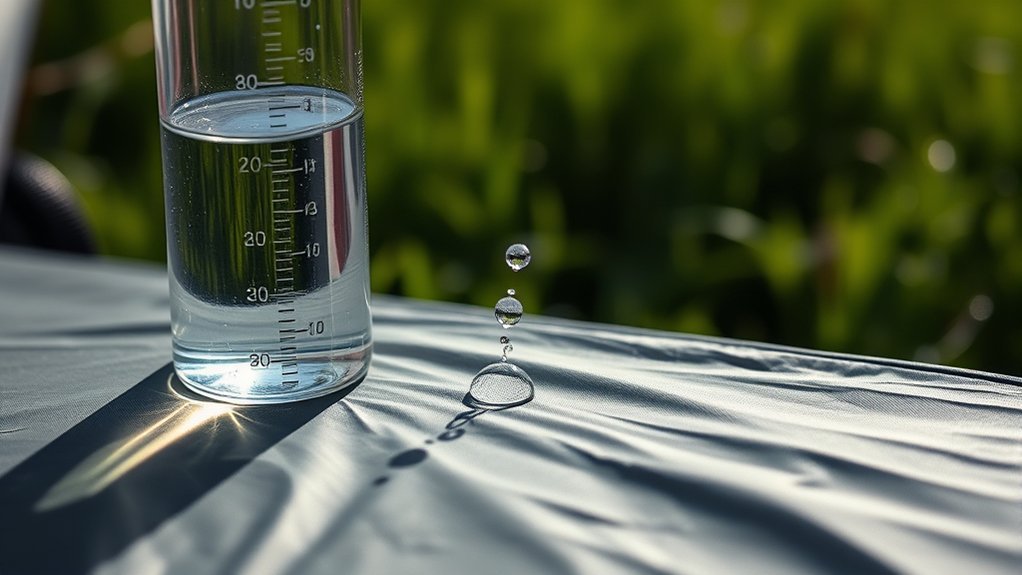
Hydrostatic head is a measure of a fabric’s resistance to water penetration under pressure. The current published ISO 811:2018 hydrostatic-pressure standard covers this type of testing for water-resistant fabrics. The AATCC TM127 test method is another recognized hydrostatic-pressure test.
The basic idea is simple: a fabric specimen is exposed to steadily increasing water pressure until water penetrates it. The result can be expressed as the height of an equivalent water column. That is why tent specifications use millimeters, often written as mm, mmH2O, or a “waterhead” rating.
For example, a fabric rated at 3,000 mm resisted pressure equivalent to a 3-meter-high column of water under the test conditions. In pressure units, 1 psi is approximately 700 mm of water column.
Note: Do not assume two fabrics with the same published HH number are identical. Test method, pressure rate, fabric conditioning, whether the material is new or weathered, and the manufacturer’s reporting procedure can affect the result.
Why Does Hydrostatic Head Matter?
HH gives you a standardized way to compare the pressure resistance of waterproof fabrics. What it does not give you is a guaranteed forecast of how a complete tent will behave in a storm.
No ISO or AATCC rule says that 1,500 mm equals light rain, 3,000 mm equals moderate rain, or 5,000 mm equals an expedition tent. Those numbers can still be useful as broad comparison points, but the finished shelter has many other potential leak paths.
| Hydrostatic Head | Practical Interpretation |
|---|---|
| Below 1,000 mm | Relatively low pressure resistance. Judge the complete shelter and the manufacturer’s rain-testing claims carefully. |
| 1,000–1,500 mm | A range used by some current lightweight tents and waterproof tent components. Good construction and intact coatings remain essential. |
| 1,500–3,000 mm | Provides additional laboratory pressure margin and is common in waterproof shelter fabrics and floors. |
| 3,000–5,000 mm | High pressure resistance, useful where extra waterproofing margin or durability is desired. |
| 10,000 mm+ | Very high laboratory pressure resistance. It does not, by itself, make a shelter more stormworthy or suitable for expeditions. |
Current products illustrate why rigid thresholds can be misleading. Some Big Agnes tent fabrics are rated at 1,500 mm, while Sea to Summit describes a 1,200 mm tent floor as waterproof. The complete design matters, not just the largest number on the specification sheet.
Hydrostatic head is a fabric pressure-resistance test, not a complete weatherproofing score for the whole tent.
Practical Hydrostatic Head Ratings

For ordinary camping, it is usually more useful to compare HH ratings within similar tent designs than to chase a single minimum number. A well-designed lightweight tent with an intact 1,200–1,500 mm fly can provide dependable waterproof protection, while a poorly sealed shelter can leak even if its fabric has a much higher laboratory rating.
If you regularly camp on saturated ground, expose a tent to heavy use, or want more margin as coatings age, a higher floor rating can be attractive. Sea to Summit, for example, uses a 1,200 mm floor on its lighter Alto model and a 2,500 mm floor on its wetter-weather Alto Plus body. That difference shows how manufacturers may tune materials for the intended use rather than follow one universal HH rule.
Rainfly Ratings and Floor Ratings Are Not the Same Problem
A rainfly normally sheds water down a sloped, tensioned surface. A tent floor faces different stresses: wet ground, abrasion, pressure from sleeping pads and gear, and concentrated loads when you kneel or place an elbow on the floor.
For that reason, it can make sense to give a floor additional waterproofing and durability margin. However, there is no rule saying every floor must have a higher HH than every fly. Current manufacturers use both equal and different fly/floor ratings depending on fabric weight, coating technology, intended conditions, and construction.
Pro Tip: When comparing tents, check the rainfly and floor specifications separately. Then look for taped or properly sealed seams, a bathtub-style floor, protected zippers, good fly coverage, and enough ventilation. Those details often tell you more than comparing HH numbers alone.
Factors Influencing Hydrostatic Head Performance
Water resistance starts with the fabric, but the finished tent is a system. Fabric construction, waterproof coating, seam treatment, age, abrasion, UV exposure, and overall design all affect whether water reaches the inside.
| Factor | Why It Matters | What to Check |
|---|---|---|
| Waterproof coating | Coatings help stop water passing through woven nylon or polyester. | PU/urethane, silicone-treated fabric, or the manufacturer’s specified system |
| Seam sealing | Needle holes and seams can leak even when the surrounding fabric is waterproof. | Factory seam tape or correctly applied seam sealer |
| Abrasion | Wear can damage the fabric or waterproof barrier, especially on floors. | Scuffs, thin areas, peeling coating, and damaged seam tape |
| UV exposure and age | Long-term exposure can weaken tent fabrics and coatings. | Fading, brittle fabric, sticky or flaking coatings |
| Tent construction | Water can enter around zippers, poorly protected openings, or badly designed seams. | Fly coverage, bathtub floor, zipper protection, vents, and tensioning |
| Pitch | A properly tensioned fly sheds water and reduces contact between inner and outer layers. | Correct pole placement, stakes, guylines, and fly tension |
Denier is another specification you may see, such as 15D or 40D. Denier describes yarn linear density; it is not a waterproof rating. A lighter fabric can have a strong waterproof coating, while a heavier fabric can still leak if its coating or seams fail.
Hydrostatic Head vs. DWR and Seam Sealing
These terms describe different jobs:
- Hydrostatic head: measures resistance to water penetrating the fabric under pressure.
- Waterproof coating: forms or contributes to the barrier that keeps water from passing through the textile.
- DWR: a durable water-repellent surface treatment that helps water bead and roll off the outside.
- Seam tape or seam sealer: closes potential leak paths around stitching and needle holes.
A rainfly can stop beading well before its main waterproof barrier has completely failed. Conversely, refreshing DWR will not repair a peeling or degraded urethane coating. REI’s tent-waterproofing guidance treats seam sealing, urethane-coating restoration, and DWR renewal as separate maintenance jobs.
Does Hydrostatic Head Cause Condensation?
Not directly. Hydrostatic head measures resistance to liquid-water penetration, while condensation forms when moisture inside the shelter reaches a cold enough surface to condense.
Ventilation, humidity, outside temperature, the number of occupants, wet equipment, campsite location, and tent construction all influence condensation. Water droplets on the inside of a rainfly therefore do not automatically mean the fabric is leaking.
Choosing the Right Hydrostatic Head Rating for Your Tent
Start with how and where you camp rather than choosing the largest HH number you can find. For fair comparisons, look at tents in the same category—such as ultralight backpacking, general three-season camping, or heavy-duty base camping—and compare their complete waterproofing systems.
Use this order when reading a specification sheet:
- Check the rainfly HH rating. Make sure the fly is described as waterproof and provides adequate coverage for the shelter.
- Check the floor separately. Consider both its HH rating and its resistance to abrasion, especially for frequent use or wet campsites.
- Look at seam treatment. Determine whether seams are factory taped, seam sealed, or require treatment by the owner.
- Check the coating system. Follow the manufacturer’s care instructions because polyurethane-coated and silicone-treated fabrics can require different sealants.
- Evaluate the design. A bathtub floor, covered openings, effective vents, proper fly spacing, and secure guylines all contribute to wet-weather performance.
- Consider durability. A specification measured on new fabric does not tell you exactly how the same material will perform after years of UV exposure and abrasion.
Testing protocol is also worth considering when comparing brands. Hilleberg explains that it changed how it reported hydrostatic-head figures to align more closely with common industry practice; its older figures incorporated an abrasion procedure before HH testing. That is a useful reminder that the number only makes sense in the context of how it was measured and reported.
Note: A footprint can protect the tent floor from abrasion, punctures, dirt, and rough ground, which can help preserve the floor over time. Do not simply add the footprint’s HH number to the tent floor’s rating; they remain separate layers with separate material properties.
How to Maintain Your Tent’s Waterproof Performance
You cannot realistically re-measure a tent’s laboratory HH rating at home, but you can inspect the parts most likely to cause trouble. Before the camping season and after demanding trips, look for peeling seam tape, damaged seams, worn floor areas, flaking or sticky coatings, and a rainfly that no longer sheds water well.
If you find a problem, match the repair to the failure:
- Leaking or deteriorated seams: use the seam sealer recommended for your tent’s fabric and coating.
- Failing polyurethane barrier: follow the manufacturer’s instructions for recoating or replacing the affected component.
- Poor exterior water beading: clean the fly correctly and refresh its DWR when appropriate.
- Abraded floor: repair damage and consider using the manufacturer’s footprint on rough campsites.
Warning: Do not machine-wash or machine-dry a tent unless its manufacturer specifically says you can. Agitation and heat can damage fabric, seams, waterproof coatings, and other components. Clean and dry the tent according to its care instructions, and never store it wet.
Frequently Asked Questions
Can hydrostatic head ratings vary by tent brand?
Yes. Brands can use different fabrics, coatings, test procedures, conditioning methods, and reporting conventions. Two tents with the same listed HH number can also perform differently because their seam sealing, fly coverage, floor design, ventilation, and construction are different.
How often should I check my tent’s waterproof rating?
You normally cannot check the actual laboratory HH rating at home. Instead, inspect the tent at least before your main camping season and after hard use. Look for peeling seam tape, damaged seams, abrasion, flaking or sticky coatings, and areas where the rainfly no longer sheds water properly.
Does hydrostatic head affect breathability in tents?
Not in a simple one-to-one way. HH measures resistance to water penetration, while breathability and condensation depend on the fabric system, ventilation, humidity, temperature, and tent design. A larger HH number therefore does not automatically mean a tent will have more condensation.
Are higher ratings always better for camping?
No. A higher HH means the fabric resisted more hydrostatic pressure in the test, but it does not tell you whether the poles, seams, zippers, floor, fly geometry, ventilation, or overall tent design are better. Once a fabric provides suitable waterproof performance, construction and durability may be more important than chasing a larger number.
What maintenance improves a tent’s waterproof performance?
Keep the tent clean and fully dry before storage, inspect seam tape and waterproof coatings, repair damaged seams with the correct sealer, and refresh DWR when water no longer beads well. If a urethane coating is peeling or failing, use the manufacturer’s recommended recoating process rather than relying on DWR spray alone.
Is a 1,500 mm hydrostatic head enough for a tent?
It can be. Current manufacturers sell waterproof tent fabrics around 1,200–1,500 mm, so 1,500 mm should not automatically be treated as suitable only for light rain. Judge it alongside seam treatment, floor and fly design, fabric durability, pitching, and the manufacturer’s intended use for the tent.
Should a tent floor have a higher HH than the rainfly?
A higher floor rating can provide useful pressure margin because floors face wet ground, abrasion, and concentrated loads from knees and gear. However, it is not a universal requirement. Some reputable tents use the same rating for the fly and floor, while others give the floor a higher specification.
What is the difference between hydrostatic head and DWR?
Hydrostatic head measures how much water pressure a fabric resists before penetration. DWR is a surface treatment that encourages water to bead and roll off. Losing water beading does not necessarily mean the waterproof barrier has failed, and refreshing DWR does not repair a damaged waterproof coating.
Sources
- ISO 811:2018 — Textiles: Determination of Resistance to Water Penetration — international hydrostatic-pressure test standard
- AATCC TM127 — Water Resistance: Hydrostatic Pressure — recognized fabric hydrostatic-pressure test method and test limitations
- REI Expert Advice: How to Waterproof a Tent — seam sealing, urethane-coating restoration, and DWR maintenance
- REI Expert Advice: Tent Care Basics — cleaning, drying, storage, coating care, and machine-washing precautions
- Hilleberg: Hydrostatic Head Testing and Reporting — how abrasion procedures and reporting methods can change published HH figures
- Sea to Summit Alto Tent Specifications — current example of a waterproof 1,200 mm tent floor
Conclusion
Hydrostatic head gives you a useful, testable way to compare the water-pressure resistance of tent fabrics, but it is not a complete weatherproofing score. A higher HH provides more laboratory pressure resistance; it does not automatically mean a tent is better in storms. Compare the rainfly and floor separately, check seams and coatings, consider the overall design, and maintain the tent correctly. Used that way, the HH rating becomes a helpful specification instead of a misleading marketing number.
