

Last Updated on July 29, 2026 by Mason Reed
A sagging rainfly can collect water, flap in the wind, touch the inner tent, and make a wet night feel worse than it needs to. The fix is usually simple: start with a square tent body, attach the fly exactly as the manufacturer intended, tension every corner evenly, and recheck the pitch after the fabric gets wet.
Quick Answer
Stop a rainfly from sagging by pitching the tent square, securing every corner and pole wrap, tensioning the fly evenly, and using the reinforced guy-out points. Recheck it after it gets wet because nylon can stretch. If sag appears, shed pooled water, reset loose stakes, and retension gradually instead of cranking one line.
Key Takeaways
- Wet nylon commonly stretches, so a fly that was taut at setup may need one careful retensioning after rain begins.
- Equal tension matters more than maximum tension. Over-tightening one corner can twist the fly, stress seams, and create a low spot elsewhere.
- Use only reinforced, manufacturer-provided tie-outs, pole wraps, buckles, and clips.
- A slipping line lock or creeping stake can look like fabric stretch, so diagnose the cause before pulling harder.
- Do not go outside to adjust guylines during lightning. A tent is not safe lightning shelter.
At a Glance
| Time Required | 5–15 minutes at setup; about 2–5 minutes for a wet-weather recheck |
| Difficulty | Easy |
| Tools Needed | Tent stakes, guylines, line tensioners, and a headlamp; optional spare cord and stakes |
| Cost | Usually $0 with the hardware supplied with your tent; replacement cord or stakes add a small optional cost |
Disclosure: As an Amazon Associate I earn from qualifying purchases. Some links on this page are affiliate links, at no extra cost to you.
Why Proper Rainfly Tension Matters

A properly tensioned rainfly sheds rain, stays separated from the inner tent, and places loads across the shelter as its designer intended. Loose panels can form low pockets where water collects. They can also flap against poles or the tent body, which increases noise and may transfer condensation to the inner fabric.
The goal is not to pull every strap as hard as possible. The goal is an even, wrinkle-free pitch with seams aligned over the pole structure. REI’s tent-pitching guidance recommends snugging fly corners evenly, checking seam alignment, and rechecking tension after the fly gets wet.
A taut rainfly is an evenly tensioned rainfly—not an over-tightened one.
Why Rainflies Sag Overnight
Before adjusting anything, identify what changed. Sag usually comes from one or more of these causes:
- Wet-fabric stretch: Nylon fly fabric can absorb some moisture and lengthen enough to loosen the pitch. Big Agnes advises retensioning a wet nylon fly after it begins to sag.
- Line-lock slippage: Thin, worn, incorrectly threaded, or incompatible cord can creep through an adjuster.
- Stake movement: Rain-softened soil, sand, snow, or shallow anchoring can let a stake rotate or pull toward the tent.
- Uneven setup: A tent body that is not square, a fly attached backward, or one corner tightened early can leave a loose panel.
- Missed attachments: Unfastened pole wraps, clips, buckles, or hook-and-loop tabs reduce support and allow the fly to shift.
- Weather changes: Cooling, dew, rain, and changing wind can alter fabric, cord, and ground tension. The direction and amount vary by shelter materials.
Note: There is no universal “safe” wind speed or a single 15–20 mph cutoff for every tent. Stability depends on the tent design, pole condition, campsite exposure, soil, stakes, and how the shelter is guyed. Follow the limits and storm-pitch instructions in your tent manual.
The 10-Minute Before-Bed Rainfly Check
- Square the tent body. Confirm that the footprint and tent corners are fully spread, poles are seated, and the structure is not twisted.
- Verify the fly orientation. Match doors, color-coded corners, buckles, clips, and vents to the manufacturer’s setup diagram.
- Fasten every structural attachment. Secure pole wraps, clips, corner buckles, and reinforced fly-to-pole connections.
- Tension corners evenly. Start with light tension, work around the tent, and make several small adjustments instead of fully tightening one corner first.
- Align the seams. Main fly seams should generally track over the supporting poles or the intended ridgeline.
- Stake out vestibules and lower fly points. Pull them far enough from the inner tent to improve runoff, airflow, and clearance.
- Add guylines before bad weather arrives. Use the reinforced guy-out points indicated by the manufacturer, especially on the windward side.
- Check clearance. Make sure the rainfly is not resting on the inner tent and that no panel contains a low pocket.
- Open protected vents. Ventilation does not prevent fabric stretch, but it helps reduce condensation inside the shelter.
- Recheck after wetting. Once rain has soaked the outer surface, inspect the pitch again from a safe position and retension only where needed.
Pro Tip: Practice a full storm pitch at home. Mark or photograph the correct line-lock threading and guyline layout so you can reproduce it in rain and darkness without guessing.
Techniques for Adjusting Guylines
Guyline adjustments work best when they support the tent’s pole structure instead of merely pulling down on loose fabric. Run each line outward from its reinforced guy-out point. Where the design allows, route the line roughly perpendicular to the fly wall and away from the pole beneath that point. This helps the line resist wind load and hold the panel away from the tent body.
If your tent has a clear front-to-back ridgeline, lightly tension the ends first, then balance the sides. On other tents, work corner by corner in a cross pattern. Always follow the model-specific manual when its sequence differs.
| Step | Action | What It Solves |
|---|---|---|
| 1. Inspect | Check cord wear, line-lock threading, knots, and slack. | Line creep and hidden damage |
| 2. Set the main shape | Tension the ridgeline or primary ends evenly when the tent design uses them. | Center sag and poor runoff |
| 3. Balance the sides | Fine-tune side and vestibule points with small adjustments. | Wrinkles and uneven loading |
| 4. Recheck wet | Retension after the fly becomes wet, then stop when panels are smooth. | Moisture-related stretch |
Use shelter-rated guyline cord that fits your line locks. Do not use surgical tubing as the primary guyline. A short shock-cord or self-tensioning loop can help on some shelters, but use it only when the tent manufacturer permits it; too much elasticity can allow extra movement in gusts.
Using Center and Panel Tie-Outs Safely

Center and mid-panel tie-outs can pull broad fly panels away from the inner tent and reduce low spots, especially on large shelters and tarps. Use only sewn, reinforced tie-out points supplied by the manufacturer. Pull each line in the direction that supports the nearby panel or pole rather than sharply sideways across a seam.
For a separate tarp, use its factory loops and pitching instructions. Do not fold, mark, puncture, glue, or improvise a new attachment point in the middle of a tent rainfly. An unreinforced tie-out can tear fabric, damage a waterproof coating, or concentrate force where the fly was not designed to carry it.
Inspecting and Securing Loose Areas
Walk around the shelter and trace each loose panel back to its likely cause:
- Check guylines: Look for cord sliding through a line lock, a knot that has loosened, or a line rubbing against a sharp edge.
- Assess the shape: Compare the fly seams with the pole lines. If the whole fly is skewed, rebalance the corners before tightening an isolated point.
- Reset weak anchors: If a stake has moved, place it in firmer ground or use a longer or wider stake suited to the soil. In sand or snow, use a buried deadman anchor when appropriate.
- Check the poles: Confirm every pole section is fully seated and every tip is captured by its grommet or hub.
- Inspect hardware: Replace cracked line locks, damaged webbing, worn cord, or bent stakes before relying on them in a storm.
Warning: Do not go outside to adjust wet ropes, poles, or stakes while lightning is occurring. The National Weather Service states that a tent offers no lightning protection. Check the forecast before camping and move to a substantial building or hard-topped vehicle before a thunderstorm reaches you when one is available.
Strategies for Managing Water Runoff
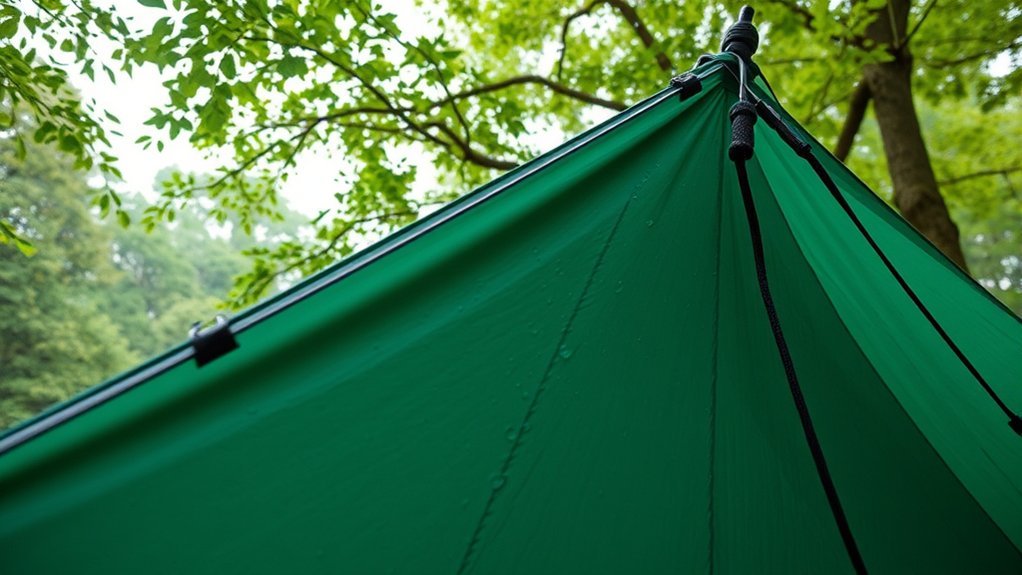
Your tent’s pole geometry should create the main slopes that shed water. Your job is to preserve those slopes by removing wrinkles, maintaining even tension, and preventing low pockets. Vestibule stakes and lower fly points should pull fabric away from the tent body without distorting doors or zippers.
| Strategy | Benefit | Material or Hardware Check |
|---|---|---|
| Keep designed slopes smooth | Promotes runoff and removes low pockets | Confirm fly orientation and seam alignment |
| Tension evenly | Reduces sag without twisting the shelter | Use cord that fits the line locks |
| Add approved guy points | Supports broad panels and improves clearance | Use reinforced factory tie-outs only |
| Reset moving stakes | Restores the original pitch | Match stake shape and length to the ground |
| Use approved self-tensioners | Can accommodate small tension changes | Confirm manufacturer compatibility |
If water has already pooled, support the panel from a safe position and tip or shake the water off before tightening. Pulling hard against a heavy pool can overload fabric, seams, poles, or tie-outs.
The Role of Stakes and Additional Cordage
Good cordage cannot compensate for a poor anchor. Choose stakes according to the ground: narrow stakes can work in firm soil, while wider or longer stakes usually hold better in loose soil. Snow and sand may require buried anchors. A premium brand name, including Easton or any other manufacturer, does not guarantee the right hold for every campsite.
- Carry enough stakes: Pack the stakes required for corners, vestibules, and storm guylines, plus a spare when conditions justify it.
- Carry compatible cord: Extra shelter-rated cord lets you lengthen a line, reach a better anchor, or replace damaged cord.
- Use several balanced guylines: Multiple approved lines distribute support better than one extremely tight line.
- Keep lines visible: Reflective cord or small markers reduce trip hazards around camp.
If a line lock is missing, a properly tied trucker’s hitch can create adjustable tension. If a line lock slips, first confirm that the cord is threaded correctly and has the diameter recommended by the tent maker. A backup knot behind the adjuster can be a temporary field fix, but replace incompatible or worn components.
Monitoring Tension Throughout the Night
You should not need to wake repeatedly for routine adjustments. A careful pre-bed check and one recheck after a nylon fly becomes wet are usually more useful than constant tightening. If rain is steady but there is no thunder, inspect from the tent doorway or another protected position when practical.
Pay attention to the apex, ridgeline, broad side panels, and vestibules. If one area droops, determine whether the fabric stretched, the cord slipped, or the stake moved. Retension only enough to restore the designed shape. If wind is increasing beyond what the shelter can safely handle, prioritize personal safety and move to a safer shelter rather than trying to save a failing pitch.
Addressing Environmental Factors
Rainfly tension changes because the shelter is a system: fabric, coatings, cord, poles, stakes, soil, wind, rain, humidity, and temperature all interact. Avoid assuming that every loose panel has the same cause.
Humidity and Wet-Fabric Effects
Nylon is the material most associated with noticeable wet-weather sag. Big Agnes explains that exposed nylon can absorb some water, stretch, and require re-staking and guyline tightening during a heavy downpour. Polyester and low-stretch composite fly materials generally change less from moisture, but their stakes, cords, and tensioners can still move.
Check the tent label or manual instead of guessing from appearance. Fabric behavior also depends on weave, denier, coating, panel design, and construction—not only the fiber name.
Wind and Weather Considerations
Check the campsite-specific forecast before setting up. Point the narrow or manufacturer-recommended end toward expected wind, use the storm guylines, and keep the load balanced around the shelter. Attach guylines before conditions become difficult; it is safer and easier than adding them in darkness or heavy rain.
Do not rely on a universal wind threshold. A sheltered, well-anchored four-season tent and an exposed ultralight shelter can perform very differently in the same reported wind. If a forecast includes severe weather, high winds, or thunderstorms beyond the shelter’s intended use, change campsites or plans.
Temperature Changes and Tension
Nighttime cooling can bring dew and alter the tension of fabric and cord, but it is inaccurate to assume that cooling alone always makes a rainfly sag. Moisture absorption, line slippage, and stake movement are often more important. Recheck the actual pitch rather than trying to predict the direction of change from temperature alone.
Rainfly Materials and Sag
| Material | Typical Overnight Behavior | Best Response |
|---|---|---|
| Nylon or silnylon | Can loosen noticeably after sustained wetting | Pitch evenly, then recheck and retension after wetting |
| Polyester or silpoly | Usually shows less moisture-related fabric stretch than nylon | Check stakes, line locks, and setup geometry if sag appears |
| Composite fly fabric | Often has low fabric stretch, though the shelter system can still loosen | Avoid over-tensioning; inspect anchors and hardware |
Common Mistakes to Avoid
- Over-tightening during initial setup: This can distort doors, overload tie-outs, and make it harder to balance the fly later.
- Blaming every sag on fabric: Check line locks and stakes before pulling harder.
- Skipping pole wraps or clips: These parts often stabilize the fly and align its load with the frame.
- Using too few guylines in a poor forecast: Install approved storm lines before the weather arrives.
- Creating homemade tie-outs: Do not puncture or attach adhesive anchors to unreinforced fly fabric unless the manufacturer specifically approves the method.
- Using worn or mismatched cord: Cord that is too thin for a line lock may slip throughout the night.
- Tightening against pooled water: Remove the water load first.
- Ignoring site hazards: Avoid depressions that collect runoff, exposed ridges in storms, dead branches, and ground that cannot hold stakes.
Rainfly Sag Troubleshooting Guide
| Symptom | Likely Cause | Fix |
|---|---|---|
| Whole fly loosens after rain starts | Wet nylon stretch | Shake off water and retension all sides evenly |
| One line repeatedly becomes slack | Slipping adjuster, wrong cord diameter, or bad knot | Rethread, retie, add a temporary backup knot, or replace the cord |
| Stake leans toward the tent | Soft ground or insufficient anchor | Move to firmer ground or use a better soil-specific anchor |
| Fly touches inner tent on one side | Uneven corner tension or missed side guy-out | Rebalance corners and use the reinforced panel tie-out |
| Door or zipper becomes hard to close | Over-tensioned vestibule or skewed fly | Ease that line and realign the fly |
| Dry fly still has a deep center sag | Incorrect orientation, incomplete pole assembly, or missing attachment | Recheck the manual, poles, clips, wraps, and buckles |
Long-Term Maintenance Tips for Rainflies
Maintenance helps a rainfly hold its intended shape and remain waterproof. Use condition-based care rather than an automatic seasonal coating schedule.
Reproofing and Seam Care
Reproof the fly when water stops beading, the waterproof coating flakes, or seams begin to leak—not simply because a calendar date has arrived. REI’s waterproofing guide separates three jobs: seam sealing, restoring a failing urethane coating, and refreshing the exterior durable water-repellent finish.
Use a product compatible with the actual coating. Silicone-treated fabric needs a different sealer from polyurethane-coated fabric. Clean the work area, follow the product instructions, and let the treatment cure completely before packing.
Inspecting for Wear
| Wear Indicator | Action | When to Check |
|---|---|---|
| Frayed seams or loose stitching | Repair before the next wet or windy trip | After each trip and before storage |
| Small tears or pinholes | Patch with a fabric-compatible repair product | After storms or contact with branches |
| Cracked grommets, buckles, or line locks | Replace the damaged hardware | Before each trip |
| Peeling seam tape or flaking coating | Use the correct repair or contact the manufacturer | During seasonal gear inspection |
| Faded, brittle, or weakened fabric | Limit further UV exposure and assess repair versus replacement | Whenever the fly feels or looks different |
A UV-protective treatment may help only when it is labeled for your specific tent fabric and approved by the manufacturer. Test any treatment as directed and never assume a general-purpose spray is safe for waterproof coatings.
Proper Storage Practices
- Clean gently: Brush off debris and use cool or lukewarm water with a tent-safe cleaner when needed.
- Dry completely: Never store the fly damp. If you must pack it wet to leave camp, unpack and dry it as soon as practical.
- Store cool and dry: Avoid long-term storage in a hot car, attic, sealed plastic bag, or other place that traps heat and moisture.
- Loosen tension for storage: Release line locks and dry the cord before packing.
- Inspect before the next trip: Confirm the fly, seams, tie-outs, guylines, stakes, and hardware are ready.
REI’s tent-cleaning guidance recommends rinsing and drying a tent completely before storage, while Big Agnes warns that storing a tent damp can lead to mildew, odor, leaks, or coating delamination.
Sources
- REI Expert Advice: How to Set Up/Pitch a Tent — even fly tension, seam alignment, wet-weather rechecks, and guyline placement
- Big Agnes: Tent Tips — wet nylon sag, re-staking, guyline use, runoff, and condensation control
- Durston Gear: Materials — manufacturer discussion of moisture-related nylon sag and polyester behavior
- REI Expert Advice: How to Waterproof a Tent — seam sealing, coating repair, and DWR restoration
- REI Expert Advice: How to Clean a Tent — cleaning and complete drying before storage
- National Weather Service: Outdoor Lightning Safety — tents do not provide lightning protection
Frequently Asked Questions
Can I use a rainfly with any tent type?
Not as a fitted fly unless the shape, size, buckles, pole attachments, and ventilation match the tent. A separate tarp can provide extra overhead coverage when pitched independently, but it should not press against the tent or block required vents. Use the tent maker’s compatible fly whenever possible.
What materials are best for rainfly construction?
There is no single best material. Nylon can offer excellent strength for its weight but may sag when wet. Polyester usually changes less with moisture and resists UV exposure well. Composite fabrics can have very low stretch but cost more and need material-specific handling. Construction, coating, seams, and design matter as much as the fiber.
How can wind affect my rainfly’s tension?
Wind can make loose fabric flap, shift stakes, work cord through adjusters, and load one side of the tent more than the other. Use the reinforced storm guy-outs, keep tension balanced, orient the shelter as the manufacturer recommends, and move to safer shelter if conditions exceed the tent’s intended use.
Should I pack my rainfly wet or dry?
Pack it dry for storage. When weather forces you to break camp with a wet fly, pack it only for transport, keep it separate from dry gear when practical, and unpack it to dry as soon as possible. Long-term damp storage encourages mildew, odor, coating damage, and seam problems.
How often should I replace my rainfly?
Replace it based on condition, not a universal three-to-five-year schedule. A lightly used, well-stored fly may last much longer, while heavy UV exposure or damp storage can shorten its life. Replacement is reasonable when fabric is brittle, coatings are broadly delaminated, structural tie-outs fail, or repairs no longer restore dependable protection.
Can I add a new tie-out to the middle of my rainfly?
Do not add one by puncturing or tying directly to unreinforced fabric. Concentrated force can tear the fly or damage its waterproof coating. Use factory-reinforced loops, a manufacturer-approved repair service, or an independent tarp above the tent.
How do I stop a guyline from slipping through its tensioner?
Confirm the cord follows the correct path through the adjuster and matches the recommended diameter. Clean mud or grit from the hardware. For a temporary field fix, add a backup knot behind the tensioner or use an adjustable hitch, then replace worn or incompatible cord and hardware.
Conclusion
A rainfly stays taut when the whole shelter works together: square tent geometry, correctly seated poles, even corner tension, secure stakes, compatible guylines, reinforced tie-outs, and a wet-weather recheck. Expect nylon to loosen after sustained rain, but do not assume fabric stretch is always the cause. Diagnose line slip, anchor movement, and setup errors before tightening harder. With a balanced pitch and condition-based maintenance, your rainfly can shed water, stay clear of the inner tent, and protect you through the night.
