

Last Updated on July 30, 2026 by Caleb Warren
Packing toiletries in a backpack is easier when every item earns its space and has a leak-safe home. The goal is not to bring the smallest possible kit; it is to carry the products you will actually use, meet airport security rules, and keep liquids away from clothing and electronics.
Quick Answer
Pack toiletries in two groups: liquids, gels, creams, pastes, and aerosols in one clear quart-size bag, and solid or dry items in a separate pouch. Use containers no larger than 3.4 ounces (100 milliliters) for U.S. carry-on screening, protect every closure from leaks, and keep the liquids bag near the top of your backpack.
Key Takeaways
- Separate carry-on liquids from solid and dry toiletries before you pack.
- For U.S. airport screening, each liquid container must hold 3.4 ounces (100 milliliters) or less and fit in one quart-size bag.
- Use tested, leak-resistant containers and place the toiletry kit away from electronics.
- Keep medicines in your carry-on and review medical-liquid exceptions before flying.
- Check the rules for every departure, connection, and return airport on an international trip.
At a Glance
| Time Required | 15–30 minutes for the first setup; 5–10 minutes to repack later |
| Difficulty | Easy |
| Tools Needed | Clear quart-size resealable bag, dry-toiletry pouch, leak-resistant containers, and labels |
| Cost | About $0–$25, depending on whether you reuse containers or buy a travel set |
Disclosure: As an Amazon Associate I earn from qualifying purchases. Some links on this page are affiliate links, at no extra cost to you.
Assess Your Toiletries Needs
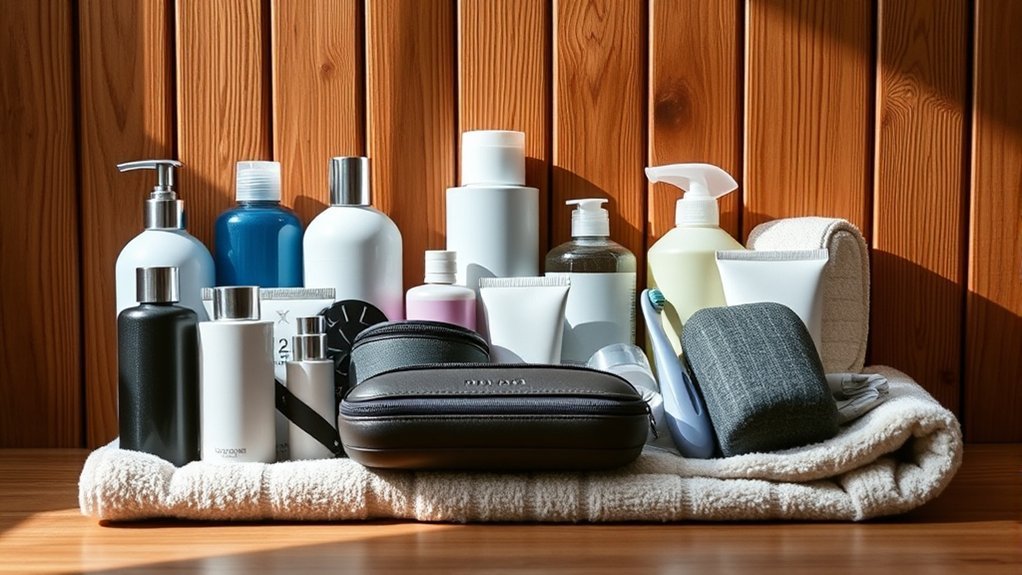
Start with your daily routine, not a store-bought travel checklist. List what you use in the morning, at night, and during the day, then remove anything your lodging supplies or that you can comfortably skip.
Adjust the kit for the trip:
- Trip length: Estimate how many uses you need rather than filling every travel bottle.
- Climate: Add sunscreen and after-sun care for strong sun, or lip balm and moisturizer for cold or dry conditions.
- Activities: Hiking, swimming, business meetings, and special events may require different hygiene or grooming items.
- Destination: Consider whether your preferred products will be easy to replace locally.
- Health needs: Keep prescriptions, essential over-the-counter medicine, contact-lens supplies, and medical devices on a separate must-pack list.
Pro Tip: Test your quantities at home. Use a small container for the same number of days as your trip, then note how much product remains. This prevents both overpacking and running out.
Know the Carry-On Liquids Rules
For flights departing from the United States, the TSA liquids, aerosols, and gels rule limits carry-on containers to 3.4 ounces (100 milliliters) or less. The containers must fit inside one clear, quart-size resealable bag per passenger.
Products that normally count as liquids include shampoo, conditioner, lotion, liquid makeup, mascara, toothpaste, gels, creams, pastes, perfume, shaving foam, spray deodorant, and contact-lens solution. A container larger than 3.4 ounces is not carry-on compliant simply because it is partly empty.
For U.S. carry-on screening, remember 3-1-1: 3.4-ounce containers, one quart-size bag, and one liquids bag per traveler.
Carry-On, Checked, and Non-Flight Packing
- Carry-on backpack: The 3-1-1 rule applies when you take liquids through a U.S. security checkpoint.
- Checked backpack: Full-size toiletries may generally be packed, but aerosols and some hazardous products have separate limits.
- Train, bus, or road trip: TSA liquid limits do not apply, although leak prevention and carrier rules still matter.
- Products bought after security: Airport purchases may follow different rules, especially when sealed for connecting international flights.
Medicines and Medically Necessary Liquids
The TSA permits medically necessary liquids, gels, and aerosols in reasonable quantities above 3.4 ounces, but you should tell the officer about them before screening. Review the TSA guidance for liquid medications before departure. Keep essential medicine in your carry-on rather than a checked bag that could be delayed.
Note: International rules can differ by airport. Check the departure airport, every connection, and the return airport instead of assuming the U.S. 3-1-1 process will be identical everywhere.
Aerosols, Razors, and Sharp Items
Personal toiletry aerosols such as hairspray, shaving cream, and spray deodorant can be permitted, but carry-on liquids remain subject to the 3.4-ounce checkpoint limit. In checked baggage, the FAA limits medicinal and toiletry articles to a total of 2 kilograms or 2 liters per person, with each container no larger than 0.5 kilogram or 500 milliliters. Aerosol nozzles must be protected from accidental release.
Disposable razors are allowed in carry-on bags. A safety razor may pass without its blade, while loose razor-type blades belong in checked baggage and should be securely wrapped.
Warning: Do not assume every spray or flammable product is a permitted toiletry. Non-toiletry flammable aerosols and many hazardous chemicals are prohibited. Search the TSA “What Can I Bring?” list and the FAA PackSafe chart for the exact product.
Choose the Right Pouches
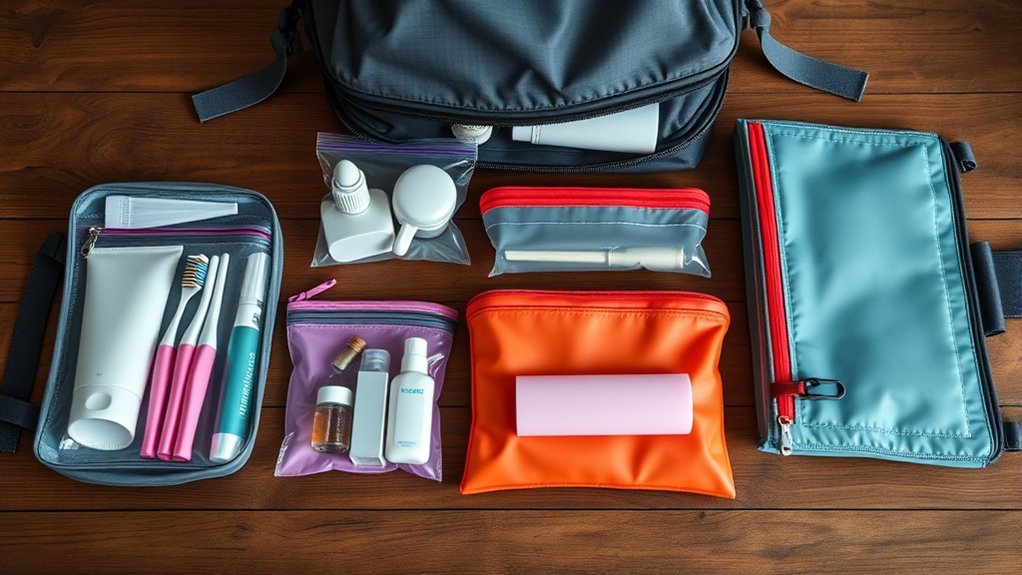
A simple two-pouch system works for most travelers:
- Clear liquids bag: Use one quart-size, transparent, resealable bag for carry-on liquids, gels, creams, pastes, and aerosols.
- Dry toiletry pouch: Use a lightweight, washable pouch for your toothbrush, comb, solid bars, dry makeup, wipes, cotton swabs, and similar items.
Choose pouches that open wide enough to see the contents without emptying the bag. Water-resistant fabric and easy-to-clean lining help contain small spills, but the pouch itself should not be your only leak barrier. Each liquid container still needs a secure closure.
You may add a tiny quick-access pouch for hand wipes, lip balm, tissues, or other items used in transit. Avoid creating so many categories that the organizers take more room than the toiletries.
Products Worth Considering

Carry-on Size: The travel toiletries bags two pack, with dimensions of 8.2 x 2 x 6 inches, strictly follow the TSA 3-1-1 liquids rule; With a TSA quart-size travel bag, you can easily and quickly pass through security screening at the airport, saving your time and reducing stress

【TSA Approved】The 7.7 x 5.9 x 2.5 inch clear toiletry bag strictly follow 3-1-1 liquids rule for carry-on bag of all airlines, so you can easily and quickly pass through airport security.

Carry-on Size: The travel toiletries bags two pack, with dimensions of 8.2 x 2 x 6 inches, strictly follow the TSA 3-1-1 liquids rule; With a TSA quart-size travel bag, you can easily and quickly pass through security screening at the airport, saving your time and reducing stress
Use Solid Toiletries Where They Make Sense
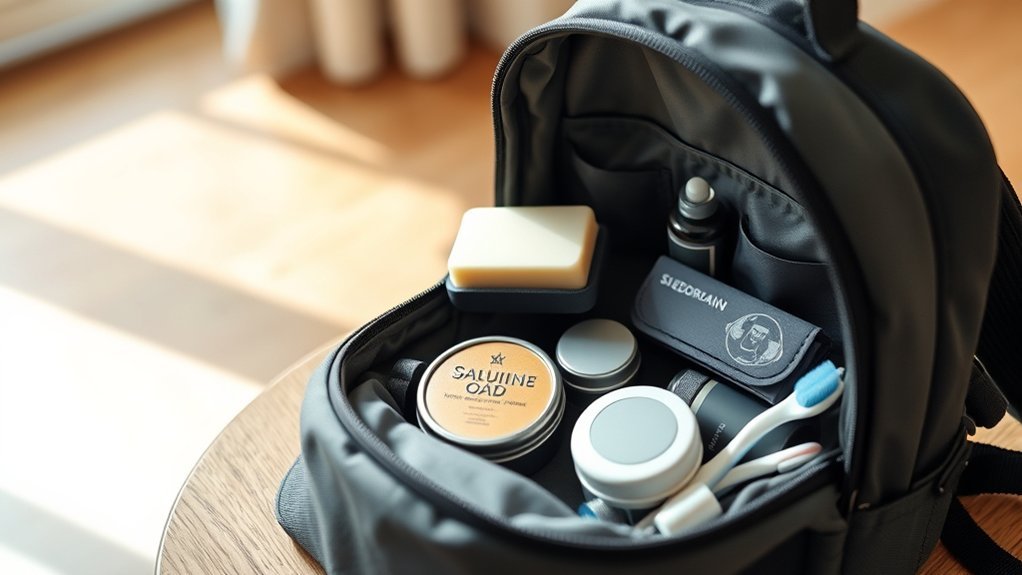
True solid toiletries can reduce the number of products competing for space in your liquids bag. They also remove many leak risks. Useful swaps include shampoo bars, conditioner bars, bar soap, solid deodorant, cleansing bars, and toothpaste tablets.
Benefits of Solid Toiletries
- They are compact and often last longer than a small liquid bottle.
- They do not spill across clothing or electronics.
- Most true solids do not need to go in the TSA liquids bag.
- Reusable tins or cases can reduce single-use packaging.
Solid products are not automatically better for every traveler. Use a product at home before relying on it during a trip, especially if you have sensitive skin, textured or color-treated hair, allergies, or a specialized routine.
Recommended Solid Product Types
Choose products based on function rather than brand. A basic solid kit might include a shampoo bar, conditioner bar, soap or body-cleansing bar, solid deodorant, and toothpaste tablets. Pack wet bars only after they have drained and dried, and use a ventilated case or soap pouch so they do not turn soft between uses.
Note: Creamy, spreadable, gel-like, or paste products may still count as liquids even when sold in a compact container. Pack by consistency, not by marketing language.
Use Leak-Resistant Containers
If you need liquids, decant only the amount required into travel-size bottles or jars that are clearly marked 3.4 ounces (100 milliliters) or less for U.S. carry-on travel. Wide-mouth jars suit thick creams, while squeeze bottles work better for shampoo and body wash. Avoid fragile glass unless the product cannot be transferred safely.
Products Worth Considering

TSA Approved Travel Bottles: 4 Pieces 2 OZ Polyethylene Bottles which are plastic and leak proof.

Leak Proof Travel Bottles: 3-layer leak-proof design prevents liquid leakage or spillage, offers protection to your luggage and cloths. Opal shape allows no liquids stuck in the bottle corner and helps you to get the last drop out without wasting any privacy products.Leak proof travel bottles for you

Travel Accessories and travel must have: Our 18 pack reusable travel bottles set with 1 toiletry bag , 2 pcs silicone bottles (3 oz/90 ml), 2 pcs silicone bottles (2 oz/60 ml), 2 pcs spray bottles , 4 pcs cream jars, 1 pcs funnels, labels, brush and 4 pcs spatula! Different accessories for your different needs.
How to Test Travel Containers
- Wash and fully dry reusable containers before filling them.
- Label each container with the product name.
- Leave a little empty space instead of filling the bottle to the brim.
- Close the cap, wipe the outside, and place the container on its side overnight.
- Squeeze flexible bottles gently and check the cap, threads, and valve for seepage.
- Place tested liquids in the clear bag as a second layer of containment.
Lock pump tops when possible, use protective caps, and avoid containers with worn threads or loose flip lids. Store the liquids bag upright when your backpack design allows it, but pack as though the bag may be turned in every direction.
Pro Tip: Put the clear bag in a spot that is easy to remove but not directly against a laptop, camera, charger, passport, or paper documents.
Organize Your Clear Liquids Bag
Lay out every liquid, gel, cream, paste, and aerosol before loading the bag. Remove duplicates, choose the smallest useful container, and make sure the bag closes without stretching the zipper or seal.
| Item | Counts as a Liquid? | Packing Note |
|---|---|---|
| Hand sanitizer | Yes | Use a 3.4-ounce container or smaller unless a current exception applies. |
| Facial mist | Yes | Protect the spray nozzle. |
| Liquid makeup or mascara | Yes | Group small tubes along one edge of the bag. |
| Toothpaste | Yes | Choose a travel tube or use tablets. |
| Lotion, sunscreen, or cream | Yes | Use a squeeze bottle or wide-mouth jar that seals tightly. |
| Solid deodorant or bar soap | Usually no | Place in the dry pouch. |
Keep the clear bag near the top or front of your backpack so you can present it quickly if requested at security. Procedures can vary by airport and screening lane, so follow the officer’s instructions.
Products Worth Considering

𝟏𝟖𝟎° 𝐎𝐩𝐞𝐧𝐧𝐢𝐧𝐠 𝐃𝐞𝐬𝐢𝐠𝐧: TSA approved toiletry bag can open up to 180°, enabling the clear bag to be easily flipped open horizontally, providing convenient access to travel essentials. The durable handle design allows for easy lifting and hanging of this clear bag.

TSA Compliant Convenience – Breeze through airport security with a TSA approved toiletry bag, perfectly sized to meet all quart size travel bag TSA approved requirements, so you’re never the person holding up the line.

【TSA Approved for Stress-Free Travel】: This travel toiletry bag meets TSA 3-1-1 liquid rules with quart-size dimensions (7.7" x 5.9" x 2.8"), helping you pass airport security quickly and easily.
Pack Essentials for Easy Access
Organize the dry pouch by routine rather than by product size. Keep dental items together, hair items together, and skin-care items together. Small elastic loops or inner pockets can stop toothbrushes, razors, and narrow tubes from collecting at the bottom.
Place frequently used travel-day items—such as hand wipes, tissues, lip balm, and a toothbrush—where you can reach them without unpacking clothing. Keep anything wet, scented, or spillable away from food and electronics.
A practical backpack order is:
- Heavy, less-needed toiletries close to your back and near the middle of the pack.
- The dry pouch above or beside clothing.
- The clear liquids bag near the top or in an accessible front compartment.
- Quick-use items in a small pocket that remains secure while you move.
Include a Small Change of Clothes
A spare outfit is not part of the toiletry kit, but it pairs well with it in a carry-on backpack. It can help after a spill, an unexpected overnight delay, hot weather, or delayed checked luggage.
Why Spare Clothes Help
Pack one lightweight, comfortable change rather than a second wardrobe. Include underwear and socks, then add a top and bottom that work with the shoes and outer layer you are already wearing. Wrinkle-resistant, quick-drying fabric is useful when space is tight.
Choose a Versatile Backup Outfit
| Item Type | Quantity | Example |
|---|---|---|
| Top | 1 | T-shirt or lightweight blouse |
| Bottom | 1 | Light pants, leggings, or shorts |
| Underwear | 1 set | Quick-drying fabric |
| Socks | 1 pair | Comfortable walking socks |
| Optional layer | 1 | Thin long-sleeve top |
Pack the Outfit Efficiently
Roll or fold the outfit into a small compression cube or waterproof pouch. Keep it separate from toiletries so a leak cannot ruin your backup clothing. Do not over-compress items if doing so creates a hard, awkward block against your back.
Maximize Space and Efficiency
Small reductions add up. Bring a comb instead of a large brush when practical, transfer only the amount you need, choose one product that can serve more than one purpose, and use hotel-provided basics when they meet your needs.
- Replace bulky packaging with labeled travel containers.
- Choose sample sizes only when the quantity matches the trip.
- Share common products with a travel partner instead of packing duplicates.
- Refill reusable bottles rather than buying a new travel set for every trip.
- Keep a master checklist in your phone so you do not rebuild the kit from memory.
A multifunction product can save room, but do not sacrifice an essential treatment or a product your skin, hair, or health depends on. Convenience should simplify your routine, not make it less reliable.
Common Toiletry Packing Mistakes
- Using a large partly empty bottle: Carry-on screening is based on container capacity, not the amount left inside.
- Forgetting that pastes and creams count: Toothpaste, mascara, lotions, and gels belong in the liquids bag.
- Trusting an untested bottle: A container that closes at home can still leak when squeezed or turned sideways.
- Mixing medicine with optional toiletries: Keep essential medication clearly identified and easy to declare or access.
- Packing wet solid bars: Let bars dry and use a draining case.
- Burying the liquids bag: Keep it accessible in case it must be removed at screening.
- Ignoring transit-airport rules: International connections may apply different liquid procedures.
- Placing liquids beside electronics: Use distance and a secondary barrier to limit damage if a cap fails.
Frequently Asked Questions
Are there toiletries that are not allowed in carry-on luggage?
Yes. Oversize liquids that do not qualify for an exception, loose razor blades, and prohibited hazardous or flammable products cannot pass through a U.S. checkpoint. Rules depend on the exact item, so check the TSA “What Can I Bring?” database and the FAA PackSafe chart before packing anything unusual.
How can I prevent spills during travel?
Use leak-resistant containers, leave a little headspace, clean product from the threads, tighten the closure, and test each bottle on its side overnight. Put all liquids in a sealed clear bag and keep that bag away from electronics and your backup clothes.
What toiletries are essential for international travel?
Start with dental care, deodorant, cleanser or soap, hair care, moisturizer, sunscreen when needed, menstrual products, contact-lens supplies, and personal medicines. Add destination-specific health items based on climate, activities, and official travel-health guidance. Check medication and liquid rules for the destination and all transit countries.
Can I bring full-size toiletries in my backpack?
Yes, when the backpack is checked and the product is otherwise permitted. Full-size liquids generally cannot pass through a U.S. carry-on checkpoint because each container is limited to 3.4 ounces (100 milliliters), unless an exemption applies. Solid toiletries can usually be carried in larger sizes.
How do I keep my toiletries organized during travel?
Use one clear bag for regulated liquids and one washable pouch for solid and dry items. Label refillable containers, group products by routine, and return each item to the same pocket after use. Keep a small transit pouch only for products you need during the journey.
Do prescription liquids have to fit in the quart-size bag?
Not always. TSA allows medically necessary liquids, gels, and aerosols above 3.4 ounces in reasonable quantities for the trip. Tell the officer about them before screening and allow extra time for inspection. International medication rules may be different.
Can I pack a razor in my toiletry bag?
Disposable and cartridge razors are generally allowed in U.S. carry-on bags. Safety razors must have the blade removed before screening, and loose razor blades should go in checked baggage with secure wrapping. Check the exact razor type in TSA guidance.
Conclusion
A well-packed toiletry kit is small because it is planned, not because essential items were left behind. Separate liquids from dry products, follow the rules for the way your backpack will travel, test every container, and keep the kit accessible but away from electronics. Add one compact change of clothes, check international and medication requirements, and you will have a cleaner, faster, and less stressful travel routine.
Sources
- Transportation Security Administration: Liquids, Aerosols, and Gels Rule — U.S. carry-on container and quart-size bag limits.
- Transportation Security Administration: Liquid Medications — medically necessary liquid exceptions and declaration guidance.
- Federal Aviation Administration: Medicinal and Toiletry Articles — aerosol protection and checked-baggage quantity limits.
- Transportation Security Administration: What Can I Bring? — item-specific carry-on and checked-baggage rules.
- Centers for Disease Control and Prevention: Pack Smart — destination-based travel health kit guidance.
- GOV.UK: Hand Luggage Restrictions for Liquids — an example of airport-specific international liquid rules.
