Last Updated on September 10, 2026 by Daniel Globe
A power bank belongs in your carry-on backpack, not in checked baggage. Pack it where you can reach it, protect it from damage and accidental activation, and confirm the watt-hour rating printed on the case. Rules changed in 2026, so the safest plan is to carry no more than two power banks, keep each at or below 100Wh, and check your airline before leaving home.
Quick Answer
Place your power bank in a protective pouch inside an easy-to-reach carry-on pocket. Verify that its watt-hour rating is visible, keep it away from metal objects, and remove it if your bag is gate-checked. For the simplest trip, carry no more than two units, each rated 100Wh or less.
Key Takeaways
- Power banks must travel in the aircraft cabin, not in checked baggage.
- Use the printed watt-hour rating—not mAh alone—to check the flight limit.
- A typical 20,000mAh power bank is about 74Wh at 3.7V, not 100Wh.
- Current international guidance limits passengers to two power banks and prohibits recharging a power bank from aircraft power.
- Airlines may apply stricter rules, including bans on using a power bank during the flight or storing it overhead.
At a Glance
| Time Required | About 5 minutes |
| Difficulty | Easy |
| Tools Needed | Protective pouch, charging cable, and the airline’s battery policy |
| Cost | $0 if you already own a pouch and cable |
Disclosure: As an Amazon Associate I earn from qualifying purchases. Some links on this page are affiliate links, at no extra cost to you.
Understanding Power Bank Capacity

Power bank capacity is often advertised in milliamp-hours (mAh), but aviation limits are based on watt-hours (Wh). The Federal Aviation Administration uses this formula:
Watt-hours = volts × amp-hours
To convert mAh to Ah, divide by 1,000. For example:
- 10,000mAh at 3.7V: 3.7 × 10 = 37Wh
- 20,000mAh at 3.7V: 3.7 × 20 = 74Wh
- 27,000mAh at 3.7V: 3.7 × 27 = 99.9Wh
Use the voltage and Wh value printed on your own power bank because battery chemistry and labeling can vary. Do not assume that every unit with the same mAh rating has the same Wh rating.
Note: A 10,000mAh bank may recharge a phone more than once, but the exact number depends on the phone battery, cable, charging losses, temperature, and how the phone is used while charging.
Capacity is only one buying factor. Also check USB-C Power Delivery output, the number of ports, weight, dimensions, and whether the product has a clear Wh label. GaN technology can make some charging electronics smaller and more efficient, but it does not replace the need to check battery capacity, output, and aviation compliance.
Airline Regulations for Power Banks
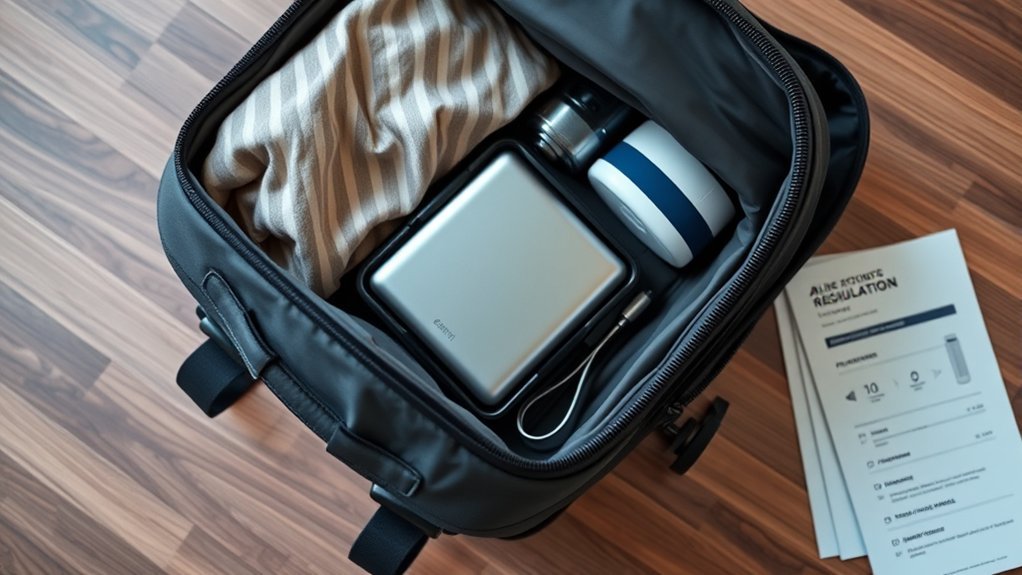
Power banks are treated as portable lithium batteries. The Transportation Security Administration, the FAA, and the European Union Aviation Safety Agency all direct passengers to keep power banks out of checked baggage.
The simplest low-risk rule is: carry no more than two power banks, keep each one at or below 100Wh, protect it from short circuits, and confirm the operating airline’s policy.
Power Bank Size Limits
Current rules are not identical in every country or airline network. Use these limits as a practical baseline:
- 100Wh or less: Usually allowed in carry-on baggage without advance approval. Since March 27, 2026, ICAO’s international instructions limit each person to no more than two power banks.
- More than 100Wh up to 160Wh: May be accepted only with the operating airline’s approval. Do not arrive at the airport expecting approval on the spot.
- More than 160Wh: Not allowed in passenger carry-on or checked baggage under normal passenger provisions.
The current FAA page says rechargeable batteries under 100Wh have no numeric limit when they are for personal use, while ICAO’s 2026 international rule sets a maximum of two power banks. Because an itinerary may involve another country, a partner airline, or a stricter carrier policy, limiting yourself to two units is the safer travel plan.
Carry-On Placement Rules
Place each power bank in your carry-on and protect it from crushing, puncture, accidental activation, and contact with metal objects. A separate pouch is better than dropping it loose beside keys, coins, or tools. Keep the bank where you can reach and monitor it rather than burying it at the bottom of a tightly packed bag.
Some airlines now require power banks to remain under the seat, in a seat pocket, or otherwise visible instead of inside an overhead bin. Follow the airline’s instructions even when they are stricter than the general national rule.
Warning: If your carry-on is gate-checked, remove every power bank before handing over the bag. Keep the power bank with you in the cabin.
In-Flight Use and Charging Rules
Do not assume that carrying a power bank means you may use it during the flight. ICAO’s 2026 rules prohibit recharging a power bank from the aircraft’s USB port or seat power. They also recommend against using a power bank to recharge another device on board. Airlines may go further: Singapore Airlines and Emirates, for example, prohibit power bank use during the flight.
Before departure, read the rule for the operating carrier on every segment. Once on board, follow the cabin crew’s directions.
Packing Your Power Bank for Security Checks

Use this packing sequence before you leave for the airport:
- Read the label. Confirm that the Wh rating is visible. If only voltage and mAh are shown, calculate Wh before travel.
- Inspect the case. Do not travel with a swollen, cracked, leaking, recalled, unusually hot, or damaged power bank.
- Protect it. Place the unit in its retail packaging or a separate protective pouch. Cover exposed terminals when necessary.
- Prevent activation. Switch off any wireless charging or always-on feature when the design allows it, and keep magnetic models away from a phone so they cannot start charging by accident.
- Pack the cable nearby. Coil it loosely and keep connectors from pressing into the power bank.
- Keep it accessible. Use an outer or top compartment so you can remove it quickly if an officer, gate agent, or crew member asks.
TSA does not publish a general rule requiring every power bank to be removed from the bag or powered on at a standard U.S. checkpoint. Screening officers may still request a closer inspection, and the final decision rests with the officer at the checkpoint.
Pro Tip: Take a clear photo of the power bank’s label before your trip. It can help you read small print, but it does not replace a visible rating on the device when an airline requires one.
What if the Rating Is Missing or Unreadable?
A power bank with no readable capacity label may be delayed or refused because staff cannot verify its rating. Check the manufacturer’s documentation before travel, but do not rely on a web page alone if your airline requires the rating to appear on the unit. Replacing an unmarked or worn power bank is usually easier than arguing about it at the gate.
Choosing the Right Power Bank for Travel
Choose capacity based on the devices you actually carry. A 10,000mAh model is lighter and usually enough for one phone during a travel day. A 20,000mAh model offers more reserve for long connections, tablets, or several devices, but it is heavier. In either case, verify the printed Wh value.
Then match output to your equipment:
- Phones and earbuds: A compact USB-C model with 20W or more is convenient for many modern devices.
- Tablets and handheld consoles: Look for higher USB-C Power Delivery output and enough capacity for the trip.
- Laptops: Confirm that the bank supports the laptop’s required USB-C PD voltage and wattage. A high advertised wattage does not guarantee compatibility.
- Several devices: Check the total shared output, not just the maximum output of one port.
Buy from a traceable manufacturer or retailer, keep proof of purchase, and avoid units with damaged packaging, vague specifications, counterfeit branding, or no safety documentation. The Wh label, sound construction, and a clear warranty matter more for air travel than decorative features.
Managing Multiple Devices With One Power Bank
A multi-port power bank reduces the number of chargers in your backpack, but charging several devices at once divides the available output. A bank advertised at 65W may provide that maximum through one USB-C port yet deliver less to each device when two or three ports are active. Check the manufacturer’s port-allocation chart before relying on it for a laptop and phone together.
Multi-Port Charging Options
For a phone, tablet, and laptop, look for at least two USB-C ports and enough total output for the largest device. Keep short, well-made cables labeled by purpose so you do not accidentally use a low-power cable with a laptop. Charge the most important device first when time is limited.
During airport use, set the power bank on a hard, open surface where heat can escape. Do not charge it inside a tightly packed backpack, under clothing, or against another warm device.
Wireless Charging Convenience
Wireless power banks reduce cable clutter, and models such as the BoostCharge Pro Magnetic Power Bank with Qi2 15W 10K can charge compatible devices magnetically. Wireless charging is usually less energy-efficient and can create more heat than a wired connection, so use a cable when you need the most power from a limited battery.
Before packing a magnetic bank, disable wireless output when possible and separate it from your phone. This helps prevent accidental charging inside the bag, which is specifically addressed in current international guidance.
Charging Your Power Bank Before Travel
Do not wait until boarding time to recharge your power bank. Charge it early enough that the unit can cool before you pack it. Stop using it if it becomes unusually hot, smells odd, changes shape, or makes noise.
Current IATA passenger guidance for 2026 says airlines prefer spare batteries and power banks at a lower state of charge and advises against last-minute recharging. Your airline may not publish a target percentage, so balance your charging needs with its policy rather than assuming that a completely full bank is always best.
Use the manufacturer-recommended charger and cable on a firm, uncovered surface. Once charging is complete, disconnect the cable, let the power bank return to room temperature, and pack it so the controls cannot be pressed.
Tips for Safe Power Bank Storage
Good storage protects both the battery and the items around it:
- Use a dedicated pouch that prevents crushing and keeps ports away from metal objects.
- Do not place heavy shoes, bottles, or hard-edged equipment on top of the power bank.
- Keep it away from direct sun, hot cars, heaters, freezing conditions, and moisture.
- Do not use a visibly damaged cable or force a loose connector into a port.
- Do not pack a power bank that is under a safety recall.
- Keep the device accessible during the flight so a heat problem can be noticed quickly.
What to Do if a Power Bank Overheats
At the airport, stop using the bank, disconnect it only if that can be done safely, move away from combustible materials, and alert airport staff. On the aircraft, notify a flight attendant immediately if the power bank becomes hot, swells, smokes, sparks, hisses, or gives off a burning smell. Do not place it in a bag, cover it, carry it to the lavatory, or try to manage an in-flight battery fire by yourself.
Warning: A swollen or damaged lithium battery can enter thermal runaway. Do not charge it, puncture it, squeeze it, or take it onto an aircraft.
Using Airport Charging Stations Effectively
Locate outlets near your gate soon after you arrive, especially during delays. An AC outlet used with your own wall charger and cable gives you more control over charging speed and connector quality than an unfamiliar public USB port. Keep your phone, cable, adapter, and power bank in sight at all times.
Check the power bank and device every few minutes. If either becomes unusually warm, disconnect it and allow it to cool. Do not stretch a cable across a walkway, block another passenger’s seat, or leave electronics unattended while visiting a shop or restroom.
Airport stations can be full or out of service, so treat them as a backup rather than your only plan. A short top-up at the gate may be enough when your airline does not allow power bank use in flight.
Best Power Banks for Frequent Travelers
The best travel power bank is not simply the one with the largest mAh number. It is the smallest reputable unit that meets your real device needs, has a readable Wh rating, and follows the rules for every airline on your itinerary. The models below are examples of useful formats, not a guarantee that a specific unit will be accepted by every carrier.
Ideal Capacity Choices
A 10,000mAh bank is a strong everyday choice for a phone, earbuds, and short trips. The BoostCharge Power Bank 10K, for example, offers multiple ports in a compact format. For longer travel days, a 20,000mAh bank provides more reserve while normally remaining below 100Wh when its nominal battery voltage is around 3.7V. Always confirm the actual label.
Avoid buying right at the flight limit unless you need the capacity. A clearly marked model well below 100Wh is easier to explain and leaves less room for labeling or conversion disputes.
Multi-Port Charging Options for Frequent Travelers
The BoostCharge Pro 3-Port Laptop Power Bank 20K is an example of a higher-output bank designed for several devices. Its manufacturer lists two USB-C ports, one USB-A port, and up to 65W output. Before buying any similar model, verify the battery’s Wh label, shared-output behavior, cable requirements, and compatibility with your laptop.
For wireless convenience, a Qi2 magnetic model can charge a compatible phone and also provide wired ports. Remember that wireless charging creates more heat and uses more of the bank’s stored energy than a comparable wired charge.
Compact Travel Designs
A compact bank is easier to monitor and less likely to be crushed inside an overfilled backpack. Look for rounded edges, recessed ports, a reliable battery indicator, and a shape that fits a separate pouch. Integrated cables can reduce clutter, but a damaged built-in cable may be harder to replace than a separate one.
Do not choose a model solely because it uses GaN, has a magnetic stand, or promises a large number of phone charges. Start with Wh, build quality, output, and airline acceptance; treat convenience features as secondary.
General Travel Tips for a Smooth Experience
Run through this final checklist before you zip the backpack:
- Confirm the Wh rating and photograph the label.
- Check the operating airline’s policy for quantity, capacity, onboard use, and stowage.
- Carry no more than two power banks unless your airline has clearly confirmed a different rule that applies to your itinerary.
- Pack each bank separately and protect it from damage and short circuits.
- Keep the bank and charging cable near the top of the carry-on.
- Remove the bank before any gate check or planeside bag check.
- Do not recharge the power bank from aircraft power.
- Do not use it in flight unless the airline and crew permit it.
- Tell the crew immediately about heat, swelling, smoke, sparks, or a burning smell.
Carry-on size and weight limits vary by airline, fare, aircraft, and route; there is no universal 8–10kg allowance. Check the baggage rule separately and remember that a dense 20,000mAh bank can add noticeable weight.
If your backpack or suitcase has a built-in power bank, confirm that the battery is removable. When the bag must go in the hold, remove the battery and keep it in the cabin according to the airline’s smart-baggage policy.
Frequently Asked Questions
Can I pack multiple power banks in my carry-on?
Yes, but the safest current rule is no more than two. ICAO’s international instructions now cap power banks at two per person, while some national rules may differ. Each bank must be in carry-on baggage, protected from short circuits, and within the applicable Wh limit. Check every operating airline.
What happens if my power bank exceeds 100Wh?
A power bank over 100Wh and no more than 160Wh may require advance airline approval. Approval is not guaranteed, and some carriers refuse power banks above 100Wh. Units over 160Wh are not allowed under normal passenger baggage rules.
Are power banks allowed in checked luggage?
No. Power banks must remain in carry-on baggage or with the passenger in the cabin. If a carry-on bag is gate-checked, remove the power bank before the bag goes into the cargo hold.
How do I know my power bank’s capacity?
Look for Wh on the label. If the label shows only voltage and mAh, divide mAh by 1,000 and multiply the result by voltage. A 20,000mAh bank at 3.7V is 74Wh. Use the values printed on your device.
Can I use my power bank during the flight?
Do not assume you can. Current international rules prohibit recharging a power bank from aircraft power and recommend against using it to charge another device. Several airlines ban all in-flight power bank use. Check the operating carrier and follow the crew.
Do I have to remove a power bank at airport security?
Not as a universal U.S. screening rule, but an officer may request separate inspection. Pack the bank where it can be removed quickly and follow local checkpoint instructions.
What should I do if my carry-on is gate-checked?
Remove the power bank, spare lithium batteries, and any other items the airline says must remain in the cabin. Put them in a personal item or keep them with you before handing over the bag.
Can I fly with a swollen or damaged power bank?
No. Do not charge, use, or fly with a swollen, cracked, leaking, recalled, or unusually hot power bank. Follow the manufacturer’s and local hazardous-waste instructions for safe disposal.
Conclusion
Pack your power bank in a separate, easy-to-reach carry-on pocket with a readable Wh label and protection from damage or short circuits. For the least complicated trip, take no more than two banks, keep each at or below 100Wh, and remove them before any gate check. Most importantly, check the operating airline’s current rule for onboard use and stowage, because carrier policies can be stricter than the general limit.
Sources
- International Civil Aviation Organization: New Power Bank Restrictions — 2026 quantity, charging, and onboard-use changes.
- Federal Aviation Administration: Airline Passengers and Batteries — U.S. Wh limits, approval rules, packing requirements, and conversion formula.
- Transportation Security Administration: Power Banks — U.S. carry-on-only screening rule.
- European Union Aviation Safety Agency: Dangerous Goods — European cabin carriage, monitoring, and in-flight safety guidance.
- International Air Transport Association: Passengers Travelling with Lithium Batteries, 2026 — practical packing, quantity, and charging guidance.