

Last Updated on July 28, 2026 by Ethan Caldwell
Measuring a luggage trailer takes more than checking the length printed in a brochure. A size such as “5 × 8” often describes the cargo bed, not the trailer’s complete road or storage footprint. For an accurate result, record the body, interior, and overall dimensions separately, then check the trailer’s weight ratings and hitch setup before towing.
Quick Answer
Park the trailer level, place all permanent equipment in its normal travel position, and measure from the forwardmost fixed point to the rearmost fixed point. Measure width across the widest permanent parts and height to the highest fixed component. Record the cargo-box and door-opening dimensions separately.
Key Takeaways
- Choose the measurement based on its purpose: overall dimensions for clearance, body dimensions for many covers, and interior dimensions for cargo.
- Include permanent fenders, spare tires, ladders, lights, roof vents, racks, and air conditioners when measuring the trailer’s complete footprint.
- Do not round measurements used for legal records or clearance checks. Round up only when a cover or storage space needs extra allowance.
- Check the trailer’s GVWR, GAWR, cargo capacity, actual loaded weight, and tongue weight before towing.
- Every tow-related rating matters. The lowest rating among the vehicle, hitch, ball, coupler, trailer, axles, wheels, and tires is the limit.
At a Glance
| Time Required | 15–30 minutes |
| Difficulty | Easy; a helper is useful for long or tall trailers |
| Tools Needed | 25-foot tape measure, notepad, pencil, level, straightedge or plumb line, and a stable step ladder if needed |
| Cost | $0 if you own the tools; approximately $10–$30 for basic measuring tools, plus any public-scale fee |
Disclosure: As an Amazon Associate I earn from qualifying purchases. Some links on this page are affiliate links, at no extra cost to you.
What Type of Trailer Are You Measuring?
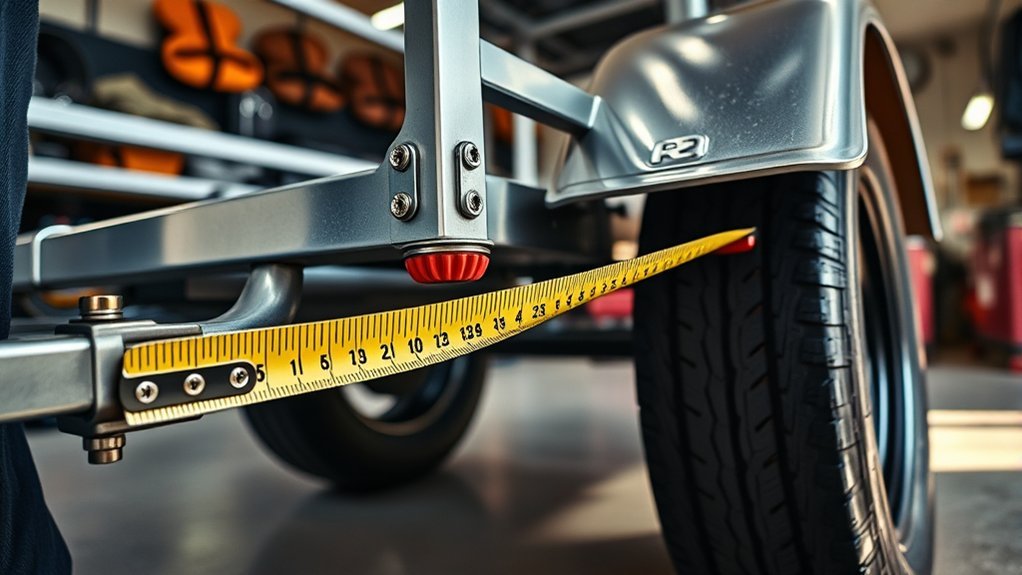
First, identify the trailer and the reason you need its dimensions. A luggage trailer is usually a small enclosed cargo trailer or utility trailer used for bags, camping equipment, tools, or household items. Its measurement method differs from that of a travel trailer, fifth wheel, toy hauler, teardrop camper, or folded pop-up trailer.
More importantly, one trailer can have several correct lengths:
- Nominal size: The marketed cargo-bed or box size, such as 5 × 8 feet.
- Interior cargo size: The usable floor length, width, and height inside the trailer.
- Body or box size: The exterior cargo enclosure without the tongue, coupler, or some accessories.
- Overall size: The complete fixed footprint in travel condition, including the tongue, coupler, permanent fenders, and fixed rear projections.
- Cover size: The dimensions requested by the specific cover manufacturer, which may exclude the tongue and use sidewall height rather than maximum travel height.
A “5 × 8” trailer is not necessarily eight feet long overall. One current Carry-On 5 × 8 utility trailer is listed at 149 inches from end to end.
If you are measuring a travel trailer, teardrop, fifth wheel, toy hauler, or pop-up for a cover, follow the cover maker’s diagram. Travel-trailer and teardrop covers often use body length without the A-frame or tongue. A pop-up is normally measured while folded, while toy-hauler measurements must account for the body’s full rear profile.
Note: Do not use a cover measurement as your road-clearance or garage-storage measurement. For clearance, use the trailer’s complete fixed length, widest point, and highest permanent point.
Prepare the Trailer and Gather Your Tools
Set up the trailer in the same condition in which it will be towed or stored. This prevents an open door, raised jack, removable rack, or uneven parking surface from changing the result.
- Park on firm, flat, level ground.
- Chock the wheels so the trailer cannot move.
- Level the trailer from front to rear using the tongue jack.
- Close and latch all doors, lids, gates, and ramp doors.
- Retract stabilizers, steps, awnings, and the tongue jack into their normal travel positions.
- Leave permanent accessories in place, including spare tires, roof racks, vents, air conditioners, ladders, lights, and fixed storage boxes.
- Remove only items that will not be attached during the intended use.
- Sketch the trailer and create spaces for every measurement before starting.
Use a tape measure long enough to span the trailer without joining separate readings. A rigid straightedge, carpenter’s level, or weighted plumb line helps transfer projecting points to the ground.
Pro Tip: Mark the ground directly below the forwardmost, rearmost, widest, and highest projections with a plumb line. Measuring between those marks is more reliable than bending the tape around curved body panels.
How to Measure Trailer Length
Do not rely on one number for every purpose. Record the trailer’s overall length, exterior body length, interior cargo length, and rear-opening dimensions separately.
Measure the Overall Length
Overall length is the trailer’s complete fixed footprint. Measure in a straight horizontal line from the forwardmost permanent point—usually the nose of the coupler—to the rearmost permanent point.
- Place a straightedge or plumb line at the front edge of the coupler.
- Mark that point on the ground.
- Find the fixed component that extends farthest behind the trailer. This may be the body, bumper, spare tire, ladder, light guard, or storage box.
- Transfer the rear point to the ground.
- Measure in a straight line between the two marks.
- Record the result exactly in feet and inches and, when useful, total inches.
Include the tongue and coupler because they remain attached during travel and storage. Do not add a removable ball mount that belongs to the tow vehicle. If a rack or other accessory is removed every time the trailer is stored, record the length both with and without it.
Measure the Exterior Body or Box Length
Body length is measured from the front wall of the cargo box to the rear wall or door. It normally excludes the A-frame, tongue, coupler, and front-mounted equipment outside the box.
This is often the measurement used when shopping for an enclosed-trailer cover, but instructions vary. Include a rear spare tire, ladder, or other projection only when the cover is designed to fit over it. Never assume that the manufacturer’s advertised bed length is the same as the exterior body length.
Measure Interior Cargo Length and Door Clearance
Measure the usable floor from the inside of the front wall to the closed rear door. Then check the narrowest usable distance created by wall framing, wheel wells, shelves, tie-down hardware, or door mechanisms.
Record these separate measurements:
- Interior floor length
- Interior width at floor level
- Width between wheel wells
- Interior height
- Rear-door opening width and height
- Side-door opening, if fitted
- Ramp length and required space behind the trailer
The door-opening measurement matters as much as the interior volume. A large item can fit inside the box yet still be too wide or tall to pass through the door.
Know When to Round Up
Write down the exact reading first. Do not round a measurement used for registration paperwork, legal compliance, a garage opening, or overhead clearance.
Round up only when selecting an item that needs fitting allowance, such as a cover, or when planning a storage space. Follow the product maker’s size chart rather than automatically adding a full foot. Excessively loose covers can move in the wind and rub the trailer’s finish.
How to Measure Trailer Width and Height
Overall width and maximum height must include permanent projections because those parts determine whether the trailer fits through a gate, garage door, narrow lane, or low-clearance area.
Measuring Overall Trailer Width
Measure horizontally across the trailer’s widest fixed points with all slide-outs, awnings, steps, and doors in their normal travel positions.
For the complete road and storage width, include permanent:
- Fenders and tires
- Exterior lights and light guards
- Door hinges, latches, and handles
- Fixed side vents
- Toolboxes and side-mounted equipment
Do not use 96 inches or any other number as a universal legal limit. The Federal Highway Administration uses a 102-inch width standard for commercial motor vehicles on the National Network, but private-trailer rules, local-road limits, and permit requirements are governed by applicable state and local law. Check every state and route involved in the trip.
Measuring Maximum Trailer Height
Level the trailer, then measure vertically from the ground to its highest permanent point. Include roof vents, air conditioners, racks, antennas in travel position, solar equipment, and other fixed rooftop hardware.
- Place a rigid level or straight board across the highest point.
- Extend the board beyond the side of the trailer.
- Use a plumb line or vertical tape to measure from the bottom of the board to the ground.
- Repeat the reading on both sides if the ground may not be perfectly level.
- Record the exact height and add a conservative clearance margin when planning a route or garage opening.
There is no single federal vehicle-height limit that applies across every U.S. road. FHWA notes that state standards for commercial vehicles vary, and private or local restrictions can differ. Posted bridge, parking-garage, tree, utility-line, and doorway clearances must also be respected.
Warning: Never exclude a roof vent, air conditioner, rack, or antenna from a travel-clearance measurement. A body-only height may be useful for a fitted cover, but it is not the trailer’s safe maximum height.
Measure Ground Clearance
Ground clearance is the vertical distance from level ground to the lowest fixed component other than the tires. Check the axle, suspension hardware, stabilizer brackets, spare-tire carrier, steps, jack foot in travel position, and plumbing or wiring guards.
This measurement helps you judge driveway transitions, speed bumps, campsite entrances, and loading ramps. It is not a replacement for departure-angle or breakover-angle checks on long trailers.
Check Cargo Space and Payload Limits
Physical space tells you whether an item fits. Weight ratings tell you whether carrying it is safe. You must satisfy both limits.
Find the trailer’s certification label, commonly attached near the tongue or front frame. Under NHTSA certification requirements, trailer labels identify values such as the gross vehicle weight rating and gross axle weight rating.
- GVWR: The maximum loaded weight assigned to the trailer by its manufacturer.
- GAWR: The maximum load assigned to an axle system.
- Unloaded or empty weight: The trailer’s weight without cargo. Published figures may not include every installed option.
- Cargo capacity: The amount of payload the trailer is rated to carry.
- Actual gross trailer weight: What the complete trailer weighs on a scale in its current loaded condition.
- Tongue weight: The downward load the trailer places on the hitch.
As a basic calculation, cargo capacity equals GVWR minus unloaded trailer weight. However, the safest approach is to use the trailer’s cargo-capacity label when provided and verify the actual trailer on a certified scale. Federal rules include cargo-capacity labeling requirements for applicable recreational trailers under FMVSS No. 110 and FMVSS No. 120.
Installed accessories, spare tires, batteries, toolboxes, racks, tie-down equipment, and permanent modifications use part of the available payload. Do not exceed the GVWR, either axle’s GAWR, or the load rating of any tire, wheel, hub, spring, or other component.
Confirm Hitch Fit and Towing Limits
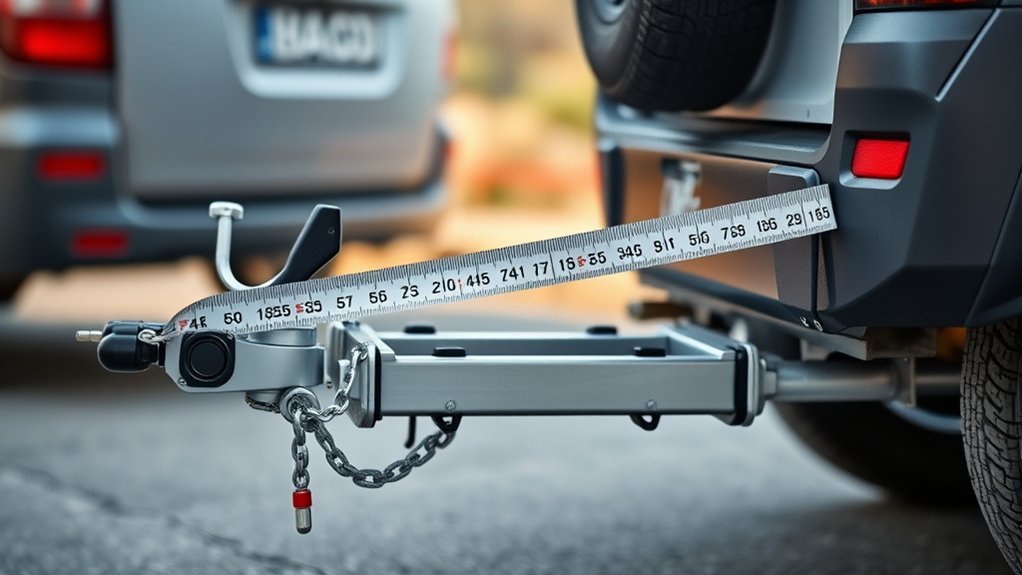
A trailer that fits in a garage is not automatically safe for a vehicle to tow. Compare the fully loaded trailer with every applicable rating in the trailer, hitch, and tow-vehicle manuals.
Check all of the following:
- Maximum loaded trailer weight for the exact vehicle configuration
- Tow-vehicle GVWR
- Front and rear GAWR
- Tow-vehicle payload capacity
- Gross combined weight rating, or GCWR
- Receiver and ball-mount ratings
- Hitch-ball size and rating
- Coupler size and rating
- Maximum tongue-weight rating
- Trailer GVWR and GAWR
- Trailer tire, wheel, and axle ratings
- Required brakes, breakaway equipment, lights, and safety chains
The lowest applicable rating controls the setup. A high receiver rating does not increase the vehicle’s towing capacity, and a high vehicle tow rating does not increase the rating of the ball, coupler, tires, or trailer.
Measure Hitch and Coupler Height
Level the loaded trailer on flat ground. Measure from the ground to the bottom or centerline specified by the coupler or ball-mount manufacturer. Then measure the tow vehicle’s receiver height on the same type of surface.
Select the correct rise or drop according to the hitch maker’s instructions so the connected trailer rides level after normal suspension compression. Confirm that the ball diameter matches the coupler marking exactly.
Check Tongue Weight
Tongue weight counts against the tow vehicle’s payload and rear-axle capacity. Measure it with a suitable tongue-weight scale or by a verified weighing method after the trailer is fully loaded.
Ford’s current general towing guidance states that conventional trailer tongue weight is commonly about 10%–15% of total loaded trailer weight. This is a general guideline, not a universal specification. Follow the trailer and tow-vehicle manufacturers’ instructions and never exceed the hitch or vehicle tongue-weight limit.
Warning: Do not decide that a load is safe from the trailer’s GVWR alone. The loaded combination must also remain within the tow vehicle’s payload, axle, hitch, tongue-weight, and GCWR limits.
Load the Trailer Correctly
Measure and weigh the trailer after placing cargo where it will travel. Secure each item to rated tie-down points so it cannot slide forward, backward, or sideways.
The commonly cited 60/40 rule means placing about 60% of the cargo weight in the front half of the trailer box and about 40% in the rear half. It does not mean placing 60% directly over the axle. U-Haul’s trailer instructions use this front-half/rear-half method for its equipment.
Use the rule only as a starting point. The trailer manufacturer’s instructions and the measured tongue weight control. Place heavy items low, keep the load balanced from side to side, and avoid concentrating all weight in one corner. Recheck the tie-downs and tongue weight after changing the load.
Record Your Trailer Measurements
Keep the completed measurements with the trailer records so you do not have to rely on memory when buying a cover, reserving storage, choosing a route, or loading cargo.
- Nominal size: The marketed bed or box size
- Overall length: Coupler to rearmost fixed point
- Exterior body length: Front cargo wall to rear cargo wall
- Interior floor length: Usable front-to-rear cargo space
- Overall width: Widest permanent points, including fenders
- Interior width: Usable wall-to-wall width
- Width between wheel wells: Narrowest floor-level cargo width
- Maximum height: Ground to highest permanent point
- Interior height: Usable floor-to-ceiling height
- Rear-door opening: Clear width and height
- Ground clearance: Ground to lowest fixed component
- Level coupler height: Ground to the manufacturer-specified measuring point
- GVWR and GAWR: Values from the certification label
- Cargo capacity: Value from the label or verified calculation
- Actual loaded weight: Verified scale weight
- Measured tongue weight: Loaded travel condition
Avoid Common Trailer Measuring Mistakes
- Using the advertised bed size as overall length: The tongue, coupler, fenders, and accessories can add substantial length or width.
- Using one length for every purpose: Overall, body, interior, and cover measurements are not interchangeable.
- Ignoring fixed projections: Spare tires, lights, fenders, ladders, and roof equipment affect clearance.
- Measuring on a slope: An unlevel trailer can produce an inaccurate height and coupler-height reading.
- Leaving a door or jack extended: Measure the trailer in its actual travel or storage configuration.
- Bending the tape around a curved surface: Measure straight horizontal or vertical distances with a straightedge or plumb line.
- Rounding before recording the result: Keep the exact number and create a separate allowance when needed.
- Trusting old specifications without checking: Accessories and modifications can change the trailer’s dimensions and empty weight.
- Checking towing capacity alone: Payload, GCWR, axle, tongue-weight, hitch, tire, and wheel limits also apply.
- Assuming one state’s size rule applies everywhere: Verify the laws and posted clearances for the complete route.
Frequently Asked Questions
How Do You Measure a Travel Trailer?
For overall travel or storage size, level the trailer and measure from the forwardmost fixed point to the rearmost fixed point, across the widest permanent parts, and from the ground to the highest permanent component. For a fitted cover, follow the cover manufacturer’s diagram because it may use body length and sidewall height instead.
What Is the 60/40 Rule for Trailers?
The 60/40 rule places about 60% of cargo weight in the front half of the trailer box and 40% in the rear half. It does not mean putting 60% directly over the axle. Treat it as a starting point and confirm the final load with the trailer manufacturer’s instructions and a tongue-weight measurement.
How Big Is a 10,000 Lb Travel Trailer?
A 10,000-pound rating does not determine a trailer’s dimensions. It usually refers to GVWR, which is the manufacturer’s maximum loaded-weight rating. Trailers with similar GVWRs can have different lengths, widths, heights, floor plans, axle layouts, and cargo capacities, so measure the specific trailer.
Is a Trailer 52 or 53 Feet?
That question normally relates to large commercial semitrailers, not luggage trailers. A luggage trailer’s nominal bed size also does not reveal its overall length. Measure the specific unit from the front of its coupler to its rearmost fixed point and confirm any registration definition with the applicable state agency.
Does Trailer Length Include the Tongue?
Overall length normally includes the tongue and coupler because they remain attached during travel and storage. Cargo-box or body length excludes them. Many trailer covers also exclude the tongue, but you must follow the cover maker’s measuring diagram.
Do Fenders Count in Trailer Width?
Yes, permanent fenders count when measuring the trailer’s overall road, gate, or storage width. Measure across whichever fixed components extend farthest. A product-specific cover may request a different body-width measurement, so check its instructions.
How Much Extra Garage Clearance Should a Trailer Have?
The opening must exceed the trailer’s measured maximum width and height, not just its body dimensions. Allow additional space for uneven approaches, suspension movement, door hardware, steering angle, and safe walking room. Do not attempt a close-clearance entry without a spotter and repeated checks.
Conclusion
Accurate trailer measurement starts with choosing the right dimension for the job. Record the nominal size, exterior body, interior cargo area, door opening, complete travel footprint, ground clearance, and coupler height as separate values. Include every permanent projection when checking road or storage clearance, and use product-specific instructions when fitting a cover.
Dimensions are only half of the process. Before towing, verify the certification label, cargo capacity, actual loaded weight, tongue weight, tow-vehicle ratings, hitch components, tires, wheels, and local rules. A careful measurement and weight check can prevent an unusable cover, a blocked garage entrance, trailer sway, overloading, and costly clearance damage.
Sources
- Federal Highway Administration — Commercial Vehicle Size and Weight Program — federal National Network width guidance and state-controlled height limits
- Electronic Code of Federal Regulations — 49 CFR 571.110 — tire, rim, and load-capacity labeling requirements for applicable vehicles and RV trailers at or below 10,000 pounds GVWR
- National Highway Traffic Safety Administration — Trailer Certification Label Interpretation — GVWR and GAWR label information
- Ford Towing Guidance — loaded trailer, vehicle, payload, and general conventional tongue-weight guidance
- U-Haul Trailer User Instructions — front-heavy 60/40 cargo-loading guidance for U-Haul trailers
- Carry-On Trailer 5 × 8 Specifications — example showing the difference between nominal bed size and overall dimensions

