
Last Updated on July 28, 2026 by Daniel Globe
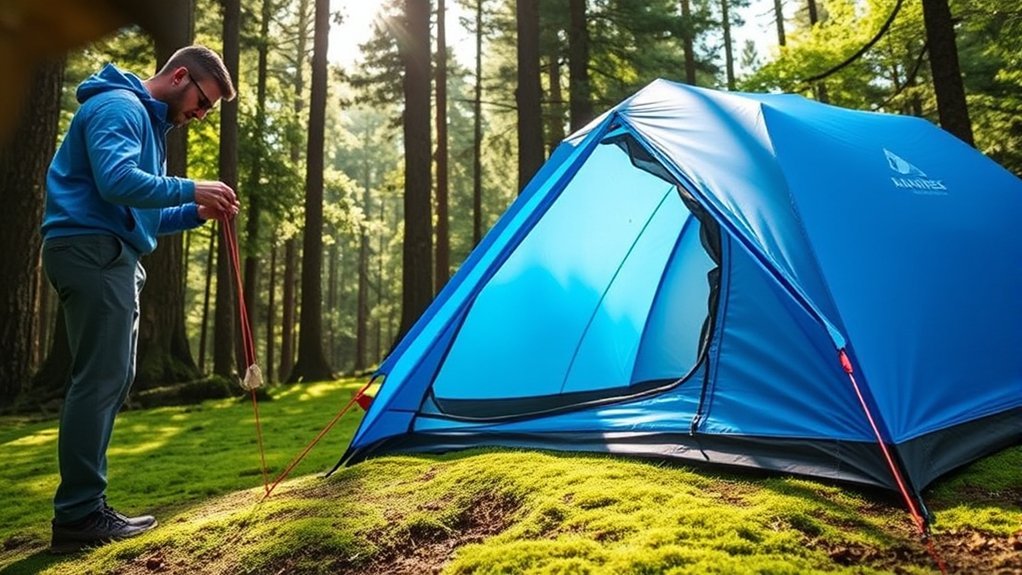
Adding guylines gives your tent extra support when wind pushes against the rainfly and pole structure. The best setup is not one-size-fits-all: use the reinforced points and cord routing shown in your tent manual, choose anchors for the ground, and tension each line until the fly is smooth without pulling seams or poles out of shape.
Quick Answer
Attach each guyline only to a reinforced guyout point identified by your tent maker. Secure the fixed end, run the cord outward in the direction the panel needs support, anchor it in suitable ground, and tension until the fly is taut—not drum-tight. Use all structural guyouts in strong wind and recheck after weather changes.
Key Takeaways
- Check the tent manual first because structural guyout points, cord routes, and required lines vary by model.
- Use cord that fits the supplied tensioners, and attach it only to reinforced loops or webbing.
- In strong or gusty wind, use every structural guyout the manufacturer specifies and anchor each line securely.
- Match the anchor to soil, rock, sand, snow, or a platform, and keep lines inside the campsite boundary.
- Tension the fly until smooth, then recheck it after rain, temperature changes, or a shift in wind.
At a Glance
| Time Required | About 5–15 minutes after the tent is pitched |
| Difficulty | Beginner-friendly; adjustable knots take a little practice |
| Tools Needed | Tent instructions, compatible low-stretch cord, stakes or other approved anchors, and tensioners or an adjustable knot |
| Cost | Usually $0 when guylines are included; replacement cost varies by cord, hardware, and quantity |
Disclosure: As an Amazon Associate I earn from qualifying purchases. Some links on this page are affiliate links, at no extra cost to you.
Understanding the Purpose of Guylines
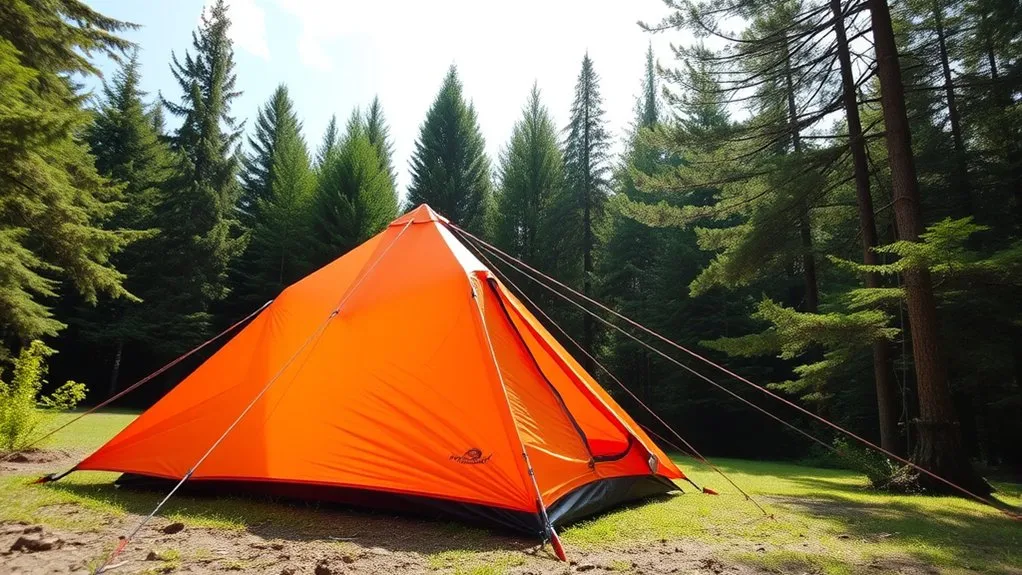
Guylines connect reinforced points on a tent or rainfly to stakes or other anchors. They help the pole structure resist wind, reduce flapping, hold the rainfly away from the inner tent, and can improve ventilation. MSR notes that guying out a tent adds stability and helps keep the fly off the tent body.
A guyline works as part of the whole shelter system: reinforced fabric, poles, clips, stakes, and cord must share the load.
Before You Add Guylines
Check the Tent Instructions
Start with the setup guide for your exact tent. The National Park Service recommends following the manufacturer’s instructions, and this matters because loops that look similar may serve different jobs. Some are structural guyout points, while others only pull out a vestibule, open a vent, or separate the fly from the inner tent.
Also fasten any hook-and-loop or webbing wraps on the underside of the rainfly around the poles when the design includes them. These connections help transfer wind load into the pole structure.
Choose Compatible Cord and Hardware
Use purpose-made guyline that is strong, low-stretch, easy to handle, and visible at night. Match the cord diameter to the tent’s tensioners instead of assuming every tensioner accepts the same size. For example, MSR says its CamRing tensioners perform best with 3–5 mm cord.
If you are replacing missing lines, test-pitch the tent before cutting cord. Leave enough length to reach a useful anchor point and to make adjustments around rocks or uneven ground. Seal or finish cut ends according to the cord maker’s directions so the sheath does not fray.
How to Properly Connect Guylines
Focus on the correct attachment point, a secure fixed end, useful pull direction, a dependable anchor, and moderate tension.
Which Guyout Points to Use First
Use the reinforced structural guyout points identified in the tent instructions. Many common dome tents place important wind-support points midway up the rainfly over a pole, but that pattern is not universal. If you have fewer lines than approved structural points in mild conditions, begin on the windward side and add lines evenly around the tent. When strong or gusty wind is expected, use every structural guyout the manufacturer specifies.
Note: Do not attach cord to zipper pulls, vents, mesh, unreinforced fabric, or a loop whose purpose is unclear. A hard pull can tear the fly or distort the tent.
Attach, Route, Anchor, and Tension
- Secure the fly-to-pole wraps. Fasten any internal hook-and-loop or webbing tabs around the poles before adding external tension.
- Tie the fixed end. Attach the guyline to the reinforced loop with the tent maker’s method. A bowline is a practical fixed loop when no quick-connect hardware is supplied.
- Route the line outward. Pull in the direction that supports the pole or panel. On common pole-supported guyouts, this is usually directly outward from the pole and close to perpendicular to the fly panel.
- Choose a clear anchor point. Keep the line inside the campsite boundary and away from doors, cooking areas, paths, and neighboring sites.
- Set the anchor. Use a stake or approved alternative suited to the surface. Seat it fully and align it according to the stake maker’s design.
- Tension gradually. Tighten until the fly is smooth and separated from the inner tent. Stop if seams pucker, poles bend out of shape, or the fly becomes drum-tight.
- Check the whole pitch. Close doors and vestibules, then adjust opposite lines in small steps so the tent remains balanced.
Pro Tip: When a guyline cannot pull close to perpendicular to the panel, REI suggests routing it over a stable support such as a trekking pole and then down to the anchor. Keep the pole tip controlled so it cannot slip into the fabric.
Warning: Guylines improve stability, but they do not turn a tent into a severe-weather shelter. Monitor forecasts and follow warnings. The National Weather Service says a tent is not safe during lightning; move to a substantial building or hard-topped vehicle when one is available.
Choosing the Right Anchors for Guylines
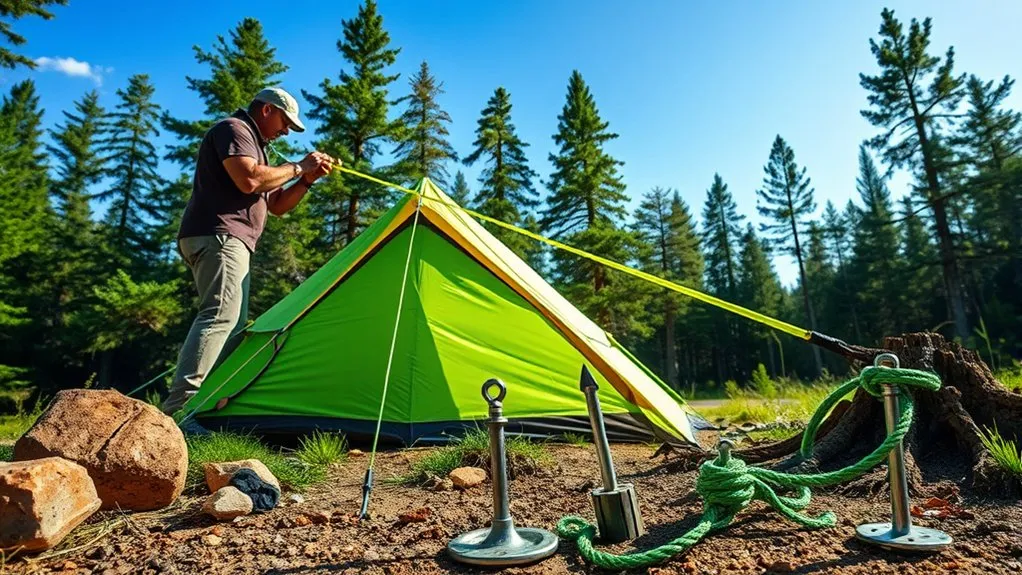
Anchor shape and placement matter as much as stake material. There is no single guyline or stake angle that works best in every surface. Create enough distance for useful leverage, then follow the instructions for the stake and tent. Drive or bury the anchor fully, keep the pull aligned with its strongest direction, and test it with a firm hand pull before relying on it.
| Surface | Useful Anchor | Setup Notes |
|---|---|---|
| Firm soil | Supplied stake or Y/V-profile stake | Seat it fully and aim the broad or strongest face against the pull. |
| Hard or rocky soil | Narrow steel pin or nail-style stake | Do not force a lightweight stake into rock; move the point or use a rock anchor. |
| Loose sand | Broad sand stake or buried deadman | Bury the anchor across the direction of pull and pack the sand firmly. |
| Snow | Snow stake, picket, or buried deadman | Compact the snow and allow it to firm before applying full tension. |
| Rock slab or no soil | Large stable rock or approved rock anchor | Protect cord from sharp edges and make sure the rock cannot roll or shift. |
| Wooden tent platform | Platform hook, fishbone anchor, or approved attachment point | Do not drive nails or screws into the platform unless the site explicitly permits it. |
Natural anchors are site-specific. Do not tie lines to shrubs, trees, signs, railings, or campground fixtures unless local rules allow it and the method will not cause damage. Some parks prohibit attaching lines to vegetation, and all guylines should stay within the assigned site.
Techniques for Tensioning Guylines
Built-in line tensioners are usually the fastest option. Thread them exactly as the tent maker shows because small hardware can lock in different directions. If a tensioner is missing, two useful knot systems are:
- Taut-line hitch: An adjustable friction hitch for moderate loads. It slides when unloaded and grips when the line is tensioned. Add a wrap only if the cord and knot instructions call for it.
- Trucker’s hitch: A mechanical-advantage system that can create much more tension. Use it carefully so you do not overload lightweight fly fabric, seams, poles, or stakes.
Make small adjustments around the tent instead of fully tightening one line at a time. The goal is a balanced, smooth fly with enough tension to resist flapping—not maximum possible force.
The Benefits of Using the Taut-Line Hitch Knot
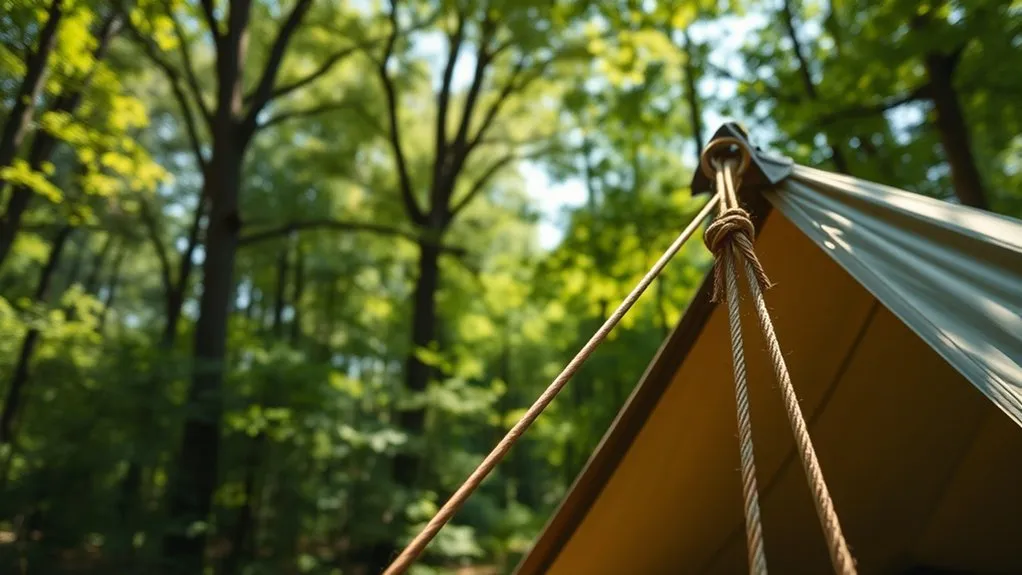
The taut-line hitch is useful because you can slide it to shorten or lengthen a guyline, then load the line so the hitch grips. It is easy to re-adjust after a weather change and does not require separate hardware. Its holding power depends on the cord’s surface, diameter, condition, and the way the knot is dressed, so practice with your actual cord before a trip.
Troubleshooting Common Guyline Problems
| Problem | Likely Cause | Fix |
|---|---|---|
| Fly still flaps | Line pulls in the wrong direction, anchor is too close, or opposite sides are unbalanced | Reposition the anchor, align the pull with the supported panel, and adjust neighboring lines. |
| Stake pulls out | Anchor is too small, shallow, or poorly matched to the ground | Use a larger or wider anchor, move to firmer ground, or build an approved deadman. |
| Line slips | Cord diameter does not match the tensioner, or the knot is poorly dressed | Use compatible cord, rethread the hardware, or retie and load-test the knot. |
| Fly sags after rain | Some wet fabrics—especially conventional nylon—relax more than others | Shake off pooled water and re-tension gradually without overloading the seams. |
| Fly touches inner tent | Low fly-edge tension, missing structural lines, or an uneven pitch | Restake the tent squarely, secure pole wraps, and adjust the approved lines. |
| Seams pucker or poles distort | Guylines are over-tensioned or pulling off-axis | Release tension, correct the pull direction, and tighten only until the fly is smooth. |
Tips for Packing Down Camp Efficiently
Release line tension before pulling stakes. Clean loose soil from the stakes, count them, and pack them together. Many campers leave guylines attached to the fly, coil each line separately, and secure it with a small elastic loop so the cords do not tangle.
Dry the tent before long-term storage. While packing in the field, inspect cords for cuts, melted spots, stiff sections, or damaged reflective strands, and check tensioners for cracks or sharp edges.
Enhancing Visibility of Guylines
Use reflective or bright cord, keep lines taut, and route them away from normal foot traffic. Small removable flags or reflective tabs can help around doors and shared campsite paths. The National Park Service identifies tent stakes and lines as trip hazards, so make camp before dark when possible and use a headlamp after sunset.
Resources for Further Learning and Practice
Practice once or twice at home with the same cord, knots, tensioners, and stakes you will carry. Set up the tent with doors closed, add the lines, and learn which anchors adjust each panel. Then lightly wet the fly and check whether your fabric needs re-tensioning. Never create hazardous wind with a vehicle, fan, or improvised pull test.
- REI Expert Advice: How to Set Up a Tent — guyout-point selection, line direction, and knot options.
- Big Agnes Tent Tips — wind orientation, guyline use, staking, and wet-fly adjustments.
- MSR Tent Guy Lines — manufacturer guidance on stability and fly separation.
Sources
- REI Expert Advice: How to Set Up a Tent — guyout locations, windward-side priority, line routing, and knot options.
- Big Agnes: Tent Tips — using structural guylines, wind orientation, stake setup, and rainfly sag.
- MSR Tent Guy Lines — tent stability and keeping the rainfly separated from the tent body.
- MSR CamRing Cord Tensioners — cord-diameter compatibility for a specific tensioner.
- National Park Service: Finding and Setting Up a Campsite — site hazards, manufacturer instructions, and trip-risk placement.
- National Weather Service: Lightning Safety Outdoors — why a tent is not a safe lightning shelter.
Frequently Asked Questions
Can I use guylines with any type of tent?
Use guylines only where the tent maker provides reinforced guyout points or an approved attachment method. Do not improvise on mesh, zipper pulls, vents, or unreinforced fabric. For a tent without structural guyouts, follow its manual and stake the body, fly edges, and vestibules as directed.
How long should tent guylines be?
Use the manufacturer’s supplied length when available. For replacement cord, test-pitch before cutting and leave enough line to reach useful anchors, work around uneven ground, and pass through the tensioner correctly. Longer lines add options but also add weight and tangle risk.
What material and diameter are best for guylines?
Choose purpose-made, abrasion-resistant, low-stretch cord that is easy to see. The correct diameter depends on the tent and hardware, so check the tensioner specification rather than relying on one universal size. Reflective cord is helpful around camp at night.
Should I use every guyline on my tent?
Follow the manual for your model. In calm weather, some nonstructural pullouts may be optional. In strong or gusty wind, use every structural guyout the manufacturer specifies, distribute the lines around the tent, and give each critical line a secure anchor.
How tight should tent guylines be?
Tighten them until the rainfly is smooth, stable, and separated from the inner tent. They should not pull seams into sharp puckers or bend poles out of shape. Close doors before the final adjustment and balance tension with small changes on opposite sides.
How can I reduce tangling during storage?
Release tension, coil each line separately, and secure it with a small elastic loop or cord keeper. You can leave guylines attached to the fly for faster setup as long as each one is bundled neatly and stored dry.
Are there alternatives to stakes?
Yes. Depending on the site, you may use a buried deadman, a large stable rock, a snow anchor, or approved platform hardware. Protect cord from sharp edges and follow campground rules. Do not attach lines to vegetation or structures unless the site allows it.
Do guylines make a tent safe in a thunderstorm?
No. Guylines can improve wind stability, but a tent does not protect you from lightning. Follow weather alerts and move to a substantial building or hard-topped vehicle when one is available.
Conclusion
Adding guylines is a quick way to improve a tent’s stability, rainfly shape, and ventilation. Use only the points approved for your model, match the cord and anchors to the hardware and ground, and tighten each line in small, balanced steps. Recheck the pitch when conditions change, keep lines visible, and treat severe-weather warnings as a reason to seek safer shelter—not simply to pull the cords tighter.

