

Last Updated on July 29, 2026 by Mason Reed
A taut-line hitch is a simple way to keep a tent guyline adjustable without untying it each time the shelter sags. The knot works by sliding along the standing part when the line is unloaded and gripping when tension returns. It is useful for tents, tarps, and light campsite shelters, but it must be tied, dressed, and tested correctly.
Quick Answer
A taut-line hitch makes an adjustable loop for a tent guyline. Wrap the working end around the stake, make two wraps around the standing part inside the loop, then finish with one half hitch outside the loop. Dress the wraps neatly, test the grip, and slide the hitch only while the line is unloaded.
Key Takeaways
- Use two wraps inside the adjustable loop and one finishing half hitch outside it.
- To tighten the guyline, unload the hitch and slide it away from the stake; slide it toward the stake to loosen.
- Keep the turns neat, leave a generous tail, and test the knot before relying on it.
- Very slick cord can make the hitch slip; use a suitable guyline or the tent maker’s tensioner.
- Do not use this tent-line knot for climbing, rescue, fall protection, hammocks, or any system that supports a person.
At a Glance
| Time Required | About 3–5 minutes to learn; a few seconds once practiced |
| Difficulty | Beginner |
| Tools Needed | Tent guyline or practice cord and a stake, pole, or fixed anchor |
| Cost | $0 when using existing camping gear |
Disclosure: As an Amazon Associate I earn from qualifying purchases. Some links on this page are affiliate links, at no extra cost to you.
Understanding the Purpose of the Taut-Line Hitch
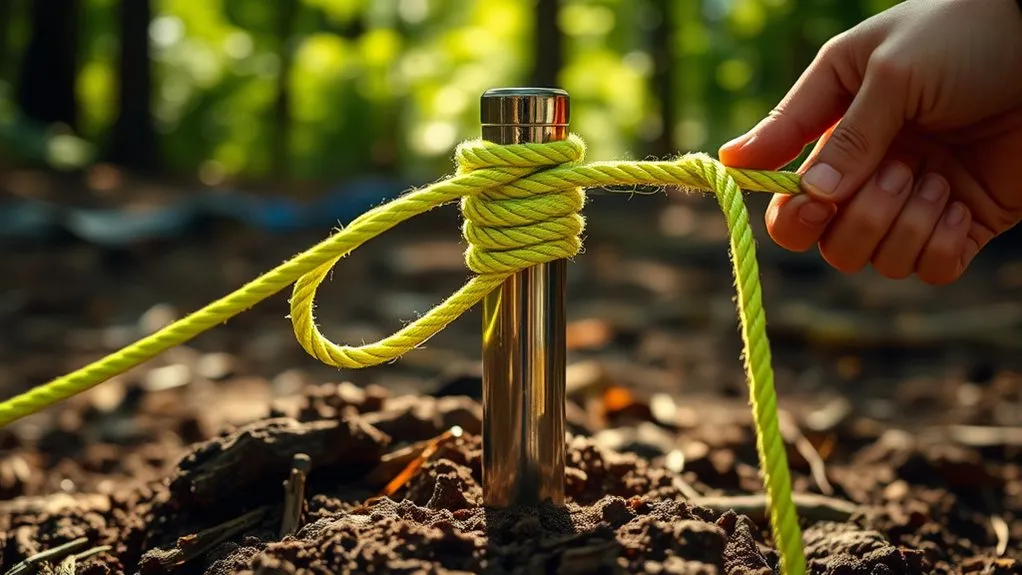
The taut-line hitch creates an adjustable loop at the end of a rope. It is commonly used to tension tent guylines because the hitch can move along the standing part when the line is relaxed, then grip when the line is pulled tight. Scouting America teaches it as a practical camping knot, and the Appalachian Mountain Club describes the same basic use for tents and tarps.
This adjustability helps when a shelter fabric settles, a stake shifts slightly, or a line develops slack. You can retension the line without pulling the stake or retying the knot. The hitch is best for light, noncritical campsite loads that stay under steady tension.
Note: In this guide, the standing part is the long section leading back to the tent or tarp. The working end is the free tail used to tie the hitch. The anchor is the stake, pole, tree, or other object the line passes around.
Step-by-Step Knot-Tying Process
Practice with a cord that is thick enough to see and handle easily. Leave enough line between the shelter and anchor to form an adjustable loop.
- Pass the line around the anchor. Take the working end around the tent stake or other fixed object and bring it back beside the standing part.
- Form the first inside turn. Cross the working end over the standing part, then wrap it around the standing part inside the loop, moving toward the anchor.
- Add a second inside turn. Wrap the working end around the standing part once more in the same direction. Keep this turn beside the first one rather than crossing it.
- Finish outside the loop. Bring the working end past the two inside turns, away from the anchor, and make one half hitch around the standing part in the same wrapping direction.
- Dress the knot. Pull each turn snug so the two inner wraps sit together and the outer half hitch sits separately. Leave a generous tail beyond the finished hitch.
The hitch should slide when the line is unloaded and grip when tension is applied. If it does not do both, retie it before using the guyline.
Completing the Taut-Line Hitch
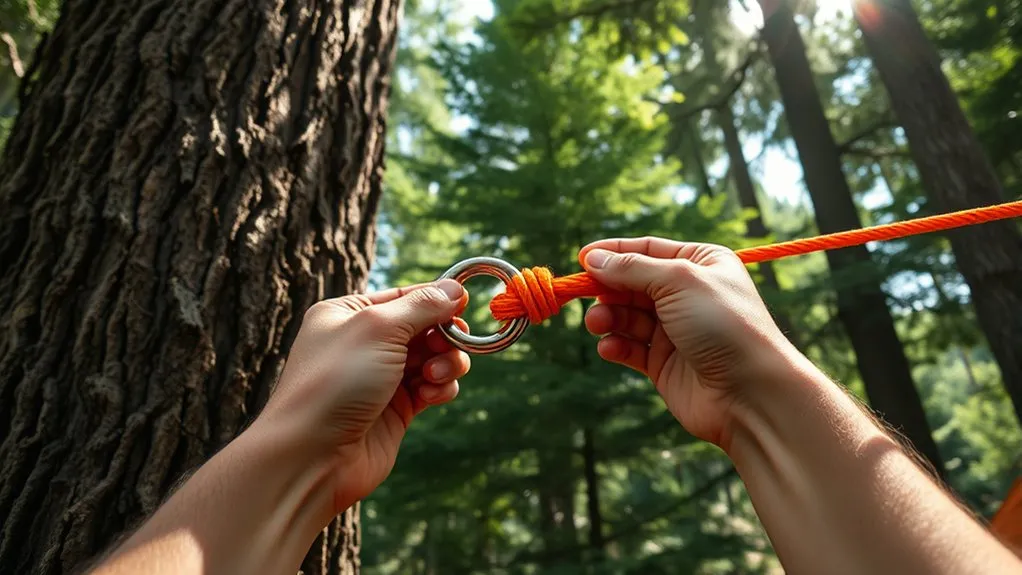
Before applying full tension, check the knot’s shape. The two wraps closest to the anchor should be inside the adjustable loop. The final half hitch should be outside that loop, on the tent side of the first two wraps. All turns should lie flat and travel around the standing part in the same direction.
Set the hitch by pulling the standing part and loop in opposite directions, then load it slowly. Test it close to the ground or with a low-stakes setup. The hitch should hold its position without creeping. To untie it, remove the tension, bend the outer half hitch to loosen it, then work the two inner wraps free.
Pro Tip: Tie the knot at home several times before your trip. Practice until you can identify the two inside wraps and the one outside half hitch at a glance.
Functionality Under Tension
The taut-line hitch is a friction hitch. Its wraps press against the standing part when the line is loaded, creating the grip that holds the adjustment. When tension is removed, you can slide the knot and change the loop size.
Knot Stability Under Load
A correctly tied hitch can hold normal tent and tarp tension, but it is not guaranteed to hold every rope, load, or weather condition. The knot may creep if the line is slick, stiff, icy, poorly dressed, repeatedly shaken, or allowed to go slack. Animated Knots notes that related taut-line and midshipman’s hitches can slide on some modern synthetic ropes, especially very slick materials.
Use the hitch only where a small amount of slippage would not injure anyone or damage important property. Check it after pitching the shelter, after strong gusts, and whenever the line appears loose.
Warning: Do not use this tent-line hitch for climbing, rescue, fall arrest, hammock suspension, lifting, towing, vehicle cargo, or any system that supports a person. Those jobs require rated equipment, an approved attachment method, and activity-specific training.
Easy Tension Adjustment
The main advantage is quick adjustment without untying. Remove or reduce the load first, hold the standing part, and move the hitch to the position that gives the right tension.
| Feature | Benefit |
|---|---|
| Adjusts without retying | Makes it faster to remove sag from a guyline |
| Grips under steady tension | Helps keep a tent or tarp properly tensioned |
| Releases when unloaded | Allows small changes without pulling the stake |
How to Adjust Tension Effectively

Adjustment direction depends on the anchor. In this guide, the line loops around a stake or other anchor, and the standing part runs back to the shelter. With that setup, slide the hitch away from the anchor to tighten and toward the anchor to loosen.
Tightening the Knot
- Hold the standing part with one hand and reduce the load on the hitch.
- Pull the standing part slightly toward the anchor to create a little slack inside the adjustable loop.
- Pinch the hitch and slide it away from the anchor, toward the tent or tarp.
- Release the line, set the hitch, and test the tension.
Loosening Techniques
To loosen the guyline, remove the load and slide the hitch toward the anchor. This makes the adjustable loop smaller and gives more usable length to the standing part. Do not force the knot while it is fully loaded; that can jam the turns or damage the cord.
| Action | Effect |
|---|---|
| Pull the standing part toward the anchor | Creates slack so the hitch can move |
| Slide the hitch away from the anchor | Tightens the guyline |
| Slide the hitch toward the anchor | Loosens the guyline |
| Dress and set the wraps | Improves grip and makes inspection easier |
| Inspect the hitch after conditions change | Catches slack or creeping before it becomes a problem |
Quick Adjustment Methods
- Use two hands: One hand controls the standing part while the other slides the hitch.
- Unload first: Push or lift the shelter line slightly to take pressure off the wraps.
- Move in small steps: Slide the hitch an inch or two, release it, and check the pitch before making another change.
- Reset after moving: Pull the line tight so the wraps bite into the standing part again.
- Check all guylines: Balanced tension is better than overtightening one side of a tent or tarp.
Common Mistakes and Troubleshooting
| Problem | Likely Cause | Fix |
|---|---|---|
| The hitch slides under tension | Slick cord, loose wraps, crossed turns, or too little steady tension | Retie and dress it; try one extra inside turn on compatible cord, or use a hardware tensioner |
| The hitch will not slide | The line is still loaded or the knot is overtightened | Unload the line, bend the knot to break friction, then slide it gently |
| The knot twists or looks uneven | The wraps cross or the final half hitch was tied in the wrong direction | Retie with all turns moving in the same direction and lying side by side |
| The guyline gets looser overnight | The stake, shelter, cord, or hitch has shifted | Reset the anchor, retension the line, and recheck after gusts or rain |
| The tail starts pulling through | The tail is too short or the knot was not set | Retie with a longer tail and test the finished hitch before use |
Practical Applications in Outdoor Settings
The taut-line hitch works well for tent guylines, tarp corners, dining flies, light awnings, privacy screens, and other temporary campsite lines that need occasional adjustment. It is especially handy when you need to remove sag without moving a well-placed stake.
It is not the right choice for every task. Do not rely on it for a ridgeline carrying a person, a heavy suspended load, a critical structural line, or transport tie-downs. For higher tension, a trucker’s hitch may provide more mechanical advantage; for very slick tent cord, a purpose-made line tensioner or a knot recommended by the shelter manufacturer is usually easier to inspect and more predictable.
Choosing Cord and Knot Alternatives
A moderately flexible, textured tent cord is easier to use than a very stiff or slick line. Braided polyester or nylon guyline often gives the wraps enough friction for normal shelter use. Inspect any supplied cord before replacing its original tensioning hardware.
Some modern lines made with very slick fibers—including certain Dyneema, Spectra, or polypropylene cords—may let a classic taut-line hitch creep or slide. An extra inside turn can improve grip on some cord, but it is not a guarantee. When the knot keeps slipping, switch to the manufacturer’s tensioner, an adjustable grip hitch suited to the cord, or another tested system rather than adding endless backup knots.
Note: Knot names and variants are not always consistent. Some references use “midshipman’s hitch” for a closely related and often more secure adjustable loop. Follow one complete method rather than mixing steps from different variants.
Rope Care and Inspection
Check the guyline before each trip and whenever the knot starts behaving differently. Replace cord with cuts, melted or glazed areas, severe fuzzing, flattened spots, chemical contamination, or damage near the anchor. Keep the line away from sharp edges and open flames.
For ordinary dirt, rinse the cord or wash it gently in lukewarm water with a mild, pH-neutral soap. Rinse well and air-dry it in a ventilated place away from direct UV exposure and heat. Do not store rope while it is wet. These care steps are consistent with Petzl’s rope-cleaning guidance; always follow the cord manufacturer’s instructions when available.
Frequently Asked Questions
Can I use any type of rope for the taut-line hitch?
No. The hitch works best on flexible cord with enough surface friction. Very slick, stiff, or icy line may creep or fail to grip. Test the exact cord under a low, noncritical load before using it on a shelter.
Is the taut-line hitch suitable for climbing or safety applications?
Not the tent-line hitch taught here. Do not use it for climbing, rescue, fall protection, or any human-support system. Use rated equipment and the knots or connectors specified by a qualified instructor and the equipment manufacturer. Petzl’s climbing knot guidance, for example, lists the figure-eight for common tie-in and anchor uses.
How does weather affect the taut-line hitch’s performance?
Wind can cycle the load, and wet, icy, dirty, or stiff cord can change how the wraps grip and slide. Weather can also loosen a stake or shelter panel. Inspect and retension the line whenever conditions change or the guyline develops slack.
Can the taut-line hitch slip under heavy loads?
Yes. It can creep or release when the cord is slick, the knot is poorly dressed, tension drops, or the load is too high or dynamic. Limit it to light, noncritical shelter lines and choose a different rated system for heavy or safety-sensitive loads.
What are the best practices for maintaining my rope?
Keep it clean, dry, and away from heat, direct UV exposure, chemicals, and sharp edges. Wash dirty cord gently with mild soap and lukewarm water, rinse it well, air-dry it fully, and replace it when you find cuts, glazing, severe fuzzing, or chemical damage.
Why will my taut-line hitch not slide?
The line may still be loaded, the wraps may be crossed, or the knot may have been pulled too tight. Take tension off the line, flex the hitch to loosen the wraps, and check that the turns lie neatly beside one another.
Which direction do I slide a taut-line hitch to tighten it?
For a guyline looped around a stake, slide the unloaded hitch away from the stake and toward the tent to tighten. Slide it toward the stake to loosen. Pull the standing part toward the stake first to create enough slack for an easy adjustment.
Conclusion
A well-tied taut-line hitch gives you a fast way to adjust tent and tarp lines at camp. Remember the pattern: two wraps inside the loop, one half hitch outside, then dress and test the knot. Slide it away from the anchor to tighten and toward the anchor to loosen. Use suitable cord, inspect the hitch as conditions change, and choose a rated system whenever a load is heavy or safety-critical.
Sources
- Scouting America: Basic Knots — supports the camping use and adjustable function of the taut-line hitch.
- Appalachian Mountain Club: How to Tie a Taut-Line Hitch Knot — supports the tying sequence, adjustment, and need to maintain tension.
- Animated Knots: Midshipman’s Hitch — supports the related knot structure and warnings about slick modern rope.
- Petzl: How Do I Wash a Rope? — supports mild-soap washing, rinsing, air-drying, and protection from heat and UV.
- Petzl: Climbing Knots — supports using activity-specific knots and the figure-eight for common climbing tie-in and anchor applications.

