

Last Updated on July 24, 2026 by Daniel Globe
Exodus gives a clear number for the men who left Egypt, but it does not state the total size of the departing population. Later census passages add more figures, while questions about Hebrew vocabulary, household size, logistics, and archaeology have led to several competing interpretations. The best answer therefore begins with what the biblical text says and then separates that from modern estimates.
Quick Answer
Exodus 12:37 says about 600,000 Israelite men traveled from Rameses to Succoth, besides dependents. Numbers later counts 603,550 military-age men, excluding Levites. A total near 2–3 million is therefore an estimate, not a number the Bible states directly, and scholars debate whether the census figures are literal, literary, or based on older units.
Key Takeaways
- Exodus reports approximately 600,000 men on foot, not a complete population count.
- Numbers 1 records 603,550 men aged 20 and older who were eligible for military service; Levites were counted separately.
- The commonly cited total of 2–3 million depends on assumptions about wives, children, older adults, and other travelers.
- The proposal that the Hebrew word eleph means “clan” or “unit” in the census remains debated.
- Archaeology has not confirmed a wilderness migration involving millions of people, but that does not determine whether a smaller historical movement occurred.
How Many Israelites Left Egypt?
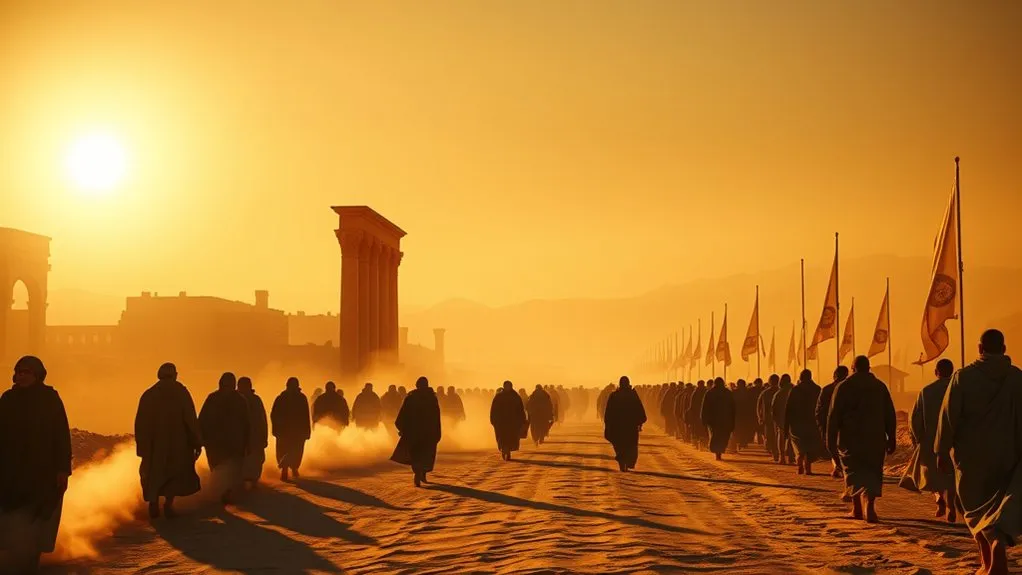
Exodus 12:37 says that approximately 600,000 men on foot traveled from Rameses to Succoth. Depending on the translation, the verse says this number did not include children, dependents, or noncombatants. The next verse also mentions a mixed group that traveled with the Israelites, along with large flocks and herds.
The Bible does not provide a complete headcount of everyone in the departing group. Estimates of roughly 2–3 million people come from adding assumed numbers of women, children, older adults, Levites, and other travelers to the 600,000 men. Those estimates can illustrate the scale implied by a literal reading, but they should not be confused with a total stated in Exodus.
The Bible explicitly reports about 600,000 men. Any estimate for the entire population requires additional assumptions that the text does not specify.
What the Main Census Passages Say
| Passage | Number | What Is Counted |
|---|---|---|
| Exodus 12:37 | About 600,000 | Men on foot, apart from dependents or children |
| Exodus 38:26 | 603,550 | Men aged 20 and older who were registered |
| Numbers 1:46 | 603,550 | Israelite men aged 20 and older who could serve in the army; Levites excluded |
| Numbers 3:43 | 22,273 | Firstborn Israelite males aged one month and older |
| Numbers 26:51 | 601,730 | Military-age Israelite men counted near the end of the wilderness period |
Why Are the Exodus Numbers Debated?
The numbers are debated because a literal census of more than 600,000 military-age men implies an enormous total population. Moving and supporting that many people would create serious questions about food, water, sanitation, camp size, communication, livestock, and travel through an arid region.
Scholars also examine how numbers function in ancient literature. Some accept the census totals as literal history. Others view them as hyperbole, symbolic numbers, later literary constructions, or expansions of a smaller historical memory. A third group argues that an older meaning of the Hebrew terminology may have been misunderstood during transmission.
The Literal Census Reading
On the plain numerical reading, the Hebrew word eleph means “thousand.” Exodus 38:26 and Numbers 1:46 then give a precise total of 603,550 men. Adding families and other travelers could produce a total population of roughly 2–3 million.
This interpretation follows the normal numerical meaning of eleph and the way the hundreds and smaller units are added in the census totals. Readers who accept the figure literally may also understand the wilderness provisions of manna and water as miraculous rather than limited by ordinary environmental conditions.
Does Eleph Mean Thousand, Clan, or Unit?
The Hebrew word eleph normally means one thousand, but related forms can refer to a clan, family division, or military grouping in some passages. This wider range of meaning has led some interpreters to propose that the Exodus group consisted of hundreds of clans or military units rather than 600,000 individual men.
That proposal produces a much smaller population, but it does not solve every difficulty. In totals such as 603,550, eleph appears within a detailed numerical system that also includes hundreds and tens. Scholars therefore disagree over whether “clan” can be applied consistently to the Exodus and Numbers censuses.
Note: It is accurate to say that eleph can describe a social or military grouping in some contexts. It is not accurate to say that scholars have established “clan” as the correct meaning in the Exodus census.
The Firstborn Number Problem
Numbers 3:43 counts 22,273 firstborn Israelite males aged one month and older. If the nation contained more than 600,000 adult men, that would appear to produce an unexpectedly small number of firstborn sons and an unusually large average number of males per household.
Interpreters have proposed several explanations, including narrower definitions of who qualified for the firstborn count, different counting periods, and literary or textual development. No single explanation has gained universal acceptance. The figure is therefore an important part of the debate rather than a simple proof for one population estimate.
Major Interpretive Views
| View | Main Claim | Main Difficulty |
|---|---|---|
| Literal | The census records more than 600,000 individual military-age men. | The implied population creates major demographic and logistical questions. |
| Clan or unit | Eleph refers to social or military groups rather than thousands of individuals. | The interpretation is difficult to apply consistently to all census figures. |
| Literary or symbolic | The large totals communicate national strength, order, or fulfillment of ancestral promises. | The precise tribal totals still require an explanation. |
| Historical core | A smaller group may lie behind a later national origin story. | Evidence cannot securely establish the group’s size, date, or route. |
What Does the Census Text Actually Say?
Numbers presents the count as a military registration. According to Numbers 1:2–3, the census includes males aged 20 and older who were able to serve in the army. It is therefore not a complete household census.
- The first Numbers census totals 603,550 military-age men.
- Women, children, older men, and people unable to serve are not included in that total.
- The tribe of Levi is excluded from the main military census and counted separately.
- The second census in Numbers 26 totals 601,730 men.
- Exodus 12:38 also mentions a mixed group traveling with Israel.
The figures clearly serve a literary purpose within Numbers. They organize the tribes, define military divisions, connect families with ancestral houses, and present Israel as an ordered national community. That literary role does not by itself prove whether the totals were intended as modern-style demographic statistics.
Could the Wilderness Support 2 Million People?
Under ordinary conditions, sustaining 2–3 million people in a dry wilderness would require enormous and dependable supplies of water, food, grazing land, fuel, waste disposal, and shelter. Even a much smaller population would place heavy pressure on local resources.
The biblical narrative addresses this problem theologically. Exodus describes manna, quail, water from a rock, and divine guidance. A faith-based reading can therefore view the group’s survival as miraculous. Historical and archaeological analysis, by contrast, asks whether physical evidence supports a migration and encampment of the reported scale.
Archaeologists have not identified camps or material remains that confirm a 40-year migration involving millions of people. This absence is a serious problem for a straightforward historical reading of the largest estimates. However, mobile groups can leave fewer remains than settled populations, so the lack of evidence cannot determine whether a much smaller group traveled through the region.
Note: Archaeology can test claims about settlements, routes, camps, and population scale. It cannot confirm or reject a miracle as a theological claim, and silence in the archaeological record does not automatically prove that no smaller movement occurred.
How Long Did the Journey to Mount Sinai Take?
The biblical text places the departure from Egypt around Passover in the first month. Exodus 16:1 says the Israelites reached the Wilderness of Sin on the fifteenth day of the second month. Exodus 19:1 then places their arrival in the Wilderness of Sinai in the third month.
Traditional interpretation often understands Exodus 19:1 as the beginning of the third month, placing the journey to Sinai at roughly six or seven weeks. The exact number of elapsed days depends on how the phrase is translated, how ancient months are reconstructed, and whether counting is inclusive.
The Bible does not provide enough information to establish a universally accepted distance in kilometers. Many ancient stops cannot be identified with confidence, and the location of Mount Sinai itself remains disputed. Claims that the journey covered exactly 700 kilometers or that the sea crossing occurred on a specific numbered day depend on a chosen modern route theory rather than on the biblical text alone.
What Does the Exodus Route Reveal?
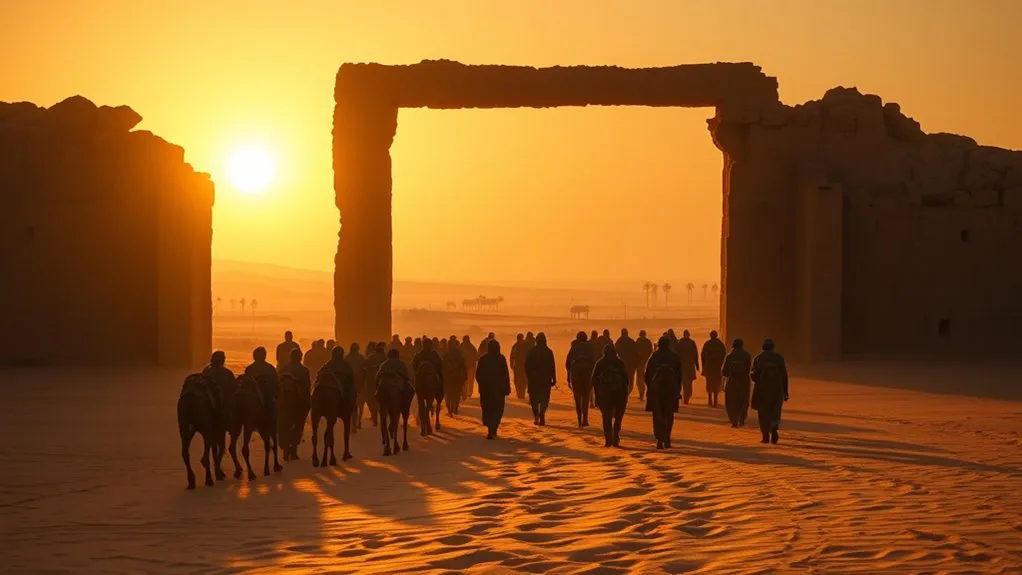
Exodus and Numbers name a sequence of stops that includes Rameses, Succoth, Etham, Pi-hahiroth, the sea, Marah, Elim, the Wilderness of Sin, Rephidim, and the Wilderness of Sinai. The sequence gives the narrative a sense of movement and progression, but most locations cannot be matched securely to modern sites.
The text also says that God guided the people with a pillar of cloud by day and a pillar of fire by night. Within the story, the route is not simply the shortest road from Egypt to Canaan. It leads the people away from Egyptian control, through tests involving food and water, and toward the covenant at Sinai.
The early journey to Sinai should not be confused with the full wilderness period. The biblical narrative describes Israel remaining in the wilderness for 40 years before the next generation approaches Canaan. That 40-year period has theological and narrative causes; it is not presented as the normal travel time between Egypt and Canaan.
Frequently Asked Questions
How many people came out of Egypt?
Exodus 12:37 reports approximately 600,000 men on foot, apart from dependents or children. It also mentions a mixed group. The Bible does not state the full population total, although a literal reading is often extrapolated to roughly 2–3 million people.
How many Israelites were counted before entering Canaan?
Numbers 26:51 gives a total of 601,730 Israelite men of military age near the end of the wilderness period. The Levites were counted separately, and the figure is not a total of every man, woman, and child.
Does the Bible say that 2 million Israelites left Egypt?
No. The Bible reports about 600,000 men and provides related military census totals. A population near 2–3 million is a modern estimate created by adding assumed numbers of women, children, older adults, Levites, and other travelers.
Does the Hebrew word eleph mean clan instead of thousand?
It can refer to a social or military grouping in some biblical contexts, but its usual numerical meaning is “thousand.” Applying the clan or unit meaning to the Exodus and Numbers censuses is a scholarly proposal, not an agreed solution.
What was Moses’s weakness?
In Exodus 4:10, Moses describes himself as slow or heavy of speech and initially doubts his ability to confront Pharaoh. Later passages also show moments of anger and frustration. The text does not provide a medical diagnosis for his speech difficulty.
How long should the journey from Egypt to Canaan have taken?
A direct ancient journey could have taken weeks rather than decades, but no precise calculation is secure because the starting point, sea crossing, route, and Mount Sinai location are disputed. The Bible’s 40-year wilderness period is explained through the story’s events and judgments, not by ordinary travel distance alone.
Conclusion
The clearest answer is that Exodus reports approximately 600,000 men leaving Egypt, while Numbers records closely related military census totals. The often-repeated figure of 2 million or more is an extrapolation from those male counts, not a total written directly in the Bible.
How the numbers should be understood remains disputed. A literal reading produces an exceptionally large population. Clan or unit interpretations reduce that population but create textual difficulties of their own. Literary and historical-core interpretations explain the figures differently but cannot establish an exact original group size. Careful readers can recognize both the importance of the Exodus in Israel’s religious identity and the limits of what the surviving historical and archaeological evidence can verify.
Sources
- Exodus 12:37–38, Sefaria — the reported 600,000 men and the mixed group leaving Egypt.
- Numbers 1:45–47, Sefaria — the 603,550 military-age men and exclusion of the Levites.
- Numbers 3:40–43, Sefaria — the count of 22,273 firstborn Israelite males.
- Counting on the Census Numbers: Mathematical Approaches to the elep in Numbers — recent analysis of attempts to reinterpret eleph in the census totals.
- The Way of the Wilderness, Cambridge University Press — difficulties identifying the Exodus itinerary and its ancient place names.
- The Torah’s Exodus, TheTorah.com — scholarly discussion of the population figures, archaeology, and historical interpretations.

