
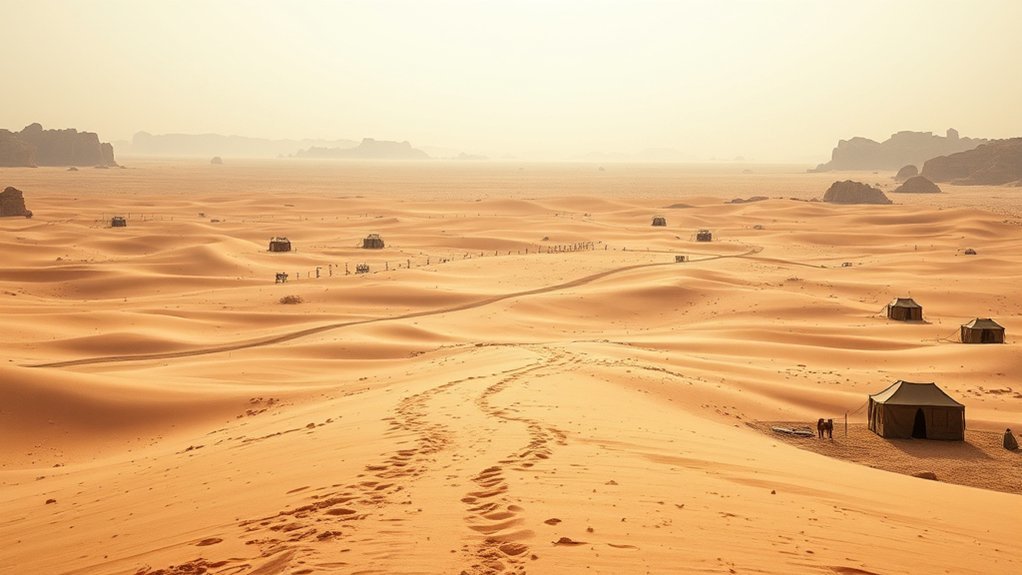
You can estimate that the Israelites walked about 776 miles, or 1,247.73 kilometers, during the 40 years in the wilderness. The route wasn’t a straight march from Egypt to Canaan; divine guidance, fear of war, and long camp stops made it slow and uneven. They traveled with portable goods, pack animals, and temporary shelter. Their journey averaged only about 15.3 kilometers a year, and the pattern reveals much more about the route and its purpose.
How Far the Israelites Walked

The Israelites’ 40-year wilderness journey covered approximately 1,247.73 kilometers, or about 776 miles, from Egypt to the Promised Land. When you map this distance, you see a long, uneven route shaped by wandering patterns rather than a straight line. They traveled about 700 kilometers from Goshen to Mount Sinai in 47 days, yet their overall average fell to roughly 15.325 kilometers, or 9.5 miles, per year. That contrast helps you grasp the scale of delay and displacement. You also notice how camps at the Wilderness of Sin and Kadesh Barnea marked stretches of waiting, where spiritual and logistical pressures tested communal endurance. These faith challenges didn’t erase motion, but they slowed liberation’s geography, turning travel into a disciplined study of survival, memory, and hope. If you’re seeking freedom, this measured journey shows that movement alone doesn’t guarantee arrival; direction, trust, and collective resilience matter too.
Why the Journey Lasted 40 Years
Because the Israelites weren’t spiritually ready for the Promised Land, their 40-year journey became a prolonged season of testing rather than a direct march to fulfillment. You can read this delay as a theological response to unbelief: Numbers 14:33-34 links their wandering to a divine judgment on a generation that refused trust. The result wasn’t mere punishment; it was formation. Over roughly 613 kilometers, the people moved slowly, averaging only about 15.325 kilometers a year, because faith challenges had to expose deeper dependence on God. In this way, the wilderness functioned as a school of spiritual growth, where your liberation required more than escape from Egypt—it demanded maturity for life in freedom. God’s longer route affirmed that readiness matters. Before you inherit promise, you must learn endurance, obedience, and collective trust.
The Route From Egypt to Canaan
From Egypt to Canaan, the distance looks deceptively short on a map—about 200 miles, or 322 kilometers as the crow flies—but Israel’s actual route was far longer and more complex. You see a path shaped not by straight lines, but by divine guidance, fear of war, and the people’s need for formation. Their first stretch from Goshen to the Red Sea, then on toward Mt. Sinai, covered roughly 500 kilometers in 25 days, showing how quickly geography can turn into history. Desert navigation here wasn’t just a matter of movement; it became a test of trust under pressure. The long way also carried spiritual lessons: freedom required more than escape from Egypt, it demanded release from enslaved thinking. Over 40 years, the route transformed a fugitive population into a covenant people. If you read it closely, you’ll see liberation often arrives through patient, disciplined, and costly passage, not instant arrival.
How the Israelites Traveled in the Desert
You can see that the Israelites traveled by a guided, stop-and-go method, moving from camp to camp across difficult desert terrain rather than following a straight, continuous route. Their pace was slow and deliberate—about 15.325 kilometers per year during the wandering years—because trials, rest periods, and communal instruction shaped each leg of the journey. You also note that divine guidance, through the pillar of cloud by day and fire by night, framed their travel as both a physical passage and a test of faith.
Desert Travel Methods
The Israelites’ desert travel was defined by slow, practical movement rather than rapid migration. You can see desert navigation as a collective discipline: people walked, carried, and camped with purpose. A pack animal, usually a donkey, hauled tools and provisions across harsh ground, reducing strain on bodies already shaped by survival.
| Method | Function |
|---|---|
| On foot | Main travel mode |
| Tents | Mobile shelter |
This arrangement let you move without fixed farms or permanent settlements. Manna and quail lessened dependence on agriculture, so travel stayed flexible and liberation didn’t stop at escape; it continued through adaptive living. Their movement wasn’t random. It was organized endurance, using portable goods, temporary shelter, and shared labor to sustain a people in motion.
Route, Pace, And Guidance
Although the Israelites moved through harsh terrain, their route followed a discernible pattern rather than a random wandering. You can trace their movement from Goshen to Mt. Sinai across about 700 kilometers in 47 days, then later through a forty-year span marked by roughly 15.325 kilometers per year. That pace reveals travel challenges: scarcity, fatigue, and the need to wait for timing beyond human control. Divine direction shaped each turn, with a pillar of cloud by day and fire by night guiding and protecting them. Their stops mattered too:
- Wilderness of Shur
- Red Sea crossing
- 8-day camp at the Red Sea
- Kadesh Barnea
- Open desert paths
You see a people learning liberation through ordered movement, not aimless drift.
How Far They Walked Each Day
On average, the Israelites covered only about 15.325 kilometers per year over their 40-year wilderness journey, so their daily progress was often slow and irregular rather than steady. If you examine their daily distances, you’ll see that movement depended on travel challenges, camp stops, and divine timing.
| Segment | Days | Avg. per day |
|---|---|---|
| Goshen to Red Sea | 25 | 20 km |
| Red Sea camp | 8 | 0 km |
| Red Sea to Sinai | 22 | 9 km |
You can read this pattern as a liberation journey shaped by constraints, not speed. Over 500 kilometers to the sea, they moved fairly briskly; after that, the pace dropped to about 9 kilometers a day on the way to Sinai. Those pauses mattered, because they reveal how hardship, formation, and collective survival governed each step.
What the 40-Year Journey Meant
Seen in context, the Israelites’ slow mileage tells only part of the story; the 40 years in the wilderness functioned as a formative season in which suffering, scarcity, and repeated testing shaped a people into a nation. You see not wasted time, but disciplined formation: God used the desert to press spiritual growth, expose unbelief, and teach faith lessons through hunger, thirst, and delay. Their route wasn’t a straight march; it was a guided path with stops, corrections, and interventions that reoriented dependence from Pharaoh to Yahweh. In that long passage, you watch slavery give way to shared identity, covenant memory, and collective resilience. The wilderness trained you to wait for liberation without surrendering hope, because promise often arrives through preparation.
- dry bread
- cracked paths
- pillar of cloud
- murmuring crowds
- a horizon of Canaan
Frequently Asked Questions
How Far Did the Israelites Travel in 40 Years?
You’d estimate the Israelites traveled roughly 775 miles, though desert wanderings and ancient routes make precision impossible. You’ll see their trek as a slow, contested path shaped by faith, survival, and liberation, not just distance.
Who Has the Closest DNA to Israelites?
Ironically, you’ll find no single “closest” group; Genetic Studies point to Ashkenazi, Sephardic, Mizrahi Jews, Druze, and Palestinians sharing strong Historical Lineage, Cultural Heritage, and Ancestral Connections with ancient Israelites.
Which Prophet Was Black in the Bible?
You can’t name one definitively black prophet, because Scripture rarely states skin color. Yet you’ll find Black prophets discussions around Zephaniah’s Cushite lineage, Moses’ Cushite marriage, and Ethiopian figures, showing Biblical ethnicity’s diverse, liberated reality.
What Was China Called in Biblical Times?
You’ll often see China associated with “Sinim” in biblical names, though ancient geography doesn’t confirm a single exact label. You should treat it as a debated, distant eastern land, not a fixed modern nation.
Conclusion
As you trace the Israelites’ 40-year trek, you see more than miles: you see a journey shaped by delay, discipline, and unexpected mercy. By coincidence, the very desert that seemed to block their promise also became the place where they learned how to live by it. You may measure the route from Egypt to Canaan, but you can’t measure its meaning so easily. In the end, their wandering shows you that distance can refine faith.