

Last Updated on July 29, 2026 by Ethan Caldwell
Biblical writers often measured long distances by travel time rather than exact miles. That makes a day’s journey useful but imprecise. The phrase can describe a normal day of travel, a group’s progress, or the reach of an area, so the safest answer is a practical range—not one fixed conversion.
Quick Answer
A “day’s journey” in the Bible is a flexible travel expression, not a fixed unit. For an ordinary traveler, roughly 15–25 miles (24–40 km) is a useful estimate, but terrain, baggage, weather, group size, and purpose could change it. Deuteronomy 1:2 gives eleven days from Horeb to Kadesh-barnea without stating miles.
Key Takeaways
- A biblical day’s journey was a time-based estimate, not a standardized unit of distance.
- About 15–25 miles is a reasonable working range for ordinary travel, but some people and groups covered less or more.
- Deuteronomy states that Horeb to Kadesh-barnea was an eleven-day journey; it does not give a mileage figure.
- Numbers connects the forty years in the wilderness to Israel’s unfaithfulness after the spies’ forty-day mission, not to eleven days of nonstop walking.
Disclosure: As an Amazon Associate I earn from qualifying purchases. Some links on this page are affiliate links, at no extra cost to you.
What Is a Day’s Journey in the Bible?
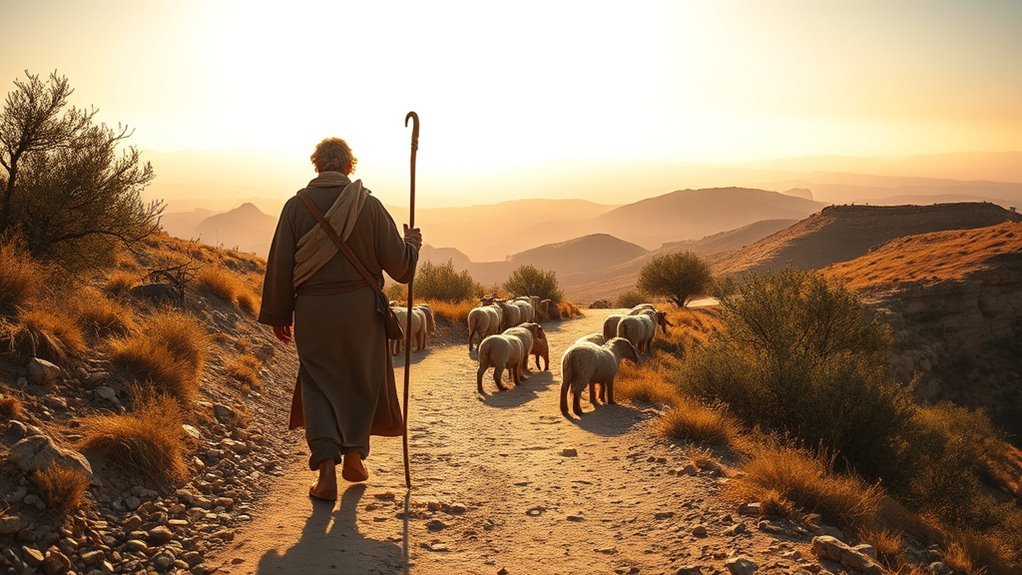
In biblical and other ancient writing, a “day’s journey” meant the distance a person or group could reasonably cover during a day. It was closer to saying “a full day on the road” than naming a fixed number of miles.
The distance changed with the traveler, route, season, weather, load, daylight, and purpose. A lightly equipped messenger on a known road could move farther than a family group, caravan, army, or community traveling with animals and supplies.
The Bible uses the phrase without supplying a universal conversion. In 1 Kings 19:4, Elijah goes a day’s journey into the wilderness, but the passage gives no mileage. In Numbers 11:31, a day’s journey describes how far the quail extended around the camp, not how far one person walked on a road.
Treat “a day’s journey” as a human travel estimate, not a hidden miles-to-days conversion formula.
Note: An ordinary day’s journey is not the same as a Sabbath day’s journey. The latter was a limited Sabbath travel distance; the footnote to Acts 1:12 gives about five-eighths of a mile, or roughly 1 kilometer.
How Far Was the Sinai to Kadesh Journey?
Deuteronomy 1:2 says the journey from Horeb to Kadesh-barnea by the Mount Seir road took eleven days. That time statement is clear. The exact mileage is not.
A figure such as 165 miles can be used only as a modern route estimate based on selected locations and a reconstructed path. It should not be presented as a number supplied by Scripture. The location of Horeb is uncertain, while Kadesh-barnea is commonly associated with an oasis south of Canaan. Different identifications and routes produce different totals.
| Claim | What the evidence supports |
|---|---|
| Horeb to Kadesh-barnea | An eleven-day journey by the Mount Seir road |
| Exact mileage | Not stated in the biblical text |
| 165 miles and 15 miles per day | A derived modern estimate, not a fixed biblical measurement |
| Forty years | The period of wilderness judgment associated with the spies’ forty days and Israel’s unfaithfulness |
Eleven-Day Route Length
The strongest statement is also the simplest: the route normally took eleven days. Dividing a proposed 165-mile route by eleven produces 15 miles per day, but that calculation depends entirely on accepting the proposed mileage first.
The eleven-day note shows that Horeb and Kadesh-barnea were connected by a known travel route in the writer’s geographic frame. It does not prove that every traveler moved at the same speed, nor does it settle the modern debate over the locations of Sinai/Horeb and the exact Mount Seir road.
Pro Tip: When mapping this journey, label the mileage as an estimate based on a chosen site and route. Keep Deuteronomy’s eleven-day statement separate from modern map calculations.
Forty-Year Wilderness Delay
The forty years were not simply eleven travel days stretched into one continuous forty-year walk. Numbers 10–14 describes Israel leaving Sinai, traveling in stages, facing several crises, sending spies into Canaan for forty days, rejecting the favorable report of Joshua and Caleb, and then receiving judgment.
Numbers 14:33–34 links the forty years to the forty days spent exploring the land—one year for each day. The article’s earlier claim that the Sinai-to-Kadesh trip itself took “nearly three months” is not stated in the text. Numbers gives a departure date from Sinai, but it does not give an exact arrival date at Kadesh that supports that total.
In the narrative’s theological frame, the deeper cause of the long wilderness period is Israel’s unfaithfulness and refusal to enter the land. The spies’ mission took forty days; waiting for them was part of the sequence, but it was not the sole cause of the forty-year judgment.
Why the Eleven-Day Trip Became Forty Years
The phrase “an eleven-day trip became forty years” is a memorable summary, but it needs careful wording. Deuteronomy contrasts an ordinary eleven-day route with Moses speaking in the fortieth year. Numbers explains that the wilderness judgment followed the people’s rebellion after the spies returned.
At Kadesh-barnea, Israel stood near the southern approach to Canaan. Fear, distrust, and rebellion shaped the decision not to enter. The forty-year period allowed the unbelieving generation to pass away before the next generation entered the land.
For readers approaching the passage devotionally, the story can illustrate how fear and disobedience delay faithful action. That application should be presented as a spiritual reading of the narrative, not as a replacement for the text’s geography and chronology.
Warning: Do not turn the eleven days and forty years into a universal promise that every personal delay is caused by unbelief. The passage addresses Israel’s specific covenant story; personal application requires humility and context.
Biblical Day’s Journey Distances
A normal day’s travel in the ancient world is often estimated within a broad range of roughly 15–25 miles. That range helps readers picture the scale, but each passage must still be read on its own terms.
| Example | What it tells us | What it does not tell us |
|---|---|---|
| Deuteronomy 1:2 | Horeb to Kadesh-barnea was eleven days by a named route | The route’s exact modern mileage |
| Judges 19:9–15 | A small party left Bethlehem late and reached Gibeah before night | A stated distance of 10 or 24 miles; those are map-based estimates |
| 1 Kings 19:4 | Elijah traveled one day into the wilderness | A precise mileage |
| Numbers 11:31 | The quail extended about a day’s journey around the camp | A standard walking distance for every traveler |
| Acts 1:12 | A Sabbath day’s journey was a limited distance of about 1 kilometer | The length of an ordinary travel day |
Judges 19 is especially useful as a caution. The text says the group left Bethlehem late, passed near Jebus, and reached Gibeah. It does not give a mileage total. Estimates depend on how the ancient sites are identified and which path is mapped.
How Far Ancient Travelers Traveled
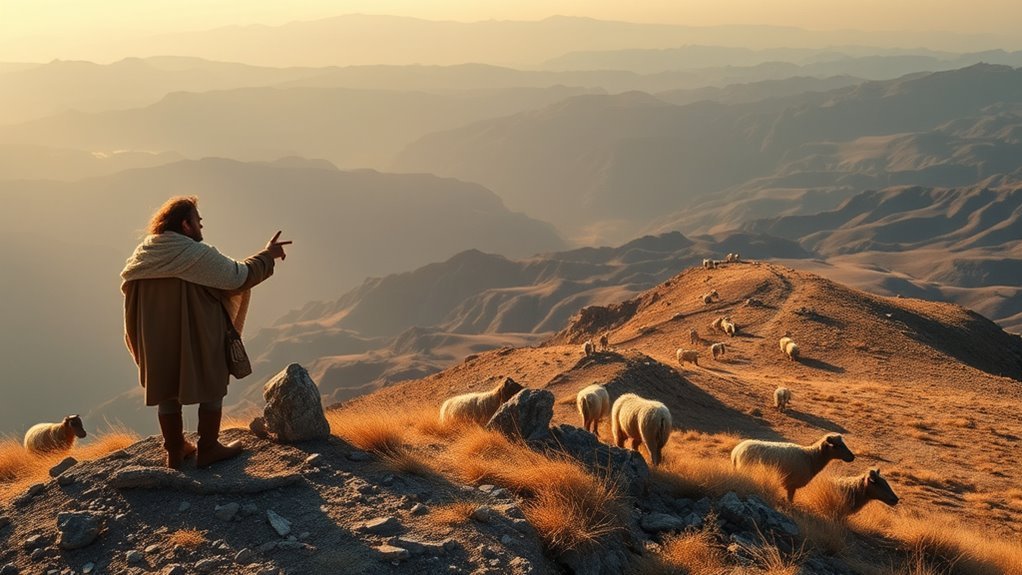
Ancient travelers could often cover substantial ground, but daily distance varied widely. Good roads, long daylight, light baggage, and urgency increased the range. Hills, loose ground, heat, illness, large groups, animals, carts, and the need to find water reduced it.
A scholarly review of distance language in Herodotus found that he often worked with about 150–200 stades for a normal day, roughly 27–40 kilometers or 17–25 miles, while also recording much lower and much higher cases. The study’s main point is that a day’s journey was a flexible rule of thumb rather than a strict unit. See the Max Planck Institute paper on a day’s journey in Herodotus.
Ancient Day’s Journey
For ordinary reading, 20–25 miles can represent a strong day by a healthy, lightly burdened traveler under workable conditions. A broader 15–25-mile range is safer when the traveler, route, and load are unknown.
| Factor | Likely effect on daily distance |
|---|---|
| Rough, steep, or sandy ground | Slower progress and more rest |
| Open road and known water sources | Longer, steadier travel |
| Heavy baggage, carts, children, or livestock | The group moves at the pace of its slowest needs |
| Courier, runner, or emergency travel | Exceptional distances that should not define the normal range |
A quoted animal speed, such as a mule moving near 3 mph, is not enough to calculate a day’s journey. Net travel distance also depends on loading, rest, feeding, water, terrain, and the pace of the whole party.
Daily Travel Distances
Daily distance was practical, not theoretical. Travelers had to reach water, shelter, a settlement, or a safe camp before dark. The route could therefore end earlier than the body’s absolute walking limit.
This is why ancient texts may use the same phrase for different distances. “A day’s journey” communicates the scale of effort and time. It does not promise survey-level precision.
How to Estimate a Biblical Journey Responsibly
- Start with the wording of the passage. Record whether it gives days, a named route, landmarks, or a fixed unit such as cubits or stadia.
- Identify the travelers. A lone messenger, a family, an army, and a large camp do not move at the same pace.
- Check whether the sites are certain. Proposed locations for places such as Horeb can change the route by many miles.
- Use a range rather than a single number. For an ordinary day, 15–25 miles is often more honest than declaring one exact figure.
- Label modern calculations clearly. Say “estimated from this proposed route,” not “the Bible says,” when Scripture gives no mileage.
Pro Tip: Separate three layers in your notes: what the text states, what geography suggests, and what spiritual meaning you draw from it. This prevents an estimate or devotional point from being mistaken for a biblical fact.
What This Journey Teaches Us

The journey from Horeb to Kadesh-barnea shows that distance alone does not explain progress. The route could be described in days, yet Israel’s larger story unfolded over decades because of decisions made at the border of Canaan.
In the biblical narrative, the central issue is not walking speed. It is trust, obedience, leadership, communal fear, and the consequences of rejecting the land after the spies returned.
A devotional reading may ask where fear is delaying a faithful next step. It should also remember that the passage describes a whole community under a particular covenant, not a formula for judging every setback in a modern person’s life.
The geographic lesson is equally valuable: ancient travel terms work best as ranges. The spiritual lesson is that movement and faithfulness are not always the same thing. A person can cover miles without moving toward the right goal.
Frequently Asked Questions
How many miles was a day’s journey in the Bible?
There was no fixed biblical conversion. Roughly 15–25 miles is a useful estimate for ordinary travel, with about 17–25 miles supported by common day-journey figures in Herodotus. Real distance varied with terrain, weather, baggage, group size, daylight, and urgency.
Is a day’s journey the same as a Sabbath day’s journey?
No. An ordinary day’s journey describes practical travel over a day. A Sabbath day’s journey was a limited Sabbath travel distance. Acts 1:12 places the Mount of Olives within that limit, commonly given as about five-eighths of a mile or 1 kilometer.
Was Horeb to Kadesh-barnea exactly 165 miles?
The Bible does not say so. Deuteronomy 1:2 gives an eleven-day journey by the Mount Seir road. A 165-mile figure is a modern estimate based on particular site identifications and a reconstructed route, so it should be labeled as approximate.
How many miles did Mary and Joseph travel to Bethlehem?
The trip from Nazareth to Bethlehem is often estimated at roughly 70–90 miles, depending on the proposed route. Luke 2:1–5 names the starting point, destination, and census, but it does not state the distance, route, number of travel days, or whether Mary rode an animal.
What do the 1,290 days mean in Daniel?
Daniel 12:11–13 places 1,290 days between the ending of the regular sacrifice and the setting up of the abomination that causes desolation. Historical, futurist, and symbolic interpretations explain the period differently, so the verse should not be reduced to one undisputed timeline.
Must a third temple be built before the Rapture?
The New Testament does not give an explicit sentence saying that a third temple must be built before believers are “caught up.” 1 Thessalonians 4:16–17 describes believers meeting the Lord, while different end-times systems arrange temple passages and that event in different ways. The answer depends on the theological framework being used.
Which disciple was said to have been boiled alive?
A later Christian tradition says the apostle John was plunged into boiling oil and survived before being exiled to an island. This story is not recorded in the Bible. It appears in Tertullian’s Prescription Against Heretics, chapter 36, so it is more accurate to call it an early church tradition than a proven historical event.
Conclusion
A biblical “day’s journey” was a practical measure shaped by the traveler and the road, not a fixed mileage. A range of about 15–25 miles helps readers picture ordinary ancient travel, while 17–25 miles matches common figures discussed in Herodotus. The Bible itself must remain the starting point: Deuteronomy gives eleven days from Horeb to Kadesh-barnea, not 165 miles.
The forty years in the wilderness belong to the larger story of the spies, Israel’s unfaithfulness, and divine judgment. They should not be described as a simple eleven-day walk that physically took forty years. The familiar saying that a thousand-mile journey begins with one step can be a useful modern proverb, but it is not a Bible verse. Read the geography with careful estimates and the spiritual message with equal care.
Sources
- Deuteronomy 1:2 — the eleven-day journey from Horeb to Kadesh-barnea by the Mount Seir road.
- Numbers 10:11–14:35 — departure from Sinai, the spies’ mission, Israel’s rebellion, and the forty-year judgment.
- Max Planck Institute for the History of Science: “A Day’s Journey in Herodotus’ Histories” — ancient day-journey ranges and their variability.
- Bible Odyssey: Kadesh and Bible Odyssey: Horeb — geographic context and location cautions.
- Luke 2:1–5; Daniel 12:11–13; 1 Thessalonians 4:16–17 — the FAQ’s biblical texts.
- Tertullian, Prescription Against Heretics, chapter 36 — the early tradition about John and boiling oil.
