

Last Updated on July 24, 2026 by Ethan Caldwell
A hotel room for four people is commonly described as a quad room, quadruple room, family room, or a room or suite that lists a maximum occupancy of four. The name alone does not guarantee a particular bed setup, so check both the occupancy limit and the sleeping arrangements before booking.
Quick Answer
A hotel room for four guests is often called a quad or quadruple room. It may contain two queen beds, two double beds, a king bed with a sofa bed, or another approved setup. Always enter all four guests and confirm the room’s maximum occupancy, bed types, child policy, and extra-person fees.
Key Takeaways
- A quad or quadruple room normally means the room can accommodate four registered guests, not that it contains four separate beds.
- Family room and suite layouts are defined by each property, so compare the actual bed description and floor plan.
- Enter every adult and child when searching because capacity, prices, breakfast charges, and available room types can change.
- A rollaway, cot, or sofa bed does not increase the permitted occupancy unless the hotel approves it.
- Confirm the final price, taxes, extra-person charges, cancellation terms, and room setup before paying.
Disclosure: As an Amazon Associate I earn from qualifying purchases. Some links on this page are affiliate links, at no extra cost to you.
What Does Four Guests Per Room Mean?
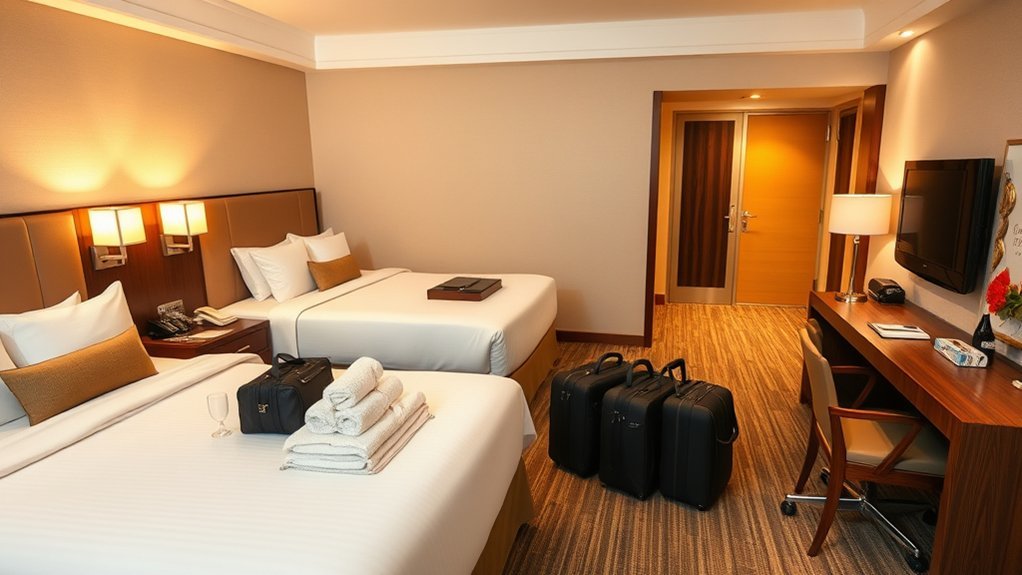
“Four guests per room” means the hotel lists that room type as suitable for a maximum of four registered occupants under the selected booking conditions. The four guests might be four adults, two adults and two children, or another permitted combination.
The exact combination matters. Some hotels have separate adult and child limits, age-based child policies, or rules about children sharing existing beds. Booking platforms may also calculate capacity and pricing differently for adults and children. For an accurate search, enter the number and ages of all travelers rather than searching for two people and adding the others later.
A four-person occupancy limit does not tell you how many individual sleeping surfaces are provided. One room might have two queen beds, while another has one king bed and a double sofa bed. A family suite could have a bedroom and a separate living area, and another property might use the term “quad room” for four single beds.
Note: The hotel’s listed maximum occupancy controls the number of guests. The presence of a large bed, sofa, floor space, or portable mattress does not automatically authorize another occupant.
The room name is only a label. The published maximum occupancy and confirmed bed setup are the details that matter.
What Are the Rules for Four-Person Rooms?
Rules for a four-person hotel room vary by property, room type, and local requirements. A hotel may limit occupancy because of the room’s size, approved layout, available exits, fire-safety requirements, licensing conditions, or its own guest policies.
Check the following rules before arrival:
- Maximum occupancy: The reservation should clearly permit four people in the selected room.
- Registered guests: The hotel may require the names and identification details of all adult occupants.
- Children and infants: Some properties include children in the total capacity, while others permit a limited number of children in addition to the adult occupancy.
- Existing-bed policies: A child may be allowed to stay free only when sharing an existing bed with an adult.
- Cots and rollaways: These are subject to room size, availability, age restrictions, and the hotel’s approved occupancy.
- Visitors: A daytime visitor may not be permitted to stay overnight without being registered and added to the booking.
- Extra-person charges: The room may allow four people but charge more for the third or fourth adult.
Warning: Do not hide the true number of guests. Undeclared occupants can create safety and registration problems and may lead to extra charges, a required room change, cancellation, or removal under the hotel’s policy.
Occupancy policies are property-specific. For example, official hotel pages can list different maximum capacities for different properties and room categories, even within the same brand. Entering all travelers during the initial search is the safest way to see rooms that the hotel actually permits you to book.
Which Hotel Room Types Fit Four Guests?
Several hotel room types can work for four people. Compare the actual bed setup, usable space, bathroom access, and privacy rather than relying only on the room name.
| Room Type | Common Setup | Best For | What to Confirm |
|---|---|---|---|
| Quad or Quadruple Room | Two larger beds, four single beds, or another four-person setup | Travelers who want one room | Exact bed types and whether four adults are permitted |
| Two-Queen Room | Two queen beds | Two couples or a family | Maximum occupancy and whether the beds are queens or smaller doubles |
| Family Room | Multiple beds, bunks, a sofa bed, or divided sleeping areas | Parents traveling with children | Adult and child limits because “family room” is not a universal layout |
| Suite With Sofa Bed | One bedroom or sleeping area plus a pull-out sofa | Groups wanting more living space | Sofa-bed size, room separation, linens, and occupancy |
| Connecting Rooms | Two rooms joined by an interior door | Families or friends needing privacy and two bathrooms | Whether the connection is confirmed rather than merely requested |
| Triple Room With Extra Bed | Three permanent sleeping places plus an approved rollaway | Short stays when space is less important | That occupancy is four and a rollaway is allowed in that room |
Do Four Guests Need Four Beds?
No. A room for four means the approved occupancy is four people. It does not necessarily provide four separate beds.
Four guests may share:
- Two queen beds.
- Two double beds, if the room permits four adults.
- One king bed and one double sofa bed.
- One queen bed, bunk beds, or another family-oriented arrangement.
- Four single beds in a true quadruple layout.
Read the bed description carefully. “Sleeps four” may require two people to share each bed, and a sofa bed may be narrower or less comfortable than a standard mattress. If nobody in your party wants to share, search specifically for four separate sleeping places or reserve two rooms.
Guests with mobility needs should also verify accessible features directly with the property. An accessible room’s capacity, transfer space, bathroom layout, and available rollaway options may differ from those of a standard room.
Connecting Rooms Versus Adjoining Rooms
Connecting rooms have an interior door between the rooms. Adjoining rooms may be beside or near each other without an internal connecting door. Booking sites and hotel staff sometimes use the terms loosely, so describe what you need instead of relying on the label.
Connecting rooms can be a good choice for four travelers because they provide more privacy, two bathrooms, and separate sleeping areas. However, a request for connecting rooms is not always a guarantee. Ask whether the hotel can confirm the connection in writing or whether it will assign the rooms only when you check in.
Pro Tip: When connecting rooms are essential, call the hotel after booking and ask whether the connection is confirmed or only noted as a preference. Record the name of the staff member and check your written confirmation.
How Do Hotels Price Four Guests Per Room?

Hotels do not use one universal pricing method for four guests. A room can be priced per room, by occupancy, or through a combination of a base rate and extra-person charges.
Booking.com’s current accommodation documentation distinguishes standard pricing, where the listed amount applies to the room up to a defined occupancy, from occupancy-based pricing, where the rate can change according to the number of adults.
Your total may include:
- Base room rate: The amount charged for the room under the stated occupancy conditions.
- Extra-person fee: An added charge for the third or fourth adult.
- Child or breakfast charge: Children may stay free in existing beds but still require paid meals.
- Rollaway or cot fee: A separate nightly charge may apply when the equipment is available.
- Taxes and mandatory fees: These may be added during checkout or collected at the hotel.
- Parking or destination fees: These may apply regardless of how many people occupy the room.
- Security or incidental hold: A temporary card authorization may cover possible hotel purchases or damage. It is different from an extra-person fee.
Rates can also change with dates, demand, cancellation flexibility, meal plans, and minimum-stay rules. Compare the final checkout total rather than only the first nightly price shown in search results.
How Do You Book a Four-Person Room?
Booking a hotel room for four normally takes only a few minutes, but you should verify more than the room name.
At a Glance
| Time Required | About 5 to 15 minutes, plus time to call the hotel when confirmation is needed |
| Difficulty | Easy |
| Tools Needed | Hotel or booking website, guest ages, payment method, and the hotel’s contact details |
| Cost | Varies by destination, dates, room type, guest count, taxes, and included services |
- Enter the correct party size. Include all adults and children and provide children’s ages when requested.
- Filter for one room that sleeps four. Do not assume a result shown for two guests also permits four.
- Read the maximum-occupancy line. Confirm that the room accepts your exact mix of adults and children.
- Check every bed type. Look for two queen beds, two double beds, a sofa bed, bunks, or separate single beds according to your needs.
- Review extra-bed rules. Verify the availability and price of rollaways or cots and whether they fit in the selected room.
- Compare the full price. Review taxes, breakfast, extra-person fees, parking, destination fees, deposits, and cancellation terms.
- Contact the hotel when a feature is essential. Confirm connecting rooms, accessibility features, bed arrangements, late arrival, or another non-negotiable requirement.
- Save the confirmation. Keep a copy showing four registered guests, the room category, dates, rate conditions, and any confirmed requests.
A guaranteed reservation usually means the hotel agrees to hold the booked category under the guarantee terms, often in exchange for payment details or a deposit. It does not always guarantee a specific room number, floor, view, or optional preference. HM Revenue & Customs’ hotel-reservation guidance similarly distinguishes a guaranteed reservation from a guarantee of one particular numbered room.
What Should You Confirm Before Paying?
Review this checklist before completing the reservation:
- The room allows four registered guests.
- The adult and child limits match your group.
- The listed beds are suitable for everyone.
- Any sofa bed, rollaway, or cot is included or confirmed.
- Connecting rooms are confirmed if they are essential.
- Breakfast is included for all four guests, not only two.
- The total includes or clearly identifies taxes and mandatory fees.
- You understand the deposit, card hold, payment, and cancellation rules.
- The hotel knows about accessibility or mobility requirements.
- Your confirmation displays the correct guest count and room category.
Frequently Asked Questions
What is a four-occupancy hotel room called?
It is commonly called a quad room or quadruple room. A hotel may instead advertise it as a family room, two-queen room, studio, or suite. Check the stated maximum occupancy because room names and layouts vary among properties.
Does a room for four always have four beds?
No. It may have two beds shared by two people each, one main bed and a sofa bed, bunk beds, or four separate single beds. Review the exact bedding description before booking.
Can four adults stay in a room with two double beds?
They can only do so when the hotel lists the room’s maximum adult occupancy as four. Two beds do not automatically authorize four adults, and bed sizes described as “double” can vary by property and country.
Do babies and children count toward hotel-room occupancy?
Often they do, but hotel and booking-system rules vary. Some rooms permit children in addition to the adult capacity, while others count every person toward the total. Enter each child and the child’s age during the search.
Are connecting rooms guaranteed?
Not always. Some hotels sell a confirmed connecting-room category or package, while others treat it as a request based on availability. Ask the property whether the connection is guaranteed and obtain written confirmation when it is essential.
What does IPO stand for in hotels?
In hotel sales, group, and events terminology, IPO commonly means “Individual Pays Own.” It indicates that each attendee is responsible for paying their own room or related charges rather than having all charges billed to a group master account. The acronym can mean something different in finance or another industry.
What does GTD mean in a hotel?
GTD generally means “guaranteed,” but its exact use depends on context. For a reservation, it can indicate that payment details or another guarantee method secures the booking. In meetings and events, it can refer to the guaranteed number of attendees or meals the organizer commits to paying for.
What is the hotel 15/5 rule?
The 15/5 rule is a guest-service training guideline used by some hotels. Staff acknowledge a guest with eye contact, a smile, or another friendly gesture at about 15 feet and offer a verbal greeting at about 5 feet. It is not an occupancy rule or a law, and the exact standard can vary by company.
Conclusion
A hotel room for four people is often called a quad or quadruple room, but family rooms, two-queen rooms, suites, and connecting rooms can also work. The most important details are the room’s published maximum occupancy, the exact bed arrangement, and the final price for your full party.
Enter every traveler when searching, including children and their ages. Before paying, confirm any extra-person fees, meal coverage, rollaways, connecting-room requests, accessibility needs, and cancellation terms. A few minutes of checking can prevent an uncomfortable bed arrangement, an unexpected charge, or a room that the hotel cannot legally or safely assign to all four guests.
Sources
- Booking.com Rates and Availability Documentation — room capacity, standard pricing, and occupancy-based pricing.
- Hyatt Reservation Frequently Asked Questions — room preferences and reservation guarantees.
- HM Revenue & Customs Hotel Reservation Guidance — guaranteed bookings and what a reservation guarantee covers.
- Agilysys Hotel Abbreviations Guide — IPO, GTD, MLOS, and other industry terminology.
- Hotel Online: The 15/5 Guest-Service Rule — documented use of the 15/5 guideline in hotel service training.
- Bangladesh Hotels and Restaurants Ordinance — an official example of room-occupancy limits being regulated and displayed.

