
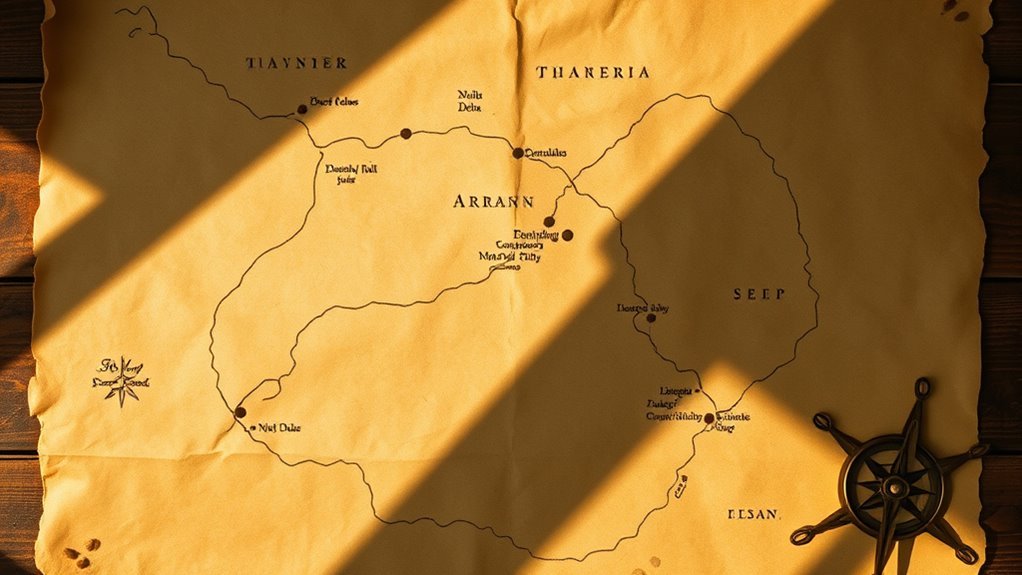
You can trace the Egypt to Canaan route from Rameses to Succoth, Pi-hahiroth, the Red Sea, Elim, the Wilderness of Sin, and on to Kadesh-barnea before Israel entered Canaan through the Jordan. The trek covered a slow, stop-and-go wilderness path, with about 89 miles from Kadesh-barnea to Sinai and roughly 7.6 miles a day on foot. Along the way, you see rescue, provision, testing, and promise, and the route map gets even clearer ahead.
What Route Did the Exodus Take?

The Exodus route began at Rameses, where the Israelites left Egypt and moved toward Succoth before turning to Pi-hahiroth, the place where they crossed the Red Sea.
You can picture the journey as a hard-won escape, shaped by Exodus challenges and bold faith. The Nile marked Egypt’s edge, while the Sinai Wilderness stretched ahead like a harsh, testing corridor.
A hard-won escape, shaped by challenge and bold faith, led into the harsh testing corridor of the Sinai Wilderness.
From there, the path bent between the Gulf of Suez and the Gulf of Aqaba, showing the route’s geographical significance. You’d travel through dry, rugged ground, where each mile demanded endurance and hope.
The journey from Rameses to the Wilderness of Sin took about 31 days, and the full trek reached roughly 60 days before Mount Sinai.
Each turn carried you farther from oppression and closer to freedom, reminding you that liberation often moves through desert spaces before it reaches promise.
Key Stops on the Egypt to Canaan Route
Along the Egypt to Canaan route, a handful of stops stand out as turning points in the story of the Exodus. At Succoth, you witness the first break from bondage, and its Succoth significance lies in that bold step into freedom.
Near Pi-hahiroth, the path narrows beside the sea, reminding you that liberation often demands faith before rescue.
At Elim, you taste Elim refreshment: twelve springs and shade after harsh travel, a mercy for weary feet.
In the wilderness of Sin, you see Wilderness provision as manna and quail fall from heaven, proving you won’t walk alone.
Kadesh-barnea carries Kadesh barnea importance as a long-term camp and launch point for scouting the land ahead.
Finally, Mt. Nebo view gives you Moses’ last look toward promise, a quiet summit where hope meets history.
How Far Was Kadesh-Barnea From Sinai?
From Kadesh-barnea to Mount Sinai, you’re looking at roughly 89 miles of desert ground, a stretch that the Israelites likely covered at about 7.6 miles a day.
That pace means the journey would’ve taken several days, especially with rest, camps, and the weight of wilderness events along the way.
The distance fits the biblical timeline and helps you see how this route marked a long season of wandering and testing.
Kadesh-Barnea To Sinai
About 89 miles separate Kadesh-barnea from Mount Sinai, a distance that helps explain why the Israelites needed roughly 29 days to make the journey on foot. You can picture a liberated people moving across harsh desert ground, carrying hope, memory, and shared purpose.
At Kadesh-barnea, the main camp gave the nation a place to gather, wait, and prepare for the next stage. That Kadesh barnea significance lies in its role as a threshold, where wandering turned toward promise.
The route to Sinai wasn’t just a march; it was a sacred passage toward the Sinai covenant. You’d see the pace slow enough for rest and key events, yet steady enough to move an entire people toward freedom and covenant destiny.
Journey Distance Estimates
Roughly 89 miles separated Kadesh-barnea from Mount Sinai, which means the Israelites would have averaged only about 7.6 miles a day on foot. You can picture a slow, determined march across scorched ridges and stony flats, where journey pacing mattered more than speed.
With distance accuracy, the route shows liberation wasn’t rushed; it unfolded step by step.
- From Rameses to the Wilderness of Sin, you track about 31 days.
- From the Wilderness of Sin to Sinai, you add roughly 29 more days.
- Across the whole Exodus, you allow about 60 days, including stops.
These estimates help you see the terrain, the hardship, and the steady movement toward freedom and the Promised Land.
What Happened During the Wilderness Wanderings?
After leaving Rameses, the Israelites entered a long season of testing in the wilderness, where God met their needs even as their faith wavered. You see wilderness challenges everywhere: bitter water at Marah, hunger in the Wilderness of Sin, fear at Rephidim, and the crushing delay after Canaan scared them. Yet divine provision kept breaking through, from manna and quail to healed waters and victory over Amalek. In Sinai, God also gave the Tabernacle, so His presence could dwell among a liberated people.
| Event | Meaning |
|---|---|
| Marah | God can sweeten what’s bitter |
| Manna and quail | Daily care meets daily need |
| Amalek battle | Freedom requires steady faith |
| Tabernacle | Liberation includes God’s presence |
When you follow this route, you don’t just trace miles; you trace discipline, mercy, and hope. The 40-year wandering taught you that rescue isn’t the end—it’s the making of a people ready to live free in God’s way.
Why Does the Red Sea Crossing Matter?
The Red Sea crossing matters because it marks the moment when God turned a trapped, enslaved people into a liberated one, making a way where no way seemed possible.
You see divine power split the waters, shield the Hebrews, and overturn Egypt’s pursuit, so fear didn’t get the final word.
This story carries deep faith significance: it teaches you that trust can meet danger and still move forward. It also holds powerful liberation symbolism, showing your path from bondage to freedom can begin in one impossible step.
In Jewish tradition, you remember it at Passover, and Christians read it as a sign of rescue and hope.
- You picture waters standing like walls.
- You feel the army’s threat fading behind you.
- You step toward the Promised Land with courage.
What Are the Main Exodus Route Theories?
With the crossing behind you, the next question is where Israel likely traveled across the wilderness. You’ll usually meet two main Exodus route theories.
The southern route moves through the Sinai Peninsula toward Jabal Musa, tracing a harsh, rugged corridor of rock, wadis, and wide silence. The northern route runs nearer the Mediterranean coast, bending toward Jabal Halal and suggesting a faster path through flatter country.
Two routes emerge: the rugged Sinai path southward, or the flatter coastal road toward Jabal Halal.
Scholars weigh these options by distance: Kadesh-barnea to Mount Sinai should be close to 89 miles if the journey averaged about 7.6 miles a day. That fits the 11-day travel hint in Deuteronomy and keeps the path believable for a people seeking freedom, not fantasy.
Some researchers also place the Red Sea crossing among lakes and marshlands near the Suez Canal. Archaeology and ancient texts keep the debate alive, so you’re left with serious, competing maps.
How Did Israel Enter Canaan?
At last, Israel crossed the Jordan River on dry ground and stepped into Canaan after forty years in the wilderness, a passage marked by divine power and solemn purpose (Josh. 3:1–5:1). You can picture the Jordan crossing as a threshold from bondage to promise, where God opened the way and led His people forward.
At this Canaan entrance, they raised stones at Gilgal, turning memory into testimony and hope into history (Josh. 4:20–24).
- You see the riverbed dry beneath their feet.
- You remember Jericho’s walls falling by God’s hand.
- You watch the land divided among the tribes as promised.
The first city, Jericho, fell under divine intervention, proving that liberation doesn’t depend on strength alone (Josh. 6).
God commanded the nations’ removal and fulfilled His promise to Abraham, giving Israel its inheritance with justice and purpose (Deut. 7:1; Num. 33:50–56).
Frequently Asked Questions
How Many Miles Did Mary and Joseph Have to Travel to Reach Bethlehem?
They had to travel about 70 to 90 miles to reach Bethlehem. You can envision this Bethlehem journey along Historical routes, over hills and valleys, likely taking several exhausting days on foot or donkey.
Conclusion
As you trace the Egypt to Canaan route, you see more than a map—you follow a journey shaped by faith, hardship, and purpose. From the Red Sea crossing to the long wilderness wanderings, every stop adds another layer to the story. Whether you picture Sinai, Kadesh-Barnea, or the path into Canaan, it all comes full circle, showing how history, geography, and belief can fit together like pieces of a well-worn puzzle.