

Last Updated on September 11, 2026 by Daniel Globe
Renting a car in Athens can make trips to Nafplio, Cape Sounion, Corinth, and other mainland destinations much easier. Inside central Athens, however, traffic restrictions, limited parking, narrow streets, and strong public transport can make a car inconvenient. Compare the complete rental cost, confirm your licence requirements, and learn the current driving rules before booking.
Quick Answer
Renting a car in Athens is most useful for trips outside the city. Compare the total price, including insurance and deposit terms, confirm whether your licence requires an International Driving Permit, and choose a compact car. Avoid unnecessary central driving, follow current parking and Daktulos rules, and document the car’s condition at pickup and return.
Key Takeaways
- Consider collecting the car on the day you leave Athens rather than keeping it while sightseeing in the city center.
- Compare the complete payable amount, not only the advertised daily rate.
- An International Driving Permit is not required for every licence, so check the rules for your issuing country and rental company.
- Greece’s default urban speed limit changed to 30 km/h in 2026, although some divided and multi-lane urban roads may allow 50 km/h.
- Check seasonal Daktulos restrictions, parking-zone markings, tolls, ferry permission, and insurance exclusions before driving.
At a Glance
| Time Required | About 20–40 minutes to compare and book, plus 15–30 minutes for pickup and inspection |
| Difficulty | Easy to book; moderate to drive and park in central Athens |
| Tools Needed | Valid driving licence, passport or accepted ID, accepted payment card, booking confirmation, navigation app, and an IDP when required |
| Cost | Varies by season, vehicle, pickup location, insurance, deposit, fuel, parking, and tolls |
Disclosure: As an Amazon Associate I earn from qualifying purchases. Some links on this page are affiliate links, at no extra cost to you.
How to Book a Rental Car in Athens

Start by deciding when you actually need the car. Athens has an extensive metro, tram, bus, and taxi network, while driving and parking in the center can be demanding. If your first few days are focused on the Acropolis, Plaka, Monastiraki, museums, and other central sights, collecting the car when you leave the city may save parking fees and reduce stress.
- Choose your pickup location. Compare Athens International Airport with a downtown office. Airport pickup is convenient for an immediate road trip, while a city office may suit travelers who will explore Athens first.
- Compare the total price. Review taxes, location fees, insurance, deposit, mileage, fuel policy, additional drivers, young-driver charges, and after-hours service.
- Confirm your documents. Check the rules for the country that issued your licence and ask the rental company whether it requires an International Driving Permit.
- Select the transmission. Automatic cars may have lower availability than manual cars, so reserve one early if you cannot drive a manual.
- Review the insurance. Identify the collision and theft excess, excluded damage, roadside-assistance terms, and any duplicate coverage you already have.
- Check travel restrictions. Obtain written permission before taking the car on a ferry, across an international border, or onto an unpaved road when the contract limits those uses.
- Save the confirmation. Keep the booking terms, emergency number, pickup address, office hours, and cancellation conditions available offline.
Documents and Payment Requirements
You will normally need a valid driving licence, a passport or other accepted identification, and a payment card accepted by the rental company. Many agencies require a credit card in the main driver’s name to secure the deposit, although policies differ.
EU-issued driving licences are generally valid throughout the European Union. Requirements for licences issued elsewhere depend on the country, licence format, rental provider, and insurer. Review the EU guidance on driving licences and insurance and confirm the final requirement with the agency before traveling.
Warning: Do not assume that a digital licence, photocopy, debit card, or third party’s credit card will be accepted. Ask the rental company what original documents and payment card it requires, how much deposit it will authorize, and whether an IDP is needed for your licence.
Understand Rental-Car Insurance
Rental agreements often include basic liability protection and may include a collision damage waiver or theft protection. These products may reduce your liability without reducing it to zero. The amount you still owe after covered damage is usually called the excess or deductible.
Check whether the contract excludes tires, wheels, windows, mirrors, roof, underbody, interior damage, lost keys, incorrect fuel, or damage caused on prohibited roads. Roadside assistance may also exclude problems caused by the renter, such as locking the key inside the vehicle.
If a credit card or travel-insurance policy includes rental coverage, confirm whether it is primary or secondary, whether it reimburses you after payment, and whether you must decline a rental-company product. Obtain written confirmation rather than relying on a general benefits summary.
Pickup and Return Checklist
Inspect the vehicle before leaving the rental location, even when an employee says minor marks are already recorded.
- Photograph or record every side of the car, including the roof, wheels, windows, bumpers, and interior.
- Make sure existing scratches, dents, stains, and warning lights appear on the condition report.
- Check the fuel level, odometer, tire condition, lights, mirrors, and windshield.
- Locate the reflective vest, warning triangle, tire-repair equipment, and roadside-assistance number.
- Test the air conditioning, navigation connection, child-seat installation, and transmission before leaving.
- Ask which fuel the vehicle takes and where the fuel door release is located.
- At return, refill according to the agreed fuel policy and keep the receipt.
- Take time-stamped photos after parking the car at the return point and retain the final receipt and inspection record.
How to Save Money on Athens Car Rentals
Book early when traveling during summer, holidays, or other busy periods, especially if you need an automatic transmission, child seat, large vehicle, or one-way rental. Early booking can improve availability, but no fixed saving percentage applies to every date.
Compare the final payable amount across several rental companies and booking services. A low daily rate may become expensive after insurance, an airport-location fee, additional drivers, limited mileage, roadside assistance, or a costly fuel option is added.
A full-to-full fuel policy is usually easier to evaluate because you collect the car with a full tank and return it full. Prepaid fuel may be less economical when you return the vehicle with unused fuel.
Also compare the security deposit and insurance excess. A cheaper rental with a large deposit or high excess may not be the best choice for your budget.
Pro Tip: When your trip begins with several days in central Athens, compare the cost of collecting the car only when you leave the city. You may avoid unused rental days, central parking charges, and difficult city driving.
Choosing the Right Car for Athens Streets
A compact car is usually easier to handle on narrow streets and fit into smaller parking spaces. Choose the smallest vehicle that can safely carry your passengers and luggage without blocking visibility.
| Feature | Why It Matters |
|---|---|
| Compact dimensions | Makes narrow streets, garage ramps, and tight parking spaces easier to manage |
| Efficient engine | Reduces fuel use on longer mainland trips |
| Correct transmission | Prevents problems if you are not comfortable driving a manual car |
| Phone or navigation support | Helps with one-way streets, restricted areas, toll routes, and parking locations |
| Roadside assistance and repair equipment | Provides support if the car has a flat tire, mechanical fault, or battery problem |
Do not assume that every modern rental car has a full-size spare tire. It may carry a temporary spare, sealant kit, or inflator instead. Ask what equipment is provided and whether roadside assistance covers tire problems.
Download an offline map before leaving Wi-Fi coverage, but follow road signs when an app gives conflicting instructions. Navigation apps may not always recognize temporary closures, pedestrian streets, or current access restrictions.
Parking and Driving in Central Athens
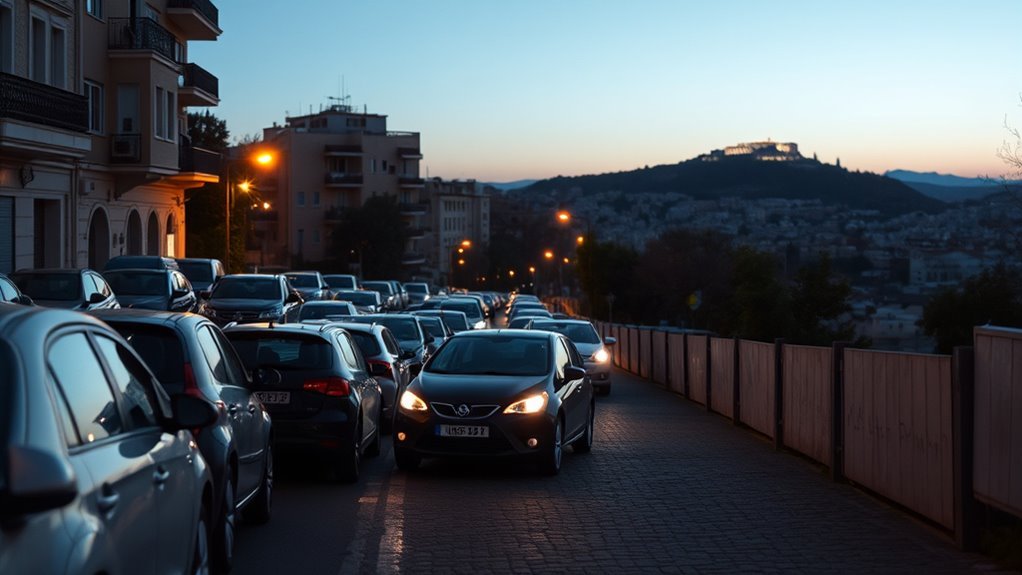
Central Athens has heavy traffic, motorcycles filtering between vehicles, narrow side streets, pedestrian areas, and controlled parking. Use a garage when you are uncertain about street markings, and never leave luggage or valuables visible inside the car.
Athens Daktulos Traffic Restrictions
The Daktulos, also called the Athens traffic restriction ring, operates seasonally rather than every day of the year. The most recent 2025–2026 period ran from October 20, 2025, through July 24, 2026. During that season, restrictions applied Monday through Thursday from 7:00 AM to 8:00 PM and Friday from 7:00 AM to 3:00 PM. They did not normally apply on Saturdays, Sundays, official holidays, or qualifying public-transport strike days.
During an active period, access for many private vehicles is based on whether the last digit of the registration number is odd or even. Boundary roads and approved exempt vehicles are treated differently. Rental and foreign-registered vehicles may qualify for specific exemptions only when the official conditions are met.
Check the current Athens Daktulos information on gov.gr before driving into the zone. Carry your rental agreement and ask the rental company whether the specific vehicle requires a permit or qualifies for an exemption.
Note: The 2025–2026 Daktulos season ended on July 24, 2026. The government sets new operating dates, conditions, and exemptions for each season, so do not rely on a previous year’s calendar.
Controlled Street Parking in Athens
Athens uses different road markings for controlled parking:
- White markings: Visitor parking spaces
- Blue markings: Resident parking spaces
- Yellow markings: Special-use spaces, including designated service or accessibility areas
Visitor parking is generally limited to three hours. The official controlled-parking schedule lists operating hours of 9:00 AM to 9:00 PM on weekdays and 9:00 AM to 4:00 PM on Saturdays. Resident and special-use restrictions may apply around the clock.
The official visitor fee schedule is €0.50 for each 30-minute period up to two hours, €4 for two and a half hours, and €6 for three hours. Check the current City of Athens controlled-parking information because rates and operating arrangements can change.
The myAthensPass service supports visitor parking payments. The city has also introduced Parkout to help drivers locate available parking in participating areas.
Municipal and private garages are available near major central destinations, including the Syntagma and Kotzia Square areas, but their prices and hours vary. Read the entrance rate board before entering and confirm whether overnight access is available.
Warning: Do not park in a blue resident space, yellow special-use space, bus lane, pedestrian area, driveway, or location marked for no parking or no stopping. A rental company may add an administration charge when it processes a parking ticket, even when you pay the original fine.
Greek Road Signs and Driving Rules
Greece drives on the right, and you normally overtake on the left. Major directional signs often include Latin letters as well as Greek, but rural and local signs may be harder to read quickly. Reduce your speed when approaching an unfamiliar junction rather than making a sudden turn.
Greek Road Signs
Greek motorway direction signs generally have a green background. Blue signs commonly guide drivers on national and other major routes, while white signs are often used for local or urban destinations. Route numbers, arrows, and destination names are more reliable than color alone.
- STOP: The familiar red octagonal sign
- Give way: An inverted triangle with a red border
- Parking: A blue square with a white letter P
- No parking: A blue circle with a red border and diagonal red line
- No stopping: A blue circle with a red border and red X
Temporary signs, traffic-police directions, and posted local limits take priority over general guidance.
Speed Limits
Greece’s revised Road Traffic Code changed the default urban speed limit. From January 1, 2026, the general urban limit is 30 km/h. A 50 km/h limit can apply on specified divided or multi-lane urban roads, while signs may set a different lawful limit for a particular road.
For passenger cars outside urban areas, the general maximums are:
- Motorways: 130 km/h
- Expressways: 110 km/h
- Other roads outside urban areas: 90 km/h
These are general limits. Lower posted limits apply near schools, junctions, tunnels, roadworks, sharp bends, settlements, and hazardous sections. Review the current Greek Road Traffic Code, Law 5209/2025, and always follow posted signs.
Essential Driving Safety Rules
- Every occupant must use an appropriate seat belt or child restraint.
- Do not hold or use a phone while driving. Set the route before moving and use a legal hands-free setup when permitted.
- Do not drive after drinking alcohol or using any substance that affects your ability to drive.
- Allow extra space around motorcycles, scooters, cyclists, buses, and pedestrians.
- Use headlights where required, including tunnels and low-visibility conditions.
- Check the rental agreement before allowing another person to drive. An unlisted driver may not be covered.
The EU’s official Greece road-safety overview provides additional country-specific rules.
Local Driving Habits
Traffic can change lanes quickly, motorcycles may pass between slow vehicles, and drivers may use the horn more often than you expect. Do not assume that a horn has one fixed meaning. It may warn of a vehicle’s presence, signal impatience, or alert another road user to danger.
Drive defensively, maintain a safe following distance, check mirrors before changing position, and expect pedestrians near crossings and side streets. Do not copy another driver who ignores a sign, enters a restricted lane, or parks illegally.
What to Do After an Accident, Breakdown, or Theft
- Stop in the safest available location and switch on the hazard lights.
- Call 112 when someone is injured, the road is dangerous, a vehicle is blocking traffic, or emergency help is required.
- Contact the rental company or its roadside-assistance provider immediately.
- Photograph the vehicles, number plates, road position, signs, damage, and surrounding conditions when it is safe.
- Exchange identification, contact, vehicle, and insurance details with the other driver.
- Follow the rental company’s instructions about police reports, towing, replacement vehicles, and repair authorization.
- For theft, keep the keys and contact the police and rental company without delay.
Do not arrange repairs, admit legal responsibility, abandon the vehicle, or move it a long distance unless emergency services or the rental company instruct you to do so.
Best Day Trips From Athens by Car
A rental car is most valuable when you use it to explore beyond the center. Nafplio, Cape Sounion, Corinth, and Delphi are popular choices, but travel time can change with traffic, roadworks, weather, and stops.
Nafplio Highlights
Nafplio is about 140 km from Athens and normally takes roughly two hours by car. The route follows the A8 toward Corinth and the A7 toward Tripoli before continuing toward Argos and Nafplio.
Palamidi Fortress offers wide views over the town and coast. You can approach the upper entrance by road or use the long staircase from town. In the harbor, you can view Bourtzi fortress and check locally whether boat access is operating during your visit.
The Old Town has neoclassical streets, cafes, shops, waterfront walks, and local Peloponnesian food. The Archaeological Museum of Nafplio includes prehistoric, Mycenaean, Classical, and later finds from the Argolid region.
| Stop | Why Go | Practical Tip |
|---|---|---|
| Palamidi Fortress | Historic fortifications and panoramic views | Wear secure shoes and check opening hours |
| Bourtzi | Harbor views and photographs | Confirm current boat access locally |
| Old Town | Architecture, cafes, shops, and waterfront walks | Park outside the busiest pedestrian streets |
| Archaeological Museum | Regional history and archaeological collections | Check the official schedule before arrival |
Coastal Drive Stops
The drive south toward Cape Sounion combines coastal scenery, beaches, towns, and the Temple of Poseidon. Depending on traffic and your starting point, the direct drive commonly takes about one and a half to two hours.
You can stop in Glyfada for cafes and shopping, continue through Vouliagmeni for beaches and the thermal lake, and visit Lavrio for its harbor and seafood restaurants. At Cape Sounion, allow enough time to park, enter the archaeological site, and watch the changing light over the Aegean.
Check the return route before sunset because coastal traffic can become slow, and some roadside viewpoints have limited or unsafe space for stopping.
Scenic Mainland Routes
Corinth is one of the easiest mainland drives from Athens. You can visit the Corinth Canal, Ancient Corinth, the Temple of Apollo, and Acrocorinth, depending on your available time.
Delphi is a longer day trip with mountain roads and a substantial archaeological site. Leave early, monitor the weather, and avoid rushing the return drive after dark.
Meteora offers exceptional monasteries and rock formations, but it is too far from Athens for a relaxed day trip. Plan at least one overnight stay so you are not spending most of the day driving.
Driving to Nafplio From Athens
From Athens, follow the A8 motorway west toward Corinth. Continue onto the A7 toward Tripoli, then take the signed route toward Argos and Nafplio. Navigation is straightforward, but always follow current road signs and closure instructions.
The A8 and A7 are toll roads. Review current prices through Olympia Odos and MOREAS. Ask the rental company whether the car has an electronic toll device, whether it adds a service charge, and which payment methods you should use.
For a smoother Nafplio trip, leave Athens early, keep a payment method ready for tolls, and allow extra time for traffic near Corinth and on the return journey.
Before departure, check the fuel level, tire-pressure warning light, weather, motorway conditions, and return-office hours. Keep water, a charged phone, charging cable, identification, rental documents, and the roadside-assistance number within reach.
In Nafplio, consider using a public car park outside the busiest Old Town streets. Many central lanes are narrow or pedestrian-focused, so parking once and exploring on foot is often easier.
Frequently Asked Questions
What documents do I need to rent a car in Athens?
You will normally need a valid driving licence, passport or accepted identification, booking confirmation, and a payment card accepted by the agency. An International Driving Permit may be required depending on the country that issued your licence, its format, the rental company, and the insurer. Confirm the exact requirements before traveling.
Are automatic cars harder to find in Athens?
Automatic cars are available, but an agency may stock fewer automatics than manual vehicles. Book early during busy periods and make sure the reservation specifically confirms an automatic transmission rather than listing it only as a preference.
Can I pick up a rental car at Athens Airport?
Yes. Athens International Airport lists rental-car desks on the Arrivals level. Check the current provider list, desk hours, pickup instructions, and whether the vehicle is collected at the terminal or reached by shuttle on the official airport car-rental page.
Is extra insurance worth buying for an Athens rental?
It depends on the included coverage, remaining excess, exclusions, and any protection provided by your credit card or travel insurer. Compare the cost of reducing the excess with the amount you could afford to pay after damage. Confirm coverage in writing and avoid paying twice for the same protection.
What should I do if I receive a parking ticket?
Read the payment or appeal instructions on the notice and act before the deadline. Keep the ticket and payment receipt, and notify the rental company when required. The agency may charge a separate administration fee for identifying the renter or processing the notice.
Do I need a rental car while staying in central Athens?
Usually not. Central attractions are connected by public transport and many neighborhoods are best explored on foot. A car becomes more useful when you leave Athens for destinations such as Nafplio, Corinth, Cape Sounion, or Delphi.
Can I take an Athens rental car on a ferry or across a border?
Only when the rental company permits it. Ferry travel, island use, and international border crossings may require written authorization, additional insurance, or an extra fee. Unauthorized travel can invalidate roadside assistance or damage coverage.
Are motorway tolls included in the rental price?
Usually not. You normally pay tolls separately unless the rental contract includes an electronic toll service. Ask how tolls are recorded, whether a service fee applies, and what payment methods are accepted on your route.
Conclusion
Renting a car in Athens makes the most sense when you want to explore destinations beyond the city. For a central sightseeing stay, delaying pickup until your departure day can reduce parking costs and difficult urban driving.
Before booking, compare the complete price, deposit, insurance excess, fuel policy, mileage, and travel restrictions. Confirm whether your licence needs an IDP, inspect the car carefully, and keep evidence from both pickup and return.
Once on the road, follow posted signs, Greece’s current speed limits, seasonal Daktulos rules, and Athens parking-zone markings. With a compact vehicle, realistic route, and clear rental terms, you can reach Nafplio, Cape Sounion, Corinth, and other mainland destinations with fewer surprises.
Sources
- Hellenic Parliament: Greek Road Traffic Code, Law 5209/2025 — current speed-limit framework and road rules
- Gov.gr: Athens Daktulos access information — seasonal traffic restrictions and permits
- City of Athens: Controlled parking system — parking-zone colors, operating hours, limits, and fees
- Your Europe: Driving licence and insurance guidance — EU licence recognition and cross-border driving preparation
- Athens International Airport: Car rentals — airport rental desks and pickup information
- Olympia Odos and MOREAS — official toll information for the A8 and A7 routes
