

Last Updated on July 23, 2026 by Ethan Caldwell
A notarized travel consent letter can prevent delays when a child travels alone, with one parent, or with an adult who is not a parent or legal guardian. However, it is not required for every trip. The correct documents depend on the child’s citizenship, destination, route, custody situation, and airline.
Quick Answer
A notarized travel consent letter is not required for every minor trip. The United States does not generally require proof of both parents’ permission for a child to leave, but a destination country, border officer, or airline may request it. Carry one for international travel when a child is alone, with one parent, or with another adult.
Key Takeaways
- A signed and notarized consent letter is usually recommended for international travel without both parents, but the exact legal rule comes from the destination and departure countries.
- U.S. citizen children generally need their own passport book for international air travel.
- TSA does not require identification from children under 18 on domestic U.S. flights, although an airline may request proof of age or other documents.
- Custody orders, guardianship records, a birth certificate, or a parent’s death certificate may be necessary in special family situations.
- Airline age limits, route restrictions, forms, check-in procedures, and fees vary, so confirm the carrier’s current policy before booking.
Legal note: This article provides general travel-document information, not legal advice. Entry, exit, custody, and airline rules can change. Check the destination government, the country of departure, and the airline before every trip.
Disclosure: As an Amazon Associate I earn from qualifying purchases. Some links on this page are affiliate links, at no extra cost to you.
Does a Minor Need a Notarized Travel Letter?
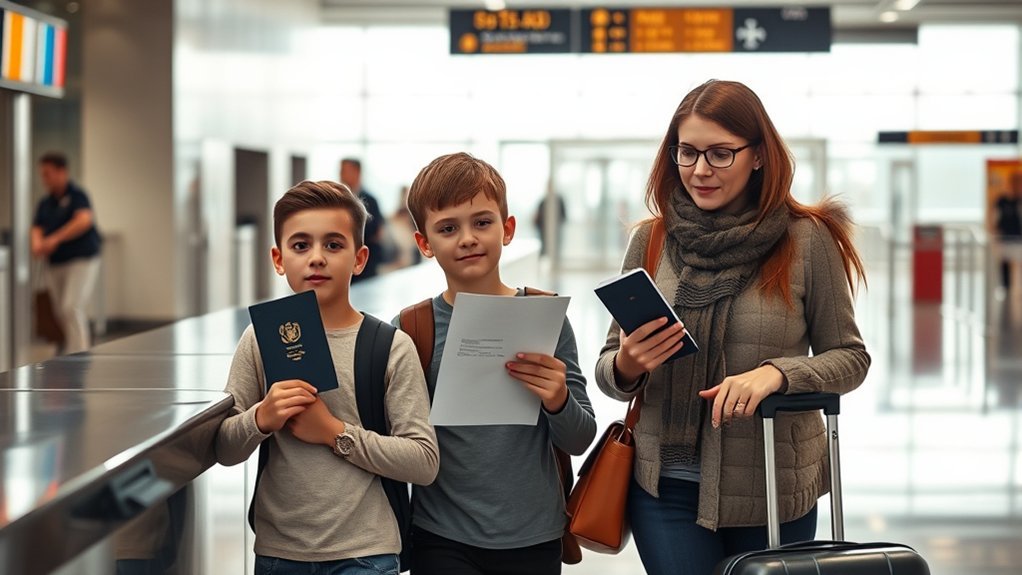
Not always. The United States does not generally require a minor to show proof of both parents’ permission when leaving the country. However, some destination countries require a signed or notarized letter from the non-traveling parent, and airlines or border officers may ask for proof of consent.
The safest approach is to carry a consent letter when a child travels:
- With only one parent or legal guardian
- Alone
- With grandparents, relatives, friends, teachers, coaches, or another adult
- With a school, sports, religious, or tour group
The letter does not replace a passport, visa, custody order, or country-specific form. Review the destination’s entry and exit rules through the U.S. Department of State’s travel-with-minors guidance and contact the destination country’s embassy or consulate when its rules are unclear.
| Travel situation | Documents to consider |
|---|---|
| Domestic U.S. flight with a parent | Airline-requested proof of age, if any; TSA does not normally require ID for travelers under 18 |
| International trip with both parents | Passport, visa or travel authorization if required, and proof of relationship when useful |
| International trip with one parent | Consent letter from the non-traveling parent plus relevant custody or family documents |
| Child traveling alone or with another adult | Consent from all parents or guardians with legal decision-making authority, airline forms, and required travel documents |
| Sole custody, deceased parent, or legal guardian | Court order, guardianship record, or death certificate, as applicable |
When Kids Need Parent Consent
A consent letter is most useful when every person with legal authority over the child is not traveling. The person who should sign depends on the family arrangement:
- One parent is traveling: The other parent or guardian with legal decision-making authority should sign when possible and appropriate.
- The child travels alone or with another adult: Both parents or all legal guardians should sign unless one person has sole legal authority.
- The child travels with a group: Parents or guardians should provide written permission, and the group organizer may need a separate roster or authorization letter.
- One parent has sole custody: Carry the relevant court order instead of assuming a consent letter alone will prove authority.
- A parent has died: Carry a certified copy of the death certificate when it explains why a second signature is unavailable.
Warning: Do not rely on a generic consent letter when a custody order restricts international travel or when there is an abduction concern. Review the court order and obtain legal advice before departure.
Domestic U.S. Flights With a Minor
For travel within the United States, TSA does not require children under 18 to provide identification at the security checkpoint. The accompanying adult must show acceptable identification. An airline may still ask for a birth certificate or another record to confirm the child’s age, especially for lap infants, discounted child fares, or an unaccompanied-minor booking.
Check the airline’s rules even when the trip is domestic. A travel consent letter is not a standard TSA requirement, but carrying one may be sensible when a child travels with an adult who is not a parent or legal guardian.
What U.S. Citizen Kids Need to Travel
Each U.S. citizen child, including an infant, generally needs a personal U.S. passport book for international air travel. A passport card is not valid for international air travel. A NEXUS card may work in limited circumstances at designated Canadian preclearance airports, but travelers should not rely on it without confirming the exact route and carrier requirements.
Depending on the destination, the child may also need a visa, electronic travel authorization, vaccination record, return-ticket evidence, or country-specific consent form. Check the destination page on the U.S. Department of State international travel website before booking.
For a child under 16, a U.S. passport is normally valid for five years and cannot be renewed using the standard adult renewal process. Review the current steps on the official child passport application page.
What to Bring for Canada and Mexico

Document rules for Canada and Mexico depend on the child’s citizenship and whether the trip is by air, land, or sea. For U.S. citizen children, use the following as a planning guide and verify the destination’s current entry rules before travel.
| Age and mode | Typical U.S. document | Important limit |
|---|---|---|
| Any age, international air | Valid U.S. passport book | A passport card is not valid for international air travel; NEXUS use is limited to qualifying Canada routes |
| Under 16, land or sea from Canada or Mexico | U.S. passport, passport card, original or certified birth certificate, Consular Report of Birth Abroad, or Naturalization Certificate | Cruise lines and destination countries may impose stricter rules than the minimum U.S. re-entry rule |
| Age 16 or older, land or sea | Passport book, passport card, or another accepted Western Hemisphere Travel Initiative document | A Global Entry card is for U.S. land or sea entry and does not by itself authorize entry into Canada or Mexico |
Traveling to Canada With a Child
Canada recommends a signed consent letter when a child enters or leaves the country without one or both parents or legal guardians. The letter is not automatically a legal requirement in every Canadian case, but border officers, airline agents, or foreign authorities may request it. Canada strongly recommends having the signature witnessed by a notary and carrying the original signed letter.
Traveling to Mexico With a Child
Mexico has a special Formato SAM exit process for certain Mexican minors, dual Mexican nationals, and foreign minors who are temporary or permanent residents of Mexico when they leave alone or with an adult who is not a parent or legal guardian. Tourist children are generally outside that SAM requirement, and the form is not normally required when the child leaves with one parent or a legal guardian. Families with Mexican citizenship or residency should review the current Instituto Nacional de Migración SAM guidance.
Note: A U.S. birth certificate may be enough for some land or sea re-entry situations, but it does not replace the entry document required by Canada, Mexico, a cruise line, or an airline. A passport book gives families the most flexibility if plans change and an emergency flight becomes necessary.
What Non-U.S. Citizen Kids Need
A non-U.S. citizen child entering the United States must have an individual travel document that matches the child’s nationality and immigration status. This may include a passport, visa, Electronic System for Travel Authorization approval, permanent resident card, refugee document, or another accepted document. The child must also meet the exit rules of the country being left.
Passport and Visa Needs
Do not assume every non-U.S. citizen child needs the same visa. Visa-waiver eligibility, Canadian and Bermudian rules, permanent residence, and other immigration categories can change the requirement. Confirm the child’s documents through the appropriate U.S. embassy or consulate and the official rules of the departure country.
- Confirm that the child’s passport or travel document will remain valid for the full trip.
- Check whether a visa, ESTA approval, residence card, or other entry document is required.
- Verify the child’s exit requirements in the country of citizenship or residence.
- Keep copies separate from the originals and store secure digital copies.
Parental Consent Letters
If a non-U.S. citizen child travels alone, with one parent, or with another adult, carry a consent letter that meets the departure country’s rules. English is useful for U.S. inspection, but another country may require its official language, a specific government form, an apostille, legalization, or consular certification.
A general notarized letter may not satisfy a country that requires its own form. Contact the child’s embassy or consulate before travel rather than relying only on an airline checklist.
Custody and Guardian Proof
Carry documents that explain who has legal authority over the child. Depending on the family situation, these may include:
- A custody or parenting order
- A legal guardianship record
- An adoption order
- A parent’s death certificate
- A child’s birth certificate or other proof of relationship
Use certified copies when the destination requires them. Make sure names are consistent across passports, tickets, consent letters, and court records, or carry a marriage certificate, name-change order, or other document that explains the difference.
Dual Nationality and Minor Travel
A child may be treated as a citizen by a country even when the family usually travels on another passport. That country may require the child to enter or leave using its passport and may apply special parental-consent rules. Contact the relevant embassy or consulate before the trip.
Airline Rules for Unaccompanied Minors
There is no single U.S. federal age rule for children flying alone. Airlines create their own unaccompanied-minor policies, and those rules can differ by age, route, departure time, aircraft, connection, and destination. Some airlines require the service for children in a set age range, make it optional for older teenagers, or refuse solo travel for very young children.
Airline Age and Route Rules
Before buying the ticket, confirm all of the following directly with the operating airline:
- The minimum age for traveling alone
- The ages for which unaccompanied-minor service is required or optional
- Whether nonstop, direct, or connecting flights are allowed
- Restrictions on the last flight of the day, overnight connections, or codeshare flights
- Required check-in time and documents
- Who may escort the child to the gate and who may pick the child up
The drop-off adult may be required to remain at the airport until the flight departs. The pickup adult should carry the exact identification the airline requires and arrive before the flight lands.
Unaccompanied Minor Fees
Airlines often charge a separate fee for unaccompanied-minor service, but there is no dependable universal price range. The amount can change and may cover one child, siblings traveling together, one direction, or each segment. Check the airline’s current optional-service fee page before payment.
Ask whether the fee includes an escort during connections, early boarding, a meal, a child-only lounge, or contact updates. Also ask what happens if a flight is delayed, canceled, diverted, or rebooked.
What to Include in a Notarized Travel Letter
A clear travel consent letter should provide enough information for an airline or border officer to verify the child, the trip, and the person giving permission. Include:
- The child’s full legal name, date of birth, and citizenship
- The names and contact details of every parent or guardian with legal decision-making authority
- The full name, address, phone number, and relationship of the accompanying adult
- The countries, cities, travel dates, return date, and important transit points
- A direct statement granting permission for the trip
- Emergency contact information
- The signatures and signing date
- Notary details when notarization is recommended or required
Include a passport number or attach a parent’s ID copy only when the destination, airline, or official form requests it. Avoid sharing more personal information than necessary, and keep the documents secure.
Example wording: “I, Taylor Morgan, give permission for my child, Alex Morgan, to travel to Canada with Jordan Morgan from August 5 through August 12, 2026.” Add the full itinerary, contact details, signatures, and any country-required language.
How to Get a Travel Consent Letter Notarized
- Check whether the destination or airline provides a required form.
- Draft the letter but do not sign it before the notary instructs you to do so.
- Bring acceptable identification for every signing parent or guardian.
- Sign in the notary’s presence and obtain the notarial certificate or seal.
- Carry the original signed letter and keep copies in a separate place.
Some countries require an apostille, consular legalization, a certified translation, or a government-issued form instead of an ordinary notarized letter. A notary verifies a signature; notarization does not guarantee that another country will accept the document.
Travel Consent Letter vs. Passport Application Consent
A travel consent letter authorizes a specific trip. It is different from the parental-consent documents used to apply for a U.S. passport for a child. For example, Form DS-3053 may be used in certain passport-application situations when one parent or guardian cannot appear. It is not a general replacement for a trip-specific travel consent letter.
How to Avoid Airport and Border Delays
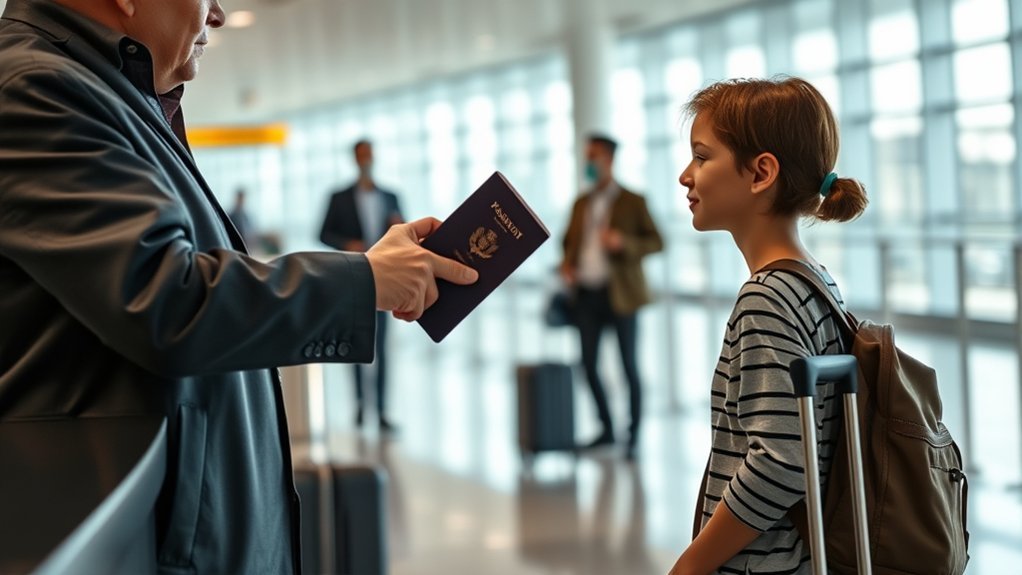
- Check the destination’s official entry and exit rules before buying nonrefundable tickets.
- Confirm the operating airline’s policy, not only the travel agent’s summary.
- Make sure the name on the ticket matches the child’s travel document.
- Carry originals when required and keep copies separate.
- Bring proof of relationship, custody, guardianship, or a parent’s death when relevant.
- Keep the non-traveling parent reachable during departure and border inspection when possible.
- Arrive early enough to complete airline forms and document checks.
Pro Tip: Recheck official rules shortly before departure. A letter that worked on a previous trip may not meet a new airline policy or a different country’s entry and exit rules.
Frequently Asked Questions
Does my child need a notarized letter to travel?
Not for every trip. The United States does not generally require two-parent permission for a minor to leave, but a destination country or airline may require or request a signed and notarized consent letter. It is strongly recommended for many international trips without both parents.
What documents does a minor need for a domestic U.S. flight?
TSA does not normally require identification from a traveler under 18. The airline may ask for proof of age or other documents, especially for an unaccompanied minor or lap infant, so check the carrier’s policy.
What documents does a U.S. citizen child need for international air travel?
A U.S. citizen child generally needs an individual, valid U.S. passport book. The destination may also require a visa, travel authorization, consent document, or other entry paperwork.
Do you need a notarized letter to travel with a child to Canada?
Canada recommends a signed consent letter when a child travels without one or both parents or legal guardians. It is not automatically required in every case, but officials or airlines may request it. Having the signature notarized can reduce questions about authenticity.
Does the letter need both parents’ signatures?
When the child travels alone or with a non-parent, signatures from all parents or guardians with legal authority are safest and may be required. When one parent travels, the non-traveling parent usually signs. A sole-custody order or similar record may replace a missing signature.
Can a travel consent letter be handwritten?
A handwritten letter may be accepted when no official form is required, but a clear typed letter is easier to review. The destination may require a specific format, notarization, translation, apostille, or government form.
What happens if the other parent cannot sign?
Carry the legal document that explains the situation, such as a sole-custody order, guardianship order, court authorization, or death certificate. When no document resolves the issue, obtain legal advice before international travel.
Conclusion
A notarized parental consent letter is a useful safeguard, but it is not a universal requirement for every child or every trip. Start with the child’s citizenship, destination, departure country, mode of travel, custody arrangement, and airline. Then carry the passport or other travel document, the correct consent paperwork, and any records that prove your relationship or legal authority.
Sources
- U.S. Department of State: Travel with Minors — destination-specific requirements, consent letters, dual nationality, and custody concerns
- USAGov: International Travel Documents for Children — U.S. child travel documents, consent guidance, and Canada/Mexico basics
- Transportation Security Administration: Acceptable Identification — domestic identification rules for travelers under 18
- U.S. Customs and Border Protection: Documents for U.S. Citizens — international air requirements and land/sea document exceptions
- Government of Canada: Consent Letter for Children Travelling Abroad — when to carry a letter, suggested contents, and notarization guidance
- Mexico Instituto Nacional de Migración: Formato SAM — exit authorization for qualifying minors leaving Mexico alone or with a third party

2 Comments
Pingback: Argentina In Spring: Weather, Packing & Travel Guide [2026]
Pingback: Best Time To Visit French Polynesia: Guide [2026]