
Last Updated on August 26, 2026 by Ethan Caldwell
Hotel check-in usually begins in the afternoon, but there is no universal time that applies to every property. Many hotels publish a check-in time around 3:00 PM or 4:00 PM, while others start earlier or use special arrival windows. Your booking confirmation and the individual hotel’s policy are the best sources for the exact time, payment requirements, minimum age, and late-arrival rules.
Quick Answer
Many hotels begin standard check-in around 3:00 PM or 4:00 PM, but the exact time varies by property. Early check-in usually depends on room availability. If you will arrive after midnight or after the front desk closes, contact the hotel. Bring acceptable identification, reservation details, and an accepted payment method.
Key Takeaways
- The hotel’s own property page or booking confirmation controls; there is no single check-in time for every hotel.
- Early check-in is normally a request rather than a guarantee unless you buy a confirmed early-arrival option or reserve the previous night.
- Late arrival is different from early check-in. Contact the hotel if you expect to arrive after midnight or outside staffed reception hours.
- Hotels commonly ask for identification and an accepted payment method and may authorize additional money for incidentals.
- Digital check-in can reduce front-desk time, but it does not necessarily guarantee that your room is ready or eliminate all identity checks.
Disclosure: As an Amazon Associate I earn from qualifying purchases. Some links on this page are affiliate links, at no extra cost to you.
What Time Do Hotel Check-Ins Start?

Hotel check-in commonly starts in the mid-to-late afternoon, with 3:00 PM and 4:00 PM being widely used times. However, there is no industry rule requiring every hotel to follow that schedule. Even hotels within the same major chain can publish different arrival and departure times.
The safest approach is to check the hotel’s own website or your reservation confirmation before travel. Marriott, for example, tells guests that individual hotel check-in and check-out times are listed in the property information on each hotel’s website. Marriott also states that early check-in is based on availability.
A posted check-in time is normally the point at which the property expects standard room access to begin. It does not necessarily mean you must arrive at that exact time, and it is not automatically the final deadline for checking in later that evening.
Note: Check-in time and a final arrival cutoff are different things. A hotel may begin check-in at 3:00 PM but still accept guests much later. Small properties and hotels with limited reception hours may require advance arrangements for late arrivals.
Why Hotels Set Check-In Times
Afternoon check-in windows give hotel teams time to turn rooms over after departing guests leave. Housekeeping must clean the room, replace linens and supplies, report maintenance problems, and make the room ready for the next guest. Depending on the property, another employee may also inspect the room before it is released.
A posted check-in time is mainly a room-readiness target, not a promise that every room becomes available at exactly the same minute.
- Housekeeping cleans and resets rooms after departures.
- Maintenance issues discovered during turnover can delay individual rooms.
- Room assignments must be matched with booked room types and special requests.
- Hotels use staggered arrivals to manage front-desk and housekeeping workloads.
On busy days, especially after a sold-out night, hotels may have little flexibility before the posted time. On quieter days, a clean room in your booked category may become available sooner.
How Hotel Check-In Works
At a traditional front desk, check-in usually starts with finding your reservation and confirming that the name and stay details are correct. Staff may ask for an acceptable form of identification and an accepted payment method. Exact requirements vary by property, country, rate type, and local law.
- Reservation verification: Staff locate your booking using your name or confirmation number.
- Identity check: The hotel may request government-issued photo identification or another form of ID it accepts.
- Payment authorization: The hotel may verify your payment method and place a temporary authorization for room charges or incidentals.
- Room assignment: Staff assign an available room that matches the category you booked, subject to the reservation terms and current availability.
- Key issuance: You receive a physical key card, mobile key, or other access instructions.
- Property information: Staff may explain Wi-Fi, breakfast, parking, checkout, amenities, and other hotel-specific details.
If you booked through an online travel agency or another third party and the hotel cannot locate your reservation, keep the booking confirmation accessible. You may need to contact the booking provider because some reservation changes must be handled through the company that issued the booking.
What to Bring for Hotel Check-In
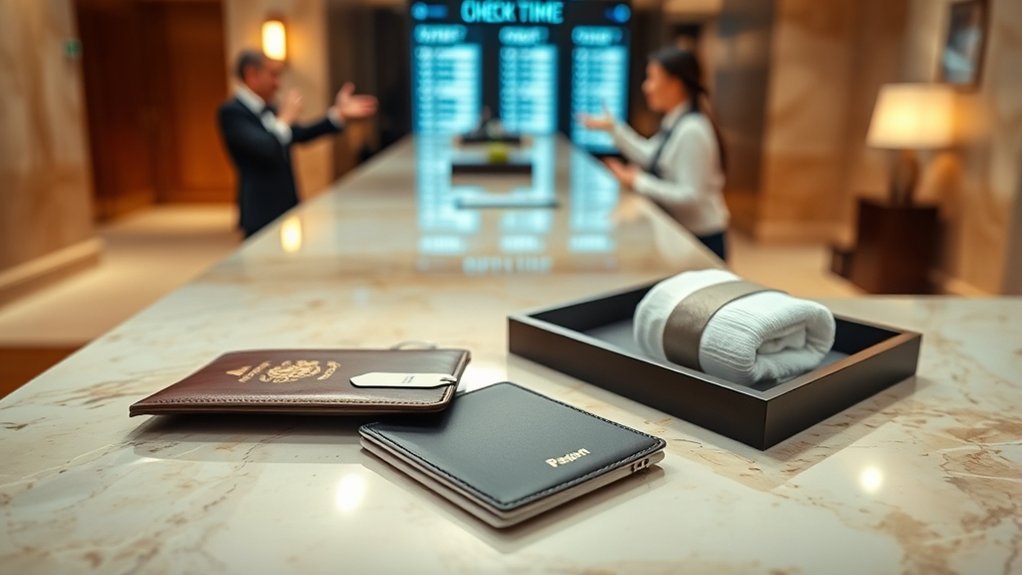
For a smoother hotel check-in, keep your identification, reservation details, and payment method easy to reach. The exact documents a property accepts can vary, so check the booking terms when traveling internationally or when the hotel has unusual age or payment requirements.
- Accepted identification: Many properties request government-issued photo ID, such as a passport or driver’s license.
- Booking confirmation: Keep your confirmation number, dates, booked room type, and rate details available on your phone or in print.
- Accepted payment method: Bring the card or other method the hotel says it accepts. A separate authorization may be required even when the room was prepaid.
- Reservation-name details: If someone else made the booking or is paying for the room, confirm the hotel’s procedure before arrival.
- Backup payment option: A second accepted payment method can help if the first card cannot be authorized.
If you requested an accessible room or accessibility feature, confirm the request with the hotel before arrival. In the United States, do not assume that you need to carry medical documentation to prove a disability. The U.S. Department of Justice’s ADA lodging guidance explains relevant accessibility obligations, and specific rules can differ outside the United States.
Minimum Age and Reservation-Name Requirements
Hotels can set minimum check-in ages, often based on property policy and local law. Do not assume that being 18 automatically qualifies you to check into every property. Some hotels use a higher minimum age, and resorts or properties with particular amenities may have additional restrictions.
The person checking in should also make sure the reservation is in an acceptable name and that any third-party payment authorization has been arranged in advance. If a parent, employer, friend, or company is paying for the stay, ask the hotel what documentation or payment authorization it requires before you travel.
Can You Check In Early?
Yes, but ordinary early check-in is usually subject to availability. A hotel cannot necessarily release your room early just because you requested it in advance; the previous guest may still be occupying the room or housekeeping may still be preparing it.
You can improve your chances by adding your expected arrival time to the reservation and contacting the property before travel. Some hotels charge for confirmed early arrival, while others provide it at no charge when a suitable room is already clean.
Official Marriott guidance states that early check-in is based on availability and is not guaranteed. If an early room cannot be provided, Marriott recommends asking whether the hotel can store your luggage while you wait.
Pro Tip: If you absolutely need a room very early in the morning after an overnight flight, requesting early check-in may not be enough. Reserving the previous night and telling the hotel about your late arrival is one of the clearest ways to protect access to the room, subject to the reservation and no-show terms.
If your room is not ready, ask whether the hotel can hold your luggage and whether registered guests may use selected facilities while waiting. Luggage-storage and amenity policies vary by property.
What Happens If You Arrive Late?
Arriving after the posted check-in time is often possible, but your reservation type and the property’s front-desk and no-show policies matter. If you expect to arrive very late, especially after midnight, contact the hotel directly and give staff your estimated arrival time.
A reservation guaranteed with a valid payment method may be protected later than an unguaranteed booking, but there is no universal midnight rule. Marriott’s current late-arrival guidance, for example, says guests arriving after midnight should contact the hotel and notes that guaranteed reservations are typically held until 6:00 AM local hotel time the following day. Its no-show charge depends on the specific hotel’s cancellation policy.
- Tell the hotel your expected arrival time if you will arrive late.
- Ask whether reception is staffed when you expect to arrive.
- Confirm whether your reservation is guaranteed and what the no-show policy says.
- If the desk closes overnight, request the exact after-hours check-in instructions.
- Keep the hotel’s direct contact details and your confirmation number available during travel.
Warning: Do not assume that a paid or guaranteed room can be collected at any hour without notice. After-midnight arrivals can cross into the hotel’s next operating date, and an unreported no-show may trigger cancellation or a charge under the booking terms.
Common Hotel Check-In Problems

Common hotel check-in problems include a reservation the desk cannot immediately locate, a payment authorization that fails, a room that is still being cleaned, or the booked room category being unavailable. Keeping your booking details and payment options accessible makes most problems easier to investigate.
Missing Reservations
If the hotel cannot find your booking, show the confirmation number, guest name, stay dates, room type, booking provider, and proof of any prepaid amount. A spelling difference, duplicate profile, recently transmitted third-party booking, incorrect date, or system issue can make a valid reservation harder to find.
- Show your confirmation email or booking-app record.
- Confirm the exact spelling of the guest name and the arrival date.
- Ask the hotel to search by confirmation number and booking provider.
- If you booked through a third party, contact that provider if the hotel cannot resolve the booking directly.
- If the property cannot honor the reservation, ask what alternative accommodation or assistance it can provide under your booking terms or brand policy.
Do not assume that a particular amount of compensation is automatically owed in every overbooking situation. Relocation and compensation policies vary by hotel, brand, booking contract, and jurisdiction.
Payment Holds
Hotels often place a temporary authorization on a credit or debit card to cover the expected bill and possible incidental charges. The amount can vary substantially based on the property, rate, stay length, parking, deposit policy, and payment method.
Hilton’s current payment guidance explains that a hotel may authorize the anticipated amount owed plus estimated incidentals. After checkout, the hotel releases the hold, but the card provider can take additional time to make the funds fully available again.
Ask the front desk for the exact authorization amount before check-in if available credit or debit-card funds are a concern. Debit-card holds can be especially important because temporarily unavailable funds can affect your usable bank balance.
Room Availability
A room can be unavailable at check-in even when you have a valid reservation. The previous guest may have departed late, housekeeping may still be preparing the room, maintenance may have taken it out of service, or the hotel may have an inventory problem.
- Ask whether the delay affects your exact room type or all available rooms.
- Ask for a realistic update and whether the hotel can notify you when the room is released.
- If another suitable room is ready, ask whether switching room types is possible.
- If the hotel cannot accommodate you at all, ask what relocation assistance applies to your reservation.
- Keep receipts if the hotel instructs you to incur a reimbursable transportation or accommodation expense.
If a specific feature is essential, such as an accessible shower, bedding configuration, or connecting-room arrangement, explain that requirement clearly instead of accepting an unsuitable replacement without discussion.
How Check-In Rules Vary by Hotel Type?
Hotel type can affect staffing, services, and how arrivals are handled, but it does not create a reliable universal check-in schedule. A budget chain, boutique hotel, airport hotel, luxury resort, hostel, and vacation rental may all use different times. The individual property’s published policy should take priority over assumptions based on price category.
Budget Hotel Policies
Budget and limited-service hotels may operate with smaller teams and fewer arrival services than full-service properties. Some have 24-hour reception, while others use limited desk hours or after-hours procedures.
- Confirm the property’s posted check-in time.
- Check whether reception remains staffed overnight.
- Ask about deposit and payment-card requirements.
- Confirm luggage storage if you expect to arrive early.
- Review the late-arrival or no-show policy before a nighttime trip.
Do not assume that a budget hotel automatically starts check-in earlier or offers less flexibility than a luxury property; both vary by location and individual operation.
Boutique Hotel Flexibility
Boutique hotels can sometimes provide a more individualized arrival experience because the property is smaller, but that does not mean early check-in is guaranteed. A small hotel with few rooms may actually have less flexibility when the booked room category is occupied the previous night.
Ask about early arrival, luggage storage, reception hours, and after-hours instructions. At independent properties, direct communication is especially useful because procedures may differ from the large-chain systems travelers are accustomed to.
Luxury Resort Exceptions
Luxury resorts may offer arrival lounges, luggage assistance, welcome services, or access to selected amenities before the guest room is ready. However, the resort’s posted check-in time still applies unless earlier room access is specifically confirmed.
- Send your expected arrival time before travel.
- Ask whether an early-arrival option can be confirmed or purchased.
- Check whether luggage storage and resort facilities are available before room access.
- Review loyalty benefits carefully; early check-in and late checkout can be subject to availability even for elite members.
A concierge, club desk, or butler service may simplify arrival at some luxury properties, but those services do not override the hotel’s inventory and room-readiness rules.
Digital Check-In And Mobile Keys
Digital check-in can let you complete part of the arrival process through a hotel app before reaching the property. At participating hotels, a mobile key can also let an eligible smartphone unlock the guest room and certain common-area doors.
Hilton’s Digital Check-in guidance currently allows eligible Hilton Honors members to choose an arrival time and, where available, select a room in the app. Its Digital Key guidance explains that the smartphone can function as a room key at participating hotels after the key is delivered.
| Option | Main Benefit | Important Limitation |
|---|---|---|
| App check-in | Complete arrival information before reaching the desk | Does not automatically guarantee early room readiness |
| Website check-in | Pre-arrival registration where supported | Availability depends on the hotel and brand |
| Mobile key | Phone-based room access | Requires a compatible hotel, account, device, and successful key delivery |
| Self-service kiosk | Can reduce front-desk waiting | Not available at every property |
| Physical key card | Works without relying on your phone battery | May still require front-desk or kiosk issuance |
Digital check-in does not always mean you can bypass the desk. Hilton notes that a guest requesting a Digital Key may still be sent to the front desk for identification. If your phone is dead, your account cannot be verified, or the mobile key fails, ask the hotel for a physical key.
Tips For A Smoother Hotel Check-In
A smooth arrival depends less on reaching the lobby at one perfect time and more on knowing the property’s rules before you travel.
- Read the booking confirmation. Check the posted arrival time, cancellation rules, deposit requirements, minimum age, and any final check-in deadline.
- Tell the hotel about unusual arrival times. This is especially important for very early arrivals, after-midnight arrivals, and properties with limited reception hours.
- Keep identification and payment ready. Make sure the reservation name and payment arrangement are acceptable to the property.
- Use digital check-in when useful. It can reduce paperwork and waiting, but do not treat it as a promise that the room will be ready before the posted time.
- Keep your confirmation accessible offline. A screenshot can help if your phone has poor service when you arrive.
- Ask about luggage storage. It is often the simplest option when your transportation arrives before the room is ready.
- Check loyalty benefits rather than assuming them. Early arrival, upgrades, and late checkout can depend on the brand, status level, hotel, and availability.
Frequently Asked Questions
What Is the 15/5 Rule in Hotels?
The 15/5 rule is a hospitality-service training guideline used by some properties: staff acknowledge a guest from about 15 feet away and give a verbal greeting at about 5 feet. It is not a universal hotel law or a rule controlling when guests can check in.
What Time Does Hotel Check-In Start and End?
Many hotels begin check-in around 3:00 PM or 4:00 PM, but the exact time varies. There is also no universal ending time. A hotel with overnight reception may accept much later arrivals, while a smaller property may impose a final check-in deadline. Contact the property if you expect to arrive late.
What’s the Most Stolen Item From a Hotel Room?
There is no authoritative worldwide dataset naming one item as the universal answer. Towels frequently appear among the most commonly reported missing hotel items in individual surveys, but results depend on the hotels and respondents studied. Complimentary toiletries are different from reusable hotel property such as towels, robes, electronics, and furnishings.
What Is the 10/5 Rule in Hotels?
The 10/5 rule is another hospitality-service guideline. In the commonly described version, staff acknowledge a guest with eye contact or a smile at about 10 feet and offer a verbal greeting at about 5 feet. The “5” refers to feet, not seconds, and the guideline is not a universal check-in requirement.
Can I Check Into a Hotel After Midnight?
Often yes, especially when the reservation is guaranteed and the property has overnight staff, but you should contact the hotel in advance. After-midnight arrivals can be treated differently under the hotel’s no-show system, and properties with limited reception hours may require special instructions.
Do I Need ID to Check Into a Hotel?
Many hotels require an accepted form of identification, often government-issued photo ID, to verify the person checking in. Requirements vary by property and country, so check the hotel’s policy if you do not have the usual passport or driver’s license available.
How Old Do You Have to Be to Check Into a Hotel?
There is no single minimum age for every hotel. Properties set their own requirements subject to applicable law, and some require the primary guest to be older than 18. Check the individual hotel’s minimum check-in age before booking.
Does Digital Check-In Mean My Room Is Ready?
Not necessarily. Digital check-in can complete registration before arrival, but room readiness still depends on housekeeping, maintenance, inventory, and the hotel’s process. Wait for the hotel’s room-ready or mobile-key notification before assuming you can enter the room.
Conclusion
Hotel check-in is easier when you treat the property’s own confirmation as the final authority. Many hotels begin check-in around 3:00 PM or 4:00 PM, but early access, late arrival, deposits, identification, minimum age, and front-desk hours can all vary. Check the policy before travel, notify the hotel about unusual arrival times, keep your reservation and payment details ready, and use digital check-in when it genuinely makes arrival simpler.
Sources
- Marriott — Early Check-In and Late Check-Out — availability rules, early-arrival requests, luggage storage, and hotel-specific check-in times.
- Marriott — Late Arrival Reservations — after-midnight arrivals, guaranteed reservations, and no-show policies.
- Hilton — Payment FAQs — card authorization, incidentals, and release of payment holds.
- Hilton — Digital Check-in — current digital arrival process.
- Hilton — Digital Key — smartphone room access and identification limitations.
- ADA.gov — Guide for Places of Lodging — U.S. accessibility and check-in considerations for guests with disabilities.

1 Comment
Pingback: Complete Plaza Hotel Owner Guide For 2026 Facts