
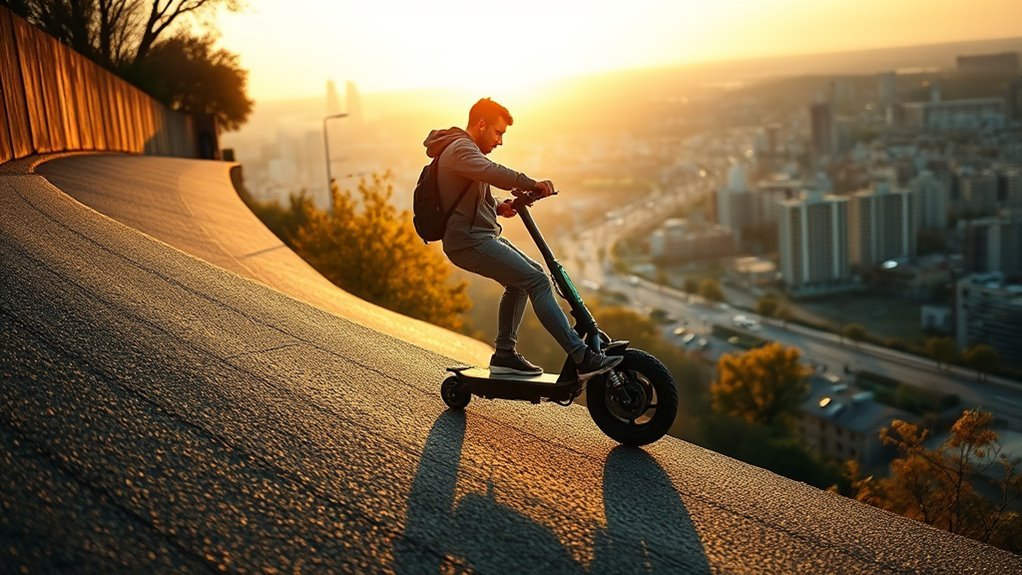
Last Updated on August 25, 2026 by Caleb Warren
Most commuter and performance electric scooters can climb hills, but their climbing ability depends directly on motor wattage, peak torque, battery voltage, and total rider payload. While an entry-level 250-watt scooter can manage gentle 5% to 10% inclines, conquering steep city hills exceeding a 15% to 20% grade requires a scooter with at least 500W to 1000W of continuous power—or a dual-motor configuration delivering 60+ Newton-meters (Nm) of torque.
Quick Answer
Yes, electric scooters can climb hills. A standard 250W–350W commuter scooter handles shallow slopes (5%–10% grade) for riders under 180 lbs. For moderate to steep hills (15%–25% grade), you need a 500W–1000W single motor or a dual-motor setup with a 48V–60V battery to prevent stalling and voltage sag.
Key Takeaways
- Torque and Wattage Rule Climbing: Peak wattage and motor torque (Nm) determine whether a scooter accelerates or stalls on an incline.
- Dual Motors Outperform Single Motors: Dual-motor configurations split the thermal load and provide two-wheel traction, eliminating front-wheel slip on steep ascents.
- Battery Voltage Prevents Fade: Systems rated at 48V, 52V, or 60V maintain higher RPM and reduce voltage sag when under sustained uphill strain.
- Rider Posture Matters: Leaning forward lowers your center of gravity, improves front-tire grip, and maximizes energy transfer uphill.
- Grade Percentages Differ from Degrees: A 15% road grade equals roughly an 8.5-degree incline, which is already considered a steep urban hill.
Disclosure: As an Amazon Associate I earn from qualifying purchases. Some links on this page are affiliate links, at no extra cost to you.
Can Electric Scooters Climb Hills?
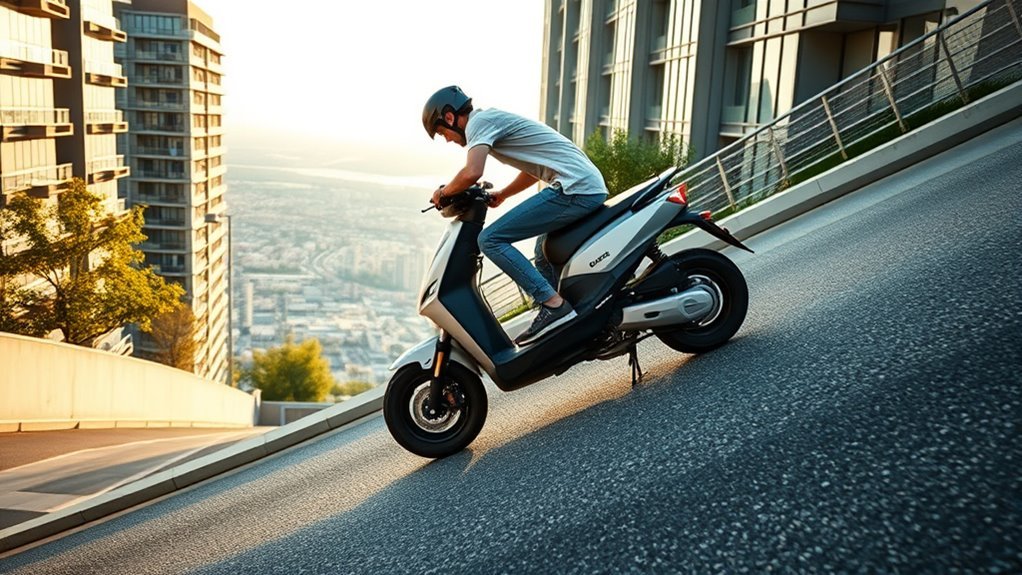
Electric scooters climb hills by converting stored electrical energy from a lithium-ion battery into rotational torque via one or two brushless direct-current (BLDC) hub motors. How effectively your scooter ascends comes down to the battle between motor tractive force and opposing forces: gravity, rolling resistance, aerodynamic drag, and rider payload.
When riding on flat ground, a scooter only needs enough power to overcome rolling friction and air resistance. The moment you hit an incline, gravity pulls directly against your forward motion. The steeper the angle, the more rotational force (torque) the motor must generate at the wheel hub to keep moving forward without stalling.
Understanding road slope is critical when assessing hill climbing. Road incline is typically measured in percent grade rather than degrees:
- Gentle Slopes (3% to 7% grade / 1.7° to 4.0°): Standard overpasses, subtle neighborhood inclines, and ADA-compliant ramps. Almost any functional 250W commuter scooter can climb these with ease.
- Moderate Hills (8% to 14% grade / 4.6° to 8.0°): Standard city hills found in hilly suburban areas. These require a minimum of 350W to 500W of sustained motor output.
- Steep Inclines (15% to 25% grade / 8.5° to 14.0°): Demanding urban streets (such as those in San Francisco, Seattle, or Pittsburgh). These hills demand 800W to 1000W+ single motors or dual-motor drivetrains.
- Extreme Grades (25%+ grade / 14.4°+): Severe terrain and off-road trails. These require high-voltage dual-motor performance scooters (2000W to 6000W peak output).
What Specs Help a Scooter Climb Better?
If you live in a hilly area, relying on manufacturer marketing claims can lead to frustrating, slow climbs. To find a scooter that truly handles inclines, evaluate these core electrical and mechanical specifications.
| Hill Grade (%) | Incline Angle (°) | Minimum Motor Specs | Recommended Battery | Expected Performance (170 lb Rider) |
|---|---|---|---|---|
| 5% – 8% | 2.9° – 4.6° | 250W – 350W (Single) | 36V | Maintains 10–14 mph with modest speed drop |
| 9% – 14% | 5.1° – 8.0° | 500W – 800W (Single) | 48V | Ascends at 12–18 mph without thermal cut |
| 15% – 22% | 8.5° – 12.4° | 1000W+ (Single) or Dual 500W | 52V – 60V | Steady 15–22 mph climbing; strong hill hold |
| 23% – 35%+ | 13.0° – 19.3°+ | Dual 1000W+ (2000W–4000W Peak) | 60V – 72V | Accelerates uphill rapidly; zero stalling |
1. Motor Power: Nominal vs. Peak Wattage
Always distinguish between nominal power (the continuous wattage a motor can sustain indefinitely without overheating) and peak power (the maximum wattage the motor controller allows for short bursts). A scooter rated at 500W nominal might peak at 900W when encountering a steep slope. For consistent hill climbing, prioritize higher nominal wattage and motor torque (measured in Newton-meters). Motors delivering 30 Nm to 70+ Nm of torque produce the rotational muscle necessary to prevent mid-hill stalls.
2. Battery Voltage and Discharge Current
Battery voltage ($V$) dictates the electrical pressure driving your motor. Higher-voltage systems (48V, 52V, 60V, or 72V) operate more efficiently under heavy load according to Joule’s Law ($P = V \times I$). Because power equals voltage multiplied by current, a higher-voltage scooter draws fewer amperes ($I$) to produce the same wattage, generating significantly less waste heat and preserving torque when climbing.
3. Single Motor vs. Dual Motors
Dual-motor scooters feature independent hub motors built into both the front and rear wheels. Dual motors offer three key advantages for hill climbing:
- Twice the Traction: Distributing drive force across both tires prevents the front wheel from slipping on steep asphalt or loose debris.
- Thermal Distribution: Two motors split the amp draw, running cooler and preventing the motor controller from throttling power due to high temperatures.
- Doubled Peak Torque: Combining two 1000W motors provides instant torque from a standstill on steep grades.
4. Tire Size and Tread Compound
Tire diameter and compound directly affect climbing efficiency. Smaller 8-inch solid rubber tires have minimal contact surface and slip easily under high torque. Larger 10-inch or 11-inch pneumatic (air-filled) or tubeless tires provide a wider contact patch, absorb road imperfections, and conform to the road surface to maintain traction on steep inclines.
How Motor Power and Battery Affect Hill Performance
When you command maximum throttle on an incline, the motor controller draws peak current from the battery pack. Understanding how the electrical drivetrain responds helps you protect your scooter’s components and maximize battery life.
“Climbing steep slopes at full throttle can draw up to three times more battery current than cruising on flat ground, inducing significant voltage sag if the battery pack lacks high-discharge cells.”
Understanding Voltage Sag on Inclines
Under heavy uphill acceleration, the internal resistance of the battery cells causes the voltage output to drop temporarily—a phenomenon known as voltage sag. If your battery level is already below 40%, severe voltage sag on a steep hill can trip the Battery Management System (BMS) low-voltage cutoff, causing the scooter to shut down unexpectedly mid-climb. Keeping your charge above 50% ensures maximum voltage and peak climbing performance.
Motor Thermal Throttling
When a motor strains on an incline at low RPM, a large portion of the electrical energy is converted into heat rather than forward motion. Modern high-end controllers include thermal sensors that automatically reduce wattage to protect the motor windings from melting. If you feel your scooter losing speed during a prolonged climb, the controller is likely throttling power to prevent thermal damage.
Warning: If your scooter stops moving on a steep incline, do not hold the throttle down while stalled. Stalling a direct-drive hub motor under full load creates high electrical resistance that can fry the motor phase wires or blow the controller MOSFETs in seconds.
Tips for Riding an Electric Scooter Uphill
Proper riding technique improves your scooter’s climbing efficiency, protects the drivetrain, and keeps you balanced.
- Shift Your Body Weight Forward: As the road tilts upward, lean your chest forward over the handlebars and position your front foot near the front of the deck. This keeps weight over the front wheel, preventing wheel spin and front-end lift.
- Select Maximum Performance Mode (Sport/Turbo): Ensure your scooter is set to its highest speed/power mode. Electric scooters use direct-drive hub motors without mechanical gearboxes; lower speed modes electronically limit amperage, reducing the torque you need for climbing.
- Build Forward Momentum Early: Approach the base of the incline with steady, controlled speed rather than starting from a dead stop at the bottom of the slope.
- Modulate the Throttle Smoothly: Apply smooth, progressive throttle rather than pinning it abruptly to prevent tire slip on loose pavement.
- Maintain Correct Tire Pressure: Underinflated tires increase rolling resistance by up to 25%, drastically sapping uphill speed and climbing power. Keep pneumatic tires inflated to the manufacturer’s recommended PSI (typically 45–50 PSI).
- Tack or Zigzag on Wide, Empty Roads: If a hill is pushing your motor to its limit, carving gentle diagonal lines across the slope reduces the effective incline angle, giving the motor a mechanical advantage.
Pro Tip: On exceptionally steep hills where your motor begins to slow below walking speed (under 4 mph), provide a few manual kick-scooter pushes. Adding leg power assists the motor through peak resistance, drops motor temperatures, and prevents low-voltage BMS shutdowns.
Best Electric Scooters for Steep Hills
When selecting a scooter specifically built to conquer hilly commutes, prioritize robust cooling, high voltage, and proven torque output. Here are three benchmark models that excel across different incline demands:
1. Apollo Pro (Extreme Incline Benchmark)
The Apollo Scooters lineup is engineered for demanding terrain. The Apollo Pro features a dual-motor setup delivering 6000W peak output and a massive 52V or 60V architecture. It easily ascends 30%+ grades with zero speed loss, utilizing an integrated unibody frame that dissipates motor heat efficiently during long uphill climbs.
2. Segway Ninebot KickScooter Max G2 (Best Single-Motor Commuter)
For daily city commuters facing moderate slopes, the Segway Ninebot Max G2 uses a 450W nominal (1000W peak) rear-wheel drive motor. Its rear-wheel configuration ensures that rider weight naturally presses down on the drive tire on inclines, allowing it to climb slopes up to a 22% grade for riders under 200 lbs without front-wheel slippage.
3. Nami Burn-E 2 (Ultimate Torque & Steep-Grade Specialist)
Equipped with dual 1000W base motors (peaking over 5040W combined) and custom 12-transistor 50A controllers, the Nami Burn-E 2 is built for extreme topography. Operating on a 72V system, it delivers immense torque to climb inclines exceeding 35 degrees without overheating or succumbing to voltage sag.
Frequently Asked Questions
Can a 250W electric scooter climb steep hills?
A 250W continuous motor can only handle mild inclines between 5% and 8% grade (roughly 3° to 5°). On hills steeper than 10%, a 250W scooter will slow significantly and likely stall unless a lightweight rider assists by kick-pushing.
How does rider weight affect hill climbing speed?
Payload directly increases the gravitational force working against the motor. A 220 lb (100 kg) rider requires approximately 40% more torque to climb a 15% grade at the same speed as a 150 lb (68 kg) rider. Riders over 200 lbs should look for dual motors or a minimum of 800W–1000W nominal power for hilly commutes.
Does riding uphill damage the scooter battery or motor?
Climbing hills does not cause damage if the scooter operates within its rated thermal and current limits. However, sustained full-throttle climbing on underpowered scooters creates intense motor heat and deep battery discharge cycles, which can accelerate cell degradation and trigger thermal throttling.
How do you safely descend steep hills on an electric scooter?
When descending, shift your weight backward and lower your stance over the rear deck. Use smooth, modulated braking rather than grabbing the brake levers abruptly. Rely on dual mechanical disc or hydraulic brakes rather than electronic regenerative brakes alone, as fully charged batteries can disable regenerative braking to avoid dangerous overcharging.
Conclusion
Electric scooters can easily conquer steep hills, provided their powertrain matches the demands of your local terrain. While budget 250W single-motor models are suitable for flat pavement and gentle bridge ramps, navigating serious urban inclines requires a scooter with 500W to 1000W+ nominal power, a 48V or higher battery, and pneumatic tires that maintain firm road grip.
By pairing the right hardware—such as a dual-motor drivetrain for steep grades—with smart riding techniques like forward weight distribution and momentum management, you can tackle the steepest inclines with confidence, stability, and total control.
Sources
- Society of Automotive Engineers (SAE) — Standards for electric drivetrain efficiency, torque measurement, and light electric vehicle gradeability.
- IEEE Transportation Electrification Community — Research on lithium-ion battery discharge dynamics, voltage sag under high load, and BLDC motor controllers.
- U.S. Consumer Product Safety Commission (CPSC) — Micromobility safety guidelines and mechanical braking requirements for electric scooters.
- U.S. Department of Transportation (USDOT) — Urban roadway grade definitions, slope calculation standards, and micromobility infrastructure studies.
