
Last Updated on September 11, 2026 by Daniel Globe
The SS Normandie was a French transatlantic ocean liner celebrated for its streamlined hull, record-setting crossings, and spectacular Art Deco interiors. Launched in 1932 and placed in service in 1935, it linked Le Havre, Southampton, and New York until World War II ended its passenger career. A 1942 fire during troopship conversion led to its loss.
Quick Answer
The SS Normandie was a French luxury ocean liner launched on October 29, 1932, and placed in service on May 29, 1935. It became famous for Art Deco design, turbo-electric propulsion, and Blue Riband speed records. A fire at New York’s Pier 88 caused it to capsize in February 1942.
Key Takeaways
- Normandie was launched in 1932 but did not begin passenger service until 1935.
- Its efficient hull and steam turbo-electric drive combined high speed with unusually smooth control.
- The liner won transatlantic speed records and became a major symbol of French Art Deco design.
- It caught fire during conversion to the U.S. transport Lafayette, capsized on February 10, 1942, and was sold for scrap in 1946.
- Important pieces of its interior survive in museum and heritage collections.
Note: Normandie was not a London-based boat. It was a French ocean liner built at Saint-Nazaire and operated by Compagnie Générale Transatlantique, commonly called the French Line.
Disclosure: As an Amazon Associate I earn from qualifying purchases. Some links on this page are affiliate links, at no extra cost to you.
What Was the SS Normandie?
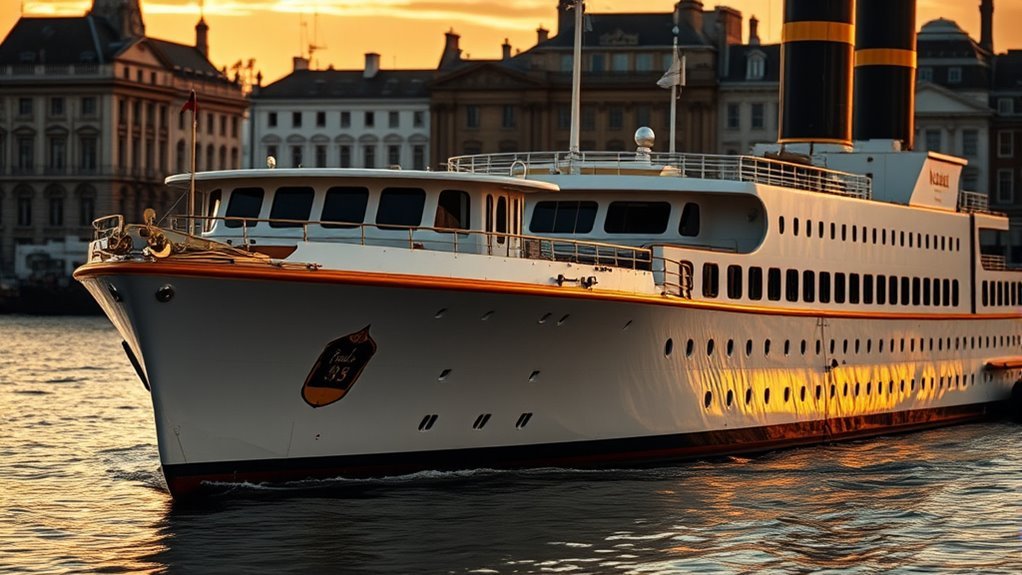
The SS Normandie was the flagship of France’s Compagnie Générale Transatlantique. Chantiers de Penhoët built the vessel at Saint-Nazaire. According to The Mariners’ Museum and Park, its keel was laid on January 26, 1931, and the ship was launched on October 29, 1932. It spent more than two years being fitted out before leaving Le Havre on its maiden voyage on May 29, 1935.
The liner served the Le Havre–Southampton–New York route. It was designed to carry almost 2,000 passengers in first, tourist, and third class, supported by a crew of more than 1,300. At roughly 1,029 feet overall, it was one of the largest moving objects of its era.
SS Normandie at a Glance
| Operator | Compagnie Générale Transatlantique, or the French Line |
| Built | Saint-Nazaire, France; laid down in 1931 and launched in 1932 |
| Passenger service | May 1935 to August 1939 |
| Main route | Le Havre–Southampton–New York |
| Passenger capacity | Up to about 1,972 passengers across three classes |
| Propulsion | Steam turbo-electric system driving four propellers |
| Speed | About 29.5 knots by design; roughly 32.2 knots during trials |
| Final fate | Burned and capsized in 1942; sold for scrap on October 3, 1946 |
Why Did the SS Normandie Matter?
Normandie mattered because it brought naval engineering, industrial design, fine art, and national prestige together in one ship. France built it during the Great Depression, when the leading Atlantic lines were competing to create larger, faster, and more impressive liners.
The vessel was also a floating showcase for French decorative arts. The Metropolitan Museum of Art describes Normandie as a major expression of French Art Deco and explains that the ship was intended to carry French art, luxury, food, and craftsmanship abroad. Jean Dupas, René Lalique, Jean Dunand, Pierre Patout, Raymond Subes, and many other designers contributed to its interiors.
Normandie was more than transportation: it was a carefully planned national showcase for French engineering and Art Deco design.
Its importance should not be reduced to glamour alone. The ship demonstrated that a huge liner could combine an efficient hull, high sustained speed, electric propulsion control, and monumental public spaces. Its bold design influenced how later generations imagined the “ocean liner style” in architecture, graphics, furniture, and popular culture.
There was a trade-off. Normandie devoted a very large share of its public space to first-class luxury, making it impressive but less broadly practical than some rivals. Its British competitor, RMS Queen Mary, generally proved more commercially popular.
How Was the SS Normandie Designed for Speed and Luxury?
A Hydrodynamic Hull Built for Speed
Naval architect Vladimir Yourkevitch helped shape Normandie’s distinctive hull. Its fine lines, clipper-like bow, and bulbous underwater forefoot reduced resistance and limited the large bow wave expected from a ship of its size. “Hydrodynamic” is the correct term for this water-moving design; “aerodynamic” applies mainly to movement through air.
The hull allowed Normandie to reach high speeds without requiring as much power as a less efficient shape. Its design speed was about 29.5 knots, while trials produced a top figure of roughly 32.2 knots. Those numbers were extraordinary for a ship weighing tens of thousands of tons.
Steam Turbo-Electric Propulsion
The original article’s phrase “four steam turbines” does not fully explain the system. Steam turbines drove electrical generators. Electricity then powered large propulsion motors connected to four propeller shafts. This turbo-electric transmission separated the turbines from the propellers mechanically.
The arrangement added weight, but it offered precise control and made it possible to reverse the propulsion motors without separate astern turbines. Contemporary and later accounts also describe the system as smoother and easier to manage than many direct mechanical arrangements. Its installed output is commonly listed at about 160,000 horsepower.
Note: Normandie’s turbines did not simply turn the propellers through direct shafts. They generated electrical power for four propulsion motors, which is why the ship is described as steam turbo-electric.
Art Deco Interiors and Passenger Amenities
Inside, Normandie was designed as a sequence of grand spaces rather than a conventional ship interior. First-class passengers had access to suites, lounges, a theater, a winter garden, and an indoor swimming pool. The scale and decoration were intended to make the crossing itself feel like the destination.
The first-class dining room was the best-known space. Commonly cited measurements put it at about 305 feet long, and it could seat roughly 700 guests. Monumental doors, illuminated glass, gilded surfaces, sculptures, and Lalique lighting turned a windowless room into one of the most theatrical interiors ever installed at sea.
Normandie’s luxury was not limited to expensive materials. Its visual unity mattered just as much. Furniture, tableware, murals, lighting, metalwork, and textiles were coordinated so that passengers experienced a complete Art Deco environment.
How Did the SS Normandie Change Ocean Travel?
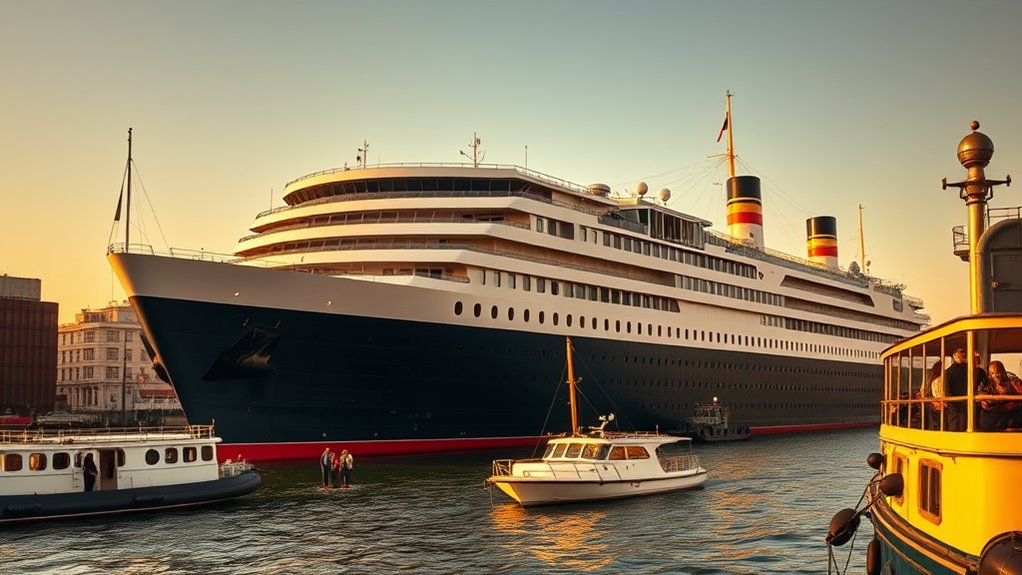
Normandie changed expectations by showing that an ocean liner could be both a high-performance machine and a major work of design. On its maiden westbound crossing in 1935, it averaged almost 30 knots and captured the transatlantic speed record. The return voyage also set an eastbound record.
The Blue Riband was an unofficial distinction associated with the fastest regular transatlantic passenger liner. Eastbound and westbound records were tracked separately because currents, weather, and routes differed. Normandie lost records to Queen Mary, regained them in 1937, and lost them again in 1938.
This rivalry mattered beyond publicity. It pushed shipping lines to improve hulls, propellers, vibration control, power plants, schedules, and passenger service. Normandie’s combination of speed and style also helped define the final great era of Atlantic liners before long-distance air travel became dominant.
Pro Tip: When comparing old ocean-liner speed records, check whether a figure is a trial speed, a service speed, or an average crossing speed. These measurements describe different kinds of performance.
What Happened to the SS Normandie?
Normandie arrived in New York in August 1939, shortly before war began in Europe, and did not return to France. After the United States entered World War II, the government took control of the ship and renamed it Lafayette (AP-53). Work began to convert it into a military transport, but it never completed that role or sailed in U.S. service.
On February 9, 1942, sparks from a cutting torch ignited a stack of flammable kapok-filled life preservers in the former first-class Grand Salon. The fire spread while the vessel’s interior was being stripped and altered for conversion.
Firefighters poured thousands of tons of water into the ship. Because the water was not evenly controlled or removed, Lafayette developed a severe port list. According to the Naval History and Heritage Command, about 6,000 tons of firefighting water contributed to the loss of stability. The ship capsized at approximately 2:45 a.m. on February 10 and came to rest on its port side at Pier 88.
Warning: The disaster is sometimes described as sabotage. Official historical accounts instead identify accidental ignition during conversion work as the cause; claims of a proven sabotage plot are not supported by the principal naval record.
Salvage and Scrapping
The wreck remained at Pier 88 for about 18 months. Salvage teams removed much of the superstructure, sealed openings, pumped out water, and finally righted the hull in August 1943. The operation was a major engineering achievement, but fire, flooding, corrosion, and wartime priorities made restoration impractical.
- The vessel was reclassified after salvage but never returned to operation.
- It was removed from the Naval Vessel Register in October 1945.
- President Harry S. Truman authorized its disposal in September 1946.
- It was sold for scrap on October 3, 1946.
- Dismantling continued at Port Newark, New Jersey.
Where Can You See SS Normandie Artifacts Today?
Although the ship no longer exists, many fittings, artworks, pieces of furniture, table-service objects, and architectural elements survived. Museums and heritage institutions use them to explain both ocean-liner history and French Art Deco.
- The Metropolitan Museum of Art, New York: The museum holds Jean Dupas’s large History of Navigation glass mural from the first-class Grand Salon. Its collection page currently lists the work as not on view.
- Musée national de la Marine, Paris: On April 15, 2026, the museum announced a new Normandie display featuring Carlo Sarrabezolles’s study for Génie de la mer with Lalique lighting elements from the liner. See the museum’s 2026 announcement.
- French Lines & Compagnies: This heritage organization preserves photographs, documents, promotional material, and objects connected with Normandie and other French liners.
Because display rotations change, check a museum’s current collection or visit page before traveling specifically to see a Normandie object.
Frequently Asked Questions
What was the SS Normandie known for?
It was known for record-setting Atlantic crossings, an efficient hull, steam turbo-electric propulsion, and some of the most ambitious Art Deco interiors ever created for a passenger ship.
Was the SS Normandie launched in 1932 or 1935?
Both years refer to different milestones. The hull was launched on October 29, 1932. After a long fitting-out period, Normandie began its maiden passenger voyage on May 29, 1935.
How fast was the SS Normandie?
Its design speed was about 29.5 knots, and it reached roughly 32.2 knots during trials. Crossing records are based on average speed over a voyage, not the highest momentary trial speed.
How many passengers could the SS Normandie carry?
Its commonly cited maximum capacity was about 1,972 passengers divided among first, tourist, and third class. Actual passenger totals varied from voyage to voyage.
Why did the SS Normandie burn?
During troopship conversion on February 9, 1942, sparks from a cutting torch ignited flammable life preservers stacked in the former Grand Salon. The fire spread through the work area before it was brought under control.
Did sabotage sink the SS Normandie?
No proven sabotage finding explains the loss. The accepted account is accidental ignition during conversion, followed by unstable accumulation of firefighting water that caused the ship to capsize.
Was the SS Normandie ever used as a troopship?
No. The United States renamed it Lafayette and began conversion, but the 1942 fire and capsizing occurred before the ship could enter troop-transport service.
Conclusion
The SS Normandie’s working life was brief, but its influence was lasting. It joined a fast, efficient hull and advanced propulsion system with a complete Art Deco environment, then proved that ocean travel could be promoted as both engineering achievement and cultural spectacle. Its 1942 destruction ended the ship, but surviving objects, records, and museum displays keep its story visible.
Sources
- The Mariners’ Museum and Park: S.S. Normandie catalog record — launch, service, dimensions, fire, salvage, and disposal.
- Naval History and Heritage Command: Lafayette (AP-53) — U.S. acquisition, fire, capsizing, salvage, and sale for scrap.
- The Metropolitan Museum of Art: Jean Dupas, History of Navigation mural — Normandie’s Art Deco program and surviving artwork.
- Musée national de la Marine: 2026 Normandie display — current presentation of Sarrabezolles and Lalique material.
- French Lines & Compagnies: 90th anniversary of the maiden voyage — French Line heritage and the May 29, 1935 departure.
- Navesink Maritime Heritage Association: SS Normandie — technical specifications, passenger capacity, propulsion, and speed.
