
Last Updated on July 30, 2026 by Daniel Globe
The distance from Canaan to Jerusalem cannot be reduced to one number because Canaan was a broad ancient region, not a single city. Jerusalem itself stood within the southern Levant commonly associated with Canaan. A meaningful distance can be calculated only after choosing a specific starting settlement, route, and historical period.
Quick Answer
Canaan was a region rather than a city, and Jerusalem was one of the settlements within that broader land. There is therefore no single Canaan-to-Jerusalem distance. Depending on the starting city, a journey could range from zero miles to well over 100 miles along ancient roads.
Key Takeaways
- Canaan was a region: It covered much of the southern Levant and did not have one central point from which to measure.
- Jerusalem was within ancient Canaan: In some historical contexts, the distance from Canaan to Jerusalem is effectively zero.
- The route depended on the starting city: Travelers from Hebron, Jericho, Shechem, Megiddo, and Hazor approached Jerusalem from different directions.
- The King’s Highway was not a direct Jerusalem road: It ran mainly east of the Jordan River and required a westward connection.
- Travel time varied: Terrain, weather, baggage, animals, group size, road conditions, and access to water all affected the journey.
Disclosure: As an Amazon Associate I earn from qualifying purchases. Some links on this page are affiliate links, at no extra cost to you.
Understanding the Distance From Canaan to Jerusalem
The central problem with a fixed mileage is the meaning of Canaan. The Institute for the Study of Ancient Cultures at the University of Chicago describes Canaan as the ancient name for the southern Levant, an area encompassing much of present-day Israel, Jordan, and the Palestinian territories. Broader definitions can also extend into parts of modern Lebanon and Syria.
Jerusalem was a city within this larger geographical and cultural region. It was not a separate destination lying a fixed distance beyond Canaan. A traveler could begin at Jerusalem itself, at a nearby highland town, on the coastal plain, in the Jordan Valley, or in northern Canaan. Each starting point would produce a different answer.
The most accurate answer is not 50 or 70 miles: Jerusalem was one place within the broader land called Canaan.
The following examples use rounded modern straight-line measurements to show why the answer varies. They are not exact reconstructions of ancient roads, which curved around hills, valleys, fields, water sources, fortified settlements, and political boundaries.
| Example starting place | Approximate straight-line distance | What it shows |
|---|---|---|
| Jerusalem | 0 miles | Jerusalem itself was within the broad region called Canaan. |
| Jericho | About 15 miles (24 km) | The road distance was longer and included a demanding ascent into the Judean hills. |
| Hebron | About 19 miles (30 km) | Hebron was relevant to travelers approaching Jerusalem from the southern highlands. |
| Shechem, near modern Nablus | About 30 miles (48 km) | A northern highland traveler could follow the central ridge toward Jerusalem. |
| Megiddo | About 55 miles (89 km) | The practical route would have been considerably longer than the direct measurement. |
| Hazor | About 88 miles (142 km) | Travel from northern Canaan could exceed 100 miles once the actual road was followed. |
Note: Straight-line distance is useful for comparison, but it does not represent the length of an ancient walking route. Travelers followed usable passes, ridge roads, valleys, springs, settlements, and safe crossing points.
Essential Travel Routes Toward Jerusalem
There was no single road called the “Canaan to Jerusalem route.” The most practical path depended on whether a traveler began north, south, east, or west of Jerusalem. The region’s large international roads also served a different purpose from the smaller routes that climbed into the central highlands.
| Route or approach | General location | Relationship to Jerusalem |
|---|---|---|
| Central highland ridge route | Ran through the hill country near Shechem, Bethel, Jerusalem, Bethlehem, and Hebron | The most relevant north–south route for highland settlements. |
| Jericho approach | Climbed west from the Jordan Valley through rugged Judean terrain | Connected Jerusalem with Jericho, Jordan crossings, and routes farther east. |
| Via Maris | Followed the Mediterranean coastal plain between Egypt and northern regions | Travelers had to leave the coastal artery and take an inland road into the hills. |
| King’s Highway | Ran mainly east of the Jordan through Transjordan | It was an important regional trade road, but not a direct highway into Jerusalem. |
The Society of Biblical Literature’s map of ancient trade routes shows the Via Maris on the coastal side and the King’s Highway east of the Jordan. Jerusalem was connected to these international arteries through regional roads rather than sitting directly on either main line.
Travelers also relied on waypoints, wells, springs, settlements, cultivated land, and recognized passes. Moving with other people could provide practical assistance and some protection, although caravan travel did not eliminate the dangers of illness, theft, conflict, or bad weather.
Why Travel to Jerusalem Matters in History
The importance of travel to Jerusalem changed across time. Bronze Age merchants, officials, farmers, soldiers, and messengers did not necessarily view the city in the same way as later Israelite or Jewish pilgrims. Treating all journeys as one religious pilgrimage collapses several centuries of history.
Canaanite Jerusalem
During the Bronze Age, Jerusalem was one city within the interconnected culture of the southern Levant. Canaan was not a single kingdom. It contained local cities and communities that traded, competed, negotiated, and interacted with larger powers such as Egypt. Roads moved goods and people, but they also carried artistic styles, languages, administrative practices, and religious ideas.
Jerusalem in Israelite and Judahite Tradition
According to the biblical account and conventional chronology, David captured Jerusalem around 1000 BCE and made it his capital. The same tradition credits Solomon with building the First Temple. These developments gave Jerusalem lasting political and religious importance, but the scale and details of the early monarchy remain subjects of scholarly debate. The Society of Biblical Literature’s overview of Jerusalem provides historical and textual context.
It is therefore more accurate to say that Jerusalem’s role as a central worship site developed during the Israelite and Judahite periods than to claim that one 70-mile journey transformed a nomadic population into a settled religious community.
Jerusalem as a Pilgrimage Center
In later biblical and Second Temple periods, journeys to Jerusalem gained a clearer pilgrimage character. Festival travel associated with Passover, Shavuot, and Sukkot brought worshippers toward the city from many directions. By then, Jerusalem’s religious meaning differed greatly from its role as a Bronze Age Canaanite city.
Jerusalem later became sacred to Judaism, Christianity, and Islam. Its exceptional religious significance is recognized in the UNESCO listing for the Old City of Jerusalem and its Walls.
Geographic Challenges Along the Way
Jerusalem sits in the Judean highlands at roughly 2,400 to 2,600 feet above sea level, depending on the part of the city being measured. Approaching it from the Jordan Valley required a sharp climb. A northern or southern highland route involved repeated slopes and uneven ridges, while travelers arriving from the coastal plain had to cross foothills before reaching the central mountains.
| Challenge | Effect on ancient travel | Likely response |
|---|---|---|
| Steep climbs | Reduced daily mileage and increased fatigue | Slower pace, rest stops, and lighter loads where possible |
| Rocky or damaged paths | Greater risk to people and pack animals | Use of known passes and established local roads |
| Limited water | Restricted route choice and group endurance | Planning around springs, wells, settlements, and stored supplies |
| Winter rain | Mud, runoff, cold exposure, and difficult crossings | Schedule changes and shelter near inhabited areas |
| Summer heat | Dehydration and greater demand for water | Earlier travel, longer rests, and careful water management |
Warning: This article explains historical geography, not a modern walking itinerary. Present-day borders, checkpoints, roads, access rules, and security conditions differ sharply from ancient conditions and can change without notice. Review the current official travel advisory for Israel, the West Bank, and Gaza before considering travel in the region.
Key Historical Stops on Routes to Jerusalem
The most relevant stops depended on the direction of travel. Bethlehem and Hebron were important for a southern approach, while Jericho, Bethel, and Shechem mattered on eastern or northern routes.
- Bethlehem: Located a short distance south of Jerusalem, Bethlehem was a logical waypoint for travelers moving north through the Judean highlands. It later became especially important in the traditions of David and the birth of Jesus.
- Hebron: Farther south, Hebron was associated in biblical tradition with Abraham, the patriarchs, and David’s early rule. It was not a necessary stop for travelers approaching from northern Canaan or the Jordan Valley.
- Jericho: Jericho stood near the Jordan Valley and was important to an eastern approach. The climb from the low valley to Jerusalem was short in direct distance but physically demanding.
- Bethel: North of Jerusalem, Bethel lay near the central highland route and held religious importance in biblical tradition.
- Shechem: Shechem was a major highland settlement north of Jerusalem and a logical reference point for travelers moving along the central ridge.
- The King’s Highway: This was a regional road rather than a stop. It carried traffic through Transjordan, where travelers could connect with westward routes and Jordan crossings.
- David’s anointing in Hebron: This is a significant biblical event connected with Hebron, but it should not be described as a physical waypoint on every journey to Jerusalem.
These places reveal how geography and historical memory became intertwined. They do not, however, form one fixed itinerary that every trader, messenger, soldier, family, or pilgrim followed.
Estimating Ancient Travel Time
A healthy traveler on a usable road might cover about 15 to 20 miles in a day, but this is only a rough benchmark. The Society of Biblical Literature’s discussion of travel from Antioch to Jerusalem uses approximately 20 miles per day as a reasonable estimate for long-distance travel.
Actual progress could be much slower. Families with children, older travelers, heavily loaded animals, large caravans, wet roads, steep hills, illness, and delays at settlements or crossings could reduce the pace to 10 to 15 miles per day or less.
| Approximate route length | Fast individual pace | Slower family or caravan pace |
|---|---|---|
| 20 miles | About 1 day | About 1–2 days |
| 50 miles | About 3 days | About 4–5 days |
| 70 miles | About 4 days | About 5–7 days |
| 100 miles | About 5–6 days | About 7–10 days or longer |
These estimates describe time in motion rather than a guaranteed schedule. Rest days, religious observances, trade, illness, animal care, resupply, and local restrictions could lengthen the journey.
Pro Tip: When reading a biblical journey, identify the named departure point before estimating distance. “Canaan” is too broad, but a route from Hebron, Jericho, Shechem, Nazareth, or Damascus can be compared more meaningfully.
Insights Into Ancient Travel Methods
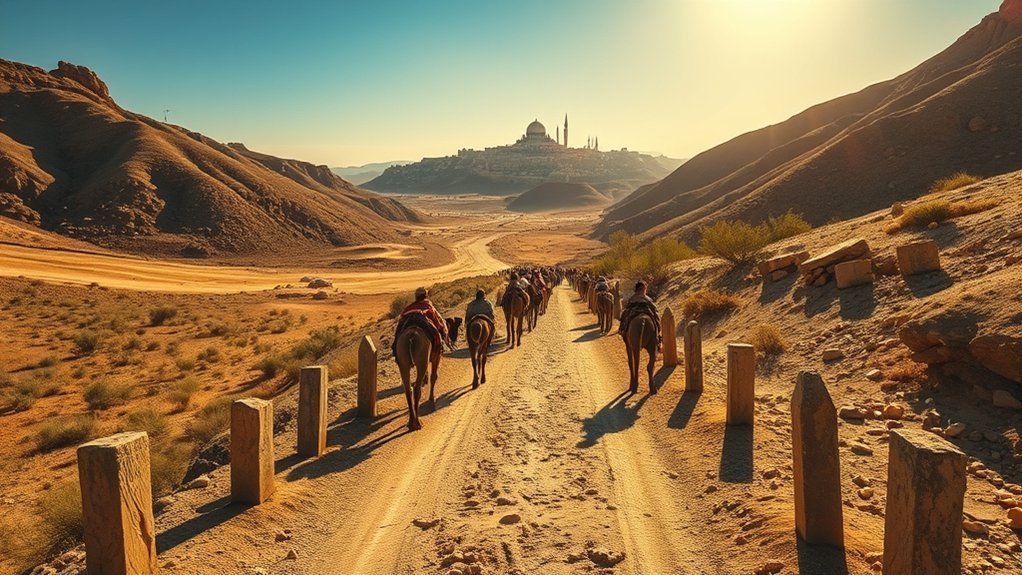
Ancient travelers combined foot travel, pack animals, established roads, local knowledge, and practical planning. The available method depended on wealth, purpose, distance, cargo, terrain, and the political conditions along the route.
Key Modes of Travel
Walking was the most accessible form of travel. Donkeys could carry food, water, textiles, tools, trade goods, and personal belongings. The Metropolitan Museum of Art’s Old Assyrian letter documents merchants who traveled long distances with donkey caravans while trading metals and textiles.
- Foot travel: Common for individuals, families, workers, messengers, soldiers, and pilgrims.
- Pack donkeys: Useful for carrying supplies and commercial goods over uneven ground.
- Caravans: Helpful for organizing people, animals, cargo, guides, and shared resources.
- Mounted travel: Faster for some officials, messengers, or people with access to riding animals.
- Carts and wagons: More practical on suitable roads and flatter ground than on narrow mountain paths.
A caravan was not automatically safer or faster. Large groups required more water, food, animal care, and coordination. Their pace could be set by the slowest traveler or the heaviest load.
Navigation Techniques Utilized
Travelers did not have modern road signs or digital maps, but they were not moving through an unknown blank landscape. Many routes had been used for generations. People could follow established tracks, ridges, valleys, rivers, springs, cultivated areas, city gates, and visible landmarks.
Local guides, oral knowledge, previous journeys, and information exchanged at settlements were likely more useful than a generalized claim that everyone navigated by the stars. The sun and night sky could help with broad orientation, but route-specific travel depended heavily on known paths and access to water.
Stone markers or cairns may have helped in some landscapes, but their use should not be treated as a universal, documented navigation system for every road toward Jerusalem.
Challenges on the Journey
Travel demanded ongoing management of food, water, health, animals, shelter, and group pace. Children and older adults could slow a family group, while loaded donkeys required feed, rest, and secure footing.
- Steep or damaged roads could reduce daily mileage.
- Illness or injury could force an extended stop.
- Water sources determined where people could rest or camp.
- Heavy rain could turn paths muddy or make channels dangerous.
- Extreme heat increased the need for water and shade.
- Robbery, warfare, tolls, and local political control could affect route choice.
- Travelers might join a larger group for shared knowledge and assistance.
These conditions explain why an apparently short direct distance could still require several difficult days.
Cultural Exchanges on Routes Through Canaan
Canaan occupied an important land bridge between Egypt, the Mediterranean coast, Syria, Mesopotamia, and Transjordan. Movement through the region carried more than cargo. Languages, artistic styles, administrative practices, religious traditions, technologies, and foodways also crossed community boundaries.
Trade Relations Along the Routes
Trade networks connected local settlements with larger regional systems. The exact goods varied by century and route, but agricultural products, textiles, metals, timber, ceramics, luxury objects, oils, wine, spices, and crafted items all moved through the ancient Near East.
- Local exchange: Food, animals, pottery, tools, and household goods circulated between nearby communities.
- Regional trade: Highland, valley, coastal, and Transjordanian settlements exchanged products suited to their environments.
- Long-distance trade: Metals, luxury goods, textiles, timber, and other high-value materials crossed much greater distances.
- Archaeological evidence: Imported pottery, seals, inscriptions, raw materials, and artistic motifs reveal contact between regions.
Trade did not produce one uniform culture. Communities adopted, rejected, or reshaped outside influences according to local needs and traditions.
Religious Interactions En Route
Bronze Age Canaan included diverse local religious practices, temples, household rituals, deities, and regional traditions. Later Israelite and Judahite religion emerged within this wider cultural environment rather than outside it.
Religious interaction should not be reduced to travelers casually blending every belief they encountered. Change occurred through long-term contact, migration, political rule, intermarriage, trade, scribal activity, conflict, and local reinterpretation.
Passover and Sukkot pilgrimage belongs to later Israelite and Jewish history. It should not be projected backward onto every traveler moving through Bronze Age Canaan. During later periods, however, festival travel helped make Jerusalem a major meeting place for communities arriving from different regions.
The Role of Trade Routes in Biblical Times
International routes gave the southern Levant strategic importance because the region stood between larger political and economic centers. The Via Maris and King’s Highway were the best-known long-distance corridors, but local roads connected them with inland cities such as Jerusalem.
- The Via Maris followed the coastal side of the region and linked Egypt with northern territories.
- The King’s Highway ran through Transjordan from the direction of the Gulf of Aqaba toward northern centers.
- The central ridge route linked highland settlements north and south of Jerusalem.
- East–west roads connected the coast, highlands, Jordan Valley, and Transjordanian routes.
These roads supported trade, taxation, diplomacy, military movement, migration, messenger networks, and pilgrimage. They also made settlements vulnerable to invading armies and competition for strategic passes.
Jerusalem’s location in the hills offered defensive advantages and access to regional roads, but it was not positioned directly on the two largest international arteries. Its importance came from the combination of terrain, political development, religious meaning, and connections to surrounding routes.
Modern Perspectives on Mapping the Ancient Journey
Modern mapping tools can calculate the distance between two identified points, but they cannot produce one historically meaningful distance between “Canaan” and Jerusalem. Canaan’s borders changed across texts and periods, and ancient travelers did not necessarily follow modern roads.
A responsible reconstruction should identify:
- The proposed starting settlement
- The approximate historical period
- The traveler’s purpose
- The likely road or geographical corridor
- Whether the measurement is straight-line or route-based
- The terrain and elevation changes
- Available settlements and water sources
- Political boundaries or security conditions for that period
Modern maps are most useful when paired with historical maps, archaeological surveys, textual evidence, and careful uncertainty. They can show topography and relative distance, but they cannot prove that one exact ancient itinerary was followed.
Frequently Asked Questions
Was Jerusalem part of Canaan?
Yes. In broad Bronze Age geographical and cultural usage, Jerusalem was a city within the southern Levant commonly called Canaan. That is why a single distance “from Canaan to Jerusalem” is misleading.
How far away were the Israelites from the Promised Land?
The answer depends on the stage of the biblical narrative. Near the end of the wilderness story, the Israelites are described as being east of the Jordan River, close to the land they were preparing to enter. Earlier parts of the journey cannot be reduced to one distance because the route and locations remain debated.
How far is Jerusalem from Cana?
Cana and Canaan are different places. Cana was a settlement in Galilee associated with the Gospel of John, while Canaan was a large ancient region. Because Cana’s precise archaeological identification is debated, estimates vary, but traditional Galilean locations are roughly 80 to 95 modern road miles from Jerusalem.
How many miles did Mary and Joseph travel to Bethlehem?
The Gospel of Luke says they traveled from Nazareth to Bethlehem but does not give a route or mileage. The direct geographical distance is around 70 miles, while a practical walking route is often estimated at roughly 80 to 90 miles, depending on the path reconstructed.
What is Canaan called today?
Canaan has no exact modern equivalent. The historical region covered parts of the area now occupied by Israel, the Palestinian territories, Jordan, Lebanon, and Syria, with its proposed boundaries varying by period and source.
How long would a 70-mile journey take in biblical times?
A strong individual moving about 15 to 20 miles per day might cover 70 miles in roughly four or five days. A family, caravan, or heavily loaded group could need five to seven days or longer because of hills, weather, water stops, illness, and animal care.
Conclusion
There is no universal distance from Canaan to Jerusalem because Canaan was an extensive ancient region and Jerusalem stood within it. A useful estimate requires a named starting city. Hebron or Jericho might be one or two days away under favorable conditions, while travel from Megiddo, Hazor, or another northern settlement could take many days.
The route also depended on geography. Highland travelers could follow the central ridge, eastern travelers climbed from the Jordan Valley, and people using the Via Maris or King’s Highway had to connect with smaller inland roads. Recognizing these distinctions produces a more accurate picture of trade, pilgrimage, political movement, and everyday travel in biblical times.
Sources
- Institute for the Study of Ancient Cultures, University of Chicago — The Levant — defines Canaan and the southern Levant and explains the region’s cultural connections.
- Bible Odyssey — Trade Routes of Palestine Map — shows the locations of the Via Maris and King’s Highway.
- Bible Odyssey — Jerusalem — provides historical and biblical context for Jerusalem, David, Solomon, and the city’s development.
- Bible Odyssey — Antioch to Jerusalem — supports the use of roughly 20 miles per day as a cautious travel estimate.
- Metropolitan Museum of Art — Old Assyrian Private Letter — documents long-distance merchants and donkey-caravan trade.
- UNESCO World Heritage Centre — Old City of Jerusalem and Its Walls — supports Jerusalem’s lasting religious and cultural importance.
