
Last Updated on July 27, 2026 by Daniel Globe
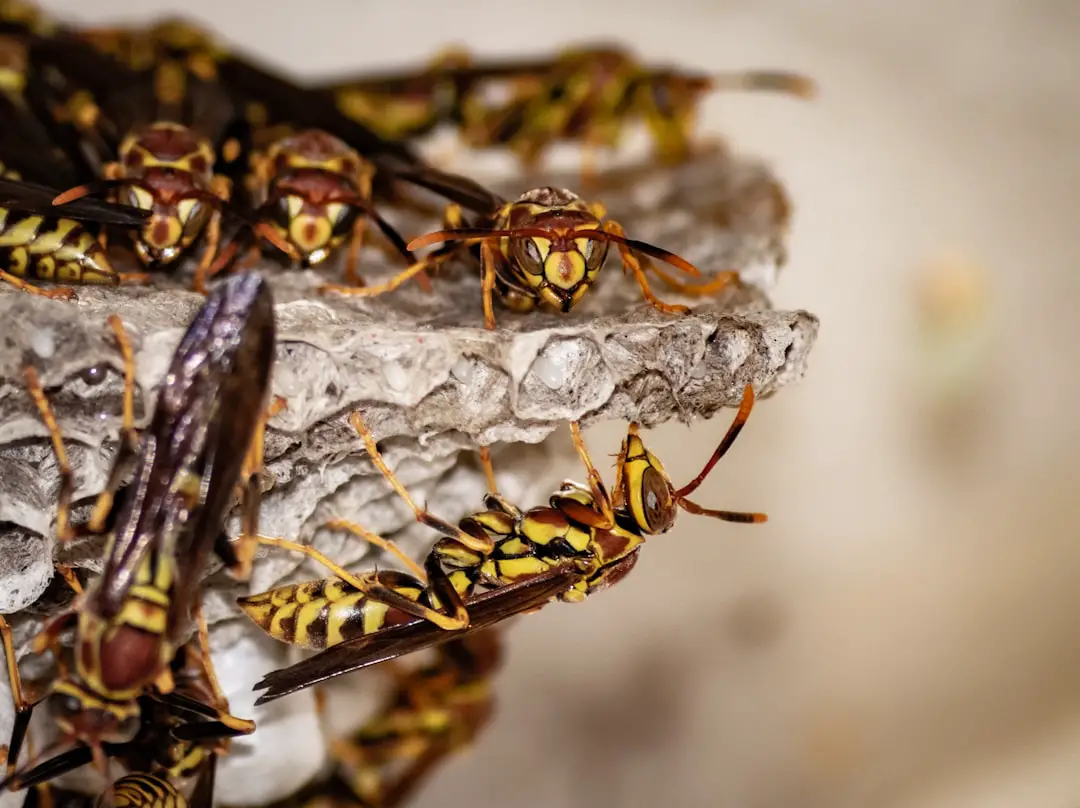
Seeing a hornet away from its nest does not reveal exactly where the colony is. Travel distance varies by species, food supply, weather, landscape, and the type of trip being measured. A worker collecting prey may remain fairly close to home, while another may follow a known food source much farther away.
Quick Answer
Hornets do not have one universal travel limit. In the best-studied yellow-legged hornet, routine foraging is often estimated within about 500 to 1,000 meters (0.3 to 0.6 mile) of the nest. Some workers travel farther, and homing ability over several kilometers should not be confused with normal daily foraging.
Key Takeaways
- There is no single travel radius that applies to every hornet species.
- Studies of the yellow-legged hornet suggest that much routine foraging occurs within roughly 500 to 1,000 meters of the nest.
- Individual workers may travel more than 2 kilometers when following a valuable food source.
- A hornet’s ability to return after being released several kilometers away is not the same as its normal foraging range.
- Food availability, colony stage, terrain, wind, rain, and competition can all change trip length.
- Do not approach or disturb a suspected nest to measure its distance from a sighting.
Disclosure: As an Amazon Associate I earn from qualifying purchases. Some links on this page are affiliate links, at no extra cost to you.
How Far Do Hornets Travel From Their Nest?
The most useful answer is a range rather than a fixed limit. A peer-reviewed RFID study of the yellow-legged hornet, Vespa velutina, estimated a foraging range of about 1,000 meters around the nest. The researchers also noted that much activity was probably concentrated closer to the colony, depending on flight duration, prey handling, and the return trip with a load.
A separate harmonic-radar study of yellow-legged hornets described a probable routine radius of roughly 500 to 700 meters. However, one tagged worker was observed foraging at an apiary 2.3 kilometers from its detected nest.
| Measurement | Evidence-based distance | What it means |
|---|---|---|
| Likely routine activity | About 500–1,000 m (0.3–0.6 mile) | A research-based estimate for Vespa velutina, not a universal rule for all hornets. |
| Documented longer foraging trip | 2.3 km (1.4 miles) | An observed worker at an apiary; this should not be treated as the normal distance of every trip. |
| Experimental homing | Some returns from release points up to 5 km (3.1 miles) | Shows orientation and return ability after displacement, not ordinary food-gathering distance. |
| Unidentified “hornet” sighting | Cannot be estimated reliably | The insect may be a true hornet, an aerial yellowjacket, a paper wasp, or another look-alike. |
A five-kilometer homing result does not mean that hornets normally search a five-kilometer radius for food. Foraging distance and return ability measure different behaviors.
True Hornets, Bald-Faced Hornets, and Yellowjackets
“Hornet” is used loosely in everyday speech. True hornets belong to the genus Vespa, while the bald-faced hornet, Dolichovespula maculata, is an aerial yellowjacket. The bald-faced hornet described by Penn State Extension builds the familiar gray, enclosed paper nest commonly seen hanging from a branch or structure.
True hornets and aerial yellowjackets are social wasps in the family Vespidae, but their nest sites, colony sizes, prey preferences, and flight behavior are not identical. This is why a distance measured for one species should not automatically be applied to another.
Many social wasp nests contain a reproductive queen, female workers, developing larvae, and, later in the season, males and new queens. Workers collect prey, sugary liquids, water, and wood fibers. Males leave the colony to mate with newly produced queens; they do not normally mate with the established mother queen in their own nest.
In the United States, the European hornet has long been established in parts of the East. The invasive yellow-legged hornet has also been detected in Georgia and South Carolina. The USDA Animal and Plant Health Inspection Service asks the public to report suspected yellow-legged hornets rather than approaching or attempting to remove their nests.
Factors Affecting the Distance Hornets Travel
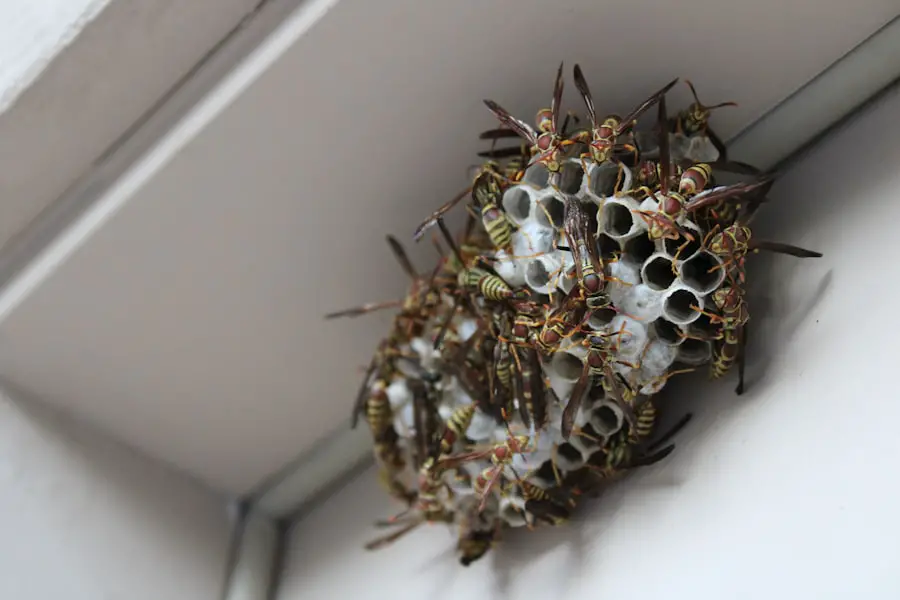
A hornet colony does not use the same travel radius every day. Workers respond to changing conditions and may repeatedly visit a dependable resource once they have learned its location.
Food and Water Availability
When prey, ripe fruit, nectar, sap, water, or human food waste is available close to the nest, workers can complete shorter trips. Scarce or scattered resources may require longer searches. A concentrated resource such as an apiary, orchard, dumpster, or outdoor dining area can attract workers from a wider surrounding area.
Colony Size and Season
Young spring colonies have relatively few workers and lower total food demand. By late summer, a mature colony may have many larvae and adults to support. More workers are active at once, which can make hornets more noticeable even when individual trip distances have not changed dramatically.
In common temperate annual colonies, the old queen, workers, and males die as cold weather arrives. Newly mated queens overwinter separately and begin new colonies the following spring. Workers left outside after a nest is treated may return to the site briefly, but they do not establish a replacement queen-led colony.
Landscape and Barriers
Woodland edges, buildings, hills, open fields, and dense urban development can alter flight paths. Hornets may follow sheltered routes, prominent boundaries, or learned paths rather than traveling in a perfect circle around the nest.
Competition and Predators
Competition from other wasps and insects may affect which resources hornets use. Disturbance or threats near a nest can also change activity temporarily, although workers must continue returning to the colony while it remains active.
Note: Nest size alone cannot be used to calculate travel distance. Species, colony stage, landscape, and resource distribution all matter.
Impact of Weather on Hornet Travel
Weather affects whether workers leave the nest, how efficiently they fly, and how long a trip takes. There is no single temperature threshold that applies to every hornet species and location.
| Weather condition | Likely effect on hornet activity | Effect on observed range |
|---|---|---|
| Warm, dry, calm weather | Supports regular flight, hunting, and material collection. | More workers may be visible across the normal foraging area. |
| Light rain | May reduce or interrupt trips. | Fewer sightings do not necessarily mean the nest is inactive. |
| Heavy rain | Strongly suppresses flight and can damage exposed resources or nests. | Activity may become concentrated near the nest or pause until conditions improve. |
| Strong wind | Makes flight control and return with prey more difficult. | Workers may use more sheltered routes or reduce long trips. |
| Cold weather, frost, or snow | Greatly reduces worker activity in temperate climates. | Late-season colonies eventually die; mated queens overwinter away from the old nest. |
A quiet nest during rain or cool weather should not be assumed to be empty. Workers can become active again when conditions improve.
Predatory Behavior and Hunting Range
Hornets are predators as well as consumers of sugary foods. Workers capture insects and other arthropods, process the prey, and carry protein-rich material back to developing larvae. Adults obtain carbohydrates from sources such as nectar, sap, ripe fruit, and larval secretions.
Prey distribution can influence hunting distance. A reliable concentration of insects may produce repeated flights along a learned route. The worker must still spend energy capturing and processing prey and then return while carrying an additional load, so maximum flight ability does not equal an efficient everyday hunting radius.
Some hornet species can recruit nestmates or attack concentrated prey resources such as honey bee colonies. That behavior should not be generalized into a claim that all hornets routinely cooperate to capture large individual prey several miles from the nest.
Can You Estimate the Nest Location From a Sighting?
A single hornet sighting cannot tell you whether the nest is 100 meters away or more than a kilometer away. The insect may be searching, feeding, collecting wood fibers, resting, or traveling along a familiar route.
Repeated movement in a consistent direction can provide trained researchers with a clue, but it does not establish an exact distance. Professional and government tracking programs may use timed flight observations, RFID tags, radio telemetry, or harmonic radar. These methods require species identification, repeated measurements, and careful interpretation.
Pro Tip: Observe an unidentified hornet only from a protected or distant position. Photograph it with zoom if this can be done safely, but do not follow it through vegetation, climb toward a nest, block its path, or attempt to capture it near suspected colony activity.
Hornets do not always fly in a simple straight line or a permanent zigzag pattern. A searching worker may change direction often, while a worker returning to a known nest or food source may use a more direct learned route.
Human Activity and Hornet Nest Distances
Changes in Food Availability and Nesting Behavior
Garbage bins, fallen fruit, pet food, sweet drinks, outdoor dining areas, compost, and insect-rich lights can attract social wasps. These resources may bring foragers close to homes even when the nest is farther away.
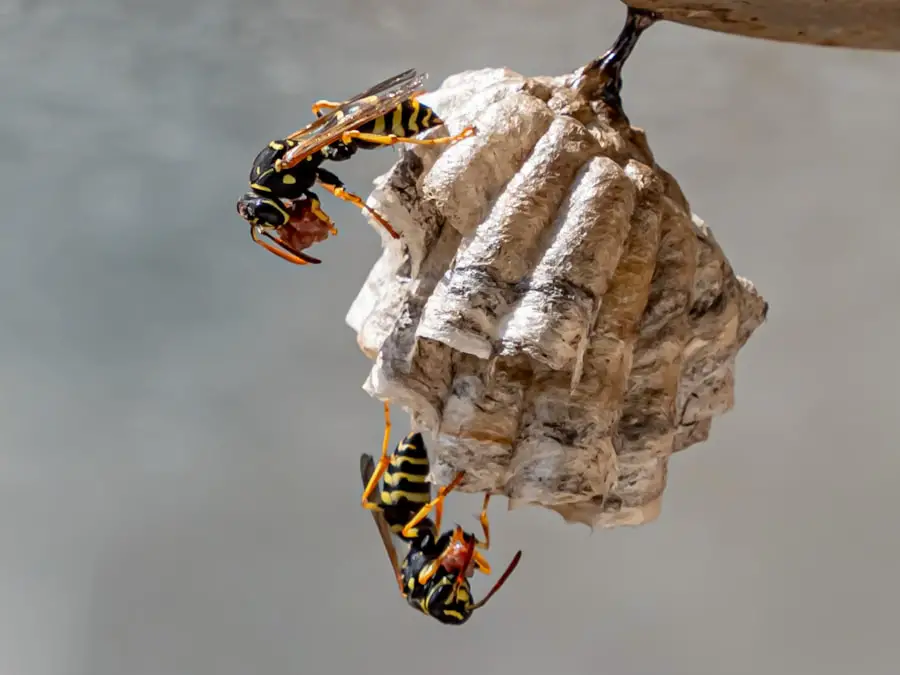
Nest placement varies by species. Bald-faced hornets commonly build exposed enclosed nests in trees, shrubs, or on structures. European hornets often use protected cavities such as hollow trees or building voids. Seeing workers near a wall opening can therefore indicate a hidden nest, but workers feeding on fruit or insects near a house may have arrived from elsewhere.
Increased Interactions and Conflicts
Foraging workers are generally less defensive than workers guarding a colony. The risk rises when people approach, vibrate, strike, mow beneath, shine a light into, or otherwise disturb a nest.
Children, pets, landscaping equipment, doorways, paths, decks, and play areas can turn an otherwise avoidable nest into a practical safety concern.
Managing Human-Hornet Interactions and Ecological Balance
Social wasps prey on many insects and can contribute to pollination while visiting flowers. A nest that is high, remote, and unlikely to be disturbed can often be left until the colony dies naturally in cold weather.
The University of Maryland Extension recommends leaving nests alone when possible, avoiding home remedies such as fire or flooding, and hiring a professional when a nest cannot be safely avoided or treated.
Removing a nest does not cause surviving workers to create a new mature colony nearby. Some workers that were away during treatment may return temporarily. A new colony requires a reproductive queen and begins through a separate founding process.
Research on Hornet Travel Patterns
Hornet travel research must account for the difference between a normal trip and an experimental release. Two commonly cited approaches illustrate that difference:
- RFID monitoring: Individually tagged workers are recorded when they leave and return. Trip duration can help researchers estimate likely foraging distance.
- Homing releases: Workers are moved known distances from the colony and monitored to see whether they return. This measures orientation ability under displacement.
- Harmonic radar: A lightweight tag allows researchers to follow portions of a flight path and search for a nest through complex terrain.
- Direct observation: Investigators watch flight direction, feeding sites, and repeated traffic, often combining these clues with tracking equipment.
In the 2018 RFID study of Vespa velutina, most recorded flights lasted less than one hour, and the researchers estimated a foraging range of about 1,000 meters. Some experimentally released workers returned from several kilometers away, including a small number from 5,000 meters.
These results show why “How far can a hornet fly?” and “How far does a hornet normally forage?” require different answers. Landscape structure, colony needs, resource availability, weather, and individual experience can all affect the result.
Tips for Managing a Hornet Nest Near Human Activity
Warning: Do not strike, burn, flood, plug, cut down, or closely approach an active hornet or social-wasp nest. Do not attempt removal if you have a history of severe sting reactions, the nest is difficult to reach, it is inside a wall, or an invasive hornet species may be involved.
Leave the Nest Alone When It Can Be Avoided
A nest away from entrances, paths, play areas, pets, and regular yard work may not require treatment. Mark the area from a safe distance and prevent people from approaching it.
Reduce Nearby Attractants
- Keep garbage and recycling containers tightly closed.
- Clean spills and remove fallen fruit.
- Cover food and sweet drinks outdoors.
- Do not leave pet food outside for long periods.
- Reduce insect-attracting outdoor lights when European hornets repeatedly gather around them.
Use a Professional for High-Risk Nests
Professional assessment is the safer option when a nest is near a doorway, inside a building void, above a play area, hidden underground, very large, or difficult to escape from after treatment. A professional can identify the species, determine the entrance, choose a labeled control method, and account for returning workers.
Do not seal the entrance to an active wall nest before the colony has been controlled. Trapped workers may search for another exit and enter indoor living spaces.
Follow the Pesticide Label
If local guidance considers homeowner treatment appropriate, use only a product labeled for the identified pest and site. Follow all application, protective-equipment, distance, storage, environmental, and disposal instructions on the label. Never improvise with gasoline, fire, boiling water, or an unlabeled chemical.
Know When a Sting Is an Emergency
A local painful or swollen area can occur after a sting. Seek immediate emergency assistance for breathing difficulty, throat or facial swelling, faintness, confusion, widespread hives, repeated vomiting, or other signs of a serious whole-body reaction. The CDC states that anaphylactic shock requires immediate emergency care.
For readers combining distant wildlife observation with a broader outdoor trip, the site’s existing guides to the best travel scooter and best sleeping bag for backpacking travel may help with mobility and overnight planning. Outdoor equipment does not make it safe to approach or disturb a hornet nest.
Frequently Asked Questions
What is the typical range for hornets to travel from their nest?
There is no universal range for all hornets. Research on the yellow-legged hornet suggests that much routine activity occurs within roughly 500 to 1,000 meters of the nest, although individual workers can travel farther.
Can hornets travel two miles in search of food?
A worker may occasionally cover that distance, but two miles should not be presented as the normal range of every hornet. One yellow-legged hornet study documented a worker 2.3 kilometers, or about 1.4 miles, from its nest, while routine activity was estimated closer to the colony.
Does seeing one hornet mean a nest is nearby?
Not necessarily. The nest could be nearby or more than a kilometer away, depending on the species and resource being visited. Repeated traffic entering the same wall opening, tree cavity, or paper nest is stronger evidence than one feeding hornet.
Do hornets travel in a straight line from their nest?
Their paths vary. A worker searching for food may turn frequently, while one traveling between a learned resource and the nest may take a more direct route. Wind, vegetation, buildings, and terrain can alter the path.
What factors influence how far hornets travel?
Important factors include species, prey and sugar availability, water, colony size, season, weather, competition, landscape barriers, and whether the worker already knows the location of a dependable resource.
How do hornets navigate back to their nest?
Hornets can learn routes and orient through their surroundings. Visual features, the sun’s position, landscape structure, and prior experience may contribute, but the exact mix varies by species and conditions.
How does bad weather affect hornet travel?
Cold, heavy rain, and strong wind generally reduce flight activity. Workers may remain in the nest, make fewer trips, or use shorter and more sheltered routes until conditions improve.
How close can I safely get to a hornet nest?
No distance guarantees safety. Do not approach a known active nest. Risk increases when a person enters the immediate nest area, blocks the flight path, creates vibration, or disturbs the supporting tree or structure. Nests near routine human activity should be assessed professionally.
Will surviving workers build a new nest after removal?
Workers that were away may return to the old location temporarily, but they do not normally establish a new mature colony. In annual temperate species, a new colony is founded separately by a mated queen.
Sources
- Ecology and Evolution: Activity Rhythm and Action Range of Vespa velutina — RFID-based foraging-range and homing-distance evidence.
- Scientific Reports: Tracking Vespa velutina With Harmonic Radar — probable foraging radius, longer observations, and tracking methods.
- Penn State Extension: Baldfaced Hornet — identification, lifecycle, nest placement, and management.
- USDA APHIS: Yellow-Legged Hornet — identification, current United States status, and reporting guidance.
- University of Maryland Extension: Social Wasps — nest-conflict prevention and safe management principles.
- CDC/NIOSH: Insects and Scorpions — sting prevention, first aid, and anaphylaxis warning.
