
Last Updated on July 27, 2026 by Daniel Globe
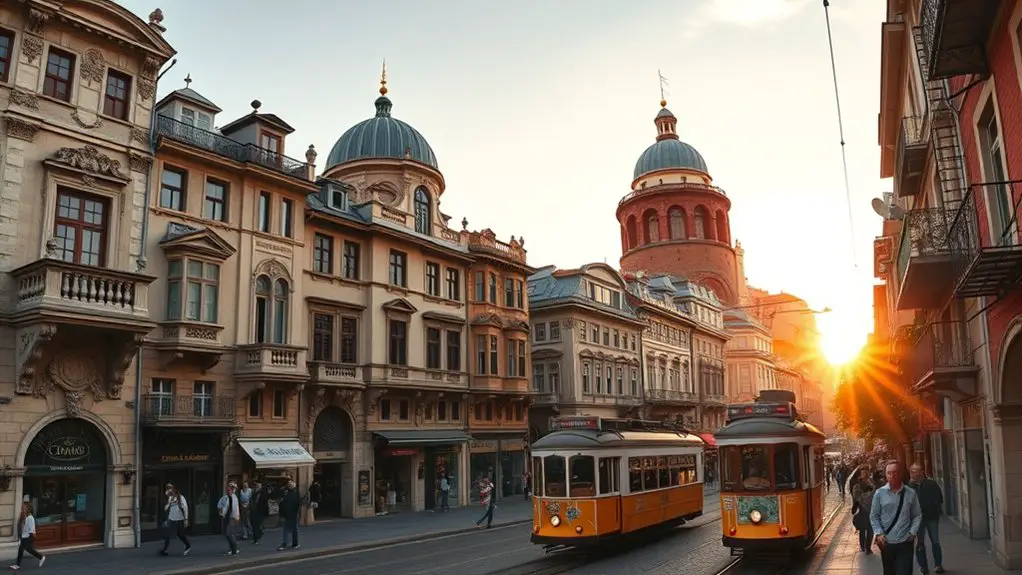
Beyoğlu is one of Istanbul’s best places to see several centuries of architecture within a relatively compact area. Around Galata and İstiklal Avenue, medieval Genoese stonework, Ottoman religious architecture, late-Ottoman European influences, Neo-Gothic churches, ornate passages, grand hotels, and Art Nouveau apartment buildings sit only minutes apart. The result is less a single architectural style than a visible record of how Istanbul changed.
Quick Answer
The most important Beyoğlu architectural landmarks include Galata Tower, İstiklal Avenue, Pera Palace Hotel, Galata Mevlevi Lodge, the Church of St. Anthony of Padua, Çiçek Pasajı, Casa Botter, and the historic Tünel. Together, they show Beyoğlu’s evolution from medieval Galata to cosmopolitan Ottoman Pera and modern Istanbul.
Key Takeaways
- Galata Tower is a medieval Genoese landmark built as part of Galata’s fortifications and now operates as a museum and viewing point.
- İstiklal Avenue is the best single route for seeing Beyoğlu’s late-Ottoman apartment buildings, churches, passages, consular buildings, and commercial architecture.
- Pera Palace Hotel opened in 1895 for travelers arriving on the Orient Express and combines a Neoclassical exterior with richly decorated historic interiors.
- Beyoğlu is not defined by one “Ottoman style.” Its architecture reflects Ottoman, Genoese, Levantine, European, Christian, Muslim, commercial, and modern influences.
- Casa Botter shows how historic buildings can be restored and reused: the 1901 Art Nouveau landmark now serves as an arts and design center.
Disclosure: As an Amazon Associate I earn from qualifying purchases. Some links on this page are affiliate links, at no extra cost to you.
Beyoğlu Architectural Landmarks at a Glance
| Landmark | What to Notice | Period / Style |
| Galata Tower | Massive cylindrical stone walls, defensive form, conical roof | Medieval Genoese, mid-14th century |
| Galata Mevlevi Lodge | Semahane, cemetery, fountain, tombs, religious complex | Ottoman, founded 1491 |
| Pera Palace Hotel | Formal exterior, ornate interiors, historic hotel details | Opened 1895; Neoclassical and Oriental influences |
| St. Anthony of Padua | Brick façade, pointed arches, vertical Gothic forms | 1906–1912; Venetian Neo-Gothic |
| Çiçek Pasajı | Ornate façade, enclosed passage, European-style commercial design | Late Ottoman / 19th-century passage culture |
| Casa Botter | Curved lines, floral ornament, decorative façade details | 1901; Art Nouveau |
| Historic Tünel | Historic underground transport connection between Karaköy and Beyoğlu | Opened 1875; transport heritage |
The Galata Tower: A Symbol of Resilience
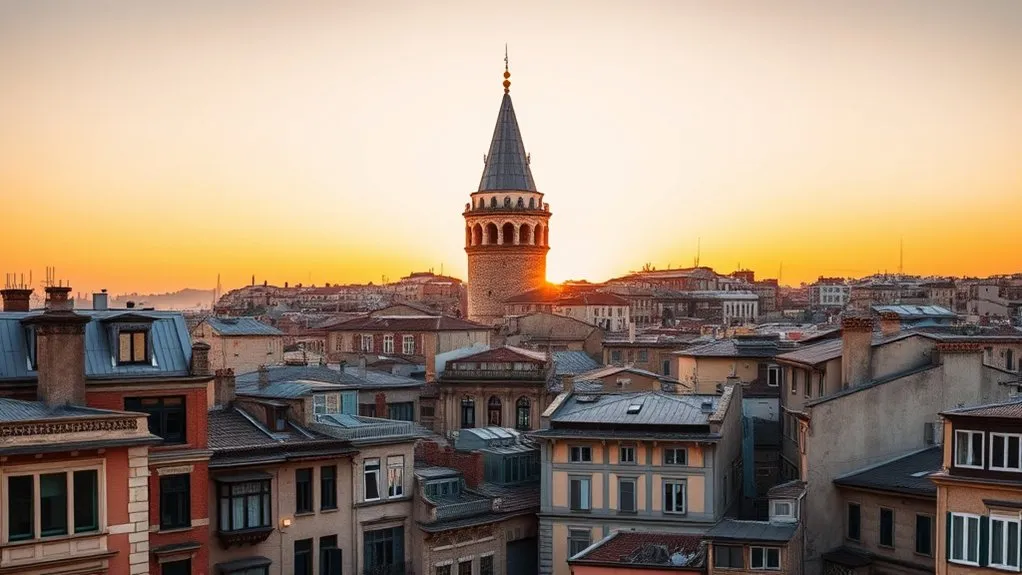
As you move through the steep streets of Galata, the Galata Tower immediately stands apart from Beyoğlu’s later apartment blocks and commercial buildings. Its thick cylindrical stone body belongs to a much earlier chapter of the district’s history.
According to the Turkish Ministry of Culture and Tourism, the Genoese constructed the tower in the mid-14th century as part of the fortifications surrounding their Galata colony. After the Ottoman conquest, the building served several purposes, including use as a dungeon and later as a fire lookout.
The official Turkish Museums description gives the tower’s height to the tip of its roof as 62.59 meters. Its surviving mass, elevated position, and panoramic outlook explain why it has remained one of Istanbul’s most recognizable landmarks even as the neighborhood around it changed.
Galata Tower rises 62.59 meters to the tip of its roof, according to the official Turkish Museums listing.
The building is now the Galata Tower Museum. Displays inside cover different periods of Istanbul’s history, while the upper areas provide views over the Golden Horn, Bosphorus, historic peninsula, and the dense roofs of Beyoğlu.
Note: The tower has an elevator serving part of the building, but the official museum description also lists stair routes through upper levels. Visitors who need step-free access should check the museum’s current accessibility arrangements before going.
Istiklal Avenue: The Architectural Spine of Beyoğlu
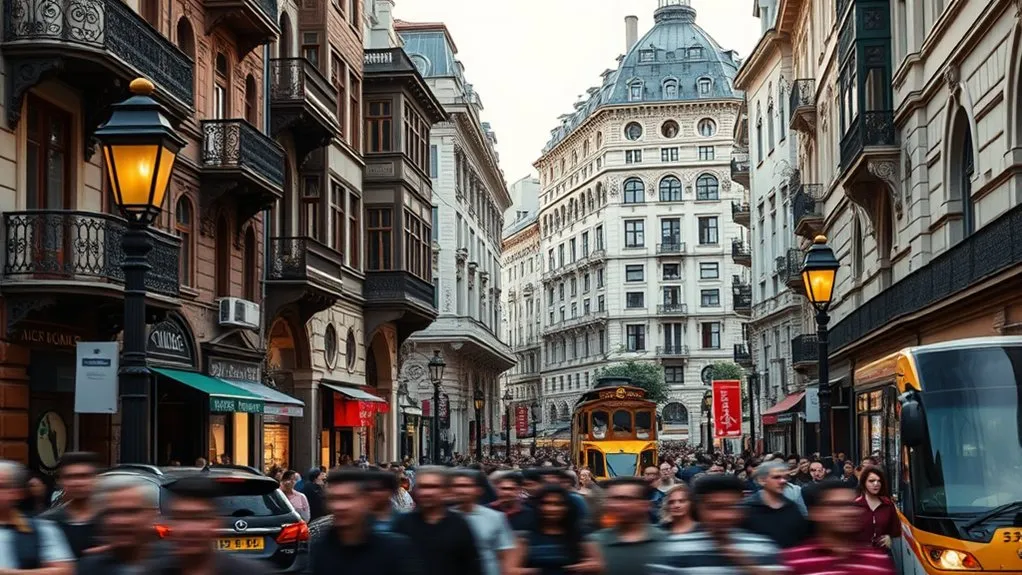
İstiklal Avenue is more than Beyoğlu’s busiest pedestrian street. It is the easiest place to understand how Pera developed into a cosmopolitan center during the later Ottoman period.
In the 19th century, the street was widely known as the Grande Rue de Péra. European embassies, Levantine families, religious communities, merchants, theaters, hotels, shops, apartment buildings, and schools shaped the area. The result was a streetscape that often looked very different from the monumental mosque and palace architecture associated with other parts of Ottoman Istanbul.
The Istanbul Metropolitan Municipality describes the avenue as one of the city’s major cosmopolitan corridors, where churches, passages, historic apartments, cultural venues, shops, and the nostalgic tram continue to reflect that history.
Look above street level as you walk. Many of the most interesting details are on upper façades: bay windows, balconies, decorative stonework, arched windows, cornices, ironwork, and carved ornament that can be easy to miss when the pavement is crowded.
Pro Tip: Walk İstiklal once at street level and then slow down for a second look at the upper floors. Some of Beyoğlu’s best architectural details sit well above the shop signs.
The Historic Pera Palace Hotel: Architecture of the Orient Express Era
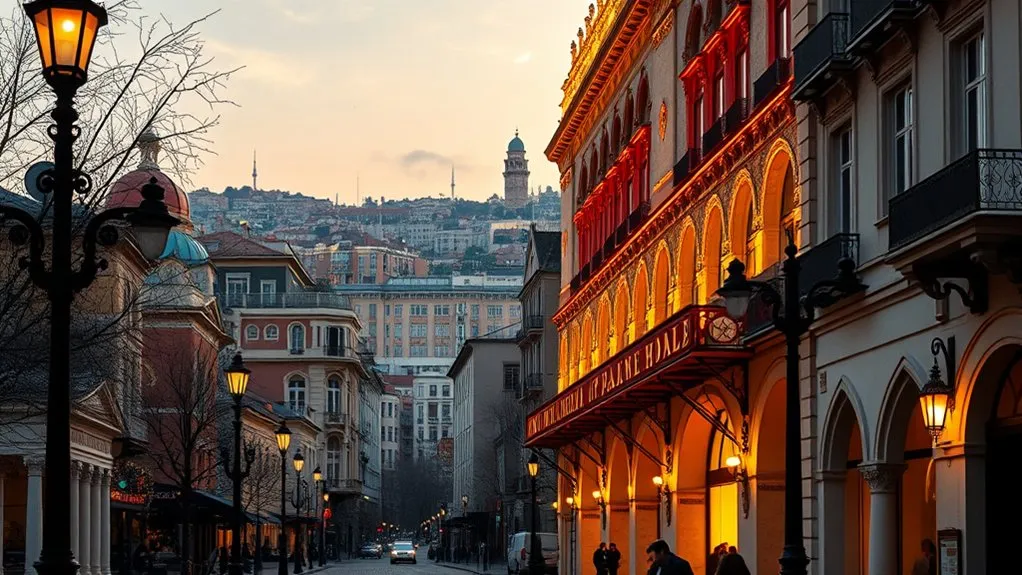
The Pera Palace Hotel represents another side of late-19th-century Beyoğlu: the era of international rail travel, grand hotels, and increasing cultural exchange between Istanbul and Europe.
The hotel’s official history says construction began in 1892 and the property opened in 1895 to accommodate passengers arriving in Istanbul on the Orient Express. Architect Alexandre Vallaury designed a Neoclassical exterior, while parts of the interior use richer Oriental decorative influences.
That mix makes the hotel valuable not merely because famous people stayed there, but because its architecture reflects the international character of Pera at the end of the Ottoman period.
Agatha Christie was among the hotel’s well-known guests, and Room 411 is associated with her visits. However, the popular story that she wrote Murder on the Orient Express at Pera Palace should be treated as a hotel legend rather than a proven historical fact; even the hotel’s own historical account describes the claim as a rumor.
The building remains a functioning hotel, so visitors should respect guest areas and current access rules when viewing its historic interiors.
Ottoman Beyoğlu Was More Architecturally Diverse Than It Looks
Beyoğlu developed under Ottoman rule, but describing its architecture only through domes, minarets, courtyards, and tile work misses what makes the district unusual.
By the 19th century, Pera had become one of Istanbul’s most international quarters. European embassies, Levantine communities, Greeks, Armenians, Jews, Catholics, Muslims, foreign merchants, and Ottoman elites all left visible marks on the built environment. That is why Neo-Gothic churches, European-inspired apartment façades, commercial passages, hotels, diplomatic buildings, and Art Nouveau details stand beside older Ottoman structures.
Galata Mevlevi Lodge: A Major Ottoman Landmark
For a clearer example of Ottoman religious architecture in Beyoğlu, visit the Galata Mevlevi Lodge near the Tünel end of İstiklal Avenue. According to Turkish Museums, the lodge was established in 1491 and is one of Beyoğlu’s important surviving Ottoman works.
The complex contains more than one building. Its historic elements include the semahane, fountain, tombs, cemetery, and other spaces connected with Mevlevi life. That makes it a useful counterpoint to the heavily European-influenced architecture farther along İstiklal.
St. Anthony of Padua: Neo-Gothic Beyoğlu
The Church of St. Anthony of Padua is one of the clearest examples of Beyoğlu’s Levantine and Catholic architectural heritage. GoTürkiye dates the present church to 1906–1912 and identifies its style as Venetian Neo-Gothic. It was designed by Italian Levantine architects Giulio Mongeri and Edoardo de Nari.
Its pointed arches, strong vertical lines, brickwork, and church courtyard create a striking contrast with the commercial buildings surrounding it on İstiklal Avenue.
Çiçek Pasajı and Beyoğlu’s Passage Culture
Beyoğlu’s covered and semi-covered passages are another defining feature of the district. These spaces linked shops, entertainment venues, restaurants, theaters, and pedestrian routes while giving builders room for elaborate European-style façades and interior decoration.
Çiçek Pasajı is the best-known example. Rather than treating it simply as a place to eat, look at its multi-story façade, repeated arches, windows, decorative details, and the enclosed commercial space behind the entrance. Other passages around İstiklal help show how shopping, entertainment, and architecture became closely connected in late-Ottoman Pera.
The Historic Tünel: Architecture Beneath the Street
Not all of Beyoğlu’s architectural heritage is above ground. The historic Tünel links Karaköy with the lower end of Beyoğlu. According to İETT’s official chronology, it opened on January 17, 1875.
The short underground railway is important because it reflects the same modernization that transformed Pera’s streets in the late 19th century. It also solves a practical problem that visitors still notice immediately: the steep climb between the waterfront and Beyoğlu.
Casa Botter: Beyoğlu’s Art Nouveau Landmark
Among the buildings on İstiklal Avenue, Casa Botter is especially valuable for understanding Istanbul’s Art Nouveau period.
The Istanbul Metropolitan Municipality dates the building to 1901. Italian architect Raimondo D’Aronco designed it for Jean Botter, the Dutch-born tailor and fashion designer who worked for Sultan Abdülhamid II.
Its façade uses the flowing curves, plant-inspired ornament, and decorative detailing associated with Art Nouveau. The original building combined commercial and domestic functions: a fashion house occupied the ground floor, a workshop sat above it, and the Botter family lived on the upper levels.
After a long period of decline, the building was restored by İBB and reopened as Casa Botter Art and Design Center. It continues to host exhibitions and cultural activities, making it one of Beyoğlu’s strongest examples of a historic building given a contemporary public use.
Modern Developments: Preservation, Restoration, and Adaptive Reuse
Modern Beyoğlu is defined not only by new construction but also by debates over what should happen to old buildings.
Adaptive reuse can give a threatened structure a viable new purpose without erasing its architectural identity. Casa Botter is a clear current example: a former fashion house and residence has become a public arts and design venue while its historical character remains central to the experience.
Other historic buildings and passages around Beyoğlu have been converted into galleries, restaurants, shops, hotels, cultural venues, and museums. These projects can keep a building active, but successful conservation depends on more than preserving a façade. Materials, scale, interior proportions, decorative details, and the historical relationship between a building and its street all matter.
Note: Restoration in Beyoğlu can be controversial. A building may look freshly repaired yet still raise questions about lost original fabric, commercial alterations, additions, or changes in use. Seeing both the preserved details and the modern interventions is part of understanding the district.
A Self-Guided Beyoğlu Architecture Walk
You can connect many of these landmarks on foot without treating them as isolated attractions.
- Start at Galata Tower. Study the massive medieval stone structure before entering the later streets of Pera.
- Walk uphill toward Galip Dede Street. Stop at the Galata Mevlevi Lodge to see an important Ottoman religious complex.
- See the historic Tünel area. The underground line itself is part of Beyoğlu’s 19th-century modernization story.
- Detour to Pera Palace. Compare its late-19th-century hotel architecture with the medieval and Ottoman sites you have already seen.
- Continue along İstiklal Avenue. Look up at apartment façades, passages, balconies, churches, and consular buildings.
- Stop at Casa Botter. Its Art Nouveau ornament is easier to appreciate once you have seen Beyoğlu’s earlier styles.
- Visit St. Anthony of Padua. Step into the courtyard to see how the Neo-Gothic church sits behind İstiklal’s commercial frontage.
- Continue to Çiçek Pasajı. Examine the passage as architecture rather than only as a dining destination.
- Finish toward Taksim Square. The changing scale and newer buildings at the northern end provide a final contrast with historic Galata.
The route involves hills, busy pedestrian areas, and uneven surfaces in places. Comfortable shoes are useful, and visitors with limited mobility should check individual building access before setting out.
Frequently Asked Questions
What Is the Best Time to Visit Beyoğlu for Sightseeing?
Spring and autumn are usually comfortable seasons for an architecture-focused walk because you can spend more time outdoors without relying on the hottest part of summer. Whatever the season, early morning is useful around Galata Tower, while late afternoon can give façades along İstiklal Avenue softer light. Weather and crowd levels can change quickly, so check conditions before setting out.
Are There Guided Tours Available for Beyoğlu’s Architectural Landmarks?
Yes. Beyoğlu and Galata are common areas for private and group history, architecture, and neighborhood walking tours. A good architecture-focused tour should go beyond landmark names and explain Pera’s Levantine communities, late-Ottoman modernization, churches, passages, apartment buildings, and the relationship between Galata and İstiklal Avenue. Tour schedules and routes change, so compare the current itinerary before booking.
How Accessible Are Beyoğlu’s Landmarks for Individuals With Disabilities?
Accessibility varies considerably. İstiklal Avenue itself is pedestrianized, but Beyoğlu also has steep streets, uneven paving, older entrances, and historic buildings that were not designed for step-free movement. Galata Tower has an elevator serving part of the structure, but stairs are still used on portions of the visitor route. Check each museum, hotel, church, or cultural venue directly for current lift, ramp, toilet, and entrance information before visiting.
What Local Cuisine Should Visitors Try While in Beyoğlu?
Beyoğlu is a good place to try meze, kebabs, döner, simit, börek, Turkish desserts, coffee, and tea. Around İstiklal, Nevizade, Asmalımescit, Galata, and nearby Karaköy, you will find everything from traditional meyhanes and pastry shops to contemporary restaurants. Galata Bridge is also known for fishing activity and restaurants, although it is not a traditional food market.
Are There Any Annual Festivals or Events Celebrated in Beyoğlu?
Yes, although venues and dates change each year. In 2026, the 33rd Istanbul Jazz Festival ran from June 30 to July 13. The Istanbul edition of the Türkiye Culture Road Festival is scheduled for September 26 to October 4, 2026, with venues across the city including locations in and around Beyoğlu. Check the Istanbul Foundation for Culture and Arts and the Türkiye Culture Road Festival for current programs.
Can You See the Main Beyoğlu Architectural Landmarks in One Day?
You can see the exteriors of the main Galata and İstiklal landmarks in one long walk, but entering museums, churches, exhibitions, and the Galata Tower will require more time. For a deeper architecture visit, split the area into Galata and lower Beyoğlu on one half-day and İstiklal, Pera, and Taksim on another.
Which Architectural Style Is Beyoğlu Best Known For?
There is no single Beyoğlu style. The district is valuable precisely because medieval Genoese, Ottoman, Neoclassical, Neo-Gothic, Art Nouveau, Levantine, commercial, diplomatic, and modern architecture overlap. The strongest impression along İstiklal Avenue is often the cosmopolitan late-19th- and early-20th-century streetscape rather than monumental classical Ottoman architecture.
Conclusion
Beyoğlu’s architecture makes sense once you stop looking for a single style. The Galata Tower preserves the memory of medieval Genoese Galata; the Galata Mevlevi Lodge represents a major Ottoman religious tradition; İstiklal Avenue, Pera Palace, St. Anthony of Padua, and the district’s passages reveal cosmopolitan late-Ottoman Pera; and Casa Botter shows the arrival of Art Nouveau and the possibilities of modern adaptive reuse.
Seen together, these landmarks explain why Beyoğlu remains one of Istanbul’s richest areas for architecture. Its buildings do more than preserve isolated moments from the past—they show how trade, religion, transportation, migration, modernization, entertainment, and conservation have continually reshaped the same streets.
Sources
- T.C. Ministry of Culture and Tourism — Galata Tower Museum — Galata Tower history, use, and museum status.
- Pera Palace Hotel — Official History — opening date, architecture, Orient Express connection, and Agatha Christie history.
- Istanbul Metropolitan Municipality — İstiklal Avenue — Pera, İstiklal Avenue, and the district’s cosmopolitan history.
- GoTürkiye — Cosmopolitan Istanbul — St. Anthony of Padua and Beyoğlu’s Levantine architectural heritage.
- Turkish Museums — Galata Mevlevi Lodge Museum — Ottoman lodge history and surviving complex.
- Istanbul Metropolitan Municipality — Casa Botter — 1901 construction, Raimondo D’Aronco, Art Nouveau architecture, restoration, and current cultural use.
