
Last Updated on July 27, 2026 by Daniel Globe
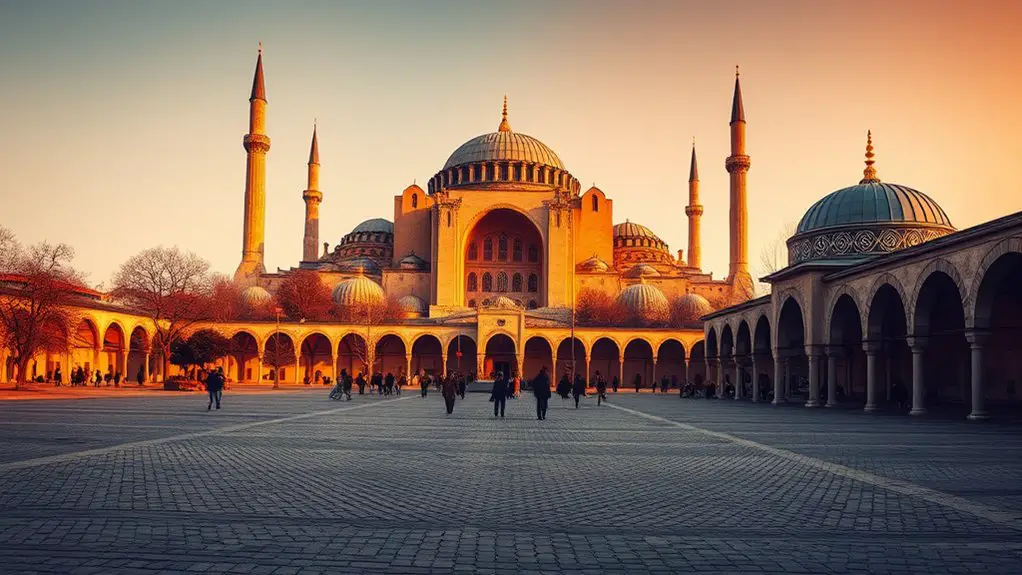
Few places show Istanbul’s layered history as clearly as Sultanahmet. Within a short walk, you can move from the remains of the Roman Hippodrome to the sixth-century Hagia Sophia, the Ottoman Blue Mosque, underground Byzantine waterworks, and Topkapı Palace. Together, these sites reveal how an imperial center changed across Greek, Roman, Byzantine, Ottoman, and modern Turkish history.
Quick Answer
Sultanahmet became historically important because it occupied the ceremonial and political heart of Byzantion, Constantinople, and later Ottoman Istanbul. Its landmarks preserve several eras at once: the Roman Hippodrome, Byzantine Hagia Sophia and cisterns, Ottoman Topkapı Palace and Blue Mosque, and a modern UNESCO-protected urban landscape.
Key Takeaways
- The Greek city of Byzantion was traditionally founded by settlers from Megara in the 7th century BCE, although human settlement in the wider Istanbul area is much older.
- Constantine made the city a Roman imperial capital in 330 CE; historians later came to call the eastern Roman state the Byzantine Empire.
- Hagia Sophia, completed in 537, became a mosque after the Ottoman conquest of 1453, a museum in 1935, and a mosque again in 2020.
- The Blue Mosque, built for Sultan Ahmed I in the early 17th century, added a major Ottoman monument directly opposite Hagia Sophia.
- Sultanahmet is part of the Historic Areas of Istanbul, inscribed on the UNESCO World Heritage List in 1985, but conservation and visitor management remain active challenges.
Disclosure: As an Amazon Associate I earn from qualifying purchases. Some links on this page are affiliate links, at no extra cost to you.
Sultanahmet History at a Glance
| 7th century BCE | Greek colonists associated with Megara establish Byzantion on the Bosphorus. |
| 330 CE | Constantine establishes Constantinople as a new Roman imperial capital. |
| 532–537 | Justinian I builds the present Hagia Sophia after the Nika revolt. |
| 1453 | Mehmed II conquers Constantinople; Hagia Sophia becomes a mosque and the Ottoman imperial center develops around the former Byzantine core. |
| 1609–1616 | Sultan Ahmed I commissions the Sultan Ahmed Mosque, better known internationally as the Blue Mosque. |
| 1935 | Hagia Sophia opens to visitors as a museum. |
| 1985 | The Historic Areas of Istanbul are inscribed on the UNESCO World Heritage List. |
| 2020 | Hagia Sophia is reopened as a mosque while remaining a major historic monument. |
The Foundations of Byzantium: A Glimpse Into the Past
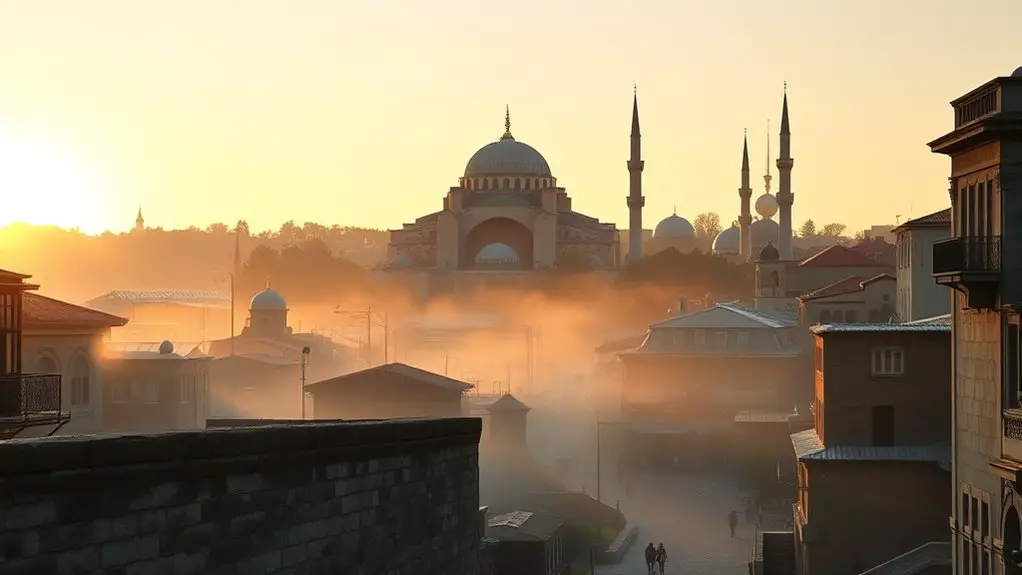
The story normally told for ancient Byzantion begins in the 7th century BCE, when Greek colonists associated with Megara established a settlement on the European side of the Bosphorus. A traditional founding date is around 657 BCE.
That does not mean Istanbul was empty before the Greeks arrived. Archaeological discoveries elsewhere in modern Istanbul, including Neolithic remains at Yenikapı, show that human occupation of the wider area reaches much farther back. The Greek foundation is important because it created the urban settlement that later developed into Roman Constantinople.
Its location was an extraordinary advantage. The settlement stood beside the Bosphorus, close to the entrance to the Black Sea, with the Golden Horn providing a sheltered natural harbor. Ships and armies moving between the Mediterranean, Black Sea, Europe, and Asia all had reason to pass nearby.
That geography gave Byzantion both commercial and military value. Control of maritime traffic could generate revenue, while water on several sides strengthened the city’s defenses. Trade, fishing, shipping, and access to regional markets helped the settlement grow long before it became an imperial capital.
Note: Historians use “Byzantine Empire” as a modern name for the medieval eastern Roman state. Its inhabitants generally understood themselves as Romans, and Constantinople remained a Roman imperial capital in their political tradition.
Constantinople: The Rise of an Imperial Capital
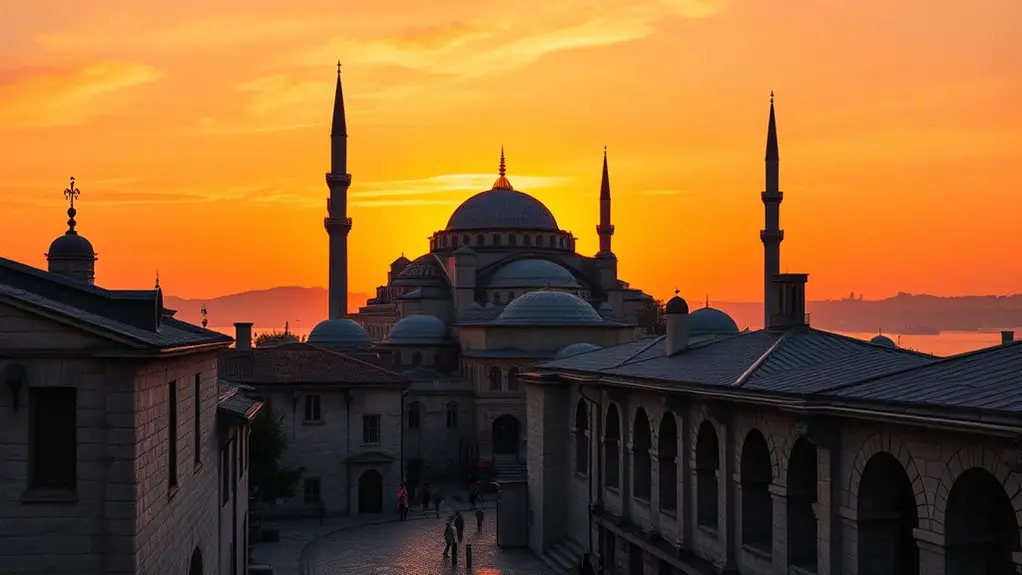
Constantine transformed the city’s role in the fourth century. In 330 CE, he established Constantinople as a new imperial capital of the Roman Empire. Its position at the meeting point of southeastern Europe and Anatolia helped connect major land and sea routes while placing the imperial government closer to strategically important eastern provinces.
Over the following centuries, Constantinople became one of the Mediterranean world’s most important political, commercial, and religious centers. The area now called Sultanahmet lay close to the heart of that imperial city.
Foundation of Constantinople
Constantine expanded the older city of Byzantion with new forums, public monuments, palaces, churches, defenses, and infrastructure. The city’s growth was not simply a renaming. It represented a major transfer of imperial attention and resources toward the eastern Mediterranean.
| Feature | Description | Historical Importance |
|---|---|---|
| Location | Between Europe and Asia beside the Bosphorus | Connected important land and maritime routes |
| Defenses | Powerful walls combined with surrounding waterways | Helped protect the capital for centuries |
| Harbors | Ports serving the Golden Horn, Marmara, and wider maritime network | Supported commerce, transport, and naval power |
| Imperial institutions | Palaces, ceremonial spaces, churches, and administrative buildings | Made the city a center of Roman government |
| Cultural diversity | Merchants, officials, clergy, soldiers, and travelers from many regions | Encouraged long-term artistic and intellectual exchange |
The Hippodrome and the Imperial Center
One of the most important surviving clues to Roman Constantinople is the former Hippodrome, whose long open space is reflected in today’s Sultanahmet Square. It was a venue for chariot racing, imperial ceremonies, celebrations, and political demonstrations.
Ancient monuments displayed along its central barrier included the Egyptian Obelisk of Theodosius and the Serpent Column. Their survival makes the square more than a park between two famous mosques: it is part of the ceremonial landscape of Roman Constantinople.
Nearby infrastructure was equally important. The city depended on aqueducts, reservoirs, and underground cisterns. The Basilica Cistern, close to Hagia Sophia, is one of the best-known surviving examples of this sophisticated water system.
Architectural Marvels and Innovations
Constantinople drew on Roman engineering while developing architectural forms that became closely associated with Byzantine art. Domes, vaults, marble revetments, mosaics, columns, and carefully controlled natural light gave major buildings an extraordinary sense of scale.
The most celebrated example is Hagia Sophia. Emperor Justinian I commissioned the present building after the Nika revolt of 532, and it was completed in 537 by Anthemius of Tralles and Isidore of Miletus.
Its enormous dome rests above a square central space through curved triangular structures called pendentives. The system was not invented there, but Hagia Sophia demonstrated it at a monumental scale that profoundly influenced later sacred architecture.
Cultural and Religious Significance
Constantinople was a major center of imperial Christianity, administration, trade, scholarship, and artistic production. Hagia Sophia served as the city’s principal cathedral for much of the Byzantine period and was closely tied to imperial ceremony.
The city was never culturally static. Merchants, diplomats, soldiers, pilgrims, and craftspeople connected it with the Mediterranean, the Black Sea, the Balkans, Anatolia, the Middle East, and more distant Eurasian trade networks.
Those contacts did not produce an uninterrupted story of harmonious coexistence; Constantinople also experienced wars, religious disputes, riots, crusader conquest, plague, and political upheaval. Its importance lies partly in the fact that so many different political and religious eras left visible traces in the same urban landscape.
The Great Transformation: From Byzantine to Ottoman
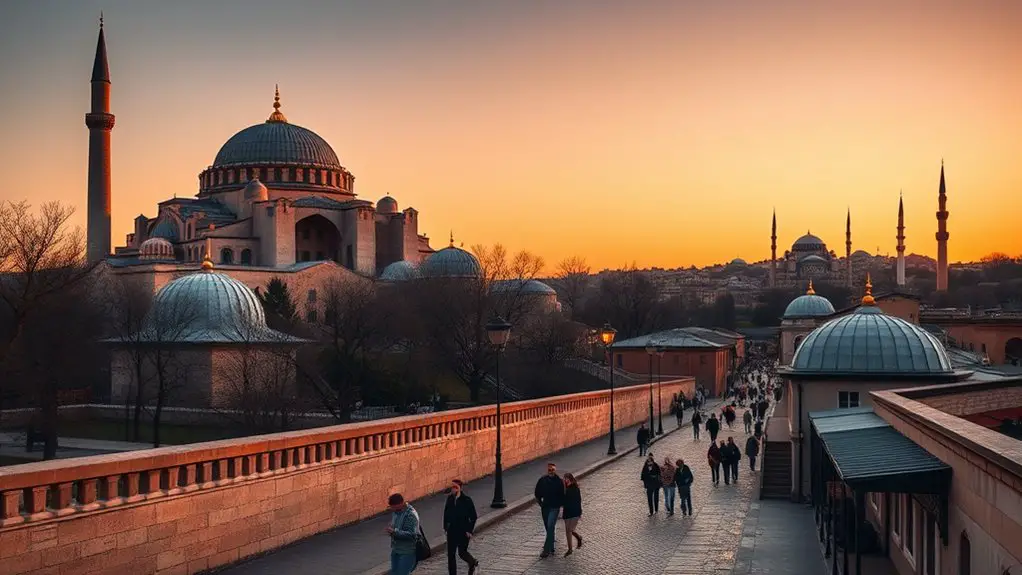
By the 15th century, the Byzantine state had lost most of the territory it once controlled. In 1453, Sultan Mehmed II conquered Constantinople, ending Byzantine imperial rule in the city and beginning a new Ottoman chapter.
The transformation was dramatic, but the Ottomans did not simply erase everything that came before. They reused, repaired, adapted, and built around older structures. Hagia Sophia became an imperial mosque, while Ottoman religious and civic buildings gradually reshaped the skyline.
After 1453, the former Byzantine imperial center became an Ottoman imperial center, preserving major Roman and Byzantine structures while surrounding them with new palaces, mosques, schools, baths, fountains, markets, and public institutions.
One of the most important Ottoman additions was Topkapı Palace, developed beginning in the 15th century near the old Byzantine acropolis. Its position reinforced the Historic Peninsula’s role as the seat of imperial power.
The architectural transition was therefore a process of adaptation as well as new construction. Byzantine domes, spatial ideas, masonry, and surviving monuments became part of a larger Ottoman architectural environment. Ottoman architects developed their own mature mosque tradition while working in a city whose most famous dome had dominated the skyline for centuries.
Architectural Wonders: The Hagia Sophia and Its Legacy
Hagia Sophia is central to Sultanahmet’s history because the building itself records several eras. Its masonry, mosaics, Ottoman additions, calligraphy, minarets, and modern conservation work all belong to different chapters of the city’s story.
Architectural Design Innovations
The building’s most famous feature is its vast central dome. Four pendentives transfer the transition from the circular base of the dome to the square formed by the main supporting piers. Half-domes, arches, buttressing, and later structural interventions help manage the enormous forces created by the roof.
A ring of windows near the base of the dome floods the upper interior with light. Combined with reflective marble and mosaic surfaces, the effect made the dome appear unusually light despite its mass.
Hagia Sophia suffered earthquake damage and structural failures over its long history, so what visitors see today is the result of repeated rebuilding and reinforcement rather than an untouched sixth-century structure. Ottoman architect Mimar Sinan was among those involved in strengthening it.
Cultural Significance Through Time
Hagia Sophia’s religious function changed more than once. The present building opened as a Christian cathedral in 537. Following the Ottoman conquest in 1453, it became a mosque, and minarets, a mihrab, minbar, calligraphy, and other Islamic elements were added over time.
It opened as a museum in 1935. In July 2020, the building was reopened for Muslim worship as a mosque.
That sequence makes Hagia Sophia especially important for understanding Sultanahmet. Christian mosaics, the Byzantine structural core, Ottoman religious additions, and modern interventions occupy the same monument. Rather than belonging exclusively to one architectural period, it physically documents the city’s changing institutions and identities.
The Blue Mosque: A Symbol of Ottoman Grandeur
Directly across the historic square, the Sultan Ahmed Mosque created a powerful Ottoman counterpart to Hagia Sophia. Sultan Ahmed I commissioned it in the early 17th century, and official Turkish sources generally date its construction to 1609–1616.
The architect, Sedefkâr Mehmed Ağa, worked within the mature Ottoman mosque tradition associated with Mimar Sinan while responding to one of the most historically charged sites in the capital.
| Feature | Description | Why It Matters |
|---|---|---|
| Central dome | About 43 meters high | Anchors the mosque’s cascading composition of domes and semi-domes |
| Minarets | Six | Give the mosque one of Istanbul’s most recognizable silhouettes |
| Interior tiles | More than 20,000 İznik tiles according to official tourism sources | Their blue-dominated decoration inspired the popular English name “Blue Mosque” |
| Function | Active mosque | It remains a living religious building as well as a major historical monument |
The visual relationship between the Blue Mosque and Hagia Sophia is one of Sultanahmet’s defining features. Their domes belong to different periods and religious traditions, yet together they illustrate how successive rulers built monumental architecture in the same ceremonial center.
Why Is the Area Called Sultanahmet?
The modern neighborhood is closely identified with the Sultan Ahmed Mosque and the square surrounding it. The mosque was commissioned by Sultan Ahmed I, whose name in Turkish appears as Sultan Ahmet; “Sultanahmet” became the familiar name associated with the area.
That modern name can disguise how much older the landscape is. Sultanahmet Square overlaps the former Hippodrome of Constantinople, while Hagia Sophia, the Basilica Cistern, and other surviving structures predate the Ottoman mosque by many centuries.
Cultural Convergence: The Meeting Point of East and West
Sultanahmet is often described as a meeting point of East and West, but the phrase is most useful when tied to specific history rather than treated as a slogan. Istanbul’s position between the Balkans and Anatolia and between the Black Sea and Mediterranean made it a long-term crossroads for people, goods, technologies, artistic traditions, and religious ideas.
- Architecture: Roman and Byzantine building traditions remained visible as Ottoman architects developed imperial mosques, palaces, baths, schools, and fountains.
- Trade: Constantinople linked Mediterranean shipping with routes extending through Anatolia and farther into Eurasia.
- Art: Mosaics, marble carving, ceramics, calligraphy, textiles, metalwork, and manuscript traditions reflect different political and cultural periods.
- Religion: Christian and Islamic monuments document major changes in the city’s religious institutions rather than one unchanging tradition.
This long interaction helps explain why Sultanahmet cannot be understood as exclusively Byzantine or exclusively Ottoman. Its significance comes from the accumulation of several historical layers in one compact landscape.
Constantinople and the Silk Roads
It is common to call Sultanahmet a Silk Road center, but that wording needs care. The Silk Roads were networks of land and maritime routes, not one road passing through a single square.
Constantinople nevertheless stood near the western end of important Eurasian commercial systems. Goods arriving through eastern land routes, Black Sea ports, Anatolia, the Mediterranean, and other networks could circulate through the capital. Silk, spices, precious materials, manufactured goods, ideas, artistic forms, and technologies all moved through these wider systems.
It is therefore more accurate to describe Constantinople and its ports as a major commercial crossroads connected to Silk Roads trade than to say the modern neighborhood of Sultanahmet itself was a single Silk Road trading station.
Sultanahmet and UNESCO World Heritage
In 1985, the Historic Areas of Istanbul were inscribed on the UNESCO World Heritage List. Sultanahmet forms part of the property’s Urban Archaeological component, alongside monuments that demonstrate the city’s Byzantine and Ottoman development.
UNESCO highlights the unusual concentration of architectural masterpieces created over many centuries, including Hagia Sophia, the Hippodrome, Topkapı Palace, the Blue Mosque, churches, mosques, cisterns, fortifications, and other structures across the Historic Peninsula.
Sultanahmet’s significance is not based on one monument alone. Its World Heritage value comes from a historic urban landscape in which Roman, Byzantine, and Ottoman architecture can still be read together.
Sultanahmet Today: Preserving History in a Modern World
Modern Sultanahmet must function as several things at once: a residential and commercial neighborhood, an active religious landscape, one of Istanbul’s busiest visitor districts, and part of a World Heritage property.
Conservation therefore involves more than cleaning historic facades. Authorities and specialists must consider structural stability, earthquakes, archaeological remains, visitor circulation, restoration methods, traffic, infrastructure, development pressure, and the impact of new construction on the Historic Peninsula’s skyline.
UNESCO’s 2025 World Heritage Committee decision acknowledged preservation work but also raised concerns about management procedures, visitor conditions at Hagia Sophia, heritage-impact assessments, restoration and development projects, and the protection of the property’s Outstanding Universal Value.
The Committee requested further monitoring in 2026 and an updated state-of-conservation report by December 2026. That makes Sultanahmet’s preservation an active process rather than a finished success story.
Pro Tip: When studying Sultanahmet’s history, look beyond the famous buildings themselves. The Hippodrome’s surviving monuments, street levels, cisterns, palace grounds, reused columns, Ottoman fountains, and changes in the skyline reveal how each era adapted the city it inherited.
Frequently Asked Questions
What role did Sultanahmet play in Silk Road trade?
It is more accurate to speak of Constantinople than the modern Sultanahmet neighborhood. Constantinople was a major commercial center linking Mediterranean and Black Sea shipping with trade routes through Anatolia and farther east. Those networks connected the city to the broader systems now called the Silk Roads, through which goods, people, artistic ideas, and technologies circulated.
How has tourism affected Sultanahmet’s historical sites?
Tourism supports jobs, businesses, museums, interpretation, and awareness of Sultanahmet’s heritage, but very high visitor numbers also create pressure. Crowd management, wear on historic spaces, traffic, commercial development, worship requirements, and visitor access all have to be balanced with conservation. UNESCO continues to review visitor management and preservation across Istanbul’s World Heritage property.
Are there local legends associated with Sultanahmet?
Yes. Centuries of imperial history have produced stories about underground passages, hidden chambers, lost treasures, supernatural events, and monuments around the Hippodrome and old Constantinople. Many such tales belong to folklore rather than documented history, so they are best treated as part of the district’s storytelling tradition unless supported by archaeological or historical evidence.
What challenges does Sultanahmet face in preservation efforts?
Major challenges include earthquake risk, aging materials, intense visitor traffic, infrastructure needs, restoration quality, new development, changes to the historic skyline, and coordination among agencies responsible for individual monuments and the wider World Heritage property. UNESCO has also emphasized the need for heritage-impact assessments and stronger visitor-management planning.
How do residents feel about living near historical sites?
There is no reliable basis for claiming that a specific percentage of Sultanahmet residents share one view. Living in a major heritage district can bring pride, employment, business activity, and access to extraordinary monuments, but it can also mean crowds, traffic, rising commercial pressure, noise, and changes to everyday neighborhood life. Attitudes naturally vary among residents and businesses.
Is Hagia Sophia still a museum?
No. Hagia Sophia opened as a museum in 1935, but its status changed again in 2020 and it now functions as a mosque. It remains a major historic monument within the UNESCO-listed Historic Areas of Istanbul, with visitor access managed alongside its religious use.
Why are Hagia Sophia and the Blue Mosque historically important together?
They face one another across the historic core but belong to different imperial eras. Hagia Sophia represents the engineering and ceremonial ambition of sixth-century Constantinople, while the Blue Mosque represents the mature Ottoman mosque tradition of the early 17th century. Seen together, they make Sultanahmet’s transition from Byzantine to Ottoman imperial center unusually easy to understand.
Conclusion
Sultanahmet’s importance comes from the fact that its past was never completely replaced. The Roman Hippodrome still shapes the main square. Byzantine engineering survives in Hagia Sophia and underground cisterns. Ottoman rulers transformed the same imperial center with Topkapı Palace, mosques, schools, fountains, and other buildings, while the Blue Mosque created one of Istanbul’s defining skylines.
That layered history also explains why preservation remains complicated. Sultanahmet is not a frozen archaeological site; it is an active neighborhood, religious center, tourism hub, and UNESCO-protected landscape. Understanding it means looking beyond individual monuments and seeing how nearly two millennia of imperial, religious, architectural, and urban change remain visible in the same streets.
Sources
- UNESCO World Heritage Centre — Historic Areas of Istanbul — World Heritage status, Sultanahmet’s archaeological component, Byzantine and Ottoman monuments, and Outstanding Universal Value.
- UNESCO World Heritage Committee — Decision 47 COM 7B.131 — current conservation, visitor-management, and heritage-impact concerns.
- Republic of Türkiye Ministry of Culture and Tourism — Hagia Sophia — construction history, architects, dimensions, Ottoman conversion, and museum period.
- GoTürkiye — Architectural Wonders — Hagia Sophia and Blue Mosque history, construction dates, İznik tiles, and six minarets.
- The Metropolitan Museum of Art — Byzantium, ca. 330–1453 — Constantinople’s foundation, Eastern Roman identity, trade position, and Byzantine chronology.
- UNESCO Silk Roads Programme — About the Silk Roads — the wider network of Eurasian land and maritime trade routes and cultural exchange.
