
Last Updated on July 25, 2026 by Daniel Globe
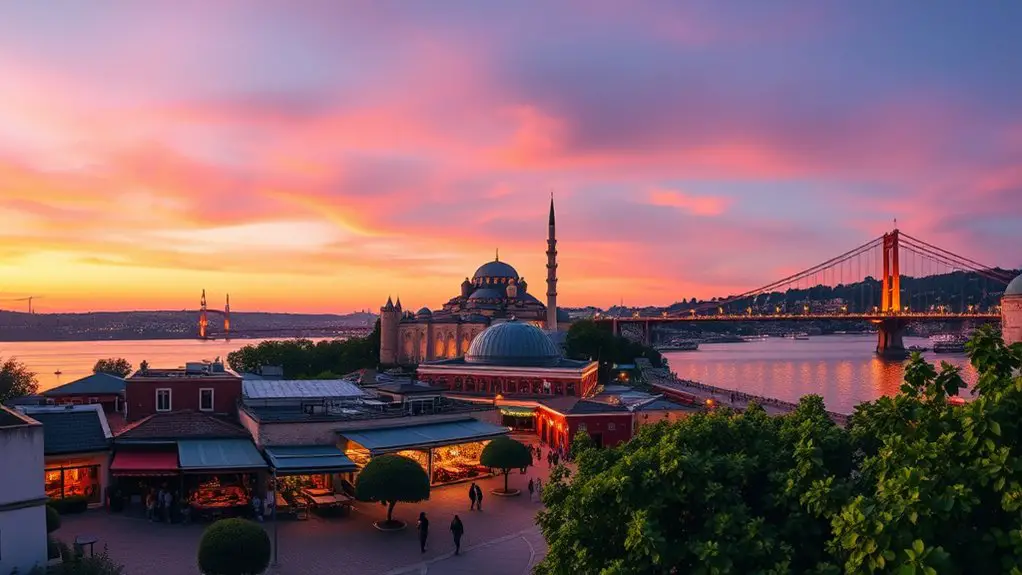
Ortaköy brings several of Istanbul’s most recognizable subjects into one compact waterfront area: the Büyük Mecidiye Mosque, the Bosphorus, ferry traffic, lively streets, and the 15 July Martyrs Bridge. The best results come from visiting at the right time, choosing a clear foreground, and allowing enough time for both daylight and evening photography.
Quick Answer
The best photography spots in Ortaköy are the mosque waterfront, Ortaköy Pier, the public square, the ferry landing, café-lined side streets, and elevated viewpoints such as Yıldız Park or Ulus Park. Arrive before sunset, photograph the blue hour, and remain after dark for illuminated mosque and bridge scenes.
Key Takeaways
- Start with the Ortaköy Mosque waterfront for the classic mosque, bridge, and Bosphorus composition.
- Use Ortaköy Pier for sunsets, reflections, ferry movement, silhouettes, and night photography.
- Visit early for cleaner architectural photographs or stay through blue hour for balanced city lights.
- Treat craft stalls, ferry departures, mosque access, and bridge lighting as changeable rather than guaranteed.
- Respect worshippers, ask before taking close portraits, and keep tripods clear of crowded pedestrian routes.
At a Glance
| Time Required | About 2–3 hours for the waterfront and evening lights; add more time for Yıldız Park or Ulus Park. |
| Difficulty | Easy around the waterfront; moderate if you add uphill parks or carry a tripod. |
| Tools Needed | Phone or camera, lens cloth, charged battery, and optional compact tripod or image stabilization. |
| Cost | Public streets and waterfront viewpoints are generally free; transport, food, tours, and private terraces cost extra. |
Note: Ortaköy is busiest on pleasant evenings and weekends. Early morning offers more open space, while the period from sunset through blue hour provides the best balance of sky color, reflections, and city lights.
Disclosure: As an Amazon Associate I earn from qualifying purchases. Some links on this page are affiliate links, at no extra cost to you.
Ortaköy Mosque: The Classic Waterfront Frame
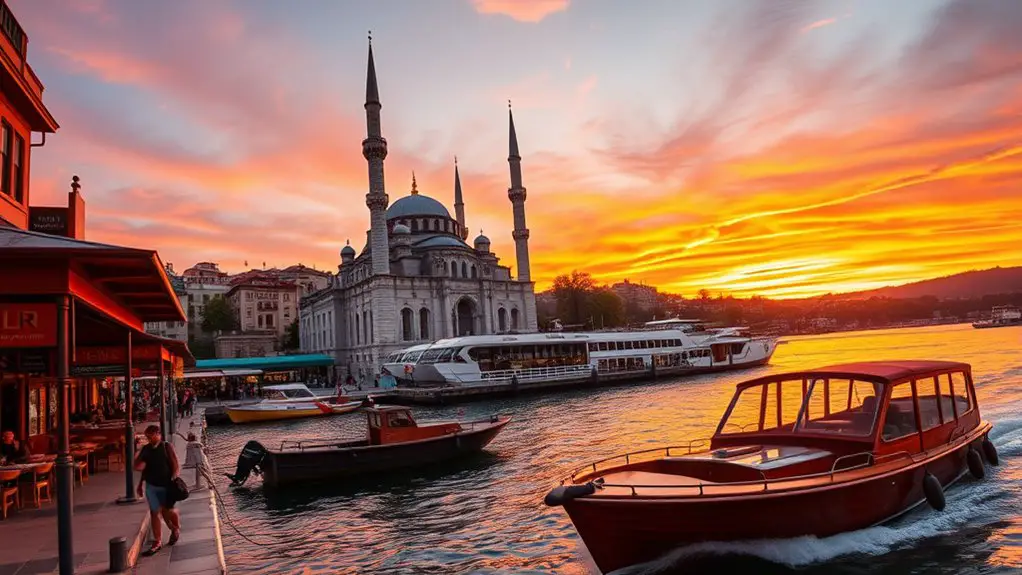
Ortaköy Mosque is formally known as the Büyük Mecidiye Mosque. It was commissioned by Sultan Abdülmecid, built between 1849 and 1854 by Nigoğos Balyan, and combines Neoclassical and Baroque influences.
The most recognizable exterior composition places the mosque in the foreground with the 15 July Martyrs Bridge extending across the background. Walk a short distance around the public waterfront instead of taking every photograph from the first open space you see. Small changes in position can separate the minarets from the bridge cables and reduce visual clutter.
- Wide view: Include the mosque, water, bridge, and a strip of sky to establish the setting.
- Architectural detail: Photograph the windows, façade ornament, dome, and minarets with a standard or short telephoto lens.
- Reflection frame: Move closer to the water when conditions are calm and look for broken reflections beneath the mosque.
- Human scale: Include a few small figures in the square to show the mosque’s relationship to daily neighborhood life.
Interior access depends on worship, ceremonies, maintenance, and instructions at the entrance. The mosque remains an active place of worship, not simply a photography attraction.
Warning: Follow posted dress and visitor instructions, avoid photographing people during prayer, silence camera sounds when practical, and do not set up a tripod where it obstructs worshippers or entrances.
15 July Martyrs Bridge: Iconic Bosphorus Views
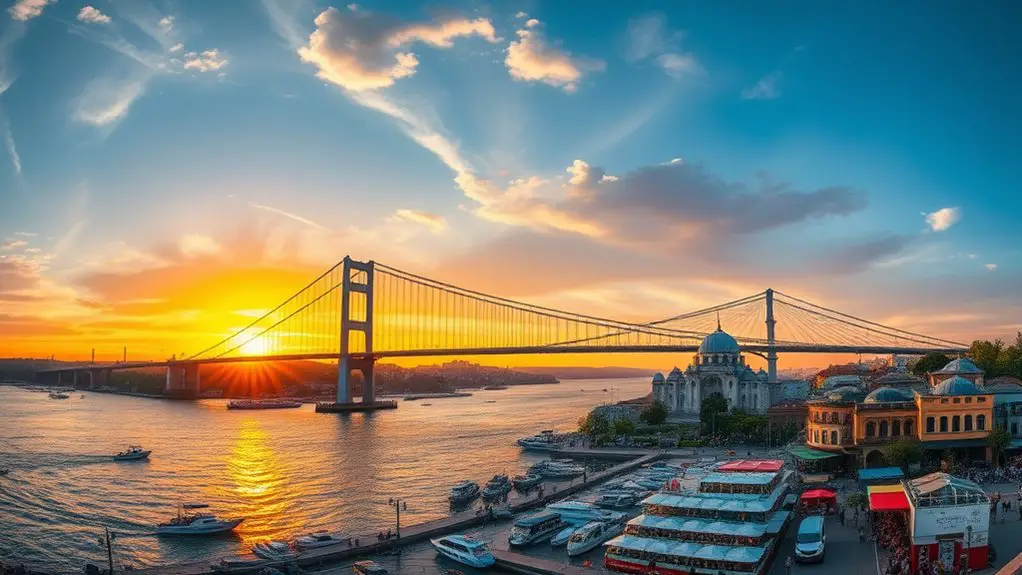
The bridge beside Ortaköy is officially the 15 July Martyrs Bridge, though many English-language visitors still call it the Bosphorus Bridge. Opened in 1973, it created the first uninterrupted road connection across the Bosphorus between Istanbul’s European and Asian sides.
From Ortaköy, the bridge works as a background, a leading line, or the main subject. The best choice depends on the sky and water. A dramatic sunset favors a wider frame, while flat or hazy light often works better for details, boats, and graphic cable patterns.
- Use the waterfront rail or paving lines to guide the eye toward the bridge.
- Wait for a ferry or smaller boat to pass beneath the span for scale.
- Try a vertical frame that layers paving, people, mosque, bridge, and sky.
- Use a longer focal length to compress the bridge, boats, and Asian shoreline.
Pro Tip: Check all four edges of the frame before pressing the shutter. Bridge cables, lamp posts, railings, and cropped pedestrians can make an otherwise strong composition feel accidental.
Ortaköy Waterfront: Reflections and Street Scenes
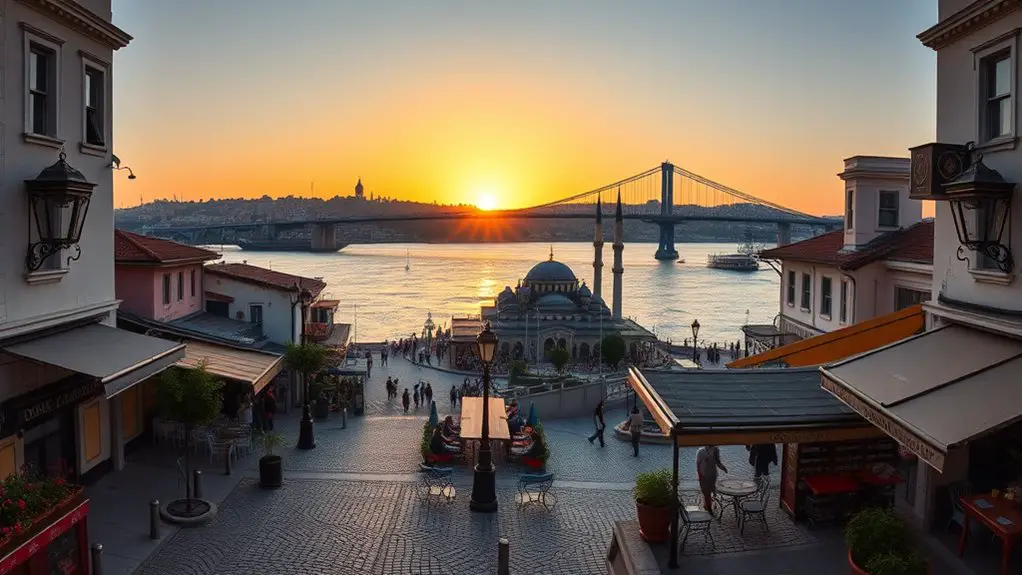
The Ortaköy waterfront combines architecture, water, boats, vendors, visitors, and changing light within a short walking distance. It is the most flexible area for photographers who want both landmark images and candid neighborhood scenes.
Begin with a clean establishing photograph of the mosque and bridge. Then turn away from the landmark view and look for smaller details: tea glasses on a table, hands preparing food, birds above the water, passengers approaching the ferry, and reflections beneath moored boats.
A strong Ortaköy photo series should show more than the postcard view: include the people, boats, food, textures, and changing light that give the waterfront its character.
- For reflections: Shoot low and keep the brightest highlights from clipping.
- For moving boats: Use a faster shutter speed to freeze motion or a slower one for controlled blur.
- For street scenes: Choose a simple background and wait for one clear gesture or interaction.
- For bad weather: Use wet paving, umbrellas, café windows, and low clouds as part of the composition.
Local Cafés: Candid Street Photography
The café-lined streets near Ortaköy Square are useful for photographing everyday activity. Steam, glass reflections, outdoor tables, narrow lanes, signs, and passing pedestrians can create more intimate images than the open waterfront.
Instead of photographing every busy table, find a clean background and wait for a single moment: a server carrying tea, friends greeting one another, a reflection passing through a window, or a musician framed between café tables.
- Use doorways and window frames as natural borders.
- Expose for faces rather than bright signs or lamps.
- Use a quiet shutter mode where available.
- Keep enough distance to preserve a natural scene.
A phone or compact camera is often less intrusive than a large camera in crowded café areas. Portrait privacy still matters: ask permission before taking a close, identifiable photograph of one person, especially a child or someone working at close range.
Ortaköy Craft Stalls and Art Displays
Craft stalls, artists, souvenir sellers, and small vendor displays may appear around the square and nearby streets. Their number and operating times can change with the day, weather, season, permits, and local events, so treat them as a possible subject rather than a guaranteed permanent market.
Colorful Local Artwork
Paintings, prints, illustrated souvenirs, and handmade decorations provide strong color and texture. Look for arrangements with a clear pattern instead of trying to fit an entire crowded stall into one photograph.
- Fill the frame with repeating colors or shapes.
- Use a wider aperture to isolate one item from a busy display.
- Photograph an artist’s hands at work only after receiving permission.
- Include part of the surrounding street when the location adds context.
Street Food and Vendor Displays
Ortaköy is especially associated with street food such as kumpir, waffles, and simit. Preparation scenes can be visually effective because they combine hands, ingredients, steam, signs, and customer interaction.
Photograph from the side rather than blocking the service counter. A short sequence—ingredients, preparation, finished dish, and customer interaction—usually tells a stronger story than one isolated photograph.
Ceramics, Textiles, and Jewelry
Small ceramics, textiles, jewelry, and decorative objects reward close observation. Watch for glare from plastic coverings or glass cases, and slightly change your camera angle until reflections no longer hide the details.
- Use soft shade for even color.
- Keep vertical and horizontal display lines straight.
- Focus on one handcrafted detail rather than the entire stall.
- Ask before moving or touching merchandise for a photograph.
Sunset at Ortaköy Pier: Golden-Hour Photography
Sunset is the most popular photography period at Ortaköy Pier because the sky, bridge, mosque, boats, and water can all receive different layers of color. It is also one of the busiest times, so arriving early is more useful than rushing into the first available position.
When to Arrive
Reach the waterfront about 45–60 minutes before sunset. This gives you time to study the cloud cover, choose a foreground, and photograph the change from daylight into golden hour and blue hour.
- Begin with wider views while the scene is bright.
- Move to silhouettes as the sun approaches the horizon.
- Photograph the mosque and bridge lights during blue hour.
- Remain alert to ferry movement, which can briefly block or improve a composition.
Color and Exposure
Sunset colors can change quickly. Avoid overprocessing them in the camera or during editing. Preserve detail in bright sky areas, then lift darker foregrounds carefully if your file format allows it.
- Tap or meter near the bright sky on a phone, then reduce exposure slightly.
- Use exposure bracketing when the sky is much brighter than the square.
- Clean the lens before shooting toward strong light.
- Check the histogram or highlight warning instead of trusting screen brightness alone.
Pier Silhouettes
People, railings, birds, minarets, and passing boats can form clear silhouettes against the sunset. Keep silhouettes simple. Overlapping figures, signs, and lamp posts quickly become an unreadable dark mass.
Move sideways until each important shape has space around it. A small figure looking across the water can provide scale without dominating the mosque or bridge.
Ortaköy Square and Greenery: City-and-Nature Frames
The open spaces and planted areas around Ortaköy Square can provide foreground leaves, shaded benches, flower details, and quieter views toward the Bosphorus. These elements help break up the hard lines of the mosque, paving, bridge, and waterfront railings.
Use branches carefully as a frame rather than allowing them to cover the mosque or minarets. A medium aperture can keep both the foreground leaves and distant architecture recognizable, while a wider aperture creates a softer natural border.
The square is also useful for environmental portraits and scenes showing how the waterfront functions as a social space. Photograph respectfully and avoid presenting strangers as the main subject without permission.
Nearby Elevated Viewpoints: Yıldız Park and Ulus Park
For a wider view of the Bosphorus, add an elevated location outside the immediate waterfront area. Yıldız Park combines wooded paths, gardens, pavilions, and higher Bosphorus views. Ulus Park is another elevated option known for looking over the Bosphorus.
These are not simply different corners of Ortaköy Square. Allow additional travel and walking time, and confirm your return route before staying for night photography.
- Yıldız Park: Best for greenery, layered city views, paths, and a quieter visual contrast to the waterfront.
- Ulus Park: Best for broad Bosphorus views and compressed skyline photographs with a telephoto lens.
- Clear weather: Use a longer lens to isolate bridges, ships, and shoreline neighborhoods.
- Hazy weather: Include foreground trees or railings to create depth rather than relying on distant detail.
Ortaköy Ferry Pier: Dynamic Boat Scenes
Ortaköy Ferry Pier adds motion and scale to the waterfront. Ferries approaching or leaving the landing can be framed with the mosque, bridge, passengers, or Bosphorus shoreline.
Official Ortaköy–Üsküdar–Kadıköy and Ortaköy–Beşiktaş–Eminönü schedules vary between weekdays, weekends, holidays, and operating periods. Check Şehir Hatları on the day of your visit rather than relying on an old departure time.
A ferry can briefly hide the mosque or bridge, but it can also provide the scale, movement, and human activity that turn a static landmark photograph into a complete Istanbul scene.
- Use continuous autofocus for ferries moving toward the pier.
- Try a fast shutter speed for crisp spray and passengers.
- Use a slower shutter only when you can hold the camera steady and keep nearby people sharp.
- Stay behind barriers and outside active boarding paths.
- Protect equipment from wind, spray, and accidental knocks near the water.
Night Photography in Ortaköy
After sunset, Ortaköy changes from a colorful street scene into a layered night cityscape. The mosque becomes the brightest architectural subject, the bridge forms a line across the dark water, and ferries create moving points of light.
Illuminated Mosque Photography
The waterfront is the easiest place to photograph the illuminated mosque. Expose carefully because the bright façade can lose detail while the surrounding square remains dark.
- Start with the lowest practical ISO.
- Use image stabilization or a stable support.
- Check highlights on the mosque after each major exposure change.
- Include some blue-hour sky instead of waiting until the sky is completely black.
- Use nearby people as small silhouettes rather than brightening every shadow.
15 July Martyrs Bridge After Dark
The bridge is illuminated after dark, but color, brightness, timing, and special-event displays can vary. Do not plan a photograph around a guaranteed blue, red, or purple sequence.
| Lighting Condition | Photography Approach | Useful Position |
|---|---|---|
| Steady bridge lights | Use a stable exposure and protect detail in the brightest sections. | Ortaköy waterfront or pier |
| Changing colors or intensity | Take several frames and review color clipping between changes. | Open view near the mosque |
| Boat light trails | Use a controlled long exposure without blocking pedestrian traffic. | A secure, wide section of the waterfront |
Warning: The waterfront can be crowded, windy, slippery, and poorly lit in places. Keep camera straps secure, remain behind barriers, watch for ferry queues, and never step into a road or boarding route to improve an angle.
Frequently Asked Questions
What time is best for photography in Ortaköy?
Early morning is best for cleaner architecture and fewer people. For color and city lights, arrive 45–60 minutes before sunset and remain through blue hour. Weekday mornings are usually easier for uncluttered compositions than pleasant weekend evenings.
Are photography tours available in Ortaköy?
Private Istanbul photography walks and local-guide tours may include Ortaköy, but availability, routes, prices, and schedules change. Check the guide’s current itinerary and confirm whether the tour focuses on instruction, portraits, landmarks, or general sightseeing before booking.
Is there an entrance fee for the viewpoints?
The public square, streets, and ordinary waterfront viewpoints generally do not require an entrance ticket. Ferry rides, food, organized tours, private terraces, and some commercial venues charge separately. Park facilities and access arrangements can also change.
What camera equipment is recommended for Ortaköy?
A phone or camera with a standard zoom is enough for most scenes. A wide lens helps in the square, while a short telephoto lens isolates bridge, boat, and architectural details. Bring a lens cloth, spare battery, and optional compact tripod for blue-hour or night photographs.
Are there restrictions on photography in Ortaköy?
Ordinary exterior photography from public areas is generally straightforward, but you must follow signs, staff instructions, security controls, and rules inside religious or private properties. Avoid photographing worshippers during prayer, ask before close portraits, and do not obstruct entrances or ferry operations.
Can I take good Ortaköy photos with a phone?
Yes. Clean the lens, avoid excessive digital zoom, tap on bright areas to control exposure, and use night mode only when subjects are mostly still. Hold the phone against a railing or stable surface when low light makes handheld images blurry.
How long should I spend photographing Ortaköy?
Allow about two to three hours for the mosque, waterfront, pier, streets, sunset, and early night lights. Add several more hours if you plan to travel to Yıldız Park or Ulus Park for elevated views.
Conclusion
Ortaköy works best as a complete photo walk rather than a single postcard stop. Begin with the Büyük Mecidiye Mosque, adjust your position for the 15 July Martyrs Bridge, explore the waterfront and café streets, and return to the pier as daylight fades. By staying through blue hour, you can build a varied set of architectural, street, ferry, sunset, and night photographs without leaving the neighborhood’s central waterfront.
Sources
- Türkiye Directorate General of Foundations — official construction, architect, architectural-style, restoration, and worship-status information for Büyük Mecidiye Mosque.
- GoTürkiye: Ortaköy — official destination background and description of the waterfront neighborhood.
- Türkiye General Directorate of Highways — official bridge name and 1973 opening information.
- Şehir Hatları: Ortaköy–Üsküdar–Kadıköy — current official ferry timetable and operating-day information.
- Şehir Hatları: Ortaköy–Beşiktaş–Eminönü — current official ferry timetable and pier information.
- GoTürkiye: Yıldız Park — official information about the park, its landscape, and panoramic Bosphorus views.
