
Last Updated on July 27, 2026 by Daniel Globe
Galata packs several of Istanbul’s most photogenic views into a compact area. You can photograph the city from the top of Galata Tower, frame the tower between old neighborhood buildings, catch ferries and reflections along the Karaköy waterfront, or cross Galata Bridge for wide Golden Horn skylines. The best location depends on whether you want a panorama, street scene, landmark portrait, or sunset.
Quick Answer
For the best views in Galata, start with Galata Tower for the highest panorama, photograph the tower itself from nearby streets, then walk downhill to Karaköy Pier and Galata Bridge for waterfront and sunset shots. Early morning is best for quiet streets; late afternoon through blue hour works best beside the Golden Horn.
Key Takeaways
- Galata Tower gives you the broadest elevated panorama over the Golden Horn, Bosphorus, historic peninsula, and surrounding rooftops.
- The streets around the tower are often better than the observation deck when you want the tower itself to dominate the photograph.
- Karaköy waterfront and Galata Bridge are the strongest free locations for ferries, fishermen, skyline silhouettes, reflections, and sunset light.
- Early morning gives you quieter streets, while late afternoon, sunset, and blue hour add warmer light and stronger waterfront color.
- Accessibility varies sharply: waterfront areas are generally easier than Galata’s steep streets, and Galata Tower’s top observation level requires stairs beyond the elevator.
Disclosure: As an Amazon Associate I earn from qualifying purchases. Some links on this page are affiliate links, at no extra cost to you.
Best Galata Photo Spots at a Glance
Photo Spots at a Glance
| Galata Tower | Best for the highest panorama. Late afternoon gives dimensional light; night-museum hours can also provide evening city views when offered. |
| Streets Around Galata Tower | Best for tower portraits, old facades, balconies, and street scenes. Go early for fewer pedestrians and softer light. |
| Rooftop Cafes | Best for elevated skyline photos with a relaxed setting. Sunset is popular, so seating, photography rules, and minimum-spend policies can vary by venue. |
| Karaköy Waterfront | Best for ferries, water reflections, layered skylines, and sunset or blue-hour photographs. |
| Galata Bridge | Best for fishermen, Golden Horn panoramas, ferries, Galata Tower in the skyline, and silhouettes around sunset. |
| Galata Mevlevi Lodge | Best for historic architecture, courtyard details, calligraphy, and a quieter cultural counterpoint to Galata’s panoramic viewpoints. |
Galata Tower: The Iconic Landmark
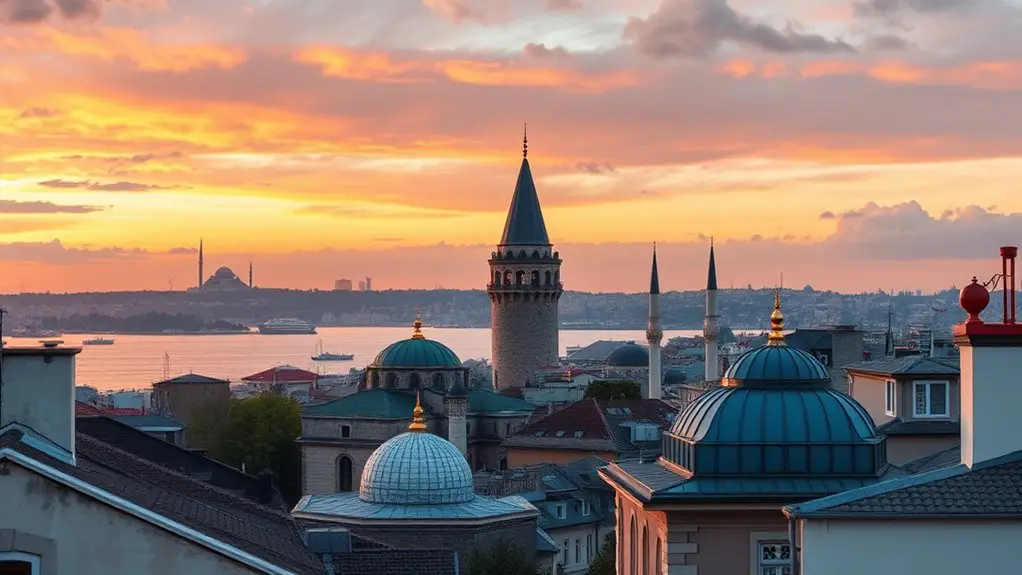
Galata Tower is the obvious starting point when you want the broadest view of Istanbul from Galata. The present tower was built by the Genoese in the mid-14th century as part of Galata’s fortifications. Today it operates as a museum and observation point under Türkiye’s Ministry of Culture and Tourism. The tower also forms part of Türkiye’s UNESCO Tentative List entry for Genoese trading posts and fortifications.
From the upper levels, you can look across the Golden Horn toward the historic peninsula and pick out a dense mix of domes, minarets, ferries, bridges, and rooftops. Turn toward the Bosphorus and you get an entirely different composition built around water traffic and the wider city.
Galata Tower works best as two photo locations in one: climb it for the Istanbul panorama, then return to street level and photograph the tower framed by the surrounding neighborhood.
For wide cityscapes, a phone’s standard or wide camera works well. A short telephoto lens is useful when you want to isolate mosque domes, ferries, bridges, or architectural details on the opposite side of the Golden Horn.
The official Galata Tower Museum page currently lists daytime opening from 08:30 to 18:30 and additional night-museum hours from 18:30 to 23:00 during the applicable night-museum program. Hours, admission prices, and night access can change, so the Ministry listing is the best source for the date of your visit.
Accessibility Warning: Galata Tower is not fully step-free to its highest panorama. The Ministry’s official tower brochure states that the elevator reaches the sixth floor and the eighth-floor observation level is reached by stairs.
How to Photograph Galata Tower From the Street
Some of the most recognizable Galata photographs are taken below the tower rather than from it. Step back into streets such as Büyük Hendek Caddesi and nearby lanes and use the surrounding buildings as a natural frame. A vertical composition often works well because it emphasizes the height of the tower above the narrow street.
Early morning has two advantages: the light is softer and the streets are less crowded. Later in the day, pedestrians, shop signs, delivery scooters, and cafe tables create a busier street-photography look.
Pro Tip: When photographing the tower from a narrow street, move farther back before switching to an ultra-wide lens. Too much wide-angle distortion can make the tower lean dramatically unless that effect is intentional.
Rooftop Cafes With Stunning Views
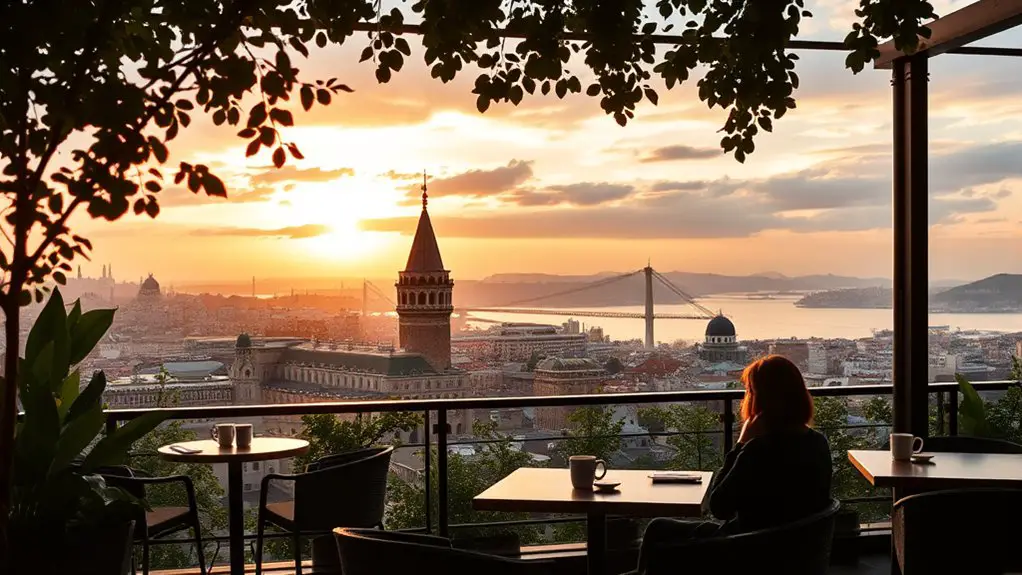
Rooftop cafes around Galata, Şişhane, and Karaköy can give you an elevated cityscape without the tight circulation of a historic observation tower. Depending on the terrace, your frame may include Galata Tower, the Golden Horn, the historic peninsula, or the Bosphorus.
They are especially useful near sunset because you can stay in one position while the light changes from warm golden tones to blue hour and city lights. A foreground cup of Turkish coffee, a railing, or part of the terrace can also add depth instead of producing another flat skyline photograph.
Remember that a rooftop cafe is a business rather than a public observation deck. Seating arrangements, photography policies, reservation requirements, and minimum spending can change. Ask before setting up a tripod or conducting a prolonged portrait session, and avoid leaning over barriers for a better angle.
Note: A terrace that looks public from the street may belong to a hotel, restaurant, or residential building. Use established businesses and public spaces rather than entering unmarked stairways or rooftops in search of a photograph.
The Scenic Streets of Galata
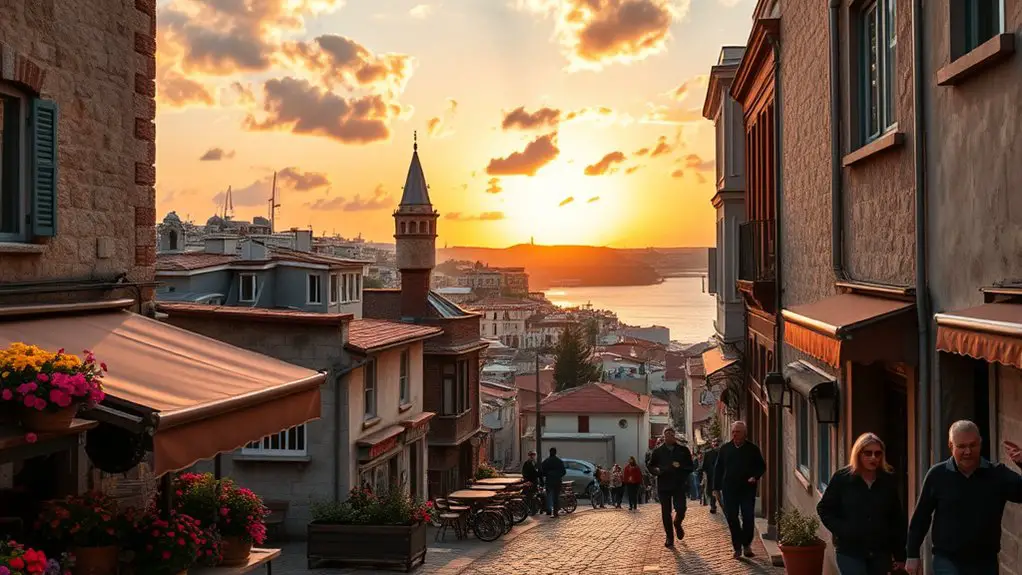
The streets surrounding Galata Tower reward a slower style of photography. Instead of looking only for panoramas, watch for stone walls, balconies, old doorways, cafe windows, steep grades, signs, street art, and glimpses of the tower appearing between buildings.
Galip Dede Caddesi is a useful spine through the neighborhood, while the lanes around Büyük Hendek Caddesi and Serdar-ı Ekrem Caddesi give you changing angles on Galata’s architecture. One or two steps sideways can completely change how a tower, balcony, or distant minaret fits between the buildings.
Morning is normally easier for clean architectural photographs. Once shops and cafes are active, the same streets become better for candid urban scenes.
For street photography, keep pedestrian flow in mind. Galata’s sidewalks and lanes can be narrow, and stopping in the middle of a busy route for a posed shoot quickly becomes disruptive. When a recognizable person is the main subject rather than incidental background, asking permission is the considerate approach.
Karaköy Pier: A Waterfront Perspective
After Galata’s steep streets, head downhill toward Karaköy for a more open photographic environment. Karaköy sits beside the Golden Horn where it meets the Bosphorus, giving you water, ferries, bridges, skyline layers, seagulls, and reflections in the same area.
Karaköy Pier remains part of Istanbul’s active Şehir Hatları ferry network, so boat traffic creates changing foreground elements throughout the day.
Scenic Sunset Views
Late afternoon is particularly effective because the light becomes warmer and lower, adding shape to the buildings across the water. As sunset approaches, expose for the sky rather than the darkest foreground areas if you want rich color instead of a washed-out horizon.
Passing ferries can improve a composition by giving it scale and movement. Try one frame with the boat centered and another where it enters from the edge and moves into open space.
After sunset, wait a little longer. Blue hour can be more photogenic than the exact sunset because the sky retains color while building, ferry, and bridge lights begin to appear.
Golden Horn and Bosphorus Backdrop
The waterfront also gives you a useful sense of Istanbul’s geography. Rather than photographing a single monument, you can layer water in the foreground, ferries in the middle distance, and the historic skyline beyond.
Reflections vary with wind, boat traffic, and surface conditions, so do not expect a mirror-flat Bosphorus. Ripples can actually make better photographs when city lights break into lines of color across the water.
The Historic Galata Bridge
Galata Bridge crosses the Golden Horn between Karaköy and Eminönü, linking the Beyoğlu side of the city with the historic peninsula. Istanbul Metropolitan Municipality documents a long history of bridges at this crossing, while the present structure carries pedestrians, road traffic, and the tram across the water.
The bridge is also one of Istanbul’s classic everyday-life photo locations. Fishermen line the upper pedestrian level, while commercial spaces and restaurants occupy the lower level. That combination gives you architecture, people, fishing rods, ferries, water, and skyline views within a few minutes’ walk.
You can read the city’s official history and structural description on the Istanbul Metropolitan Municipality Galata Bridge page.
The upper walkway is the classic place to photograph Galata Bridge’s fishermen; the lower level is where you find its commercial and restaurant spaces.
Best Angles on Galata Bridge
Look back toward Karaköy to place Galata Tower above the buildings on the hillside. Turn toward the historic peninsula for mosque-filled skyline photographs. Near the middle of the bridge, fishing rods and pedestrians can form strong leading lines toward the skyline.
A moderate telephoto lens is especially useful here because it compresses distant buildings and makes domes, minarets, and Galata Tower appear closer together. A wider lens works better when the fishermen, bridge railing, and water are part of the story.
Keep your camera and bag close to your body when the walkway is crowded, and do not step backward into pedestrian or fishing activity while composing through a viewfinder.
Galata Mevlevi Lodge: Architecture and Cultural Details
The Galata Mevlevi Lodge Museum offers a different kind of photograph from Galata Tower and the waterfront. Founded in 1491, the historic complex is valuable for its architecture, garden setting, tombs, semahane, calligraphy, musical instruments, and connection with Istanbul’s Mevlevi heritage.
It is better approached as a cultural and architectural photography stop than as a guaranteed panoramic viewpoint. The official museum information does not advertise a public rooftop terrace overlooking the Golden Horn.
Look for quieter compositions built around gateways, stonework, trees, architectural symmetry, and smaller decorative details. Interior photography rules can change, so follow the museum’s posted instructions and staff guidance rather than assuming that flash, tripods, or professional equipment are permitted everywhere.
The Ministry currently lists the museum as closed on Mondays. Its Turkish visitor page lists opening at 09:00 and closing at 19:00, with the ticket office closing earlier. Temporary restoration or exhibition work can also affect which parts of the complex are open.
Sunset at the Bosphorus
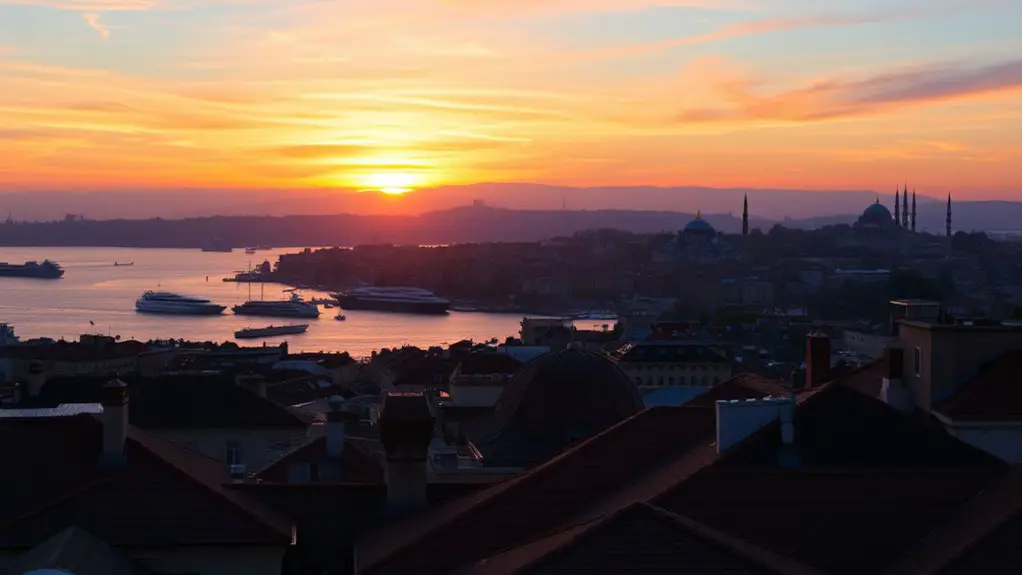
You do not need a secret rooftop to photograph a memorable Istanbul sunset. From the Karaköy waterfront and Galata Bridge, the transition from the Golden Horn toward the Bosphorus gives you water, passing boats, silhouetted architecture, and changing sky color.
Arrive before the sun becomes your only subject. The strongest photographs often happen while warm side light is still striking buildings and ferries. Once the sun reaches the horizon, look for silhouettes and reflections; after it disappears, stay for blue hour.
- Arrive early: Give yourself time to choose a position before the busiest sunset period.
- Protect the highlights: Tap or meter on the bright sky so sunset color is not overexposed.
- Add a foreground: A railing, ferry, fishing rod, person, or reflection gives the skyline depth and scale.
- Try several focal lengths: Wide shots show the setting; telephoto shots isolate domes, boats, and skyline layers.
- Stay after sunset: Blue hour can produce a better balance between the sky and city lights.
Pro Tip: On a phone, clean the lens before shooting toward the sun or bright city lights. A tiny fingerprint can turn point lights into large hazy streaks and reduce contrast across the whole image.
Hidden Gems of Galata: Lesser-Known Viewpoints
Galata’s best quieter photographs are usually found by changing your angle rather than searching for an unmarked rooftop. Explore public side streets around the tower, Şahkulu, Büyük Hendek Caddesi, Galip Dede Caddesi, and the downhill routes toward Karaköy.
From one corner, Galata Tower may fill the end of a narrow street. A block away, it can appear only as a small stone tower above old roofs. Doorways, balconies, stairways, cafe windows, and patches of street art can become foreground frames without leaving public space.
Small changes in elevation are especially useful. Galata’s hills naturally create views over lower roofs, so pause where a public street opens rather than entering private terraces or residential courtyards.
Warning: Do not climb onto roofs, walls, barriers, construction areas, or private terraces for a photograph. Galata’s steep streets already provide plenty of legal changes in elevation without taking unnecessary risks or trespassing.
A Simple Galata Photography Route
A practical route is to begin around Galata Tower while the streets are still relatively quiet, photograph both the tower and the surrounding lanes, walk toward the Galata Mevlevi Lodge and Galip Dede area, then descend through Galata toward Karaköy.
From Karaköy, continue to the waterfront and Karaköy Pier. Finish by walking onto Galata Bridge, where you can photograph both the historic peninsula and the Galata skyline as the afternoon light changes.
This order also uses the neighborhood’s elevation to your advantage: you begin on the hill and gradually work downhill toward the water rather than repeatedly climbing Galata’s steep streets.
Photography Tips for Better Galata Photos
Choose Your Light for the Subject
Early morning is best when clean streets, architecture, and unobstructed Tower compositions matter most. Late afternoon adds warmth and texture. Sunset and blue hour favor the waterfront, bridge, ferries, and skyline.
Midday is not necessarily wasted time. Narrow streets can produce dramatic patches of light and shadow, while museums and cafes give you options when the overhead light is too harsh for broad cityscapes.
Use Foregrounds and Layers
A skyline alone can look flat. Place a cafe railing, fishing rod, ferry, balcony, doorway, or pedestrian in the foreground and let the landmark sit farther back. Galata is especially good for this layered style because historic buildings create natural frames almost everywhere.
Do Not Over-Rely on Ultra-Wide
Ultra-wide lenses fit tall buildings into tight streets, but they exaggerate perspective. Take a few steps backward when possible and compare a standard focal length before deciding which version looks stronger.
Respect Crowds and Private Space
Personal photography in public outdoor spaces is straightforward in most situations, but individual museums and businesses can set their own rules. Follow no-photography signs, ask before using substantial equipment inside a venue, and avoid turning a busy walkway into an extended portrait set.
Frequently Asked Questions
What is the best time of day for photography in Galata?
Early morning is best for quieter streets and cleaner photographs of Galata Tower. Late afternoon gives buildings warmer directional light, while sunset and blue hour are strongest around Karaköy waterfront and Galata Bridge. The ideal time therefore depends on whether you are photographing streets, architecture, or the skyline.
Are there entrance fees for the viewpoints in Galata?
Public streets, the Karaköy waterfront, and walking across Galata Bridge do not require an attraction ticket. Galata Tower is a ticketed Ministry museum, and the Galata Mevlevi Lodge is also a museum attraction. Rooftop cafes normally require you to be a customer and may have their own seating or spending policies.
Is photography allowed in all the locations mentioned?
Personal photography in outdoor public areas is generally straightforward, but museums, restaurants, and other private venues can set rules for flash, tripods, professional equipment, or commercial shoots. Follow posted restrictions and staff instructions at each venue, and ask before making an identifiable person the main subject of a close street portrait.
Can I access these Galata viewpoints with a wheelchair?
Access varies. Karaköy’s waterfront and the upper pedestrian route across Galata Bridge are generally easier than Galata’s steep hill streets. Galata Tower is not fully step-free to the highest observation level: the official Ministry brochure says the elevator reaches the sixth floor and the eighth-floor panorama is reached by stairs. Confirm specific museum access needs before visiting.
Are guided tours available for Galata’s photo spots?
Yes. Istanbul tour operators regularly offer Galata, Karaköy, and Beyoğlu walking tours, and some photographers offer private photo walks or portrait sessions. Check what a tour actually includes before booking because Galata Tower admission, museum entry, rooftop access, and professional photographs may be separate.
Where is the best place to photograph Galata Tower itself?
The streets immediately around the tower are best for close architectural compositions, especially Büyük Hendek Caddesi and nearby lanes. For a more distant skyline view, photograph back toward Galata from Karaköy waterfront or Galata Bridge, where the tower rises above the surrounding hillside buildings.
Conclusion
Galata works so well for photography because its best views are not all the same. Galata Tower gives you the classic high panorama; the surrounding streets turn the tower itself into the subject; rooftop cafes provide elevated city frames; and Karaköy waterfront and Galata Bridge add ferries, fishermen, reflections, and sunset light.
Start early when you want quieter streets, then work downhill toward the water as the day progresses. By sunset, you can be on the waterfront or bridge with the Golden Horn and Istanbul skyline in front of you. The result is a much more varied set of photographs than you would get from chasing a single famous viewpoint.
Sources
- Türkiye Ministry of Culture and Tourism — Galata Tower — current museum status, visitor hours, night-museum information, and historical background.
- Türkiye Ministry of Culture and Tourism — Galata Tower Museum Brochure — tower history, floor arrangement, elevator endpoint, stair access, and observation level.
- Türkiye Ministry of Culture and Tourism — Galata Mevlevi Lodge Museum — history, current visitor information, collections, and accessible museum areas.
- Istanbul Metropolitan Municipality — Yeni Galata Köprüsü — bridge history, Karaköy/Eminönü orientation, structure, and lower-deck commercial areas.
- Şehir Hatları — Karaköy Pier — official ferry-pier information.
- UNESCO World Heritage Centre — Genoese Trade Routes Tentative List — Galata Tower’s Genoese heritage and historic context.
