
Last Updated on July 25, 2026 by Daniel Globe
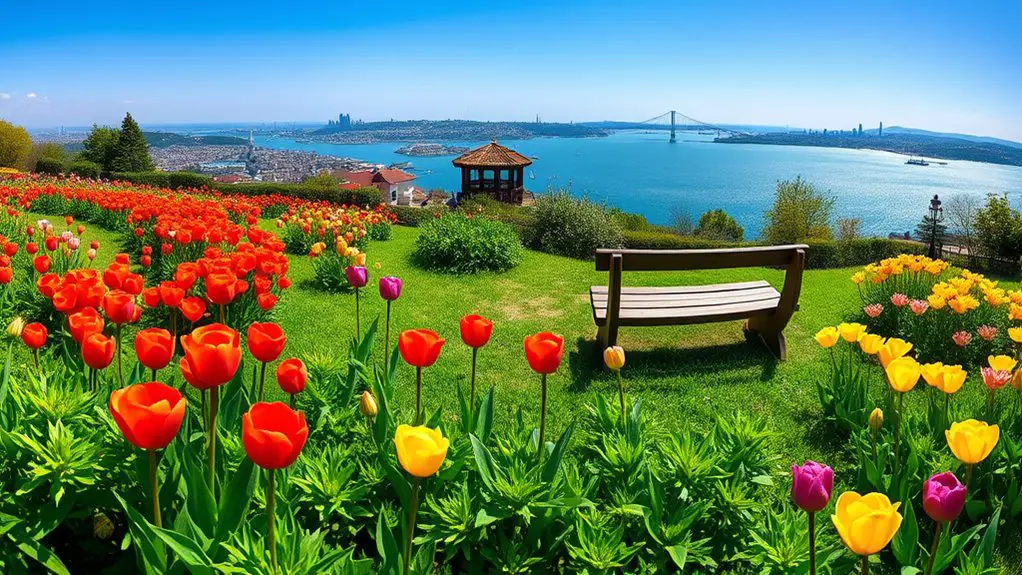
Emirgan offers some of Istanbul’s most rewarding outdoor photography, from spring tulip beds and wooded hills to historic pavilions and Bosphorus views. The strongest images come from matching each location with the right season, light, and viewpoint rather than rushing through the park’s main paths.
Quick Answer
The best Emirgan photo spots are the tulip beds and ponds in Emirgan Grove, the Yellow, Pink, and White Pavilions, the upper Bosphorus viewpoints, the waterfront near Emirgan Pier, and Emirgan Hamid-i Evvel Mosque. Visit on an early weekday for softer light, fewer people, and cleaner backgrounds.
Key Takeaways
- April is usually the strongest period for tulip photography, but the exact peak depends on weather and annual planting schedules.
- The park contains three historic buildings: the Yellow, Pink, and White Pavilions.
- Upper paths provide the broadest Bosphorus views, but Emirgan Grove is hilly and may require a steady uphill walk.
- The waterfront, pier, and mosque are below the grove and should be treated as a separate part of the photo route.
- Personal snapshots are normally straightforward, while organized or commercial shoots may require advance permission.
At a Glance
| Time Required | 2–4 hours for the grove; add time for the waterfront and mosque |
| Difficulty | Easy to moderate; expect hills, slopes, and some steps |
| Tools Needed | Phone or camera, charged battery, lens cloth, water, and comfortable shoes |
| Cost | No general walking ticket is normally required for the public grove; transport, food, events, and commercial permits are separate |
Disclosure: As an Amazon Associate I earn from qualifying purchases. Some links on this page are affiliate links, at no extra cost to you.
Best Emirgan Photo Spots at a Glance
| Photo Spot | Best Light or Season | Best Subject | Access Note |
|---|---|---|---|
| Tulip beds | Usually April; early morning | Color patterns, close-ups, paths, and layered flower beds | Stay on paths and keep equipment outside planted beds |
| Ponds and small bridges | Calm mornings or overcast days | Reflections, leading lines, trees, and water details | Watch for wet surfaces and passing visitors |
| Yellow, Pink, and White Pavilions | Morning or late afternoon | Color, façades, windows, garden framing, and architectural details | Interior or terrace access depends on current operations |
| Upper grove viewpoints | Clear mornings and warm evening light | Bosphorus, ferries, wooded slopes, and bridge views | Reaching the best openings may involve a long uphill walk |
| Emirgan waterfront | Blue hour and late afternoon | Ferries, water texture, opposite-bank scenery, and shoreline life | Use designated road crossings when moving between the grove and shore |
| Emirgan Mosque | Soft morning or evening light | Neoclassical façade, roofline, minaret, fountain, and Bosphorus setting | Avoid disrupting worship or photographing people without consent |
Emirgan Grove: A Floral Wonderland
Emirgan Grove, also called Emirgan Korusu, rises above the European shore of the Bosphorus. Its wooded slopes contain winding paths, ponds, small bridges, playgrounds, picnic areas, historic buildings, and changing views through the trees.
Spring is its most famous season. Tulip displays spread across the hills and paths, creating wide color patterns as well as smaller details for close-up photography. Outside tulip season, the park still offers deep summer greenery, autumn leaves, bare winter branches, ponds, and architectural subjects.
Begin with a wide establishing shot that shows the shape of a flower bed or path. Then move closer for individual blooms, water droplets, contrasting colors, or repeating patterns. Including a bridge, tree trunk, pavilion, or person at a respectful distance can give the scene scale.
Emirgan’s strongest photographs combine its flowers or architecture with a clear sense of place: a curving path, wooded slope, pond, pavilion, or glimpse of the Bosphorus.
The Historic Yellow, Pink, and White Pavilions
Emirgan Grove does not contain one building officially known as the “Historical Emirgan Pavilion.” It contains three 19th-century structures named for their colors: the Yellow Pavilion, Pink Pavilion, and White Pavilion.
Each adds a different architectural backdrop to the surrounding landscape. Their colored exteriors, windows, rooflines, stairs, and garden settings are more reliable photographic subjects than unverified stories about a single palace-like building.
Note: The pavilions may operate as cafés, social facilities, restaurants, or event spaces. Public access to an interior, balcony, or terrace can vary, so do not plan a photograph that depends on entering a specific room.
Architectural Details and Design
Photograph the pavilions from several distances. A wide frame can show how the building sits among mature trees and gardens. A medium frame can emphasize the façade and roofline, while a close view can isolate windows, railings, carved surfaces, or contrasting paint.
Avoid standing too close with an ultra-wide lens unless you want exaggerated vertical lines. Stepping back and keeping the camera level produces straighter walls. Trees and flower beds can act as natural frames, but check the edges of the image for distracting branches, signs, or bins.
Scenic Surroundings and Views
The paths between the three pavilions are part of the experience. Ponds, bridges, lawns, old trees, and occasional Bosphorus openings create more varied compositions than photographing each façade straight on.
Views differ by location, season, leaf cover, and venue access. Instead of expecting an unrestricted balcony panorama, look for public paths where the foliage naturally opens toward the water.
Historical Significance and Heritage
The three pavilions were built during the 19th century and remain important visual features of the grove. They show that Emirgan is more than a seasonal flower display: it is also a landscaped historic setting where architecture and nature share the frame.
Keep captions precise. Name the specific pavilion when you know it, rather than labeling every building “Emirgan Pavilion.” This improves both travel accuracy and the usefulness of image alt text.
Sunset and Evening Views of the Bosphorus
Late-afternoon light can add warmth to the water, shoreline buildings, ferries, and wooded slopes across the Bosphorus. The exact position of the setting sun changes throughout the year, so a direct sun-over-water composition is not guaranteed from every path.
Expose for the bright sky to protect color near the horizon, then lift darker foreground areas during editing if needed. On a phone, tap the bright part of the sky and lower the exposure slightly before taking the photograph.
After sunset, remain for blue hour if the park and your route are still safely accessible. The cooler sky can balance warm lights from boats, shoreline buildings, and bridges.
Pro Tip: Leaves can block broad water views during spring and summer. Walk a little higher or farther along the public path instead of forcing the shot through dense branches.
The Tulip Gardens: Emirgan’s Most Colorful Display
During Istanbul’s tulip season, Emirgan’s planted beds become its main photographic attraction. The layouts can include sweeping curves, contrasting bands of color, and flower groups arranged around paths, ponds, trees, and signs.
The displays are replanted and redesigned, so a composition seen in an older photograph may not exist in the same form during your visit. Treat each year as a new layout rather than searching for one exact flower pattern.
Tulip Colors and Varieties
You may encounter different flower forms, heights, and color combinations across the grove. Instead of relying on an unverified variety name, photograph labels where provided or describe the visible color and shape accurately.
For visual variety, take three types of image:
- Wide: Show the full bed, path, pavilion, or tree canopy.
- Medium: Isolate a repeating group of flowers or contrasting colors.
- Close: Focus on one bloom, petal texture, water droplets, or backlighting.
Best Time to Visit for Tulips and Seasonal Color
April is usually the strongest month for Emirgan’s tulip displays. The official city tourism calendar listed Istanbul’s 2026 tulip celebration for April 1–30, but future event dates and the actual peak bloom can change with weather and planting conditions. Check the official Istanbul events calendar before arranging a tulip-focused trip.
| Period | Likely Conditions | Best Photo Focus |
|---|---|---|
| Late March | Early flowers may appear, but coverage varies | Fresh greenery, early beds, ponds, and quieter paths |
| April | Usually the main tulip period; crowds can be heavy | Large displays, patterns, close-ups, and pavilion framing |
| May | Remaining tulips may fade as other greenery strengthens | Mixed seasonal planting, trees, architecture, and Bosphorus views |
| Summer | Tulips are no longer the main attraction; foliage is dense | Shade, ponds, pavilions, picnics, and framed water views |
| Autumn | Changing leaves and softer seasonal light | Tree-lined paths, fallen leaves, and warm architectural scenes |
| Winter | Quieter paths and reduced foliage | Branch patterns, mist, pavilions, and clearer sightlines |
Tulip Photography Tips
Use paths, bed edges, and streams as leading lines. A low camera angle can make the flowers appear taller, but keep your body and equipment outside the planted area.
Early morning usually provides softer light and fewer people. Late afternoon can create attractive backlighting, though the park may remain crowded during the festival period. On a bright midday visit, look for open shade or use the sky’s reflection on pale petals carefully to avoid blown highlights.
The rule of thirds is useful, but it is not mandatory. Symmetrical planting often works better with a centered composition. Before taking the photograph, decide whether the bed’s pattern calls for symmetry or a more dynamic off-center frame.
Warning: Do not step into flower beds or place tripods among the plants. Besides damaging the display, leaving the path can create unsafe crowding and spoil other visitors’ photographs.
Panoramic Views From Emirgan’s Upper Paths
As you climb through the grove, openings between the trees can reveal the Bosphorus, ferries, shoreline neighborhoods, wooded hills on the Asian side, and parts of the Fatih Sultan Mehmet Bridge. The available view changes with leaf cover and your exact position.
Four useful subjects to look for are:
- The Bosphorus and passing ferries: Leave room in front of a moving vessel so it appears to travel into the frame.
- Bridge views: Use a longer focal length when the Fatih Sultan Mehmet Bridge appears through the trees.
- Layered slopes: Combine nearby branches, the water, and the opposite shoreline to create depth.
- Minarets and rooflines: Use distant architecture as a small point of interest rather than claiming a close view of palaces far down the strait.
A clear morning often gives the sharpest distant detail. Haze can reduce clarity, but it can also create soft layers and a quieter mood.
Scenic Spots Along the Emirgan Waterfront
The Emirgan waterfront is below the hillside grove rather than part of its upper garden paths. Near the coastal road, pier, and mosque, you can photograph passing boats, water texture, shoreline activity, and the Asian side of the Bosphorus.
Reflections are strongest when the water is calm, but wind and ferry wakes can produce interesting abstract patterns. Use a fast shutter speed to freeze sparkling water or a slower handheld exposure, where practical, to soften small waves.
Benches and open sections of the shore can provide a lower viewpoint than the park. Watch the background carefully: poles, road signs, traffic, and moored boats can either add local context or distract from the main subject.
Note: The coastal road separates much of the grove from the waterfront. Use marked crossings and do not step into traffic while searching for a better camera angle.
The Historic Emirgan Hamid-i Evvel Mosque
Emirgan Mosque, officially known as Emirgan Hamid-i Evvel Mosque, stands near the Bosphorus below the grove. According to an official Diyanet architectural publication, Sultan Abdülhamid I commissioned the mosque in 1781 in memory of his son Mehmed and Mehmed’s mother, Hümâşah Kadın. The building was reconstructed under Sultan Mahmud II in 1834.
The mosque is notable for its rectangular, roof-covered form, neoclassical façade, refined interior decoration, minaret, imperial section, and relationship with the nearby square and fountain. These features provide more accurate photo subjects than the domes and tilework sometimes attributed to it in generic descriptions.
Four worthwhile compositions are:
- Façade and square: Step back enough to keep the walls and windows straight.
- Roofline and minaret: Use the sky as a clean background.
- Mosque and Bosphorus context: Include a small section of water, ferry, or waterfront activity where the angle permits.
- Fountain and surrounding street scene: Show how the mosque fits into historic Emirgan rather than isolating every detail.
As an active place of worship, the mosque requires respectful behavior. Avoid blocking doors, remain quiet near prayer times, dress appropriately before entering, and ask permission before photographing people.
Hidden Gems and Quieter Viewpoints
Emirgan’s quieter photographs usually come from small openings beside secondary paths rather than a single secret lookout. Walk beyond the busiest flower beds and watch for benches, old trees, bends in the path, elevated lawns, and gaps that frame the water.
A viewpoint can change significantly across the year. A broad winter opening may be covered by leaves in summer, while spring flowers can turn an ordinary path into a strong foreground.
Stay on established public paths and avoid climbing banks or crossing barriers. A photograph made safely from a slightly less dramatic angle is better than damaging plants or risking a fall.
A Practical Photo Route Through Emirgan
This route reduces backtracking while covering both the Bosphorus waterfront and the grove:
- Start at the waterfront: Photograph the pier, ferries, mosque exterior, square, and early light on the Bosphorus.
- Enter the lower part of the grove: Begin with ponds, bridges, and nearby seasonal planting before crowds build.
- Follow the main garden paths: Photograph the largest tulip beds or seasonal displays from both wide and low angles.
- Visit the three pavilions: Use trees and flowers to frame the Yellow, Pink, and White buildings.
- Continue toward the upper paths: Stop at public openings for Bosphorus and bridge views.
- Return in softer light: Revisit a favorite pavilion, pond, or flower bed after the direction of light has changed.
The route involves climbing. Visitors who prefer a gentler visit can focus on the lower gardens, ponds, and waterfront rather than trying to reach every upper viewpoint.
Getting There, Parking, and Accessibility
Public buses serve the Emirgan waterfront and connect it with several parts of Istanbul. Because routes and departure times can change, check the official IETT Emirgan information on the day of your trip.
Selected city ferry services also call at Emirgan. A ferry can be a scenic way to arrive, but stops vary by line, day, and season. Confirm the current service through the official Şehir Hatları timetable.
Parking may be limited during weekends, holidays, and tulip season. Arriving early or using public transport is usually more reliable than planning around a guaranteed nearby space.
The grove is built on a hillside. Some routes include steep slopes, steps, uneven paving, or long distances between attractions. Visitors with limited mobility should allow extra time, use the gentlest available paths, and follow current on-site accessibility signs.
Photography Etiquette and Safety
- Keep all feet, bags, reflectors, and tripods outside flower beds.
- Do not block paths, pavilion entrances, café seating, mosque doors, or road crossings.
- Ask before taking a recognizable close photograph of another visitor.
- Avoid photographing worshippers during prayer without clear permission.
- Keep valuables secure in crowded festival areas.
- Carry water and wear shoes suitable for hills and potentially wet paths.
- Follow temporary signs, barriers, event rules, and staff instructions.
Warning: Organized portrait sessions, advertising work, filming, large crews, and other commercial production may require municipal permission and fees. Review the current İBB photography and filming provisions before bringing professional lighting, multiple tripods, models, or a production team.
Sources
- Visit Istanbul — Emirgan Grove — official overview of the grove, seasonal scenery, ponds, paths, picnic use, and three historic pavilions.
- Visit Istanbul — Festivals and Events — official 2026 tulip-event period and current city event information.
- IETT — Transport to Emirgan Pier — current public bus connections serving Emirgan.
- Şehir Hatları — Ferry Timetables — current city ferry lines and schedules.
- Diyanet, Din ve Hayat: Boğaziçi — Emirgan Mosque’s date, patronage, reconstruction, plan, and architectural character.
- İstanbul Metropolitan Municipality 2026 Fee Schedule — municipal provisions for organized filming and photography.
Frequently Asked Questions
What is the best time to visit Emirgan Park for photos?
Visit in April for the strongest chance of seeing the main tulip displays, although peak bloom depends on the weather. For softer light and fewer people, arrive early on a weekday. Autumn is also rewarding for foliage, while winter can provide quieter paths and clearer views through the trees.
Are there entrance fees for Emirgan Grove or the pavilions?
A general admission ticket is not normally required to walk through the public grove. Food, drinks, private events, commercial photography, and services inside pavilion facilities may have separate costs or access conditions.
Is parking available near Emirgan’s main viewpoints?
Parking may be available in or around the Emirgan area, but spaces should not be treated as guaranteed. Tulip season, weekends, and holidays can be especially busy. Public buses or a ferry service that calls at Emirgan are often more dependable.
Can I bring food and drinks to Emirgan Grove?
The official city guide identifies the grove as suitable for picnics, so bringing a simple meal or drink is generally reasonable. Use bins, leave planted areas undisturbed, and follow all current signs concerning fires, grills, glass, waste, and restricted areas.
Are guided tours available for Emirgan’s viewpoints?
Private licensed guides may include Emirgan in a wider Bosphorus or tulip-season itinerary, but a standard recurring official viewpoint tour was not confirmed. Check the guide’s route, language, duration, pavilion access, and photography focus before booking.
Can I use a tripod in Emirgan Grove?
A small tripod for personal photography may be practical when it does not block a path or enter a planted bed. Larger setups, models, lighting equipment, and commercial production may require municipal permission, so verify the current rules before the visit.
Is Emirgan Grove easy to explore with limited mobility?
Some lower areas may be manageable, but the grove’s hillside setting includes slopes, steps, uneven surfaces, and longer uphill routes. Allow extra time, use gentler marked paths, and check current on-site accessibility information before attempting the upper viewpoints.
Conclusion
Emirgan rewards photographers who slow down and explore beyond the first flower bed. Begin with the mosque and waterfront, follow the ponds and tulip paths toward the three historic pavilions, and finish at an upper Bosphorus viewpoint if the terrain suits you.
April brings the most famous color, but the grove remains worth photographing through summer greenery, autumn foliage, and quieter winter days. Respect the flower beds, worshippers, other visitors, and current access rules, and you will return with photographs that show both Emirgan’s beauty and its true character.
