
Last Updated on July 25, 2026 by Daniel Globe
For memorable photos around Taksim, start with the Republic Monument in Taksim Square, then follow İstiklal Avenue for street scenes, historic façades, Çiçek Pasajı, and the red nostalgic tram. Continue toward Galata for street-level tower compositions and panoramic views from Galata Tower. One important correction: Taksim Maksemi is a historic water-distribution building and museum, not a hilltop sunset viewpoint.
Quick Answer
The best photography spots around Taksim include Taksim Square and the Republic Monument, İstiklal Avenue and its nostalgic tram, Çiçek Pasajı, Taksim Maksemi, the streets around Galata Tower, and Galata Tower’s observation level. Visit early for quieter streets or later for warmer light and lively city scenes.
Key Takeaways
- Go early in the morning for cleaner compositions on İstiklal Avenue; choose late afternoon and evening when you want warm light, signs, crowds, and movement.
- The nostalgic T2 tram is one of the area’s strongest photo subjects, but stay clear of the rails and never block the moving tram for a photograph.
- Galata Tower is the main elevated panoramic viewpoint on this route and requires admission; its surrounding streets also offer excellent free exterior compositions.
- Çiçek Pasajı is valuable for architecture and interior atmosphere, but today’s passage is dominated by restaurants and meyhanes rather than the flower stalls that inspired its name.
- Taksim Maksemi is a historic Ottoman water-distribution structure and İBB Cumhuriyet Museum—not a hill or panoramic lookout.
Disclosure: As an Amazon Associate I earn from qualifying purchases. Some links on this page are affiliate links, at no extra cost to you.
Taksim Square: Republic Monument and City Life
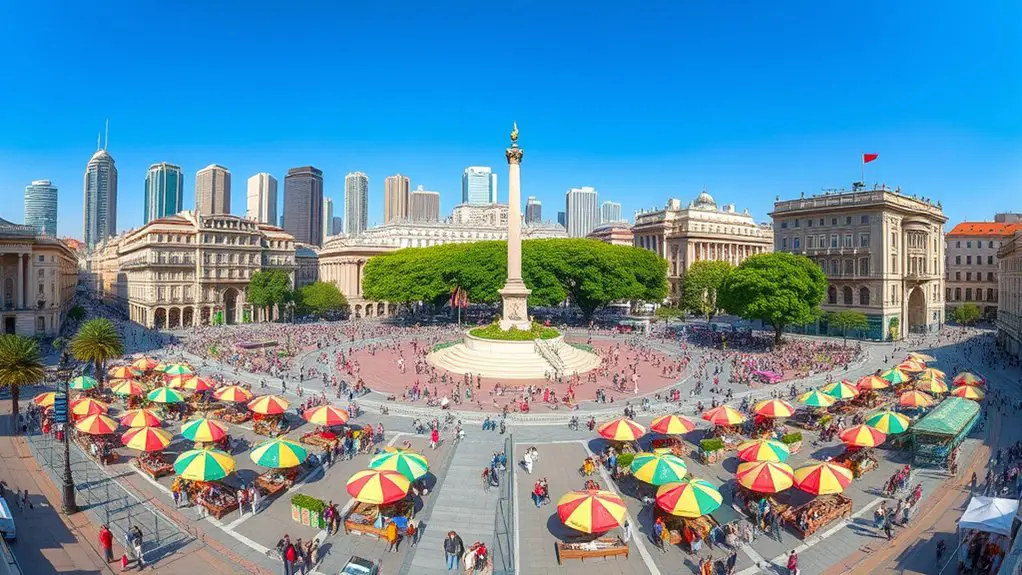
Taksim Square is a natural starting point because it combines open space, architecture, transport, and constant pedestrian movement. The Republic Monument gives you a clear focal point in the middle of the square while the surrounding buildings, mosque, cultural venues, commuters, and visitors provide changing backgrounds.
The monument was created by Italian sculptor Pietro Canonica and officially opened on August 8, 1928. Its two principal sides represent the Turkish War of Independence and the new Republic, making it more than a decorative backdrop. The Atatürk Encyclopedia’s history of the Taksim Republic Monument provides more detail about its design and construction.
For a cleaner architectural shot, move around the monument rather than photographing it only from the busiest pedestrian approach. A lower angle can isolate the figures against the sky, while a wider frame can include the square’s activity and show how the monument functions within modern Taksim.
Pro Tip: Visit shortly after sunrise if you want fewer people around the monument. Later in the day, use the crowds deliberately as foreground movement instead of waiting for an empty square that may never appear.
Galata Tower: Panoramas and Street-Level Compositions
Galata Tower is farther down the Beyoğlu route toward Galata rather than immediately beside Taksim Square, but it is one of the strongest photography stops in the wider Taksim–İstiklal area.
The present tower was built by the Genoese in the mid-14th century as part of Galata’s fortifications. During the Ottoman period it later served, among other functions, as a fire-observation tower. Today it operates as a museum under Turkey’s Ministry of Culture and Tourism.
The upper level provides broad views across Istanbul, including the Golden Horn, Bosphorus, historic peninsula, rooftops, and dense cityscape. The official Galata Tower museum page should be checked before visiting because hours and access arrangements can change. As of July 2026, the Ministry lists regular daytime opening from 08:30 to 18:30 and night-museum hours from 18:30 to 23:00.
You do not have to enter the tower to make a good photograph. The narrow streets around Kuledibi and Galata create strong upward-looking frames, especially when the cylindrical stone tower appears between older façades. A moderate telephoto view can compress the street and tower, while a wider lens emphasizes the steep streets and surrounding architecture.
Note: Galata Tower is a ticketed museum attraction. Photographing the tower from surrounding public streets is free, so exterior shooting is a useful alternative when queues are long or you do not need the observation-level view.
İstiklal Avenue: Street Scenes and the Nostalgic Tram
İstiklal Avenue offers a different type of photography. Instead of one fixed landmark, the subject is movement: pedestrians, storefront reflections, architectural details, street musicians, signs, side passages, and the red nostalgic tram.
The T2 Taksim–Tünel nostalgic tram remains an operating public-transport service on İstiklal Avenue. İETT describes it as one of Istanbul’s symbolic transport vehicles and continues to operate and maintain the line. You can confirm its history and current role through İETT’s official nostalgic-tram information.
Early morning is best when you want stronger symmetry, visible façades, and fewer people around the tram. By afternoon and evening, the street becomes more crowded, but that creates opportunities for motion blur, silhouettes, reflections, performers, and layered street scenes.
Instead of standing directly in front of the tram, photograph from the side of the route or use a longer focal length to frame it through pedestrians. Around Galatasaray, side passages and intersecting streets also let you step away from the densest flow for architectural details and quieter compositions.
Warning: The nostalgic tram operates through a heavily pedestrianized street. Do not stand, pose, place a tripod, or leave equipment on the rails for a photograph. Keep watching for the tram even when the surrounding crowd appears stationary.
Çiçek Pasajı: Historic Architecture and Interior Details
Just off İstiklal Avenue, Çiçek Pasajı offers a compact change of scene from outdoor street photography. The passage was completed in 1876 on the site associated with the former Naum Theatre and was originally known as Hristaki Pasajı/Cité de Péra.
Its ornate façade, arched interior, decorative details, upper levels, and covered passage make good subjects for architectural photography. Look upward as well as straight ahead: balconies, columns, ironwork, decorative faces, and the rhythm of the interior can produce stronger images than a simple photograph down the center aisle.
The name can be misleading to first-time visitors. Flower sellers became strongly associated with the passage during the 20th century, but by the 1950s many had moved elsewhere and restaurants, taverns, and meyhanes increasingly occupied the space. An İstanbul Metropolitan Municipality guide to historic markets and passages describes this transition.
Çiçek Pasajı was completed in 1876, but the flower sellers behind its familiar name are part of its history; today the passage is better known for historic architecture, restaurants, and meyhanes.
Because the passage is an active dining space, avoid blocking entrances or photographing diners at close range without permission. For architecture, a quieter time of day will usually give you more control over vertical lines and interior symmetry.
Taksim Maksemi: Historic Architecture, Not a Hilltop Viewpoint
The place sometimes confused with a supposed “Maksemi Hill” is actually Taksim Maksemi, a historic water-distribution structure beside Taksim Square. It is not an elevated hill overlooking the Golden Horn or Bosphorus.
According to İstanbul Metropolitan Municipality records, Sultan Mahmud I commissioned the maksem in 1732–33. Water arriving through the Taksim water system was divided and distributed from this structure, and the function of “taksim,” meaning division or distribution, is closely connected with the area’s name.
After restoration and reuse, the building now serves as İBB Cumhuriyet Museum. The İBB Cumhuriyet Museum page provides current museum information and explains the history of the maksem.
For photography, concentrate on the octagonal form, stone exterior, entrance details, inscriptions, and the contrast between this 18th-century water structure and the much busier modern square around it. The nearby Republic Monument provides another historical subject within a very short walk.
If your priority is a true elevated sunset panorama, Galata Tower is the relevant viewpoint on this route. Taksim Maksemi is better treated as an architectural and historical stop.
Best Time to Photograph Taksim and İstiklal Avenue
There is no single best hour because the area changes character throughout the day.
- Early morning: Best for quieter İstiklal Avenue scenes, cleaner architecture, easier tram compositions, and fewer people around the Republic Monument.
- Late afternoon: Useful for warmer directional light and more active street scenes.
- Blue hour and evening: Good for illuminated storefronts, tram lights, signs, reflections, and a stronger sense of nightlife.
- Busy midday periods: Less useful for empty architectural frames but excellent when crowds and movement are part of the photograph.
Golden hour can be attractive, but the surrounding buildings create strong areas of shade. Check the direction of the light rather than assuming every location will be evenly illuminated just before sunset.
Easy Taksim-to-Galata Photography Route
A simple walking route lets you photograph the main locations without repeatedly retracing your steps:
- Taksim Square: Begin with the Republic Monument and wider square.
- Taksim Maksemi: Photograph the historic water-distribution building and museum exterior near the square.
- İstiklal Avenue: Follow the tram route and photograph street scenes, façades, performers, and reflections.
- Çiçek Pasajı: Step inside for architectural details and a covered interior scene.
- Tünel and lower Beyoğlu: Continue toward the Galata end of İstiklal, where the streets become narrower and steeper.
- Galata Tower and Kuledibi: Finish with exterior tower compositions or enter the tower for the panoramic view.
Carry only the equipment you expect to use. A phone or small camera works well for the crowded sections of İstiklal, while a wide-to-normal lens is useful for architecture and a short telephoto can help isolate the tram or Galata Tower through the streets.
Pro Tip: Treat people and movement as part of the composition rather than a problem to remove. Taksim and İstiklal are rarely empty, and photographs often feel more authentic when the tram, pedestrians, performers, and architecture share the frame.
Street Photography Etiquette and Practical Safety
Taksim and İstiklal Avenue are busy public spaces, so stay aware of other pedestrians while composing a shot. Keep bags and camera straps controlled in dense crowds, avoid stopping suddenly in narrow passages, and move to the side before changing lenses or checking images.
For wide street scenes, people may naturally appear in the frame. For close portraits of performers, vendors, workers, or identifiable individuals, asking first is the more respectful approach. Inside restaurants, museums, shops, and cultural venues, follow any photography rules displayed by the operator.
Frequently Asked Questions
What is the best time to visit Taksim for photos?
Go early in the morning for fewer people and cleaner photographs of the Republic Monument, İstiklal Avenue, and the nostalgic tram. Late afternoon and evening are better for warmer light, illuminated storefronts, motion, and lively street scenes. Golden hour can work well, although surrounding buildings often create deep shade.
Are there entrance fees for the photography spots?
Taksim Square, İstiklal Avenue, the exterior of Çiçek Pasajı, Taksim Maksemi’s exterior, and the streets around Galata Tower can be photographed without an admission ticket. Galata Tower is a ticketed museum, and İBB Cumhuriyet Museum inside Taksim Maksemi also has its own admission policy. Check their official pages before your visit because prices and hours can change.
Can I find guided photo tours in Taksim?
Yes. Private walking and photography tours are offered around Taksim, İstiklal, Galata, and nearby Beyoğlu. When choosing one, check whether the guide actually provides photography instruction or simply leads a sightseeing route. A portfolio and clearly stated itinerary are useful indicators for photographers.
Where can I buy photography equipment nearby?
Electronics retailers around central Beyoğlu can be useful for common items such as memory cards, cables, chargers, or power banks, but specialist camera and lens stock varies considerably. For an important replacement body, lens, or battery, check a dedicated camera dealer’s current inventory before making a special trip.
Are restrooms available at the photography spots?
Do not assume every outdoor photo stop has a public restroom. Streets, squares, and exterior viewpoints may have no dedicated facilities. Museums, larger cultural venues, transport hubs, and cafés are more reliable options, although access conditions can vary.
Is Galata Tower within walking distance of Taksim?
Yes for travelers comfortable with a longer city walk. A natural route follows İstiklal Avenue from Taksim toward Tünel and then continues downhill through Beyoğlu toward Galata Tower. Allow extra time because İstiklal is crowded and there are many worthwhile photography stops along the way.
Can I photograph the nostalgic tram on İstiklal Avenue?
Yes, and it is one of the area’s most recognizable subjects. Photograph from a safe position beside the route and let the tram move naturally through the frame. Never stand or pose on the rails when the tram is approaching, and do not block passengers or the driver’s path.
Sources
- T.C. Ministry of Culture and Tourism — Galata Tower Museum — tower history, visitor status, opening hours, and night-museum information.
- İstanbul Metropolitan Municipality — Cumhuriyet Museum / Taksim Maksemi — history, function, restoration, and current museum use of Taksim Maksemi.
- İstanbul Metropolitan Municipality — Historic Markets and Passages — Çiçek Pasajı history and its transition from flower sellers to dining and meyhane use.
- Atatürk Encyclopedia — Taksim Republic Monument — monument design, sculptor, historical context, and 1928 opening.
- İETT — Taksim–Tünel Nostalgic Tram — official history and operation of the tram on İstiklal Avenue.
