
Last Updated on September 11, 2026 by Daniel Globe
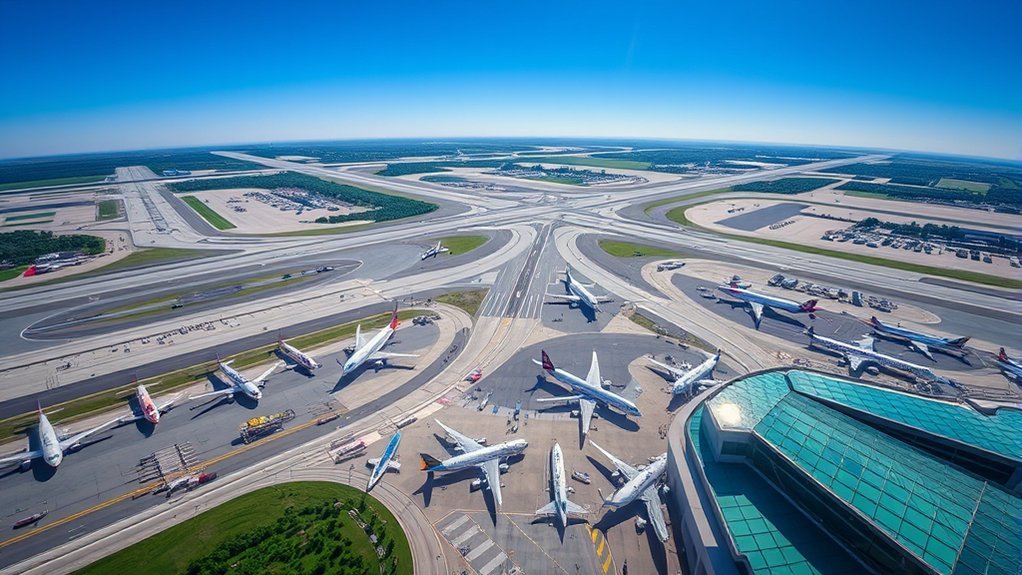
An airline hub is an airport that an airline uses as a central connecting point in its route network. Flights arrive from many cities, passengers and baggage transfer, and new flights depart for other destinations. This system can create more route choices and frequent service, but it can also produce longer trips and widespread delays when a major hub has bad weather or operational problems.
Quick Answer
An airline hub is a central airport where an airline brings together flights from different cities so passengers can connect to other destinations. Airlines use hubs to serve more city pairs with fewer individual routes. Atlanta, Chicago O’Hare, Dubai, London Heathrow, and Singapore Changi are well-known examples.
Key Takeaways
- An airline chooses its operational hubs, while the FAA separately classifies U.S. airports by their share of national passenger boardings.
- Hub-and-spoke networks let airlines connect many smaller markets through one central airport.
- Passengers may gain more schedule and destination choices but face layovers and greater disruption risk.
- The largest hub depends on the metric, such as total passengers, international passengers, cargo, aircraft movements, or one airline’s departures.
- Technology can improve scheduling, baggage tracking, identity checks, and passenger communication, but it cannot remove weather and capacity limits.
Disclosure: As an Amazon Associate I earn from qualifying purchases. Some links on this page are affiliate links, at no extra cost to you.
What Is an Airline Hub?

An airline hub is an airport where an airline concentrates a large part of its flight schedule. Instead of operating a nonstop flight between every possible pair of cities, the airline carries passengers from smaller or lower-demand markets to the hub. Those travelers then connect to flights going in different directions.
For example, an airline may fly passengers from several smaller cities to Atlanta. After a connection, those passengers can continue to New York, Los Angeles, London, or another destination. This network design is called the hub-and-spoke model. The central airport is the hub, and the routes extending from it are the spokes.
Hubs usually support a mixture of two passenger groups:
- Connecting passengers: Travelers who arrive on one flight and leave on another.
- Origin-and-destination passengers: Travelers whose trip starts or ends in the hub city.
Note: The word “hub” has two meanings in U.S. aviation. An airline hub is a role within an airline’s route network. The FAA also classifies airports as large, medium, small, or nonhub based on their share of annual U.S. passenger boardings. An airport’s FAA category does not automatically make it a connecting hub for every airline. See the FAA airport category definitions.
How the Hub-and-Spoke System Works
Many airlines schedule hub flights in groups called banks or waves. A group of aircraft arrives within a planned period, passengers and bags transfer, and another group departs. This arrangement creates many possible connections without requiring the airline to fly every route nonstop.
- Spoke flights arrive: Aircraft bring passengers from several cities into the hub.
- Passengers connect: Travelers move to their next gates while checked bags are transferred behind the scenes.
- Departure flights leave: Aircraft carry passengers from the hub to a new group of destinations.
- The cycle repeats: Large hubs may operate several connecting banks throughout the day.
Some airlines use tightly grouped banks to maximize the number of possible connections. Others use a rolling hub, with arrivals and departures spread more evenly through the day. A rolling schedule may reduce gate pressure and delay propagation, although it may offer fewer short connections.
| Schedule Type | How It Works | Main Tradeoff |
|---|---|---|
| Banked hub | Many flights arrive and depart in concentrated waves. | More connection choices, but greater pressure on gates, baggage systems, and security areas. |
| Rolling hub | Flights are distributed more evenly across the day. | Smoother facility use, but some connections may require longer waits. |
Historical Evolution of Airline Hubs in the U.S.
Connecting airline networks existed before U.S. deregulation. Delta Air Lines was an early developer of extensive hub-and-spoke operations at Atlanta in the 1950s. According to the Delta Flight Museum, Delta scheduled arrivals and departures so passengers from medium and smaller southeastern communities could connect through Atlanta. Eastern Air Lines also grouped connecting flights at Atlanta during that period.
The Airline Deregulation Act of 1978 then removed much of the federal control over domestic airline routes, fares, and market entry. Airlines gained more freedom to decide where to fly and how to organize their networks. This change encouraged carriers to expand and restructure hub systems, merge route networks, enter new markets, and compete more directly. The FAA’s aviation history explains that deregulation created a more competitive industry and contributed to rapid traffic growth.
During the following decades, airports such as Atlanta, Chicago O’Hare, Dallas/Fort Worth, Denver, Charlotte, Detroit, and Minneapolis-St. Paul became major connecting points for U.S. airlines. International gateways also expanded as alliances, codeshare agreements, and open-skies arrangements made it easier to connect passengers across different airline networks.
Types of Airline Hubs and Related Terms
Not every hub performs the same job. Airlines may assign different roles to airports based on geography, local demand, available gates, runway capacity, and international traffic.
- Primary hub: One of an airline’s largest and most important connecting airports.
- Secondary hub: A smaller connecting point that supports a region or reduces pressure on the primary hub.
- Regional hub: An airport that gathers passengers from nearby smaller cities and connects them to a broader network.
- International gateway: A hub with strong long-haul or cross-border service, often linking domestic flights with international departures.
- Cargo hub: An airport used to sort and transfer freight between aircraft, trucks, and distribution facilities.
- Seasonal hub: A connecting operation that becomes more important during a particular travel season.
Hub vs. Focus City
A focus city has a meaningful concentration of flights but usually fewer connecting banks and less network importance than a full hub. Airlines may use focus cities to serve strong local demand without building a large transfer operation.
Hub vs. Airline Base
An airline base is a location where pilots, flight attendants, aircraft, or maintenance teams are assigned. A crew or maintenance base may also be a hub, but the terms are not interchangeable.
What Is a Fortress Hub?
“Fortress hub” is an informal term for an airport where one airline controls a particularly large share of flights, gates, or passengers. A dominant position can support frequent service and strong connectivity, but it may also make it harder for competing airlines to expand.
Economic Benefits of Airline Hubs
Airline hubs can help a carrier serve more markets than it could support with nonstop flights alone. Combining passengers from several origins may produce enough demand to operate a route that would otherwise be too lightly used.
Potential airline benefits include:
- More city-pair coverage: One hub can connect dozens or hundreds of origin-and-destination combinations.
- Higher aircraft load factors: Passengers from different cities can fill seats on the same onward flight.
- Schedule frequency: Concentrated demand may support several departures per day on important routes.
- Shared facilities: Gates, lounges, maintenance teams, crew bases, and ground equipment can be concentrated at major locations.
- Network loyalty: A large hub can make an airline’s frequent-flyer program more useful to local travelers.
Airports and surrounding regions may also gain jobs, visitor spending, cargo access, business investment, and improved links to national and international markets. These gains are not automatic, however. Airport construction, road traffic, aircraft noise, emissions, and public infrastructure costs must also be considered.
Benefits and Drawbacks for Passengers
For passengers, a hub can open routes that would not be available nonstop from a smaller home airport. It can also provide several departure times and easier access to international flights.
| Possible Benefits | Possible Drawbacks |
|---|---|
| Access to more destinations | Longer total travel time than a nonstop flight |
| More departure-time choices | Risk of a missed connection |
| One-ticket baggage transfers | Greater baggage-handling complexity |
| Alternative flights during some disruptions | Hub-wide delays during storms or congestion |
| Better access from smaller cities | Long walks, terminal changes, or security checks |
Pro Tip: Do not choose a connection based only on the shortest time shown. Consider the airport’s size, terminal layout, weather, immigration requirements, and whether you are traveling with children, reduced mobility, or checked baggage.
Challenges Facing Airline Hubs Today

Major hubs handle large numbers of aircraft, passengers, bags, vehicles, and employees within limited space. When demand approaches runway, gate, taxiway, or terminal capacity, even a small disruption can cause long delays.
Common challenges include:
- Weather disruption: Thunderstorms, snow, wind, fog, and low visibility can reduce the number of safe takeoffs and landings.
- Delay propagation: A late aircraft or crew can affect several later flights across the network.
- Gate congestion: Arriving aircraft may have to wait when gates remain occupied.
- Baggage pressure: Short connections leave less time to transfer checked bags.
- Air traffic constraints: Busy airports may compete for limited runway and airspace capacity.
- Local impact: Noise, road congestion, land use, and air quality affect nearby communities.
- Competitive access: Airlines need gates and facilities to start or expand service at airports dominated by established carriers.
- Cybersecurity: Airlines and airports depend on interconnected scheduling, identity, baggage, communications, and operational systems.
The FAA notes that weather remains a leading cause of delays in the U.S. National Airspace System. Airlines can adjust schedules and routes, but they cannot remove the safety limits created by severe weather.
Hartsfield-Jackson Atlanta International Airport handled 106,302,208 passengers in 2025, while Chicago O’Hare led the world in aircraft movements. The two rankings show why “biggest hub” must always be tied to a specific metric.
Future Trends Shaping Airline Hubs
Airline hubs are becoming more data-driven, but their future will also depend on airport capacity, energy use, community concerns, labor, security, and changing passenger demand.
Sustainability Initiatives in Aviation
Aviation sustainability efforts include more efficient aircraft, improved air traffic procedures, lower-emission ground vehicles, energy-efficient terminals, waste reduction, and sustainable aviation fuel. ICAO identifies SAF as an important tool for reducing aviation’s lifecycle carbon emissions and supports a long-term aspirational goal of net-zero carbon emissions from international aviation by 2050.
SAF should not be described as having one fixed emissions benefit. Its lifecycle performance depends on the feedstock, conversion process, energy source, transportation, land-use effects, and certification method. The fuel still produces carbon dioxide when burned in an aircraft, but some pathways can reduce net lifecycle emissions compared with conventional jet fuel. Learn more from the ICAO sustainable aviation fuel program.
Electric and hybrid-electric aircraft may eventually support some short-distance services, but battery weight, aircraft certification, airport charging systems, and range remain important limits. They are not yet a general replacement for the large jets operating most major hub routes.
Technological Innovations Impacting Operations
Airlines and airports use software and real-time data to predict passenger flows, assign gates, track aircraft, manage crews, transfer baggage, and recover from disruptions. These tools can improve decisions, but their value depends on accurate data and coordination among airlines, airports, ground handlers, security agencies, and air traffic control.
| Technology | Practical Use at a Hub | Important Limitation |
|---|---|---|
| Predictive analytics | Forecasts delays, missed connections, staffing needs, and gate conflicts. | Unexpected weather and equipment failures can still disrupt the plan. |
| Biometric or digital identity systems | Can speed identity checks, bag drop, boarding, or border processing where approved. | Privacy rules, consent, accuracy, and alternative screening methods remain important. |
| Baggage tracking | Records custody changes and helps locate bags during transfers. | Tracking information does not guarantee that a bag will make a very short connection. |
| Airport simulation and digital twins | Tests terminal layouts, passenger flows, gate plans, and disruption scenarios. | Results depend on the quality of the model and its assumptions. |
Global Overview of Major Airline Hubs
A major airport may act as a hub for one airline, several airlines, an alliance, cargo operators, or a combination of these. Airport traffic rankings also measure different activities, so one airport may lead in total passengers while another leads in international passengers, cargo, or aircraft movements.
| Airport | Hub Role | 2025 Context |
|---|---|---|
| Atlanta, ATL | Delta’s largest hub and a major domestic connecting point | First worldwide in total passengers, with 106,302,208 |
| Dubai, DXB | Emirates’ global connecting hub | First in international passenger traffic and second in total passengers |
| Chicago O’Hare, ORD | Major hub for United and American | First worldwide in aircraft movements |
| London Heathrow, LHR | British Airways hub and major international gateway | Among the world’s leading airports for total and international passengers |
| Hong Kong, HKG | Passenger gateway and major Cathay Pacific and cargo hub | First worldwide in air cargo traffic |
| Singapore Changi, SIN | Singapore Airlines and Scoot hub linking Asia with long-haul markets | Handled nearly 70 million total passengers |
These figures come from the ACI World final 2025 airport rankings, published on July 15, 2026.
How Technology Enhances Airline Hub Operations
Technology supports nearly every stage of a hub connection. Scheduling systems coordinate aircraft, crews, gates, and passenger itineraries. Airline apps can send gate changes, boarding times, rebooking options, and baggage updates directly to travelers.
Baggage systems are especially important at connecting airports. IATA Resolution 753 requires member airlines to track baggage at four core points: passenger handover, aircraft loading, delivery to a transfer area, and return to the passenger. Airlines must also share relevant tracking information with interline partners.
Automated kiosks and mobile boarding passes can reduce some lines, while biometric and digital identity systems may speed approved identity checks. These systems do not remove the need for secure alternatives, human oversight, privacy safeguards, and support for passengers who cannot or do not wish to use a biometric process.
During disruptions, network-control systems help airlines identify which aircraft, crews, and passengers are affected. Software can suggest replacement flights, but recovery still depends on available seats, legal crew working limits, gates, aircraft, maintenance support, and weather conditions.
What Are the Differences Between Hub-and-Spoke and Point-to-Point Models?

A hub-and-spoke network routes a large share of passengers through central connecting airports. A point-to-point network places more emphasis on direct flights between individual cities. In practice, most large airlines combine features of both systems.
| Feature | Hub-and-Spoke | Point-to-Point |
|---|---|---|
| Route design | Flights are concentrated around one or more connecting airports. | More flights operate directly between origin and destination cities. |
| Small-market access | Can connect a smaller city to many destinations through one hub. | Direct service normally depends on enough demand for the individual route. |
| Passenger travel time | May require a layover and a longer journey. | A nonstop flight is usually faster when available. |
| Disruption risk | A major hub problem can spread through much of the network. | Disruption may be less concentrated, but fewer alternative flights may be available on some routes. |
| Costs | Can combine demand and improve seat use, but requires complex transfer operations. | Can reduce connection handling, but route success depends more directly on local demand. |
Southwest Airlines remains a useful example of a carrier with a primarily point-to-point route structure. However, its 2025 Form 10-K explains that the airline increasingly designs its network around core stations and blends nonstop demand with planned one-stop connections. This shows why modern airline networks do not always fit into one strict category.
How Airlines Choose a Hub Airport
An airport does not become a successful airline hub simply because it is large. Airlines examine how the airport fits into the wider network and whether it can support reliable connections.
Important selection factors include:
- Geographic position: The airport should connect target markets without excessive detours.
- Local passenger demand: A strong home market helps fill flights even when connecting demand falls.
- Runway and airspace capacity: The airport must handle planned arrivals and departures safely.
- Gate availability: An airline needs enough gates in suitable locations to support transfers.
- Airport costs: Landing fees, rent, labor, fuel, and facility charges affect profitability.
- Ground transportation: Roads, rail links, parking, and public transit help support local demand.
- Weather and reliability: Frequent storms, fog, snow, or wind may reduce schedule performance.
- Competition: Existing airline strength can provide an advantage or make market entry difficult.
- International facilities: Customs, immigration, security, and terminal space are necessary for gateway operations.
- Growth potential: Airlines consider future gates, runways, terminal projects, and community support.
Case Studies of Successful Airline Hubs
Delta’s Atlanta Hub
Atlanta combines a large local market, a central position in the southeastern United States, extensive airport facilities, and decades of connecting operations. Delta’s current hub snapshot reports nearly 1,000 peak-day departures to 207 destinations. These figures describe Delta’s schedule and can change by season.
ACI World recorded 106,302,208 passengers at ATL in 2025, making it the world’s busiest airport by total passenger traffic. The airport’s scale supports many connections, but its importance also means that severe weather or operational problems can affect flights throughout Delta’s wider network.
Southwest’s Point-to-Point Strategy
Southwest primarily uses point-to-point service instead of concentrating most operations at a small number of traditional hubs. This structure supports many nonstop routes and frequent service between important city pairs.
The model has become more blended over time. Southwest now organizes more of its schedule around core stations and planned connections. Its 2025 regulatory filing also describes new international airline partnerships designed to connect passengers beyond Southwest’s own network.
Singapore Airlines at Changi Airport
Singapore Airlines uses Changi Airport as its home hub, linking regional flights within Asia to longer services serving Europe, Australia, Africa, India, and other markets. Singapore’s geographic position makes it useful for connections between Southeast Asia and long-haul destinations.
Singapore Airlines also works with partner airlines, while its related low-cost carrier Scoot adds destinations and different service options. The airline’s current route map says Singapore Airlines and Scoot collectively fly to more than 120 destinations. Travelers should check the live schedule because routes and frequencies can change by season.
How Airline Hubs Work for Connecting Passengers
When all flights are on one reservation, the airline normally builds the itinerary around its published connection rules. Checked baggage is usually tagged to the final destination, although international entry rules may require you to collect and recheck it at the first arrival airport.
Before booking, check:
- Whether both flights use the same terminal or concourse.
- Whether you must pass through security again.
- Whether immigration and customs occur during the connection.
- Whether checked baggage transfers automatically.
- Whether the itinerary uses one ticket or separate tickets.
- Whether a later replacement flight is available if the first flight is delayed.
- Whether the connection is late at night, when alternatives may be limited.
Warning: Separate-ticket connections carry extra risk. The second airline may treat you as a no-show if the first flight arrives late, and it may not rebook you without charge. You may also need to collect baggage, change terminals, and pass through security again.
During a disruption, use the airline’s app while also checking airport departure screens. An app may offer automatic rebooking before you reach a service desk. Keep essential medication, identification, charging equipment, and one change of clothing in your carry-on in case you and your checked bag travel on different flights.
Frequently Asked Questions
What are the main hubs for airlines?
Major examples include Atlanta for Delta, Dallas/Fort Worth for American, Chicago O’Hare for United and American, Dubai for Emirates, London Heathrow for British Airways, Frankfurt for Lufthansa, Doha for Qatar Airways, and Singapore Changi for Singapore Airlines. Hub assignments and schedules can change.
What are the benefits of going through an airline hub?
A hub may give you access to more destinations, several departure times, one-ticket baggage transfers, and more rebooking choices. It can be especially useful when your home airport does not have a nonstop flight to your destination.
What are the disadvantages of a hub connection?
A connection adds travel time and creates a risk of missed flights, delayed baggage, terminal changes, and overnight disruptions. Bad weather at one large hub can also affect flights across the airline’s network.
How long should an airline hub connection be?
There is no single ideal time. A domestic connection in one terminal may need less time than an international connection involving immigration, customs, baggage collection, or a terminal transfer. Choose more time when the airport is unfamiliar, weather is poor, or the trip is on separate tickets.
Will my checked baggage transfer automatically at a hub?
It usually transfers automatically when all flights are on one reservation and the airlines have a baggage agreement. However, some international arrivals require you to collect and recheck the bag. Ask the check-in agent where the bag is tagged and confirm the destination on the receipt.
Which airline should I stay away from?
Hub structure alone cannot tell you which airline to avoid. Compare the airline’s schedule, fees, refund rules, route reliability, baggage policy, customer-service options, and the availability of replacement flights. Safety questions should be based on official regulatory information, not an airline’s use of hubs.
What is the biggest airline hub in the U.S.?
By total passenger traffic, Hartsfield-Jackson Atlanta International Airport was the largest U.S. and global airport in 2025, with 106,302,208 passengers. By aircraft movements, Chicago O’Hare ranked first. Always check which metric a ranking uses.
Is an FAA large-hub airport the same as an airline hub?
No. The FAA classifies a large hub as a U.S. commercial-service airport receiving at least 1% of annual national passenger boardings. An airline hub is an airport the airline uses to organize connecting flights. The two concepts may overlap, but they measure different things.
Conclusion
Airline hubs allow carriers to connect many cities through a smaller number of central airports. They can create more destination choices, frequent flights, and access for smaller communities. They can also add layovers, baggage complexity, congestion, and network-wide disruption when a major hub develops problems.
When comparing an itinerary, look beyond the ticket price. Check the airport layout, connection time, baggage process, weather, terminal changes, and availability of later flights. A hub connection can be a practical way to reach your destination, but a nonstop flight may be worth more when time and reliability are your main priorities.
Sources
- Federal Aviation Administration: Airport Categories — explains statutory U.S. large-, medium-, small-, and nonhub classifications.
- Federal Aviation Administration: A Brief History of the FAA — supports the 1978 deregulation history.
- Delta Flight Museum: 1940s–1950s Timeline — documents early Atlanta hub-and-spoke development.
- Airports Council International World: Final 2025 Airport Rankings — supports current passenger, cargo, and aircraft-movement statistics.
- Southwest Airlines 2025 Form 10-K — describes Southwest’s current point-to-point and core-station network structure.
- International Civil Aviation Organization: Sustainable Aviation Fuels — supports current aviation sustainability goals and SAF guidance.
