

Last Updated on September 11, 2026 by Daniel Globe
Airline hubs are centralized airports that air carriers use as primary transfer points to funnel passengers between originating cities and final destinations. By concentrating routes through major airports like Atlanta, Dallas/Fort Worth, or Chicago-O’Hare, airlines can connect hundreds of destinations across global networks with fewer total flights. For travelers, navigating through a hub offers access to frequent departure times, broader global route options, and competitive airfares, though peak connection waves can introduce terminal congestion and layover delays.
Quick Answer
An airline hub is a central airport used by an airline to funnel passengers from surrounding smaller cities (“spokes”) into a single transfer node. This “hub-and-spoke” network allows airlines to combine passenger demand from multiple routes onto shared flights, offering travelers hundreds of destination choices without requiring direct, nonstop flights between every single city pair.
Key Takeaways
- Network Efficiency: Hubs allow full-service airlines to serve exponentially more city pairs using significantly fewer aircraft and flight routes.
- Flight Banking: Carriers cluster arrivals and departures into synchronized time windows (“banks”) to streamline layovers for connecting passengers.
- Hub Types: Airports serve varying strategic roles, including primary passenger hubs, fortress hubs, cargo superhubs, and secondary reliever gateways.
- Connection Logistics: Layover success depends on Minimum Connection Times (MCT), terminal layout, and baggage transfer efficiency during weather delays.
Disclosure: As an Amazon Associate I earn from qualifying purchases. Some links on this page are affiliate links, at no extra cost to you.
What Is an Airline Hub?
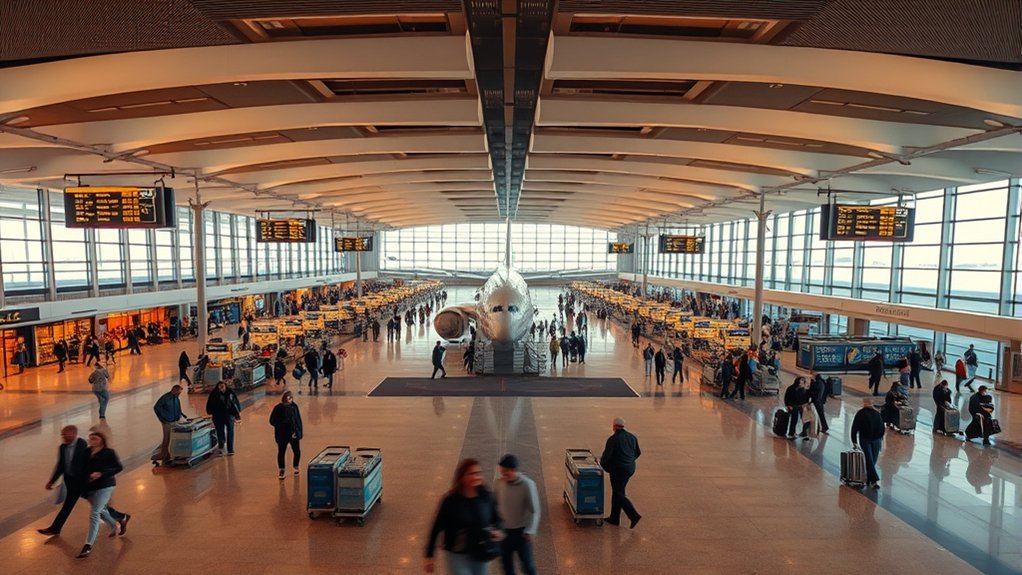
An airline hub is an airport that serves as a central focal point for an airline’s flight operations. Rather than flying directly between every point on a map, carriers collect passengers from smaller satellite airports—known as spokes—and transport them to a central hub. At the hub, passengers disembark, cross the terminal, and board connecting aircraft bound for their final destinations.
Major full-service legacy carriers build their entire business models around these centralized connection points. According to operational metrics tracked by the Bureau of Transportation Statistics (BTS), funneling traffic through primary airports lets airlines maximize passenger load factors (the percentage of filled seats) while maintaining frequent daily departure schedules. For travelers, flying through a major hub like Delta’s base in Atlanta (ATL) or American Airlines’ stronghold in Dallas/Fort Worth (DFW) delivers expanded schedule flexibility and access to international routes. However, severe weather or mechanical bottlenecks at a single major hub can ripple throughout the airline’s entire network, causing cascading flight cancellations nationwide.
How the Hub-and-Spoke Model Works
The hub-and-spoke model gets its name from a bicycle wheel: the airport sits at the central hub, while flight routes extend outward like spokes to surrounding regional markets. Understanding how this structure operates helps explain why major airlines structure their schedules around specific transfer windows.
Hub Structure
At the center of this network sits a major airport equipped with expansive terminal infrastructure, multiple parallel runways, and advanced baggage processing systems. The hub acts as a central sorting facility for passenger traffic. Rather than operating 1,000 separate nonstop routes between 50 different cities—which would require an unsustainable fleet size—an airline can connect all 50 cities through one central hub using just 50 inbound and 50 outbound flight legs.
Following the passage of the U.S. Airline Deregulation Act of 1978, legacy carriers rapidly reorganized their networks around central hubs. Delta Air Lines pioneered this operational approach at Hartsfield-Jackson Atlanta International Airport, demonstrating that centralizing passenger volume dramatically lowered seat-mile costs while enabling carriers to expand service to smaller regional communities.
Spoke Connections
Spokes represent the secondary and regional destinations surrounding a hub. Feeder flights bring travelers from smaller regional airports (such as Charleston, South Carolina or Peoria, Illinois) into the primary hub. Once these feeder flights land, passengers walk to adjacent gates to board outward-bound flights traveling to other spoke cities across the globe.
By relying on spoke connections, an airline can fill a 180-seat passenger jet heading from Atlanta to London by aggregating travelers who originated in 30 different regional spoke cities. Without the hub consolidating that regional demand into a single aircraft, nonstop flights between smaller cities and major international destinations would not be economically viable.
Hub-and-Spoke vs. Point-to-Point Models
| Feature | Hub-and-Spoke System | Point-to-Point System |
| Primary Airline Users | Legacy Network Carriers (Delta, United, American) | Low-Cost Carriers (Southwest, Ryanair, Allegiant) |
| Flight Connections | High volume of connecting transit itineraries | Direct nonstop routes; minimal connecting passengers |
| Aircraft Utilization | Subject to ground downtime during connection windows | Rapid gate turnarounds (25–30 min) keep planes airborne |
| Network Vulnerability | Hub storms can paralyze regional or national operations | Disruptions are isolated to specific regional city pairs |
Why Airlines Rely on Hubs
Airlines depend on hub networks because they offer major operational efficiencies, cost controls, and revenue advantages that point-to-point operations cannot match for long-haul networks.
Lower Costs, Better Loads
By routing multiple passenger streams into a central point, airlines achieve higher load factors—the proportion of filled seats on an aircraft. Higher load factors reduce the revenue required per seat-mile to break even on a flight leg. Centralizing operations at hubs also consolidates maintenance crews, flight operations staff, customer service teams, and specialized ground support equipment in fixed locations, creating massive economies of scale.
Wider Network Reach
Hub networks deliver extensive geographic reach. A carrier operating out of a single primary hub can link 100 inbound spoke cities to 100 outbound destinations, creating 10,000 potential travel pairs with just 200 total flights. Data published by the Federal Aviation Administration (FAA) confirms that hub consolidation remains the single most effective driver of long-distance air transit connectivity across North America.
“Delta Air Lines operates more than 1,000 daily peak departures from its Hartsfield-Jackson Atlanta hub alone, connecting travelers directly to over 200 domestic and international destinations.”
More Efficient Operations
Hub operations allow legacy airlines to deploy varied aircraft sizes suited to specific demand corridors. Smaller regional jets can fly spoke routes from low-density cities to feed passengers into the hub, where they transfer onto large wide-body aircraft (such as the Airbus A350 or Boeing 787) for transoceanic segments. This fleet flexibility ensures that aircraft capacity matches market demand precisely across each segment of a journey.
How Hub Banking Shapes Flight Schedules
To ensure passengers spend minimal time waiting on the ground, airlines structure their hub schedules using a strategy called hub banking (or complexing). In a banked hub schedule, flights arrive and depart in distinct coordinated waves throughout the day.
During an arrival bank, dozens of inbound flights land within a narrow 30-to-45-minute window. Passengers deplane, walk through the concourse, and transfer to their next gates. Approximately 45 to 60 minutes later, a departure bank opens, with dozens of aircraft taking off in rapid succession to destination spokes. A major hub airport may operate between 6 and 12 distinct flight banks each day.
Warning: Tight connection windows during peak flight banks leave little room for error. If your inbound flight experiences a 20-minute air traffic control delay, you may miss your departure bank, resulting in extended layovers or overnight rebookings.
While strict flight banking minimizes connection layover times, it creates severe structural spikes in airport runway traffic, terminal gate utilization, and baggage system loads. To combat severe congestion, some carriers utilize rolling hubs (or de-banked hubs), spreading arrivals and departures evenly across the day. Rolling hubs increase average layover times slightly but dramatically improve operational reliability and reduce aircraft idle times on taxiways.
Cargo, Scissor, Fortress, and Reliever Hubs
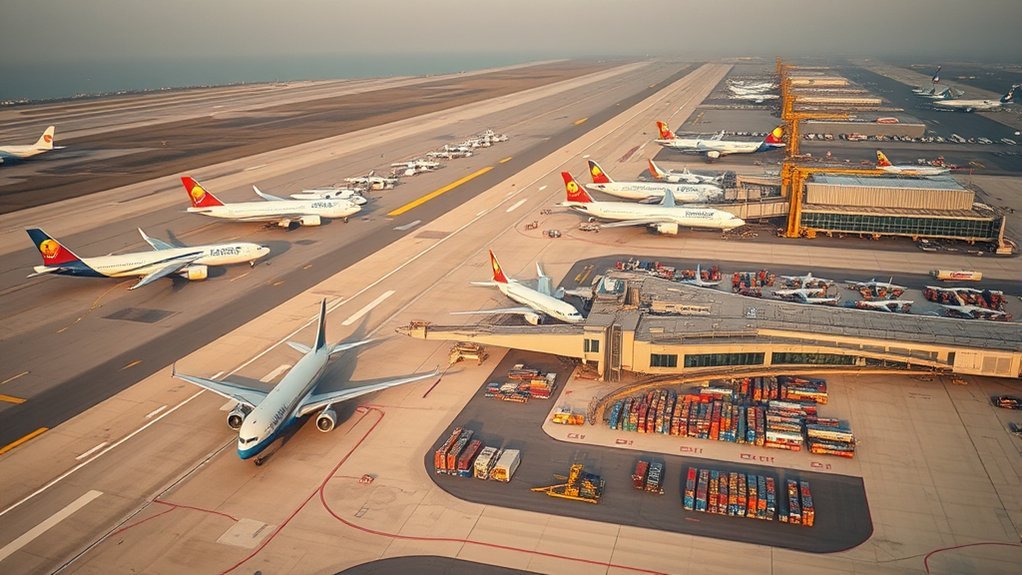
Airports and carriers utilize several distinct hub configurations depending on geographical advantages, cargo demands, and competitive positioning:
- Cargo Hubs: Built exclusively for freight logistics and package distribution. FedEx operates its global Superhub at Memphis International Airport (MEM), while UPS operates its Worldport at Louisville Muhammad Ali International Airport (SDF). These hubs process millions of tons of express freight during midnight sorting windows.
- Fortress Hubs: An airport where a single dominant airline controls the vast majority of gates, takeoff slots, and passenger traffic (often exceeding 70% to 80% market share). Examples include Delta in Atlanta (ATL) and American Airlines in Dallas/Fort Worth (DFW). High market concentration gives carriers immense scheduling power but can lead to higher local airfares for non-connecting passengers.
- Scissor Hubs: An intermediate airport where flights from multiple originating cities arrive simultaneously, cross-exchange passengers, and continue onward to multiple destinations. This model allows carriers to swap international passengers midway across long transoceanic routes.
- Reliever and Dual-Airport Gateways: In major metropolitan markets, carriers split domestic and international traffic across secondary hubs to relieve runway congestion. For example, in New York, Delta and American utilize LaGuardia (LGA) primarily for domestic short-haul business routes, while routing heavy international wide-body flights through John F. Kennedy International Airport (JFK).
How Deregulation Changed Airline Hubs
Prior to 1978, the U.S. Civil Aeronautics Board (CAB) regulated domestic airline routes and ticket pricing, mandating specific point-to-point services. When Congress passed the Airline Deregulation Act, government price and route controls were eliminated, allowing airlines complete freedom to design their route maps.
Legacy airlines quickly realized that point-to-point networks were far too inefficient for nationwide coverage. Reorganizing fleet operations around centralized hubs created rapid expansion opportunities, allowing airlines to enter hundreds of new passenger markets almost overnight without acquiring hundreds of additional aircraft. Today, deregulation legacy hubs remain the foundation of North American commercial aviation infrastructure.
Airline Hub Examples by Carrier
Major airlines designate specific hub airports across their networks based on geographic coverage and market demographics:
- Delta Air Lines: Atlanta (ATL) serves as its primary global megahub, supported by major domestic hubs in Detroit (DTW), Minneapolis-St. Paul (MSP), and Salt Lake City (SLC), along with coastal gateways in Seattle (SEA), Los Angeles (LAX), and New York (JFK/LGA).
- American Airlines: Dallas/Fort Worth (DFW) and Charlotte (CLT) operate as massive mid-continent connection engines, complimented by Miami (MIA) for Latin American routes, Philadelphia (PHL) for European transoceanic traffic, and Chicago-O’Hare (ORD).
- United Airlines: Chicago-O’Hare (ORD), Denver (DEN), and Houston-Intercontinental (IAH) cover central domestic transit, while Newark (EWR), San Francisco (SFO), and Washington-Dulles (IAD) operate as primary international gateways.
- Alaska Airlines: Seattle-Tacoma (SEA) serves as its primary hub, supported by secondary bases in Anchorage (ANC), Portland (PDX), and San Francisco (SFO).
On an international scale, global carriers rely on massive transit hubs to capture long-haul international traffic. Emirates utilizes Dubai International Airport (DXB) to connect Europe, Asia, and Africa, while Qatar Airways operates Hamad International Airport (DOH) in Doha as a modern global transfer gateway.
Hubs vs. Focus Cities and Bases

Airlines use distinct terms to describe their operational presence at different airports across their maps:
Operational Facility Comparison
| Facility Type | Primary Operational Function | Key Characteristics & Examples |
| Airline Hub | Full passenger transit sorting node linking incoming and outgoing spokes. | Banked schedules, heavy connection traffic, extensive lounge networks. (Ex: Delta at ATL, AA at DFW) |
| Focus City | An airport with non-hub direct flights aimed at strong origin-and-destination (O&D) local market demand. | Limited flight connecting infrastructure; caters to local travelers skipping connections. (Ex: JetBlue at Boston) |
| Crew / Flight Base | An operational station where pilots, flight attendants, and aircraft are stationed overnight. | Mainly supports maintenance and crew staging for point-to-point carriers. (Ex: Southwest at Nashville or Austin) |
Minimum Connection Times (MCT) and Hub Logistics
Behind the terminal walls, hub operations rely on complex logistical choreography. One critical parameter published by published industry clearinghouses is the Minimum Connection Time (MCT)—the shortest legal layover duration an airline allows when selling a single-ticket connecting itinerary.
MCT varies significantly based on airport geography and terminal connections:
- Domestic-to-Domestic Connections: Typically ranges between 30 and 45 minutes at streamlined hubs (such as Charlotte or Salt Lake City).
- Domestic-to-International Connections: Usually requires 60 minutes to account for passport checks and distant gate assignments.
- International-to-Domestic Connections: Requires 90 to 120 minutes because travelers must clear customs and border protection, retrieve checked luggage, re-check bags, and clear security screening.
Pro Tip: When booking layovers through massive hub airports like Chicago-O’Hare (ORD) or London Heathrow (LHR), add a buffer of at least 30 minutes to the airline’s published MCT to protect against gate changes, lengthy concourse walks, and luggage transit delays.
What Makes a Hub Airport So Important?
Hub airports serve as essential economic engines for their regions. Beyond providing travel convenience, hub status generates billions of dollars in local economic activity, attracts corporate headquarters seeking direct global access, and supports thousands of aviation jobs ranging from maintenance technology to air traffic logistics.
According to official passenger traffic reports from Airports Council International (ACI World), Hartsfield-Jackson Atlanta International Airport processes over 104 million passengers annually, retaining its position as the busiest passenger hub on earth. By bringing millions of connecting passengers through a single airport, hubs sustain high-frequency flight schedules that make air travel accessible, interconnected, and efficient.
Frequently Asked Questions
What are the primary hubs for major U.S. airlines?
Major U.S. legacy hubs include Atlanta (ATL) for Delta Air Lines; Dallas/Fort Worth (DFW) and Charlotte (CLT) for American Airlines; Chicago-O’Hare (ORD), Denver (DEN), and Houston (IAH) for United Airlines; and Seattle-Tacoma (SEA) for Alaska Airlines.
What is the 45-minute rule for American Airlines connections?
The 45-minute rule refers to American Airlines’ standard Minimum Connection Time (MCT) guidelines for domestic-to-domestic transfers at major hubs like DFW and CLT. It indicates the minimum layover required to guarantee passenger and baggage transfer under normal operating conditions. If an inbound flight delay reduces layover time below this window and causes a missed connection, the airline will rebook you on the next available flight without change fees.
How do point-to-point carriers differ from traditional hub airlines?
Point-to-point carriers (like Southwest or Ryanair) fly passengers directly between origin and destination cities without funneling them through a central connecting hub. This model reduces layovers and gate turnarounds, but it limits the carrier’s ability to offer broad international transfer itineraries across smaller regional markets.
What are the main benefits of booking flights through an airline hub?
Flying through a hub provides access to significantly more daily flight departure options, better long-haul and international connectivity, competitive ticket pricing due to seat capacity, and access to flagship airline lounges and expedited transfer facilities.
Conclusion
Airline hubs remain the backbone of global air travel networks. By structuring routes around centralized airports and synchronized flight banks, carriers can connect thousands of city pairs efficiently while maintaining high flight frequencies and affordable airfares. The next time you book an itinerary with a layover, checking the hub airport’s layout, minimum connection times, and flight banking windows will ensure a smoother, stress-free transit experience.
Sources
- Bureau of Transportation Statistics (BTS) — Airline Passenger Travel and Fleet Load Factor Metrics
- Federal Aviation Administration (FAA) — National Plan of Integrated Airport Systems (NPIAS)
- U.S. Department of Transportation (DOT) — Airline Deregulation Act Overview and Consumer Travel Reports
- Airports Council International (ACI World) — World Airport Traffic Dataset and Top Airport Rankings
- Delta News Hub — Atlanta (ATL) Operational Statistics and Route Network Data

