
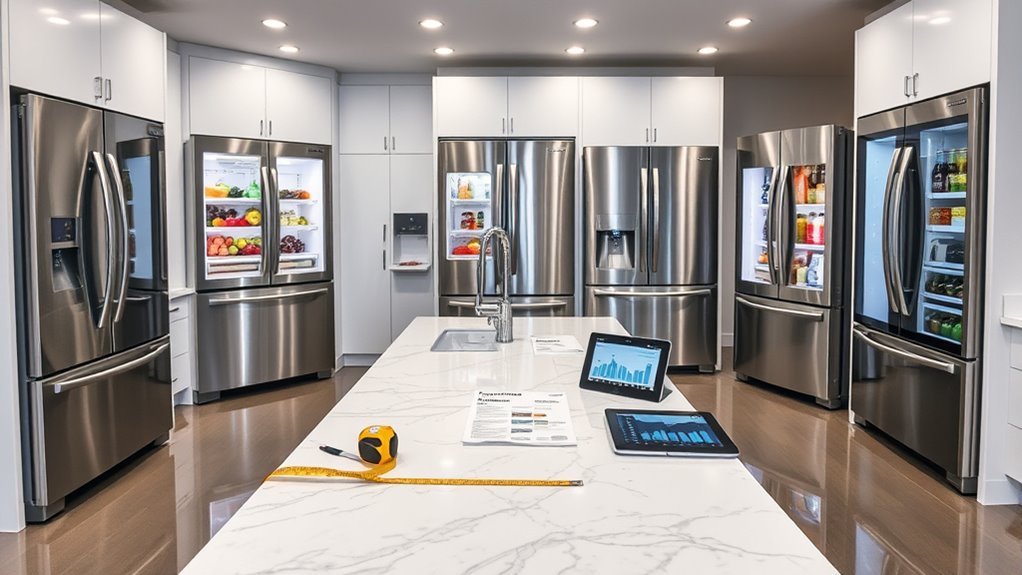
Consumer Reports’ best refrigerators help you compare reliable, efficient, and well-designed models by type. If you want a French-door fridge, look for strong temperature control, flexible storage, and useful extras like icemakers. Counter-depth models give you a flush look and save floor space, while side-by-side units work well in narrow kitchens. CR also weighs reliability and owner satisfaction, so you can avoid weak brands and choose with more confidence as you go on.
Best Refrigerators by Type

French-door refrigerators are the most popular type, making up more than half of new purchases, and they often include icemakers and digital controls for added convenience.
You can use this format to compare refrigerator features across styles, since Consumer Reports tests more than 270 models each year. It rates energy efficiency, temperature control, and usability, so you can judge how each design performs in real conditions.
Side-by-side refrigerators work well when your kitchen is narrow, because they need less door swing space.
Top-freezer models often deliver higher reliability than French-door units, which can matter if you want lower-maintenance ownership.
Counter-depth models give you a flush look with cabinetry without the cost of built-ins.
If you’re evaluating French-door options, the LG LFCS22520S shows strong thermostat control and temperature uniformity, though owner satisfaction is low at 3 out of 10.
That contrast helps you balance specs with lived experience.
Best French-Door Refrigerators
What should you look for in a French-door refrigerator? You should prioritize French door features that support easy access, flexible storage, and reliable temperature control.
This style now accounts for over half of new refrigerator purchases because it combines wide shelves, bottom freezers, icemakers, and digital controls.
In testing, you should expect climate-controlled chamber evaluations that measure temperature consistency and energy use across more than 270 models.
The LG LFCS22520S delivers strong thermostat control and temperature uniformity, but its owner score is just 3 out of 10, so consumer satisfaction is mixed.
Strong thermostat control and temperature uniformity, but its owner score is just 3 out of 10.
If you want value, the Midea MRF18B4AST costs about $995 and performs well on temperature and efficiency, though it skips an icemaker and water filter.
Reliability remains middling overall, but Bosch and Fisher & Paykel usually rate better, while some LG models show higher compressor failure rates.
Best Counter-Depth Refrigerators
If you want a refrigerator that sits nearly flush with your cabinetry, counter-depth models are a smart choice because they’re typically under 30 inches deep and deliver a built-in look at a lower cost.
You get a compact design that preserves floor space and keeps your kitchen lines clean. Many models add spillproof shelves and adjustable shelving, so you can organize food with less waste and more control.
For smaller spaces, pick units with strong thermostat control and energy efficiency, such as the Samsung RT16A6195SR. You’ll likely spend less than on a true built-in, while still gaining a refined, integrated appearance.
Consumer Reports tests more than 270 refrigerator models, so counter-depth options are evaluated for performance, reliability, and efficiency.
That helps you compare choices objectively and select a model that supports practical daily use without excess cost or bulk.
How CR Rates Fridge Brands
Consumer Reports rates fridge brands with a statistical model that blends lab test results and consumer survey data from more than 280 refrigerator models each year.
You get brand scores that weigh performance, pricing, brand reliability, and consumer satisfaction, so you can compare French-door, side-by-side, and other configurations without guesswork.
CR then assigns a Best Brand for each category to the brand with the highest Overall Score, which combines reliability and satisfaction metrics.
That matters because survey data show about 33% of refrigerators need repairs within five years, and weak brands can cost you time, money, and autonomy.
CR’s performance ratings also help you judge untested models by linking them to measured outcomes and owner reports.
The result is a disciplined, evidence-based ranking system that lets you identify strong brands and avoid products with higher repair risk.
How to Measure and Buy a Fridge
Before you buy a fridge, measure the available space in several spots for width, depth, and height, then subtract 1 inch from the width and height for ventilation and leave about 1 inch of clearance at the back for airflow.
Use precise measuring techniques, since walls and floors can vary. Check common widths from 24 to 36 inches if your kitchen is tight.
For capacity, choose 19 to 22 cubic feet for a family of four; pick 30 to 33 cubic feet if you buy in bulk for a larger household.
Review Consumer Reports’ width-based ratings to compare models that match your opening. Also plan for delivery considerations before you order.
- Measure width, depth, height in multiple spots.
- Confirm 1 inch rear airflow and side clearance.
- Verify doorway and hallway dimensions for delivery.
- Match cubic feet to household needs and shopping habits.
Frequently Asked Questions
What Is the Number One Top Rated Refrigerator?
The Whirlpool WRFF3136SZ is your top-rated refrigerator. You get strong energy efficiency, excellent thermostat performance, and practical storage capacity, though it doesn’t include a water or ice dispenser.
Conclusion
So, after sorting through the “best” refrigerators, you get the thrilling privilege of paying more for doors that open slightly differently and shelves that pretend to be a lifestyle choice. You’ll still need to measure your space, check CR ratings, and buy the model that actually fits your kitchen, not your fantasy renovation. In the end, you’re not choosing a refrigerator for inspiration—you’re choosing a cold box that works, without drama, noise, or expensive regret.