
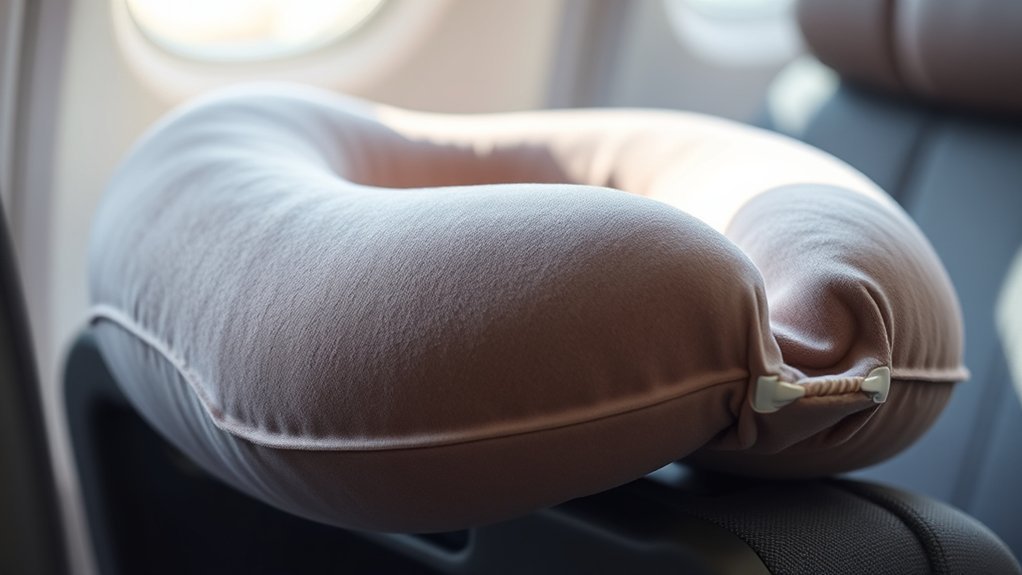
Last Updated on September 10, 2026 by Daniel Globe
The open end of a travel pillow is part of its U-shaped design, but it is not always meant to sit behind your neck. Many traditional pillows are worn with the opening in front, while some travelers rotate them so the padded curve supports the chin. The best position depends on the pillow’s shape, its instructions, and the direction your head moves when you fall asleep.
Quick Answer
A U-shaped travel pillow has an opening so you can place it around your neck, adjust its fit, and remove it easily. The opening may face forward or backward. Keep it in front for traditional side and rear support, or try it behind you if the padded curve supports your chin and limits forward head drop.
Key Takeaways
- The gap is the open end of a U-shaped pillow, not a universal feature that must sit at the back.
- Follow the manufacturer’s instructions first because travel-pillow shapes work differently.
- Use the position that limits forward or sideways head movement without pushing your neck out of alignment.
- The pillow should feel snug and supportive, but it should not press tightly against your throat.
- Travel pillows may improve comfort, but they are not a treatment for persistent neck pain.
At a Glance
| Time Required | 2 to 5 minutes |
| Difficulty | Easy |
| Tools Needed | Your travel pillow and the seat you plan to use |
| Cost | $0 if you already own the pillow |
Disclosure: As an Amazon Associate I earn from qualifying purchases. Some links on this page are affiliate links, at no extra cost to you.
Why Travel Pillows Have an Opening
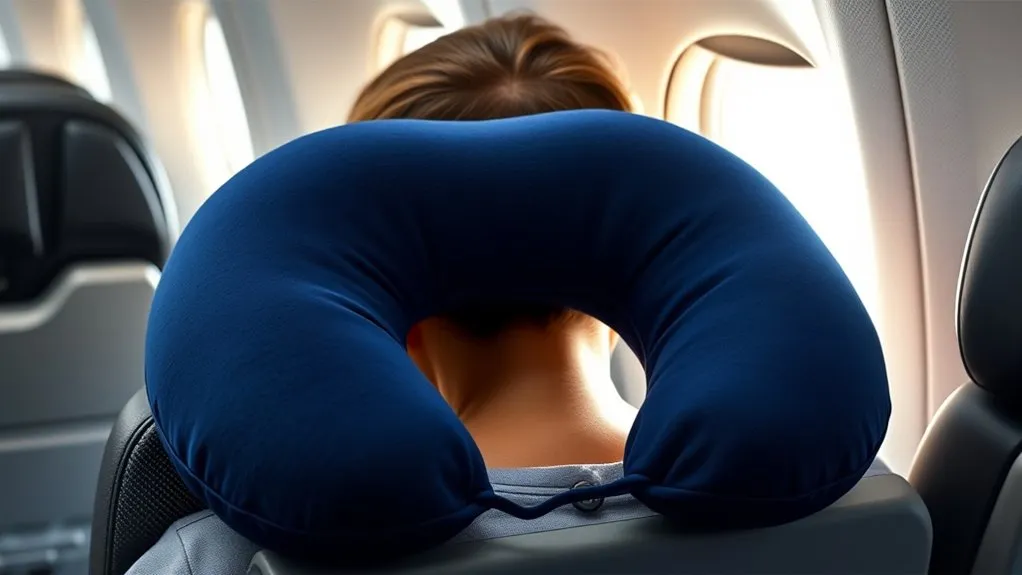
On a traditional U-shaped travel pillow, the gap is simply the open end of the U. It allows you to place the pillow around your neck without pulling it over your head. It also gives the two arms room to sit on your shoulders, move closer together, or connect with a snap, buckle, tie, or hook-and-loop closure.
The opening can serve different purposes depending on the product. Some pillows leave the front open for airflow and adjustment. Others use the padded curve under the chin and leave the opening behind the neck to reduce forward head drop. Wraparound and scarf-style pillows may not use a front-versus-back opening at all.
There is no single correct direction for every travel pillow. The correct position is the one intended for that design and fitted to keep your head as close to a neutral position as possible.
Cleveland Clinic notes that placing the opening behind the neck can give the head more support when it leans forward. However, manufacturers such as Cabeau also make pillows specifically designed with a large opening at the front. This is why checking your pillow’s instructions is more reliable than following a universal front-or-back rule.
Should the Opening Face the Front or Back?
Start with the position shown in the manufacturer’s instructions. If you no longer have them, look at the pillow’s shape, closure, labels, seams, and areas of raised support.
| Position | May Work Best When | What to Check |
|---|---|---|
| Opening in front | The pillow has a thick or flat rear section and raised sides designed to limit sideways movement. | Make sure the rear padding does not push your head forward or force your chin down. |
| Opening in back | Your chin drops toward your chest and the padded curve fits comfortably under your chin. | Make sure the pillow does not press against your throat or push your head backward. |
| Support on one side | You normally lean toward a window or one side of the seat. | Place the tallest or firmest support on the side toward which your head falls. |
| Wraparound position | The pillow uses a scarf, internal brace, overlapping panel, or full-circle design. | Follow the product-specific wrapping and fastening instructions. |
Pro Tip: Test both permitted positions at home for five minutes. Relax your neck, close your eyes, and notice where your head starts to move. Use the position that stops that movement without forcing your chin up, down, or to one side.
Common Mistakes to Avoid With Travel Pillows
A travel pillow can still feel uncomfortable when it is the wrong size, worn in the wrong position, or poorly matched to the seat. Avoid these common mistakes:
- Assuming every pillow works the same way: A standard U-shaped pillow, a scarf-style support, and a structured chin-support pillow require different positioning.
- Ignoring the manufacturer’s instructions: Closures, flat backs, raised sides, and internal braces often show how the pillow is intended to be worn.
- Using too much rear padding: A thick pillow behind your neck may combine with the seat headrest and push your head forward.
- Letting the pillow sit too low: If the pillow rests mainly on your shoulders, it may not reach the areas that need support.
- Fastening it too tightly: The pillow should remain in place without pressing hard against your throat.
- Overinflating an inflatable pillow: A fully inflated pillow can be too firm or tall. Release a little air until your neck feels relaxed.
- Expecting it to cure neck pain: A travel pillow can provide temporary support, but it cannot diagnose or treat an underlying condition.
Warning: Loosen or remove the pillow if it affects comfortable breathing or swallowing, causes numbness, increases pain, or forces your head into an awkward angle. Do not use a closure more tightly than the manufacturer recommends.
How to Position Your Travel Pillow Correctly
Use this process instead of assuming that the opening must always face one direction.
| Step | Action | Goal |
|---|---|---|
| 1 | Check the label, product page, or included instructions. | Identify the intended front, back, closure, and support areas. |
| 2 | Sit fully against the seat and use a slight recline when allowed. | Give your back and head a stable base. |
| 3 | Place the pillow in its intended position and relax your shoulders. | Check whether the pillow reaches the sides or front of your head without riding up. |
| 4 | Close your eyes and let your head relax for 30 to 60 seconds. | Identify whether your head falls forward, backward, or sideways. |
| 5 | Rotate the pillow only if its design permits and the new position better controls that movement. | Match the support to your natural head-drop direction. |
| 6 | Adjust the closure, height, firmness, or air level. | Keep the head centered without pressure against the throat. |
| 7 | Move your head gently and confirm that you can breathe, swallow, and relax normally. | Confirm a secure but comfortable fit before sleeping. |
Your ears should remain roughly over your shoulders rather than far in front of them. The pillow does not need to hold your head perfectly still. It only needs to limit the movement that repeatedly wakes you or leaves your neck in an uncomfortable position.
How to Tell If the Fit Is Wrong
- Too tall: The pillow pushes your jaw upward, presses into your ears, or tilts your head to one side.
- Too low: Your head still falls far enough to wake you, and the pillow provides little contact above the shoulders.
- Too firm: The pillow creates a pressure point or pushes your head away from the seat.
- Too soft: The filling collapses before it can slow your head movement.
- Too loose: The pillow slides, twists, or drops onto your shoulders.
- Too tight: You feel pressure on the throat, jaw, skin, or sides of the neck.
Note: The best fit can change with the seat. A pillow that works against a flat train seat may feel too thick against an airplane headrest that already projects forward.
Essential Features for Choosing the Best Travel Pillow
Choose a pillow based on how you sleep while sitting, not only on the filling material or appearance.
- Correct height: The sides should reach the area below your ears without forcing your shoulders down or your jaw up.
- Support in the right direction: Choose chin support for forward head drop, taller side panels for sideways movement, or a structured wrap for more controlled support.
- Adjustable fit: Inflatable chambers, overlapping panels, straps, snaps, or hook-and-loop closures can help you fine-tune the fit.
- Seat compatibility: A flat or thin back may work better with a thick headrest than a bulky rear cushion.
- Breathable cover: Airflow and moisture control can matter during a warm or crowded trip.
- Washable components: Look for a removable cover or a design that can be cleaned according to clear care instructions.
- Portable size: Consider whether the pillow compresses, deflates, rolls, or clips securely to your luggage.
Common Travel Pillow Types
| Type | Main Advantage | Possible Limitation |
|---|---|---|
| Traditional U-shaped | Simple, familiar, and easy to place around the neck. | May not control forward head drop unless rotated or closed in front. |
| Wraparound or scarf-style | Can provide targeted support with less bulk behind the neck. | Must be wrapped and adjusted according to its specific design. |
| Inflatable | Packs small and allows firmness adjustments. | Can feel rigid or unstable when overinflated. |
| Memory foam | Contours to the neck and usually offers steady cushioning. | Takes more luggage space and the foam insert may not be washable. |
| Structured chin or side support | Targets a specific direction of head movement. | Fit can be highly personal and may feel restrictive if sized incorrectly. |
Benefits of Using Your Travel Pillow Correctly
A correctly fitted pillow may make sitting and resting more comfortable by limiting unsupported head movement. The benefit depends on the pillow, your body size, the seat, and how your head naturally moves when you relax.
More Stable Head and Neck Support
Keeping your head closer to a neutral position can reduce the amount of time it spends tilted sharply forward or to one side. Mayo Clinic advises keeping the head centered over the spine and taking movement breaks during long trips. A travel pillow may help with that goal, but it should work with your posture rather than forcing your neck into position.
| Possible Benefit | How Proper Fit Helps |
|---|---|
| Less head movement | Side, rear, or chin support can slow the movement that occurs as your muscles relax. |
| More neutral posture | The correct height avoids pushing the head far forward, backward, or sideways. |
| Fewer pressure points | A properly adjusted pillow spreads support without pressing hard on one area. |
| More comfortable resting | Less slipping and head bobbing may make it easier to remain relaxed. |
A Better Chance to Rest Comfortably
A travel pillow cannot guarantee better sleep. However, support that reduces repeated head bobbing or an uncomfortable sideways tilt may make it easier to rest without waking as often to reposition yourself.
Research on pillows shows that design, height, and material can affect comfort, pain, and alignment. However, a systematic review did not find a significant overall sleep-quality improvement from pillow use in people with chronic neck pain. It is therefore more accurate to describe a travel pillow as a comfort tool rather than a proven sleep treatment.
Travel Pillow Use Cases
The same pillow can perform differently depending on your seat and the direction in which your head falls. These common situations show how positioning may change:
| Travel Situation | Useful Adjustment |
|---|---|
| Window seat | Place stronger side support between your head and the window side without leaning directly against a hard surface. |
| Middle seat | Use balanced side support or chin support because there may be no wall or window to lean against. |
| Aisle seat | Keep your head supported within your seat space and avoid leaning into the aisle. |
| Long train ride | Adjust the pillow after checking whether the seat has a flat or projecting headrest. |
| Overnight bus trip | Use a secure closure if available because braking and road movement can shift a loose pillow. |
| Home reading or napping | Use the pillow for temporary support while seated, but change position and take breaks rather than remaining still for long periods. |
How to Clean and Maintain a Travel Pillow
Always follow the care label because the cover, filling, air bladder, and internal support may require different cleaning methods.
- Memory-foam pillow: Remove and wash the cover if permitted. Do not soak or machine wash the foam unless the manufacturer specifically says it is safe.
- Inflatable pillow: Deflate it and wipe the surface with a damp cloth and mild soap. Let it dry fully before folding or storing it.
- Microbead or fiber-filled pillow: Check whether the entire pillow is washable or only the removable cover.
- Structured or scarf-style pillow: Remove plastic frames or internal supports before washing when instructed.
- Storage: Make sure every part is dry before packing it away to reduce odor and moisture buildup.
Frequently Asked Questions
Should a travel pillow opening face the front or back?
It depends on the pillow. Use the manufacturer’s intended position first. A front opening often works with traditional rear-and-side support, while an opening behind the neck may work better when the padded curve supports a chin that falls forward.
Can travel pillows be used for purposes other than travel?
Yes. You can use one for temporary support while reading, watching television, gaming, or resting in a chair. It should not force your neck into an uncomfortable position, and you should still change position and take movement breaks.
How do I clean and maintain my travel pillow?
Read the care label before washing it. Many memory-foam models have a machine-washable cover but a foam insert that should only be wiped and air-dried. Inflatable and structured pillows may require different care or removal of internal components.
Are all travel pillows designed with an opening in the back?
No. A basic U-shaped pillow has an open end, but that opening is commonly worn in front. Some pillows can be reversed, some are designed with a front opening, and wraparound or scarf-style models may not have a comparable opening.
What materials are typically used in travel pillows?
Common options include solid memory foam, shredded foam, polyester fiber, microbeads, inflatable air chambers, and structured plastic supports covered with fabric and padding. Each material differs in firmness, weight, heat retention, packability, and cleaning requirements.
Can a travel pillow help with neck pain during everyday use?
It may provide temporary support while you are seated, but it is not a treatment for ongoing neck pain. Stop using it if your symptoms worsen. Speak with a healthcare professional if pain persists or occurs with weakness, numbness, tingling, severe headache, fever, or a recent injury.
How tight should a travel pillow be?
It should be snug enough to stay in place but loose enough for you to breathe, swallow, and move comfortably. Loosen it immediately if it presses against your throat, causes skin discomfort, or makes your head feel trapped.
Conclusion
The opening in a travel pillow does not have one required position. It is the open end of the pillow’s shape, and the best orientation depends on how that specific product supports your head. Start with the manufacturer’s instructions, then check whether your head falls forward or sideways. Adjust the position, height, firmness, and closure until your head feels supported without pressure on your throat or an awkward neck angle.
Sources
- Cleveland Clinic: Tips for Traveling With Back Pain — supports opening-back positioning as one option for forward head support.
- Mayo Clinic: Neck Pain, Symptoms and Causes — supports neutral head and spine alignment, posture, movement breaks, and symptom guidance.
- Cabeau: The Neck’s Evolution S3 Neck Pillow — shows a travel pillow intentionally designed with a front opening and model-specific cleaning instructions.
- Trtl Travel: How to Wear and Care for Trtl Pillows — supports design-specific fitting, wrapping, adjustment, and washing instructions.
- PubMed: Effects of Pillow Designs on Neck Pain, Sleep Quality, and Spinal Alignment — supports qualified discussion of pillow shape, height, comfort, pain, and sleep-quality evidence.
