
Last Updated on September 11, 2026 by Daniel Globe
Commercial air travel did not begin with a large airport or a crowded jet. It began with one pilot, one paying passenger, and a small flying boat crossing Tampa Bay in 1914. Airmail contracts, safer aircraft, government regulation, and jet engines then turned that short experimental route into the worldwide airline system you know today.
Quick Answer
Commercial air travel is usually dated to January 1, 1914, when the St. Petersburg-Tampa Airboat Line began scheduled passenger flights across Tampa Bay. The service was small and short-lived, but it proved the airline model. Airmail contracts, improved 1930s airliners, and jet service in the 1950s later made passenger flying practical on a large scale.
Key Takeaways
- The first widely recognized scheduled passenger airline began operating in Florida on January 1, 1914.
- The route used a Benoist Model XIV flying boat that carried one passenger beside the pilot.
- U.S. airmail service and the Air Mail Act of 1925 gave early airlines the reliable income they needed to survive.
- The Boeing 247 and Douglas DC-3 made passenger service faster, safer, and more financially practical during the 1930s.
- Commercial jet service expanded during the 1950s, followed by wide-body aircraft and a more competitive airline market.
What Counts as the Start of Commercial Aviation?
The answer depends on how you define commercial aviation. Pilots had carried paying passengers, mail, and cargo before 1914. Airships also operated passenger services before fixed-wing airlines became practical.
However, historians commonly use January 1, 1914, because the St. Petersburg-Tampa Airboat Line offered a published schedule, a fixed route, and tickets for paying passengers. It is widely recognized as the first scheduled airline service using a fixed-wing aircraft.
Note: The first scheduled airline, the first commercial flight, and the first purpose-built commercial airliner are not necessarily the same thing. The 1914 service marks the accepted beginning of scheduled passenger airline travel.
When Did Commercial Airplanes Start?
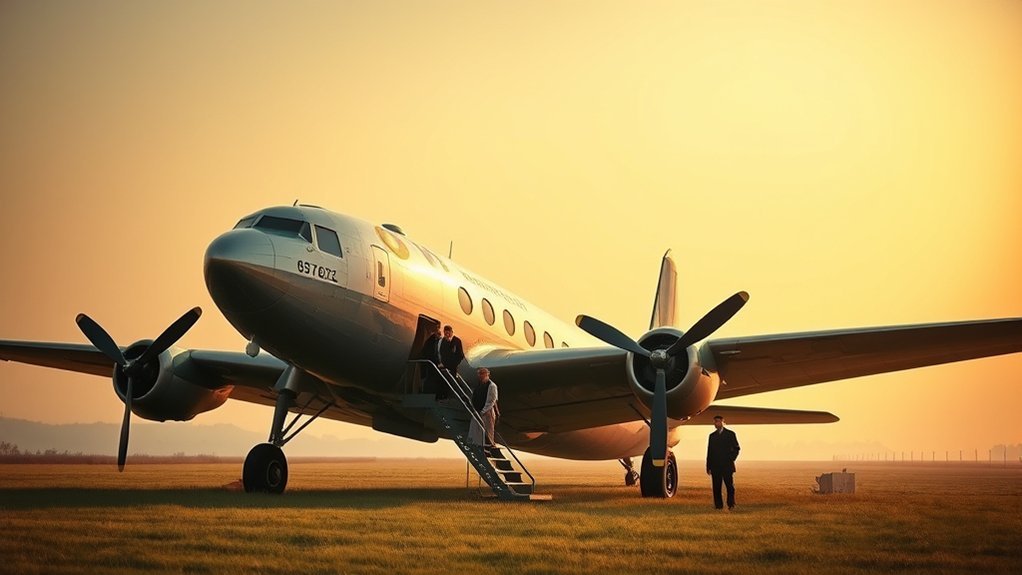
The first widely recognized scheduled commercial passenger airline began operating on January 1, 1914. The St. Petersburg-Tampa Airboat Line connected St. Petersburg and Tampa, Florida, across Tampa Bay.
Pilot Tony Jannus flew the first trip in a Benoist Model XIV flying boat. The aircraft carried one passenger beside the pilot in an open cockpit. The route covered about 18 miles and took roughly 23 minutes, compared with a much longer trip around the bay by land.
Former St. Petersburg mayor A. C. Phiel paid $400 at an auction for the first passenger seat. The airline’s ordinary one-way fare was $5. According to the Smithsonian National Air and Space Museum, the service transported 1,204 passengers before closing at the end of March 1914.
The first scheduled airline lasted only three months, but it established the basic model still used today: a published route, regular departure times, and tickets sold to passengers.
Commercial Aviation Timeline
| Year | Milestone | Why It Mattered |
| 1914 | St. Petersburg-Tampa Airboat Line begins | Established the first widely recognized scheduled passenger airline service. |
| 1918 | Scheduled U.S. airmail service starts | Helped develop routes, navigation methods, pilots, and aviation infrastructure. |
| 1925 | Air Mail Act becomes law | Allowed private airlines to receive government contracts for carrying mail. |
| 1933 | Boeing 247 enters the modern-airliner era | Combined all-metal construction, greater speed, and improved passenger design. |
| 1935–1936 | Douglas DC-3 is introduced | Made it possible for airlines to earn a profit from passenger service without depending entirely on mail subsidies. |
| 1952 | De Havilland Comet begins jet passenger service | Became the first jet airliner to enter scheduled commercial service. |
| 1958 | Boeing 707 begins U.S. international service | Helped make long-distance jet travel commercially successful. |
| 1970 | Boeing 747 enters airline service | Expanded passenger capacity and helped establish the wide-body era. |
The First Commercial Airplanes and Mail Routes
The 1914 passenger service proved that scheduled flying was possible, but it did not create a stable airline industry by itself. Early aircraft were small, expensive to operate, exposed to bad weather, and unable to carry enough passengers to cover their costs.
Mail provided a more dependable business. The United States began regularly scheduled airmail service in 1918 between Washington, Philadelphia, and New York. Early flights used Curtiss Jenny mailplanes, including the JN-4H aircraft associated with the first scheduled service.
The federal government also developed routes, landing fields, navigation beacons, and night-flying procedures. These systems later supported passenger airlines.
The Air Mail Act of 1925, also called the Kelly Act, authorized the Postmaster General to award mail-carrying contracts to private companies. The first private contract routes began operating in 1926. The National Postal Museum explains that some early carriers earned most of their revenue from mail rather than passengers.
Those contracts gave airlines enough predictable income to buy better airplanes, hire pilots, expand routes, and begin offering more passenger seats.
How Early Commercial Air Travel Grew
Commercial passenger travel expanded rapidly during the late 1920s and 1930s. Pan American developed international routes, while United, American, Eastern, and Transcontinental and Western Air, later known as TWA, became major names in U.S. domestic aviation.
The Boeing 247, introduced in 1933, is often described as one of the first modern airliners. It had an all-metal body, retractable landing gear, two engines, and space for 10 passengers. It was faster and more advanced than many aircraft already in airline service.
The Douglas DC-3 made an even greater commercial impact. First flown in 1935, its passenger version entered service in 1936. It normally carried about 21 passengers and became the first airliner widely credited with operating profitably on passenger revenue without requiring mail subsidies.
The Smithsonian’s history of early commercial aviation reports that U.S. airlines carried about 6,000 passengers in 1929, more than 450,000 in 1934, and approximately 1.2 million in 1938. Flying remained expensive for many families, but it was no longer a tiny experiment.
How the Jet Age Changed Commercial Airplanes
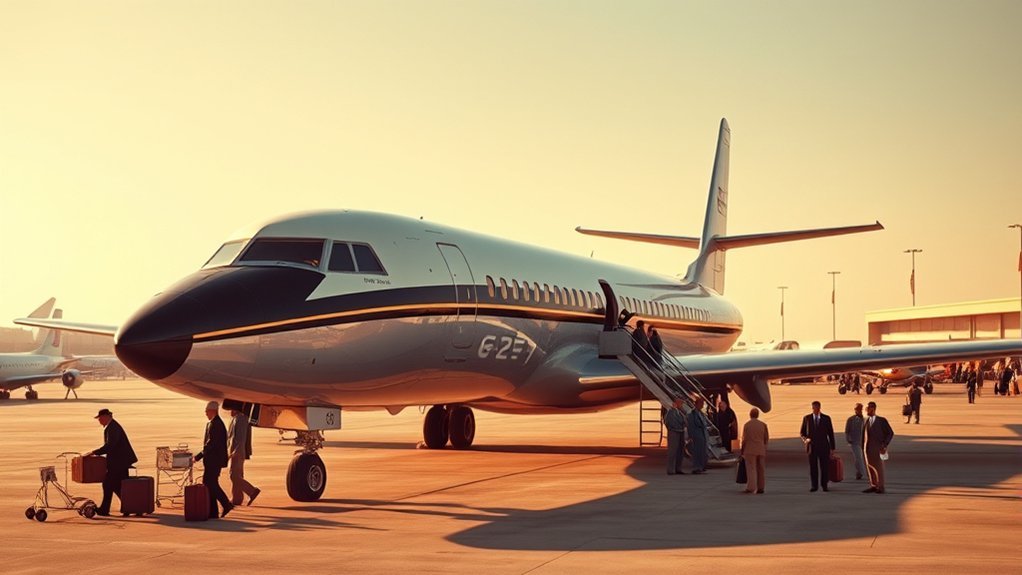
Jet engines allowed commercial airplanes to fly higher, faster, and farther than most piston-engine airliners. They also supported larger aircraft and more frequent long-distance service.
The British de Havilland Comet became the first jet airliner to enter scheduled passenger service in 1952. Its early operation was interrupted after structural failures led to fatal accidents, investigations, and major design changes. Those lessons influenced later jet-airliner engineering.
Boeing’s 367-80, known as the Dash 80, first flew in 1954 as a prototype for future jet transports. It was not itself a Boeing 707. The production 707 was developed from that program, and Pan American opened U.S. international jet service with the Boeing 707 in October 1958.
The Douglas DC-8 entered airline service soon afterward. The 707 and DC-8 offered greater speed, range, capacity, and commercial reliability than earlier jets. The Smithsonian’s commercial-airliner history describes how these aircraft helped establish jet travel on major domestic and international routes.
Jets did not make every ticket inexpensive overnight. However, their productivity allowed airlines to carry more passengers over longer distances in less time. As airline networks and competition grew, flying became available to a much wider part of the public.
How Commercial Aviation Became a Global Industry
The next major change came with wide-body aircraft. The Boeing 747 entered airline service in 1970 and carried far more passengers than earlier narrow-body jets. Other manufacturers followed with aircraft such as the McDonnell Douglas DC-10, Lockheed L-1011, and Airbus A300.
Wide-body cabins supported high-capacity international routes, while smaller jets connected regional and domestic markets. Improvements in air traffic control, navigation, airport design, weather forecasting, maintenance, and aircraft certification also made large airline networks more practical.
In the United States, the Airline Deregulation Act of 1978 reduced federal control over airline fares, routes, and market entry. Airlines gained more freedom to compete, create hub networks, introduce discounted fares, and open or close routes. The results included more travel choices, but also airline failures, mergers, and changes in service to smaller communities.
Modern commercial aviation now includes full-service airlines, low-cost carriers, regional airlines, charter companies, cargo operators, and specialized passenger services. The industry grew from one-passenger flying boats into a worldwide transportation network.
Who Flies Commercial Airplanes Today?
Modern airline aircraft are normally flown by two qualified pilots: a captain and a first officer, sometimes informally called a co-pilot. Both share flight duties, monitor aircraft systems, communicate with air traffic control, and follow standardized operating procedures. The captain has final authority and responsibility for the flight.
In the United States, pilots serving in most scheduled airline operations must hold an Airline Transport Pilot certificate or qualify for a restricted ATP. The standard unrestricted airplane ATP pathway normally requires at least 1,500 hours of flight experience. Certain military pilots and graduates of approved aviation programs may qualify for restricted ATP privileges with fewer hours.
The Federal Aviation Administration’s ATP guidance also explains that pilots must complete required training, testing, medical qualification, and aircraft-specific preparation. Airline pilots continue receiving simulator training and proficiency checks after they are hired.
The original claim that the FAA expects only 18,000 pilots over an entire decade was inaccurate. The U.S. Bureau of Labor Statistics projects about 18,200 openings for airline and commercial pilots each year, on average, from 2024 through 2034. Many openings will result from retirement or workers leaving the occupation rather than new job growth alone.
Frequently Asked Questions
What year did commercial flights become a thing?
Scheduled commercial passenger airline service is generally dated to 1914. On January 1 of that year, the St. Petersburg-Tampa Airboat Line began carrying paying passengers across Tampa Bay on a published schedule.
Was the 1914 Tampa Bay flight the first commercial flight ever?
Not under every possible definition. Earlier pilots had carried paying passengers, and commercial airships already existed. The Tampa Bay service is important because it is widely recognized as the first scheduled airline using a fixed-wing aircraft.
What was the first commercial passenger airplane?
The Benoist Model XIV flying boat is commonly identified with the first scheduled passenger airline service. It carried one passenger beside pilot Tony Jannus on the St. Petersburg-Tampa route in 1914.
What was the first modern commercial airliner?
The Boeing 247, introduced in 1933, is often called the first modern airliner because it combined an all-metal body, two engines, retractable landing gear, and improved speed and comfort. The later Douglas DC-3 achieved greater commercial success and made passenger-only profitability practical.
What was the first commercial jet airliner?
The British de Havilland Comet became the first jet airliner to enter scheduled commercial service in 1952. The Boeing 707 entered Pan American service in 1958 and helped make long-distance jet travel commercially successful in the United States.
Why avoid seat 11A on a plane?
There is no universal reason to avoid seat 11A. Seat layouts differ by airline and aircraft. On one plane it may have a normal window and good legroom, while on another it may have a misaligned window, limited recline, or a location near an exit, galley, engine, or lavatory. Check the seat map for your exact flight.
What drinks should you avoid ordering on a plane?
There is no universal list of drinks that every passenger must avoid. Water is the simplest option for staying hydrated. Coffee, tea, soda, juice, and alcohol depend on your health, preferences, and tolerance. Limit alcohol if it makes you feel dehydrated, tired, or unwell.
What is a female pilot called?
A female pilot is called a pilot. The historical word “aviatrix” may appear in older writing, but modern aviation uses the same professional title for pilots of every gender.
Sources
- Smithsonian National Air and Space Museum: Early Airlines — the 1914 Tampa Bay route, aircraft, fares, flight time, and passenger total.
- National Postal Museum: Building the Commercial Aviation Network — the Air Mail Act, contract routes, and the financial role of airmail.
- Smithsonian National Air and Space Museum: Early Commercial Aviation — early airlines, passenger growth, and development of the airline industry.
- Smithsonian National Air and Space Museum: Evolution of the Commercial Airliner — the Boeing 247, DC-3, Boeing 707, and wide-body aircraft.
- Federal Aviation Administration: Airline Transport Pilot Training — current ATP and restricted ATP training pathways.
- U.S. Bureau of Labor Statistics: Airline and Commercial Pilots — current employment and 2024–2034 occupational projections.
Conclusion
Commercial passenger aviation is generally traced to January 1, 1914, when the St. Petersburg-Tampa Airboat Line began scheduled flights across Tampa Bay. That small operation lasted only three months, but it introduced the basic airline model.
Airmail contracts gave later carriers financial stability, the Boeing 247 and Douglas DC-3 made passenger service practical, and jet aircraft transformed long-distance travel. Wide-body airplanes, improved infrastructure, stronger safety systems, and greater competition then helped commercial aviation grow into the global transportation industry it is today.
