

Last Updated on August 2, 2026 by Daniel Globe
London is easy to explore when you know what to watch for, but visitors can still encounter tourist scams, aggressive sales tactics, illegal transport offers, pickpocketing, phone theft, card fraud, and overpriced tourist services. The safest approach is simple: verify who you are dealing with, agree prices before committing, use official transport and ticket sellers, and keep phones, cards, and bags secure in crowded places.
Quick Answer
Common London tourist scams and traps include fake charity collections, illegal minicab offers, pedicab overcharging, street ticket touts, card and ATM scams, distraction theft, and phone snatching. Use TfL-licensed transport, verify charities independently, keep valuables zipped away, agree prices before paying, and report fraud or theft promptly.
Key Takeaways
- Verify charities independently rather than relying only on a collector’s clothing, badge, or story.
- Only black cabs can legally pick you up from the street without a booking; private hire vehicles and minicabs must be pre-booked through a TfL-licensed operator.
- London’s pedicab licensing and fare rules take effect in stages from 30 October 2026 to 18 February 2027, so confirm the fare before travelling in the meantime.
- Keep your phone and wallet out of easy reach in crowds, on station platforms, near train doors, and around busy tourist attractions.
- A high souvenir price is not automatically a scam, but UK businesses must present mandatory charges clearly, and shop prices already include VAT where applicable.
- If you lose money through fraud, contact your bank immediately and use the UK’s Report Fraud service; report theft and immediate danger to the appropriate police service. Emergency calls are free from any phone.
Disclosure: As an Amazon Associate I earn from qualifying purchases. Some links on this page are affiliate links, at no extra cost to you.
Recognizing and Avoiding Fake Charity Collectors
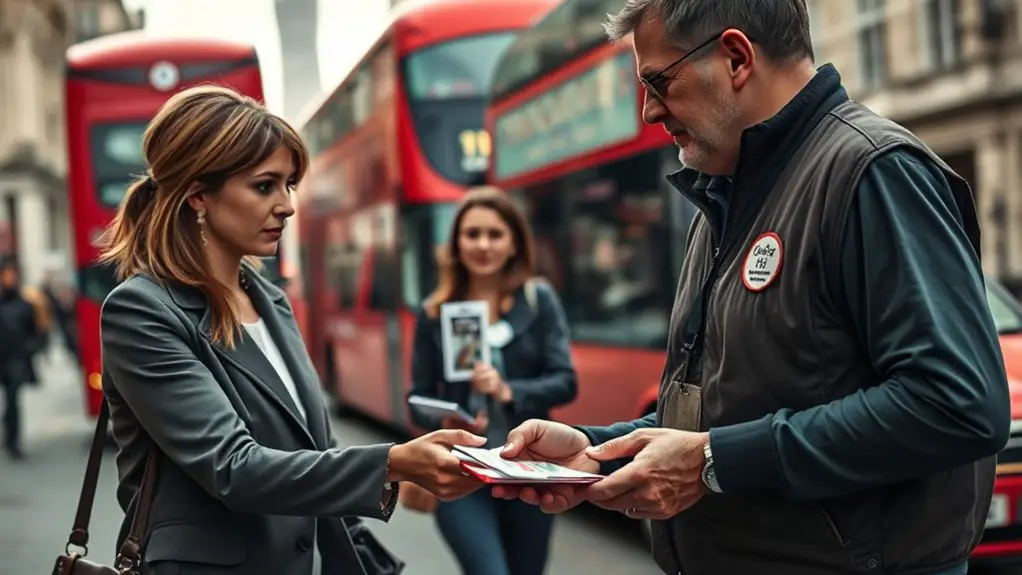
Charity fundraising is common in busy parts of London, and most genuine fundraisers are easy to identify. The problem is that a convincing badge, branded jacket, or collection bucket does not by itself prove that the person is legitimate.
The Fundraising Regulator advises donors to check identification, look for the charity’s name and registration details, and be cautious if a collection tin appears damaged or a fundraiser cannot answer basic questions about the organisation.
Identification requirements vary with the type of fundraising. Some volunteer cash collectors do not have to wear the same type of ID badge as professional street fundraisers, so the absence of one particular badge is not automatic proof of fraud. The better test is whether you can independently confirm the charity and collection.
Before giving a meaningful amount of money, search the organisation through the official Charity Commission register or visit the charity’s own website by typing its address yourself. Do not use a QR code or payment link simply because a stranger hands it to you.
Warning: A legitimate fundraiser should never need your card PIN, online-banking password, one-time security code, or full login credentials. If anyone asks for them, stop the transaction.
Pressure is another warning sign. You are always free to decline, walk away, and donate directly through the charity later. A genuine cause does not require you to make an immediate decision on the pavement.
Common Taxi and Rideshare Scams
The safest way to avoid London taxi scams is to know the difference between a taxi, commonly called a black cab, and a private hire vehicle or minicab. They operate under different rules.
Black Cab Fares and Payments
London taxis are licensed by Transport for London, and their normal fares are regulated and calculated by a taximeter. A licensed taxi can be hailed in the street, taken from a taxi rank, or booked in advance.
According to Transport for London, black cabs must accept card and contactless payments without a card surcharge. TfL also states that there is no extra taxi charge for luggage, additional passengers, or assistance dogs.
Some legitimate additional charges can apply in defined situations, including certain bookings, so the presence of an extra charge is not automatically evidence of a scam. What matters is whether the charge is permitted and clearly explained.
At the end of the journey, check the meter and request a receipt if anything looks wrong. TfL accepts complaints about taxi overcharging and driver conduct.
Private Hire and Rideshare Bookings
Private hire vehicles, including app-based rideshare services and minicabs, work differently. They must be pre-booked through a TfL-licensed private hire operator. A driver who approaches you on the street offering an unbooked minicab ride should be avoided, even if the vehicle looks professional.
Before a private hire journey begins, check the booking information against the vehicle and driver. TfL requires booking confirmation to include key information such as the vehicle registration, driver’s first name, and private hire licence number, with a driver photo where the passenger can receive one.
Private hire fares are not regulated in the same way as black-cab meter fares, but the operator must provide an accurate fare estimate unless you have already agreed a fixed fare.
Pro Tip: Before entering a rideshare vehicle, compare the registration, driver name and photo in your booking with the person and vehicle in front of you. Do not rely only on a driver calling out your destination or name.
Long Routes and Overcharging
An unexpectedly long journey can increase a fare, but a longer route does not automatically mean the driver is scamming you. Traffic, road closures and diversions can all change the best route through central London.
If a route appears seriously wrong, ask the driver about it while the journey is in progress. Keep the booking record or receipt and report suspected overcharging through the operator or TfL rather than confronting the driver aggressively.
London Pedicabs and Overcharging
Pedicabs, sometimes called cycle rickshaws, have long operated in London without formal oversight. The Pedicabs (London) Act 2024 gave TfL power to regulate the industry, and detailed regulations were finalised in February 2026.
The new system is being phased in through 2026 and 2027. Drivers could begin applying for licences from 9 March 2026, and the driver- and operator-licensing requirement, along with the main fare-control provisions, is scheduled to take effect on 30 October 2026. The separate requirement for the pedicab vehicle itself to hold a London pedicab vehicle licence is scheduled to take effect later, on 18 February 2027.
Once the October 2026 fare provisions take effect, an ordinary pedicab journey will be subject to a maximum regulated fare made up of a £5 base fare, up to £1 per minute, and up to £3 for each additional passenger. Fixed journey fares may be agreed in advance if they are below the permitted maximum. Separate fees for tours or additional services are subject to different rules and must be agreed clearly in advance.
Warning: Until London’s new pedicab fare rules take effect, do not assume a pedicab has a taxi-style regulated meter. Ask exactly how the fare will be calculated and agree the price or calculation method before the ride starts.
Beware of Overpriced Souvenir Shops
Souvenir shops around London’s busiest attractions can charge considerably more than shops or markets a few streets away. That can make them poor value, but an expensive price is not automatically a scam if it is displayed clearly and you freely agree to pay it.
Hidden Price Markups
The simplest protection is comparison shopping. Check two or three nearby shops before buying common items such as magnets, mugs, umbrellas, T-shirts or keyrings. Products that appear identical can vary significantly in price depending on location.
Be cautious when a seller will not clearly state the total cost, changes the price at the till, or adds a mandatory charge that was not disclosed. Current UK consumer rules require traders to provide transparent pricing and include unavoidable mandatory charges in the price presented to consumers.
One important correction to a common misconception: VAT due on an ordinary purchase in a UK shop is already included in the displayed consumer price. A cashier should not suddenly add UK VAT to the shelf price when you pay.
Authentic vs. Fake
Not every London souvenir claims to be a collectible or official product. A generic Big Ben magnet can be perfectly legitimate even though it is mass-produced. The question is whether the seller is accurately describing what you are buying.
| Feature | Better Sign | Red Flag | What to Do |
| Price | Clearly displayed total price | Price changes unexpectedly at checkout | Confirm the total before paying |
| Material | Matches the description and price | Seller makes unsupported claims about quality or origin | Inspect labels, finish and packaging |
| Official merchandise | Traceable retailer or venue branding | Generic item represented as officially licensed without evidence | Buy official merchandise from the attraction or recognised seller |
| Receipt | Seller provides normal proof of purchase | Seller refuses to document an expensive transaction | Keep the receipt for higher-value purchases |
For ordinary mugs, magnets, keyrings and similar items, do not expect a “certificate of authenticity.” Such documentation only makes sense when a seller is making a specific authenticity, limited-edition, provenance or collectible claim.
Location Matters
Shops immediately beside famous attractions often charge a convenience premium because of their location and tourist traffic. Walk a few streets away, check local markets, or compare prices online before buying something expensive.
Local markets can be good places to find unusual gifts, but “market” does not automatically mean cheap or handmade. Ask a seller who made an item and where it came from if those details matter to you.
How to Spot and Prevent Card Skimming, ATM Tricks and Card Theft
Card fraud can involve tampered cash machines, stolen cards, PIN theft, or social engineering. When using an ATM, inspect the card slot and keypad for anything loose, bulky or obviously added to the machine. Cover the keypad while entering your PIN and stay aware of anyone watching from unusually close range.
Do not reveal your PIN or hand your bank card to a stranger who claims they are trying to help you at a cash machine.
British Transport Police also warns visitors not to give their PIN to anyone, including someone claiming over the phone or in person to be an undercover police officer investigating fraud on your account — this is a distinct and common trick, and a genuine officer never needs your bank-card PIN.
For cash withdrawals, an ATM inside a bank or another controlled location can reduce your exposure to tampering and distraction compared with an isolated street machine. For purchases, contactless cards or mobile wallets avoid inserting the card into a conventional reader, although you should still check transactions and keep control of your device.
- Inspect an ATM before inserting your card.
- Shield the keypad while entering your PIN.
- Do not let a stranger take your card “to help.”
- Walk away if someone crowds or distracts you during a withdrawal.
- Check banking alerts and statements for transactions you do not recognise.
- Freeze or cancel a missing card immediately through your bank.
Choosing a Reliable Tour Guide
London does not have a single government licence that every walking tour guide must hold, so describing every non-accredited guide as “unlicensed” is misleading. Instead, check the guide’s qualifications, reputation, booking terms and experience.
The Institute of Tourist Guiding awards professional qualifications including Blue, Green and White Badges. The London Blue Badge qualification involves extensive study and practical assessment and is widely recognised within the tourism industry.
Some major attractions also control who may conduct guided tours inside their properties. A guide who is excellent at an outdoor neighbourhood walk may therefore not have the same access or endorsement as a qualified guide working inside a particular attraction.
Before paying for a private tour, check independent reviews, the company’s contact information, cancellation terms, the exact itinerary and what is included in the advertised price. Be wary of someone who approaches you unexpectedly, pressures you to pay immediately, refuses to provide booking details, or makes extravagant claims that cannot be verified.
Note: A Blue Badge is a professional tourist-guiding qualification, not the same thing as the statutory TfL licences required for taxi and private hire drivers.
Fake Tickets and Street Touts
Be cautious when someone outside a theatre, concert venue or tourist attraction offers a supposedly rare ticket or last-minute bargain. British Transport Police advises visitors not to buy theatre or concert tickets from street touts and to use reliable sources instead.
Buy directly from the venue, event organiser, or an authorised ticket agent whenever possible. Before using a resale platform, check whether the venue recognises transferred or resold tickets and whether the ticket is tied to a named purchaser.
A seller demanding cash, refusing to provide verifiable ticket details, or insisting that you must decide immediately gives you a good reason to walk away.
Protecting Yourself From Pickpocketing and Phone Snatching
Pickpockets often work where people are crowded or distracted: stations, trains, busy shopping streets, queues, nightlife areas and major attractions. British Transport Police notes that thieves may work in teams, with one person creating a distraction while another takes the victim’s property.
A distraction does not have to look threatening. Friendly conversation, a staged bump, a request for help, or sudden crowding can all pull your attention away from your valuables.
Carry zipped bags in front of you or across your body rather than behind you. Keep your wallet in a secure internal or zipped pocket, and do not leave a phone sitting on a café table or loosely in an open coat pocket.
Phone snatching deserves separate attention. In a 2026 Metropolitan Police operation, officers described a tactic in which suspects asked people to unlock their phones to follow them on social media and then stole the unlocked device. Treat unexpected requests to unlock or hand over your phone with caution.
- Keep phones away from the edge of the pavement when not in use.
- Step away from train doors before concentrating on your screen.
- Use a strong screen lock, device tracking and remote-lock features.
- Do not hand an unlocked phone to a stranger for directions, photographs, social media or payment.
- Keep passports and backup cards separate from your everyday wallet when practical.
Staying Safe With Public Transportation
London’s Tube, buses, Overground, Elizabeth line and rail services are convenient, but busy trains and stations are also good environments for distraction theft. Keep bags zipped and in sight, especially while boarding, leaving a train, using escalators, or standing in a crowd.
For pay-as-you-go travel, both Oyster and contactless payment are widely used. Adult contactless payments generally use the same adult-rate pay-as-you-go fares as Oyster rather than automatically costing more.
The important rule is to use the same card or device throughout a journey and, where required, when touching in and out. Touching in with a physical bank card and touching out with a phone linked to that card counts as two different payment methods and can lead to incomplete journey charges.
Pro Tip: Keep the Oyster card or bank card you intend to use away from other contactless cards when touching a reader. This helps prevent “card clash” and makes it easier to keep all journeys on the same payment method for fare capping.
Avoid placing a phone, purse or wallet on a train seat or table where it can be grabbed just before the doors close. British Transport Police advises passengers to keep valuables zipped away and to pay attention to distraction tactics.
What to Do If You Are Scammed or Robbed in London
Act quickly, but put personal safety first. Do not chase a thief into traffic or become involved in a physical confrontation over a phone or wallet.
- Immediate danger: call 999 or 112 for police, ambulance or fire services. These calls are free from any phone, even without credit or a SIM.
- Non-emergency crime: contact police on 101 or use the relevant police online reporting service.
- Rail and Tube incidents: British Transport Police can be contacted by text on 61016 for non-emergency incidents on the rail network.
- Lost or stolen bank cards: freeze or cancel them through your bank immediately and review recent transactions.
- Fraud: report fraud or cybercrime through Report Fraud, the national service that replaced Action Fraud in December 2025.
- Stolen phone: remotely lock the device, mark it lost through the manufacturer account, contact your mobile provider, and change important passwords if the thief may have seen or obtained your unlock code.
- Keep evidence: save receipts, booking confirmations, vehicle registrations, screenshots, payment records and descriptions of the people involved.
If you paid by card for something fraudulent or a transaction appears that you did not authorise, contact your bank promptly. Your bank can explain which protections or dispute procedures apply to your specific transaction.
Frequently Asked Questions
What are signs of a fake charity collector in London?
Warning signs include pressure to donate immediately, vague answers about the organisation, damaged collection containers, suspicious payment links, or requests for sensitive banking information. Check the charity independently through the Charity Commission or its official website rather than relying only on clothing or a badge.
How can I identify a legitimate London taxi or rideshare?
A licensed London taxi can be hailed in the street or taken from a taxi rank and should display the required TfL licensing information. Private hire vehicles and rideshares must be pre-booked through a TfL-licensed operator. Match the registration, driver details and booking confirmation before getting in.
Can a London black cab charge extra for luggage or card payment?
TfL states that London taxis do not charge extra for luggage or additional passengers, and taxis accept card and contactless payments without a card-payment surcharge. Other defined charges can apply in certain circumstances, such as some advance bookings.
Are London pedicabs regulated in 2026?
Yes, but the new system is being phased in. Driver-licence applications opened on 9 March 2026, and the driver- and operator-licensing requirement along with the main fare rules take effect on 30 October 2026. The pedicab vehicle-licensing requirement takes effect on 18 February 2027. Check current TfL guidance before travelling because the transition is ongoing.
Which London souvenirs are least likely to be overpriced?
There is no particular souvenir that guarantees a fair price. Compare identical or similar products at several shops, markets or official attraction stores. For branded merchandise, buy through the relevant attraction or a retailer you can verify. Remember that a high but clearly displayed price is not automatically a scam.
How can I detect card skimming devices on ATMs?
Check the card slot and keypad for loose, bulky or added parts, cover your PIN, and stop if the machine behaves unexpectedly. Avoid accepting help from strangers and never disclose your PIN, even to someone claiming to be an undercover police officer. Using an ATM inside a bank or another controlled location can reduce exposure to street-level distraction and tampering.
What credentials should I look for in a London tour guide?
There is no single statutory licence required for every London walking guide. For a professionally assessed guide, look for recognised qualifications such as the Institute of Tourist Guiding’s Blue Badge, Green Badge or White Badge, along with verifiable reviews and relevant experience.
Is Oyster safer or cheaper than contactless in London?
For adult pay-as-you-go travel, contactless and Oyster generally use the same adult-rate fare structure. The best choice depends on your circumstances. Whichever method you use, touch in and out with the same card or device and keep other contactless cards away from the reader to avoid card clash.
What should I do if my phone or wallet is stolen in London?
Move somewhere safe, freeze bank cards, remotely lock a stolen phone, and report the theft. Call 999 or 112 for immediate danger; use 101 for non-emergency police matters. For incidents on the rail network, contact British Transport Police. Fraud can be reported through Report Fraud.
Conclusion
Most London visits pass without serious problems, and a few practical habits remove much of the risk. Use licensed or properly booked transport, verify charities and tickets independently, confirm prices before committing, and keep phones, cards and bags under your control in crowded areas.
The biggest improvement is knowing the London-specific rules. Black cabs and private hire vehicles are not interchangeable, pedicab regulation is being introduced in stages through October 2026 and February 2027, normal shop prices already include applicable VAT, and a Blue Badge tour guide holds a professional qualification rather than a universal government guiding licence. When something does go wrong, act quickly by securing your accounts, preserving evidence and reporting the incident through the correct police or fraud channel.
Sources
- Transport for London — Guide to taxis and private hire — licensing, booking, payment and passenger requirements.
- Pedicabs (London) (Fares and Fees) Regulations 2026 — commencement dates and regulated pedicab fares.
- Fundraising Regulator — Tips for giving safely to charity — identifying and checking public fundraisers.
- GOV.UK / Charity Commission — Search the charity register — independent charity verification.
- British Transport Police — How to stay safe while visiting London — pickpockets, ATMs, ticket touts and emergency advice.
- Competition and Markets Authority — Price transparency — current UK requirements for total prices and mandatory charges.
- Report Fraud — City of London Police — national fraud and cyber crime reporting service that replaced Action Fraud in December 2025.
