
Last Updated on July 26, 2026 by Daniel Globe
Ticks can attach to hikers after contact with tall grass, brush, leaf litter, wooded edges, animals, or gear that has picked up a crawling tick. Some ticks carry germs that cause Lyme disease, Rocky Mountain spotted fever, anaplasmosis, ehrlichiosis, babesiosis, and other illnesses. A layered routine before, during, and after a hike offers the best protection.
Quick Answer
To avoid ticks when hiking, stay near the center of trails, wear long light-colored clothing, use an EPA-registered skin repellent, and treat approved clothing or gear with 0.5% permethrin. Afterward, inspect your body, children, pets, clothing, and gear; shower within two hours; and remove attached ticks promptly with tweezers.
Key Takeaways
- Avoid tall grass, brush, leaf litter, and trail edges whenever practical.
- Use an EPA-registered repellent whose label lists protection against ticks.
- Apply 0.5% permethrin only to clothing and gear approved by the product label, not directly to skin.
- Check your body, clothing, gear, children, and pets after outdoor exposure.
- Shower within two hours and use the dryer correctly to kill ticks on clothing.
- Remove attached ticks immediately with steady, even pressure rather than waiting for medical help.
At a Glance
| Time Required | About 5–10 minutes before the hike and 10–15 minutes for a careful post-hike check, plus shower and laundry time |
| Difficulty | Easy, but consistency matters |
| Tools Needed | EPA-registered repellent, protective clothing, fine-tipped tweezers, mirror, and access to a shower and dryer |
| Cost | Low to moderate; it varies based on the repellent, treated clothing, gear, and pet products selected |
Medical note: This guide provides general prevention information and is not a diagnosis or individualized treatment recommendation. Contact a healthcare professional if you develop concerning symptoms after possible tick exposure or need advice about preventive antibiotics.
Understanding the Risks of Tick Bites
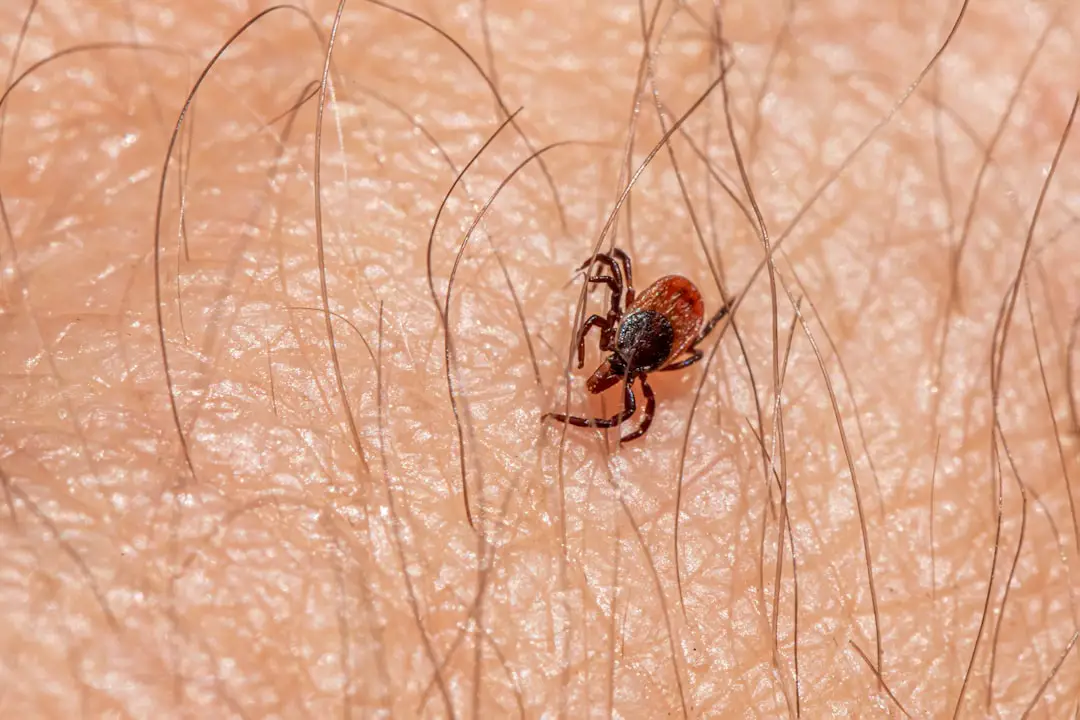
Ticks are arachnids that feed on the blood of people and animals. They do not fly or jump. Instead, many species wait on grasses, leaves, or shrubs and climb onto a passing host after contact.
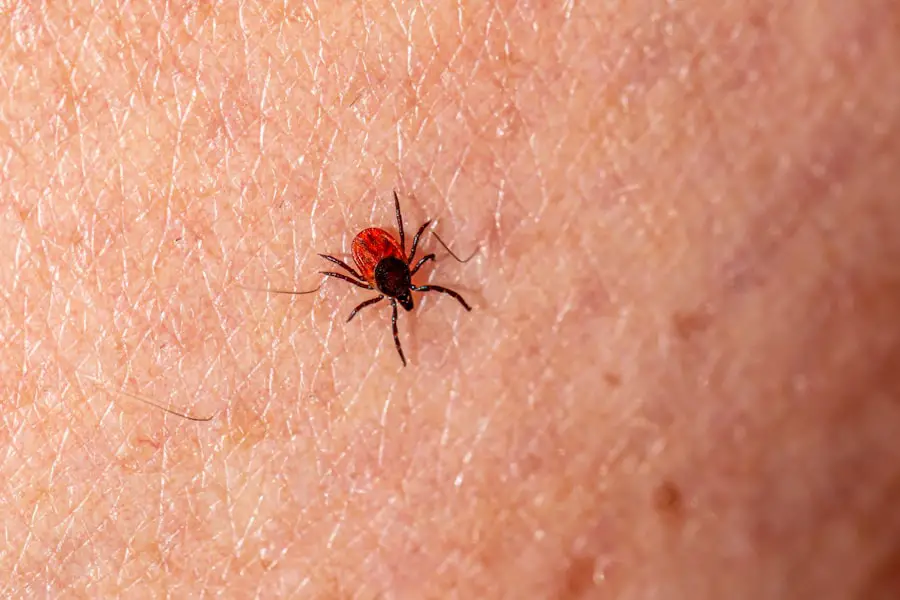
Not every tick carries a disease-causing germ, and finding a tick does not automatically mean that an infection occurred. Risk depends on several factors, including the tick species, geographic area, attachment time, and how quickly the tick was removed.
In the United States, Lyme disease is mainly spread by infected blacklegged ticks. It is most common in the Northeast, mid-Atlantic, upper Midwest, and smaller areas along the Pacific Coast. Other tick species can spread Rocky Mountain spotted fever, ehrlichiosis, anaplasmosis, babesiosis, tularemia, and additional illnesses.
Tick exposure can occur throughout the year, although many ticks are more active during warmer months. Local risk also changes with tick species, temperature, humidity, wildlife hosts, vegetation, land use, and other environmental conditions. Check local health-department information when planning a trip in an unfamiliar area.
The most reliable approach is layered protection: reduce contact with tick habitat, use suitable repellents and clothing, and complete a careful check after every hike.
Know Where Ticks Are Likely Before You Hike
Ticks are often found in wooded or brushy areas, tall grass, leaf litter, trail edges, gardens, and places used by wildlife. Exposure can also occur in neighborhood yards and urban parks, not only in remote forests.
Before leaving home:
- Check the trail or park website for tick notices and seasonal warnings.
- Look at the weather and choose clothing that covers your skin without causing dangerous overheating.
- Pack repellent, fine-tipped tweezers, a small mirror, and a sealable container or tape for disposing of a removed tick.
- Ask a veterinarian about suitable tick prevention before taking a pet into tick habitat.
- Plan where you will shower, inspect gear, and dry your clothes after returning.
Choosing the Right Clothing for Tick Prevention
Clothing creates a useful physical barrier between ticks and your skin. Wear long pants, a long-sleeved shirt, closed-toe shoes, and socks when the weather and trail conditions allow. Light-colored fabric makes dark ticks easier to notice before they reach the skin.
For additional protection:
- Tuck your shirt into your pants when practical.
- Tuck pant cuffs into socks or use gaiters in dense vegetation.
- Choose tightly woven fabric rather than loose, open-weave material.
- Keep long hair tied up and consider a hat in brushy areas.
- Inspect cuffs, waistbands, shoelaces, and pack straps during breaks.
Clothing and gear may be treated with a product containing 0.5% permethrin when the label specifically allows that use. Factory-treated clothing is another option. Protection lasts for a limited number of washes, so follow the garment or treatment label for washing and retreatment instructions.
Warning: Do not apply clothing-treatment permethrin directly to your skin. Treat only the clothing and gear listed on the product label, allow items to dry completely as directed, and keep wet treatment away from children and pets.
Products Worth Considering

Permethrin spray bonds to fabric fibers for up to 6 weeks or through 6 washings (whichever comes first) won't stain or damage clothing, fabrics, plastics, finished surfaces, or outdoor gear; fragrance free

THE ULTIMATE BUG BARRIER: Insect Shield Lightweight Hiking Socks feature built-in Permethrin to repel mosquitoes, ticks, ants, flies, fleas, chiggers, and midges, providing powerful EPA-registered protection for all your outdoor adventures
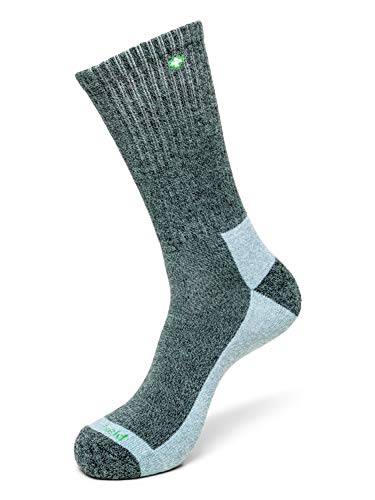
THE ULTIMATE BUG BARRIER: Insect Shield Lightweight Hiking Socks feature built-in Permethrin to repel mosquitoes, ticks, ants, flies, fleas, chiggers, and midges, providing powerful EPA-registered protection for all your outdoor adventures
Using Insect Repellent for Tick Prevention
Use an EPA-registered skin-applied repellent whose label specifically lists protection against ticks. EPA registration is more useful than marketing terms such as “natural,” “outdoor,” or “family formula.”
| Active Ingredient | What to Know | Important Caution |
|---|---|---|
| DEET | Available in many formulations and concentrations. Choose a label that lists ticks and the protection period needed for the hike. | May damage some plastics, watch faces, painted surfaces, and synthetic materials. Follow the label. |
| Picaridin | A common skin-applied option. Protection time depends on the concentration and formulation. | Use only as directed and reapply according to the label rather than a fixed schedule. |
| IR3535 | Found in some EPA-registered products labeled for ticks and mosquitoes. | Check the exact label because products containing the same ingredient can provide different protection periods. |
| Oil of Lemon Eucalyptus or PMD | EPA-registered formulations can protect against ticks when the label lists that use. | CDC advises against OLE- or PMD-containing products for children younger than three. |
| 2-Undecanone | Available in a smaller number of EPA-registered repellent products. | Confirm that the label lists ticks and follow its application limits. |
Apply repellent only to exposed skin or clothing when the label permits it. Do not spray repellent underneath clothing. Avoid eyes, mouth, cuts, irritated skin, and excessive application.
To apply repellent to the face, spray it onto your hands first and then spread it carefully, avoiding the eyes and mouth. When applying it to a child, an adult should place the product on their own hands first. Avoid putting repellent on a young child’s hands because children may touch their eyes or mouth.
If sunscreen is also needed, apply sunscreen first and insect repellent second. Reapply each product according to its own label, especially after swimming, heavy sweating, or towel drying.
Pro Tip: Do not select a repellent by ingredient name alone. Compare the product label’s listed pests, expected protection time, age restrictions, and application instructions with the length and conditions of your hike.
Products Worth Considering
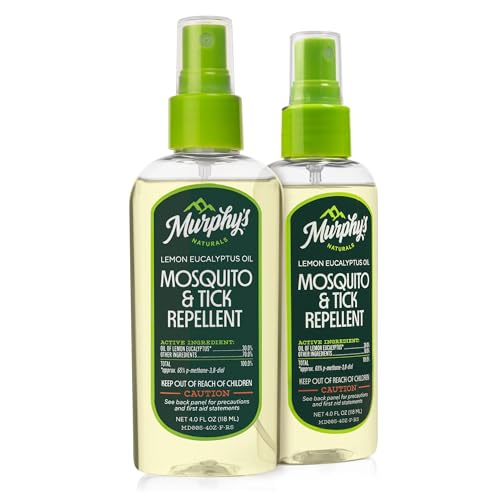
30% OIL OF LEMON EUCALYPTUS: EPA-registered formula with a plant-based active ingredient provides up to 6 hours of mosquito protection and up to 4 hours for ticks. Picaridin Free* and DEET-free* for dependable outdoor coverage. *Not a safety claim
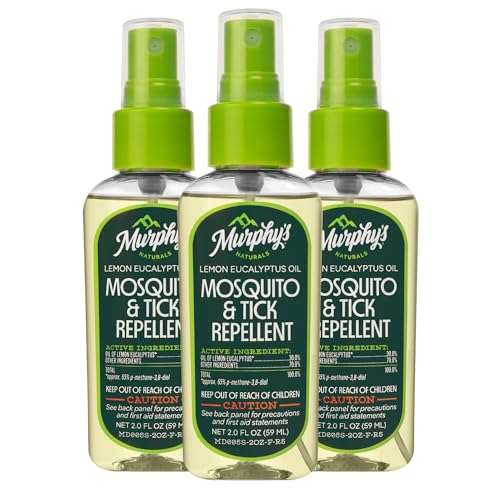
30% OIL OF LEMON EUCALYPTUS: EPA-registered formula with a plant-based active ingredient provides up to 6 hours of mosquito protection and up to 4 hours for ticks. Picaridin Free* and DEET-free* for dependable outdoor coverage. *Not a safety claim

Naturally-Scented with Real Essential Oils (Not a Synthetic Fragrance) - Mimikai's bug spray uses a blend of natural essential oils, clove, allspice, star anise, and frankincense, for a warm, aromatic scent that's noticeably different from typical bug sprays. Formulated with high ingredient standards, including those required for EPA registration and clean beauty retailers like Credo. Infused with moisturizing oils to help skin feel nourished, not stripped. Bugs hate it. Your skin will thank you.
How to Avoid Tick Habitat on the Trail
Your movement on the trail can reduce contact with waiting ticks. When possible:
- Walk near the center of a maintained trail.
- Avoid brushing against tall grass, shrubs, and low branches.
- Do not sit directly in leaf litter or dense vegetation.
- Use a ground cloth or seat pad during rest stops.
- Keep your pack and spare clothing off brush and tall grass.
- Check pant legs, socks, shoes, waistbands, and sleeves during longer breaks.
There is no universal rule requiring a check at an exact number of hours. Check whenever you have moved through dense vegetation, after sitting on the ground, and before entering a vehicle, tent, or home.
Checking for Ticks During and After Hiking
Ticks can be extremely small, particularly during the nymph stage. Use a full-length or handheld mirror and good lighting. Parents or caregivers should help children check areas they cannot see.
Inspect these locations carefully:
- In and around the hair and scalp
- Behind and inside the outer ears
- Around the neck and hairline
- Under the arms
- Inside the belly button
- Around the waist and waistband
- Between the legs and around the groin
- Behind the knees
- Around sock lines and ankles
- Anywhere clothing or pack straps pressed against the skin
Check clothing, shoes, hats, coats, trekking poles, daypacks, child carriers, and other gear. Ticks may crawl from an item and attach later. A lint roller can help collect unattached ticks from smooth clothing or gear, but it does not replace a full visual and hands-on check.
Showering and Washing Clothes After Hiking
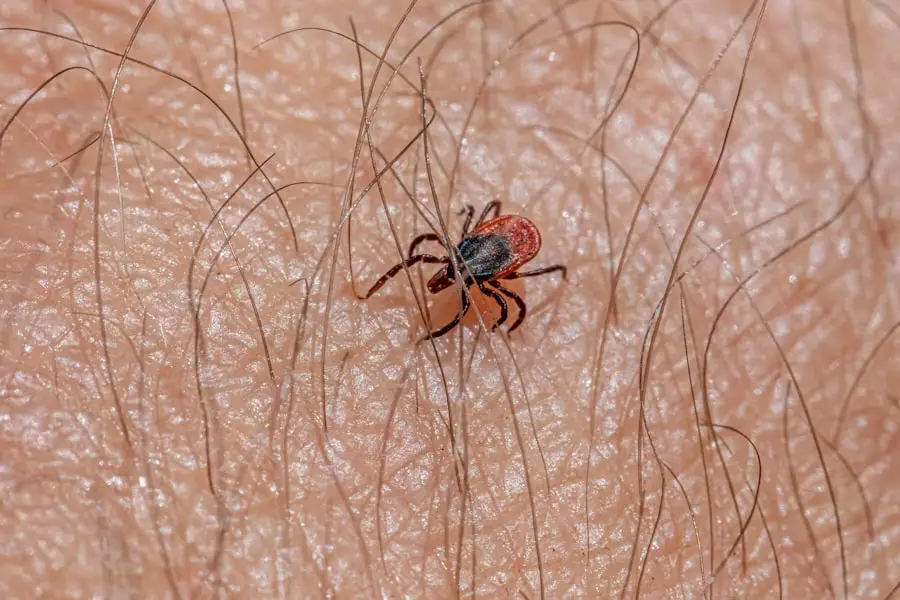
Shower as soon as practical after coming indoors. Showering within two hours can wash away unattached ticks and gives you another opportunity to inspect the entire body.
Handle clothing carefully so that a crawling tick does not move onto furniture, bedding, or another person:
- If the clothing is dry, tumble dry it on high heat for at least 10 minutes.
- If the clothing is damp, additional drying time may be needed.
- If clothing must be washed first, use hot water when the fabric allows. Cold and medium-temperature water may not kill ticks.
- Dry the load completely according to the fabric instructions.
- Inspect shoes, hats, packs, coats, and equipment that cannot go into the dryer.
Until gear has been inspected, keep it away from bedrooms, upholstered furniture, and clean clothing. A sealed bin or bag can temporarily contain the gear, but any live tick inside may remain alive, so inspection and appropriate treatment are still necessary.
Creating a Lower-Risk Area at a Campsite
Choose an established campsite in an open, relatively dry area with short vegetation and little leaf litter. Avoid placing a tent directly against dense brush, tall grass, or a wooded edge when another approved tent pad is available.
Keep footwear, clothing, towels, and packs inside the tent or in closed storage rather than leaving them in vegetation. Check tent doors, sleeping areas, and pets before settling in for the night.
Proper food storage is important because it reduces unwanted wildlife encounters, but it is not a complete tick-control method. Follow campground rules and wildlife-safety requirements rather than assuming food storage alone will make a campsite tick-free.
Note: Wood-chip or gravel barriers are recommended as part of some residential yard-management plans. They are not a standard temporary-campsite treatment. Do not move vegetation, spread material, or alter public land unless the property owner or land manager authorizes it.
Treating Gear and Equipment for Tick Prevention
Products containing 0.5% permethrin can be used on certain boots, clothing, tents, packs, and camping equipment when those items are listed on the product label. Treatment may repel or kill ticks that contact the material.
For safe use:
- Treat items outdoors or in another label-approved, well-ventilated location.
- Apply only the amount directed by the product label.
- Allow treated gear to dry completely before wearing, packing, or using it.
- Keep wet treatment away from children, pets, food, and water sources.
- Do not apply clothing-treatment permethrin to skin.
- Do not spray a pet with a clothing or gear product.
- Repeat treatment only at the interval listed on the label.
Inspect gear before putting it into a vehicle and again before bringing it into the home. Pay particular attention to pack seams, straps, tent folds, boot tongues, and other protected spaces where a tick may hide.
Products Worth Considering

Permethrin spray bonds to fabric fibers for up to 6 weeks or through 6 washings (whichever comes first) won't stain or damage clothing, fabrics, plastics, finished surfaces, or outdoor gear; fragrance free
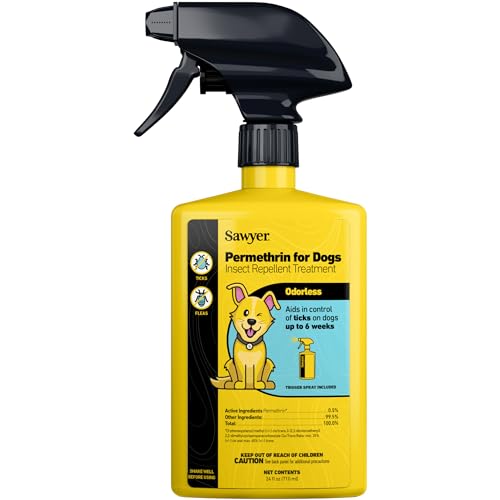
Permethrin spray bonds to fabric fibers for up to 6 weeks or through 6 washings (whichever comes first) won't stain or damage clothing, fabrics, plastics, finished surfaces, or outdoor gear; fragrance free

Rugged Efficiency: Ben's Clothing and Gear Insect Repellent ensures your outdoor apparel becomes a reliable barrier against pests
Using Tick Control Products for Pets
Dogs and cats can be bitten by ticks and may carry crawling ticks into a tent, vehicle, or home. A veterinarian can recommend an appropriate preventive product based on the animal’s species, age, weight, health history, location, and outdoor activity.
Pet products include collars, topical treatments, sprays, shampoos, and oral medicines. These products are not interchangeable. Follow the exact species and weight range on the label, and never apply a product labeled only for dogs to a cat.
Warning: Cats can be highly sensitive to chemicals used in some tick products. Do not apply a tick-prevention product to a cat without confirming that it is specifically labeled for cats and discussing the choice with a veterinarian.
Check pets after every outdoor trip, including:
- In and around the ears
- Around the eyelids and face
- Under the collar or harness
- Between the front and back legs
- Between the toes
- Around the tail
- Under thick fur
Remove an attached tick promptly. Contact a veterinarian if the pet becomes lethargic, loses its appetite, develops lameness, has a fever, or reacts abnormally after a tick product is applied.
Knowing How to Remove Ticks Safely
Remove an attached tick as soon as it is found. Do not wait to visit a clinic solely for removal because additional attachment time may increase the opportunity for disease transmission.
- Use clean tweezers. Fine-tipped tweezers provide the best control, although regular tweezers can be used if necessary.
- Grasp close to the skin. Hold the tick by its mouth area as close to the skin’s surface as possible. Avoid squeezing the swollen body.
- Pull upward steadily. Use steady, even pressure. Do not twist, jerk, or rapidly yank the tick.
- Deal with remaining mouthparts carefully. If mouthparts remain and can be removed easily with tweezers, remove them. If they cannot be removed easily, leave them alone and allow the skin to heal.
- Clean the area. Wash the bite site and your hands with soap and water, rubbing alcohol, or hand sanitizer.
- Dispose of the tick safely. Place it in a sealed container, wrap it tightly in tape, flush it down the toilet, or place it in alcohol. Do not crush it with bare fingers.
- Check for more ticks. Finding one tick means another may be present on the body, clothing, pet, or gear.
Warning: Do not cover an attached tick with petroleum jelly, nail polish, alcohol, essential oil, or another substance. Do not burn it or touch it with a hot object. These methods can delay safe removal and may agitate the tick.
You may photograph the tick next to a ruler or coin and record the date and likely location of exposure. Routine commercial testing of the removed tick is generally not recommended for treatment decisions. A positive result does not prove that you were infected, and a negative result can create false reassurance.
Seeking Medical Attention After a Tick Bite
Most tick bites do not lead to illness. Monitor your health during the following days and weeks, and tell a healthcare professional about the bite if symptoms develop.
Seek medical advice promptly if you develop:
- Fever or chills
- An expanding or unusual rash
- Severe headache or neck stiffness
- Unusual fatigue
- Muscle or joint aches
- Swollen lymph nodes
- Facial weakness or drooping
- Heart palpitations, chest discomfort, dizziness, or shortness of breath
- Progressive weakness, numbness, or difficulty walking
A small bump or mild redness immediately after a bite can be a local skin reaction and may disappear within a day or two. In contrast, the erythema migrans rash associated with Lyme disease usually expands over several days. It may be solid, oval, irregular, or target-like and does not always form a classic bull’s-eye.
There is no universal rule that every tick attached for more than 24 hours requires treatment. However, attachment time can be one factor in a clinician’s assessment. In certain circumstances, a healthcare professional may offer a single preventive dose of doxycycline after a bite from a likely blacklegged tick in an area where Lyme disease is common. The decision also depends on timing, patient factors, and other clinical details.
Do not take leftover antibiotics or another person’s medication. Testing and treatment choices should be based on symptoms, exposure history, geographic risk, and professional medical assessment.
Common Tick-Prevention Mistakes
- Assuming ticks only live deep in the woods: Exposure can occur in yards, parks, gardens, and trailhead vegetation.
- Relying on clothing alone: Ticks may crawl through openings or attach near the scalp, waist, or groin.
- Using an unregistered oil without checking the label: Marketing language does not prove that a product protects against ticks.
- Putting permethrin on skin: Clothing-treatment permethrin is intended for approved fabrics and gear.
- Waiting to remove a tick: Prompt mechanical removal is safer than waiting for the tick to detach.
- Burning or smothering an attached tick: These methods delay removal and can irritate the tick.
- Forgetting clothing, gear, children, or pets: A tick may enter the home on something other than your body.
- Waiting for a bull’s-eye rash: Tick-borne illness can occur without that classic appearance.
By combining protective clothing, suitable repellent, careful trail habits, prompt post-hike checks, correct laundry steps, pet protection, and safe removal, hikers can substantially reduce their exposure to ticks while continuing to enjoy wooded and grassy outdoor areas.
For a separate outdoor-gear topic, the site’s travel fishing pole guide discusses compact fishing equipment for trips. It is not a source of medical or tick-prevention guidance; use the official resources below for those topics.
Frequently Asked Questions
What are ticks?
Ticks are small arachnids that feed on the blood of people, mammals, birds, reptiles, and amphibians. Some species can transmit germs that cause illness. Ticks do not fly or jump; they usually climb onto a host after contact with grass, leaves, brush, animals, or infested gear.
Where are ticks commonly found?
Ticks are commonly found in wooded, brushy, grassy, and leaf-covered areas. They may also be present in gardens, neighborhood yards, urban parks, campsites, trail edges, and places frequently visited by wildlife.
How can I avoid ticks when hiking?
Walk near the center of maintained trails, avoid tall grass and brush, cover exposed skin, use an EPA-registered repellent labeled for ticks, and consider 0.5% permethrin-treated clothing or gear. After the hike, inspect your body and equipment, shower within two hours, and dry clothing on high heat as directed.
What should I do after hiking to check for ticks?
Check your hair, scalp, ears, underarms, belly button, waist, groin, backs of the knees, ankles, and other covered areas. Inspect children, pets, clothing, shoes, packs, and gear. Shower soon after returning and remove any attached tick immediately with tweezers.
What symptoms can tick-borne diseases cause?
Possible symptoms include fever, chills, headache, fatigue, muscle aches, joint pain, swollen lymph nodes, and rash. Some illnesses can also cause facial weakness, breathing problems, heart symptoms, or neurologic symptoms. Seek medical advice when concerning symptoms appear after possible tick exposure.
Does a Lyme disease rash always look like a bull’s-eye?
No. An erythema migrans rash may be solid, oval, irregular, bluish-red, or target-like. It usually expands gradually, but it does not always have central clearing. Some infected people do not notice a rash, so other symptoms and exposure history also matter.
How quickly can a tick transmit disease?
Transmission time varies by the disease, tick species, and feeding conditions. For Lyme disease in the United States, infected blacklegged ticks generally must be attached for more than 24 hours, but other tick-borne germs may follow different timelines. Remove every attached tick as soon as it is found.
Should I have a removed tick tested?
Routine commercial tick testing is generally not recommended for treatment decisions. A positive tick test does not prove that infection reached you, and a negative result can be falsely reassuring. Photographing the tick and recording the bite date and location may still help a healthcare professional assess the exposure.
Can I apply permethrin directly to my skin?
No. Products intended to treat clothing and gear should not be applied directly to skin. Apply them only to materials listed on the label, use them in the required location, and allow treated items to dry completely before use.
Should I see a doctor after every tick bite?
Not every bite requires an appointment. Remove the tick promptly and monitor for symptoms. Contact a healthcare professional if you develop fever, an expanding rash, severe headache, facial weakness, joint symptoms, breathing or heart symptoms, or another concerning change. A clinician can also determine whether a high-risk bite qualifies for preventive medication.
Sources
- CDC: Preventing Tick Bites — tick habitat, repellents, permethrin, showering, laundry, body checks, and yard guidance
- U.S. EPA: Skin-Applied Repellent Ingredients — EPA-registered repellent ingredients and product selection
- CDC: What to Do After a Tick Bite — removal steps, disposal, follow-up, and cautions against smothering or burning ticks
- CDC: Signs and Symptoms of Untreated Lyme Disease — early and later symptoms and the varied appearance of erythema migrans
- CDC: Preventing Ticks on Pets — veterinarian guidance, daily checks, and special cautions for cats
- CDC: Treatment and Intervention for Lyme Disease — current treatment overview and limited circumstances for post-exposure antibiotics
