
Last Updated on July 27, 2026 by Daniel Globe
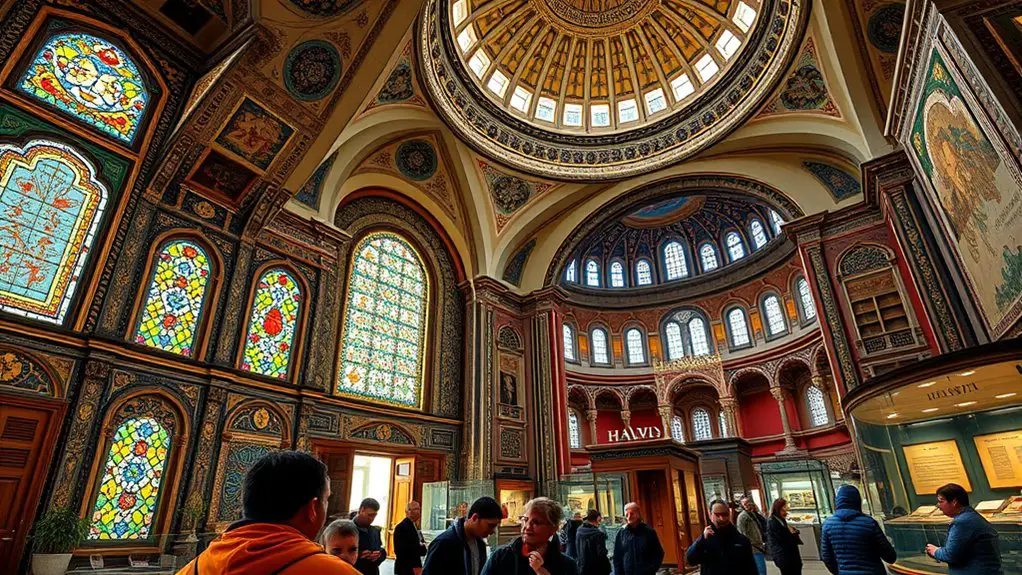
Rain does not have to derail a day in Istanbul. In fact, some of the city’s best history, art, architecture, and family attractions are indoors. From the ancient collections of Sultanahmet to contemporary galleries beside the Bosphorus and Golden Horn, Istanbul has enough museums and cultural sites to fill even the wettest day.
Quick Answer
The best Istanbul museums for a rainy day include the Istanbul Archaeological Museums, Museum of Turkish and Islamic Arts, Pera Museum, Sakıp Sabancı Museum, Istanbul Modern, and Rahmi M. Koç Museum. Hagia Sophia is also worth visiting, but it is now an active mosque with a separate tourist visitor route rather than a museum.
Key Takeaways
- Best for ancient history: The Istanbul Archaeological Museums combine three museum units and collections spanning many civilizations.
- Best for Islamic art: The Museum of Turkish and Islamic Arts is especially strong in historic carpets, manuscripts, calligraphy, metalwork, ceramics, and ethnographic material.
- Best for modern art: Istanbul Modern pairs modern and contemporary exhibitions with a Renzo Piano-designed waterfront building.
- Best with children: Rahmi M. Koç Museum’s transportation and industrial collections are especially easy to enjoy as a family.
- Best rainy-day strategy: Group nearby Sultanahmet attractions together rather than crossing the city repeatedly in wet weather.
Disclosure: As an Amazon Associate I earn from qualifying purchases. Some links on this page are affiliate links, at no extra cost to you.
Which Istanbul Museum Is Best for You?
- Ancient civilizations and archaeology: Istanbul Archaeological Museums
- Islamic art, carpets, manuscripts, and Ottoman culture: Museum of Turkish and Islamic Arts
- Ottoman-era painting and Orientalist art: Pera Museum
- Turkish painting, calligraphy, decorative art, and major temporary exhibitions: Sakıp Sabancı Museum
- Modern and contemporary art: Istanbul Modern
- Cars, trains, engineering, transport, and industrial history: Rahmi M. Koç Museum
- Monumental Byzantine and Ottoman architecture: Hagia Sophia
Pro Tip: On a very wet day, stay in one district. Hagia Sophia, the Istanbul Archaeological Museums, and the Museum of Turkish and Islamic Arts form the strongest history-focused cluster in and around Sultanahmet, cutting down the time you spend walking through the rain.
Hagia Sophia: Historic Mosque and Visitor Gallery
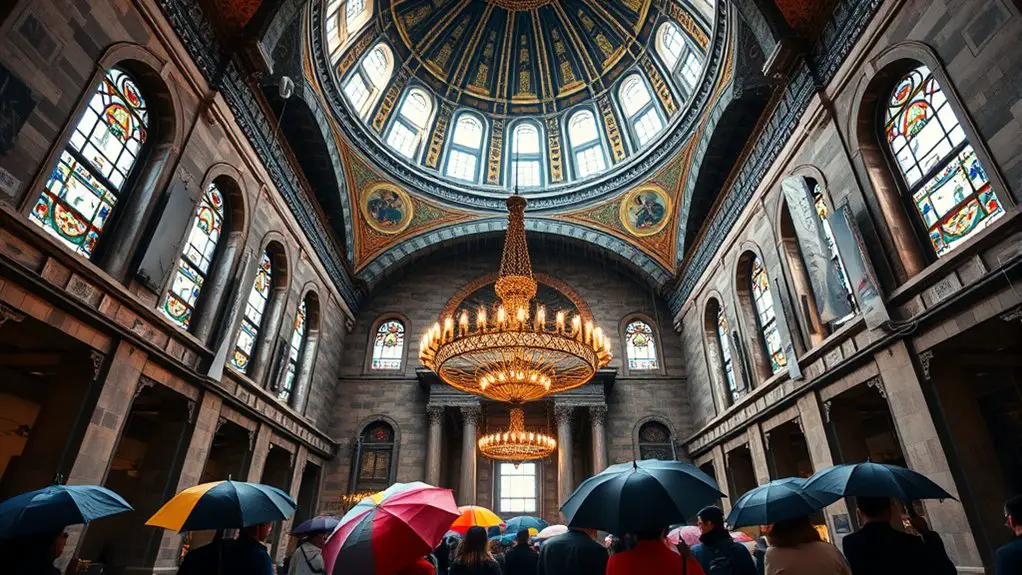
Whether you are an architecture enthusiast or a history buff, Hagia Sophia remains one of Istanbul’s most important historic interiors. It should not, however, be described as the Hagia Sophia Museum today.
Hagia Sophia was built in the sixth century during the reign of Byzantine Emperor Justinian I. Its vast dome, marble surfaces, surviving Byzantine mosaics, and later Ottoman additions show why it became one of the defining monuments of Istanbul. UNESCO includes Hagia Sophia within the Historic Areas of Istanbul World Heritage property.
Its history has included use as an Eastern Christian cathedral, a mosque after the Ottoman conquest, a museum in the 20th century, and an active mosque again after its status changed in 2020.
Note: Hagia Sophia is an active mosque, not a conventional museum. Since January 15, 2024, foreign visitors entering for tourism and cultural purposes have used a separate ticketed route through the upper gallery. Visitors should follow current mosque dress, access, photography, and worship-time rules.
Hagia Sophia’s appeal comes from seeing Byzantine and Ottoman history occupying the same monumental building rather than from treating it as a conventional museum collection.
The upper visitor route provides views into the monumental interior and access to important Byzantine-era mosaics while keeping tourist circulation separate from the principal worship area. For a rainy day in Sultanahmet, it pairs naturally with the nearby archaeology and Islamic-art museums.
Istanbul Archaeological Museums
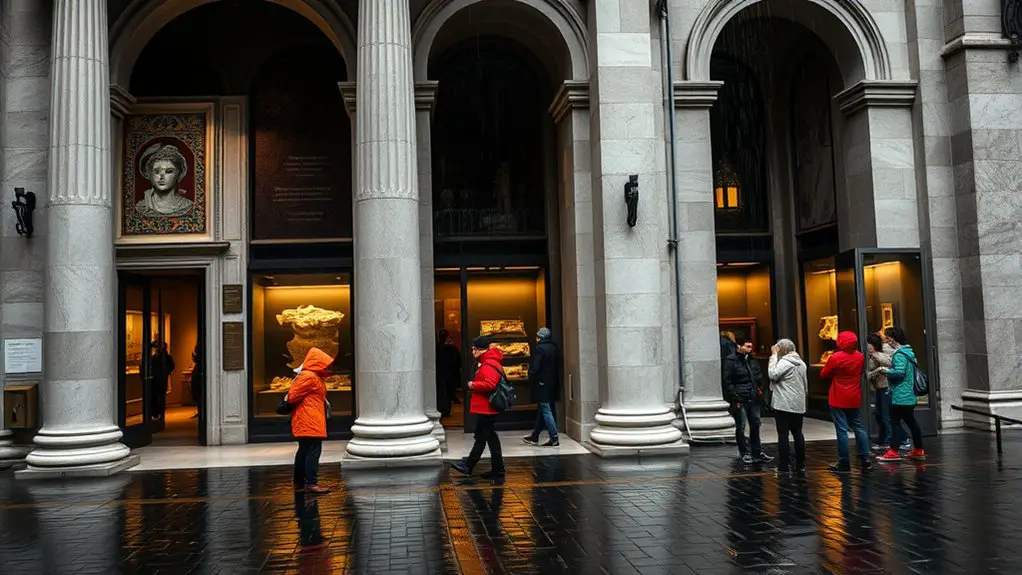
The Istanbul Archaeological Museums, close to Gülhane and Topkapı Palace, are among the strongest choices in Istanbul when rain makes outdoor sightseeing less appealing.
The complex consists of three main units: the Archaeological Museum, the Museum of the Ancient Orient, and the Tiled Kiosk Museum. Together, their holdings trace cultures from Anatolia, Mesopotamia, Egypt, the Greek and Roman worlds, Byzantium, and the Ottoman period.
One of the best-known objects is the Alexander Sarcophagus, excavated from the royal necropolis at Sidon by Osman Hamdi Bey’s expedition in the late 19th century. Despite its name and its imagery depicting Alexander, it is not Alexander the Great’s tomb.
You can also see sculpture, architectural fragments, inscriptions, ceramics, and archaeological material that helps connect Istanbul with the much broader history of the eastern Mediterranean and Near East.
Note: As of July 27, 2026, the official museum page reports several galleries and upper-floor areas as temporarily closed. The complex remains open, but not every gallery described in older guidebooks may be accessible.
This is one of the easiest museums in the article to spend several hours in, making it especially useful when a passing shower turns into an all-afternoon downpour.
Museum of Turkish and Islamic Arts
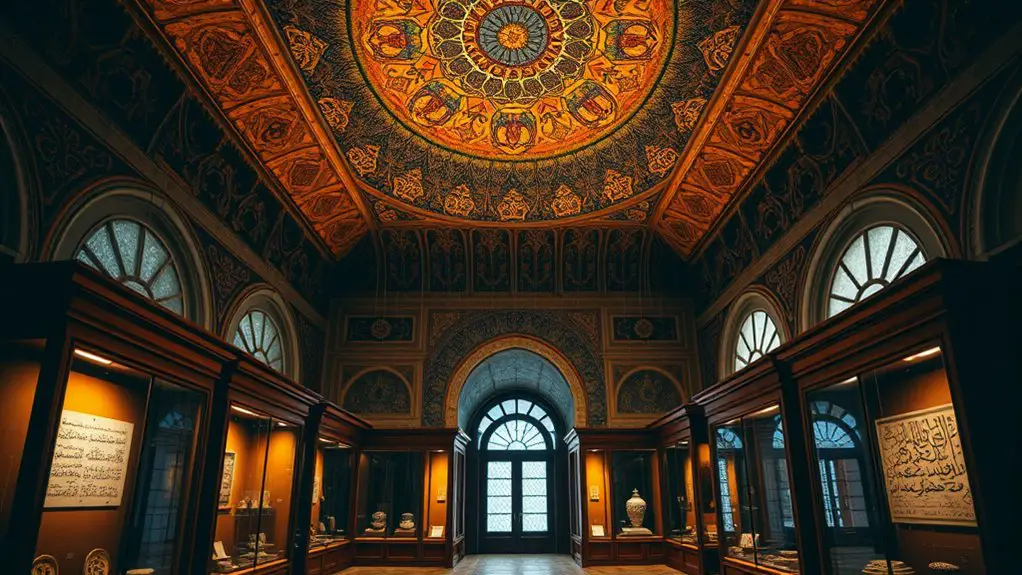
The Museum of Turkish and Islamic Arts is one of the best indoor stops in Sultanahmet for anyone interested in Islamic culture, Ottoman history, decorative arts, or historic craftsmanship.
The museum occupies the historic İbrahim Pasha Palace beside Sultanahmet Square. The institution first opened in 1914 and moved into the palace in 1983.
Its galleries include outstanding examples of historic carpets, manuscripts, calligraphy, glass, metalwork, stonework, ceramics, and objects from Abbasid, Seljuk, Mamluk, and Ottoman contexts.
The carpet collection is particularly important, with rare Seljuk examples among its highlights. Manuscripts and calligraphic works provide another reason to slow down rather than rush from room to room.
The museum also includes ethnographic material that helps show aspects of Turkish daily life rather than presenting Islamic art only as elite palace or religious objects.
Temporary exhibitions may add another layer to a visit, but the permanent collections are substantial enough to make this a worthwhile rainy-day destination on their own.
Pera Museum
In Beyoğlu, Pera Museum offers a more compact art-museum experience than Istanbul’s major archaeological collections. It occupies the former Bristol Hotel building, combining a historic exterior with galleries adapted for modern museum use.
The Suna and İnan Kıraç Foundation collections include Orientalist painting, Anatolian weights and measures, and Kütahya tiles and ceramics. One of the museum’s best-known paintings is Osman Hamdi Bey’s The Tortoise Trainer.
While exploring, keep an eye out for:
- Temporary exhibitions that change through the year
- Ottoman-era and Orientalist paintings
- Historic ceramics and objects from the museum’s foundation collections
- Pera Café on the ground floor, where you can take a break without stepping back into the rain
Pera’s central Beyoğlu location also makes it easier to combine with other indoor stops around Şişhane, Galata, and İstiklal Avenue.
For art lovers who prefer a focused visit rather than a sprawling museum complex, Pera Museum is one of Istanbul’s easiest rainy-day choices.
Sakıp Sabancı Museum
At the Sakıp Sabancı Museum in Emirgan, you’ll find Turkish painting, Ottoman calligraphy and book arts, decorative arts, archive material, and a changing program of major temporary exhibitions.
The museum occupies Atlı Köşk, a mansion overlooking the Bosphorus, together with modern gallery spaces. Its location is farther from Istanbul’s historic core than the Sultanahmet museums, so it works best when you are already staying on or exploring the European side of the upper Bosphorus.
The museum also runs cultural events, talks, tours, learning activities, and temporary exhibitions throughout the year.
Art Collection Highlights
The Sakıp Sabancı Museum’s permanent holdings are more accurately understood through three major strengths rather than as a general collection of European masters.
- Turkish Painting: The current presentation traces important developments in late Ottoman and early Republican painting, including artists such as Osman Hamdi Bey and Fikret Mualla.
- The Arts of the Book and Calligraphy: The collection includes Ottoman calligraphic works, Qurans, manuscripts, and illuminated book arts.
- Decorative Arts: Furnishings and objects associated with Atlı Köşk help preserve the mansion’s historic character.
International masters have appeared at Sakıp Sabancı Museum through major temporary exhibitions. For example, the museum hosted a dedicated Monet exhibition in 2012–2013. Such exhibitions should not be confused with the museum’s permanent collection.
This mix of permanent holdings and changing exhibitions means repeat visitors can have a substantially different experience from one year to the next.
Stunning Architecture
The Sakıp Sabancı Museum is not just about objects inside display cases. Atlı Köşk and its Bosphorus setting are part of the museum experience.
The mansion retains historic interiors while purpose-built galleries provide the controlled space needed for changing art exhibitions. This creates a deliberate contrast between the domestic scale of the old residence and the museum’s contemporary exhibition areas.
On a dry day, the landscaped garden and Bosphorus view add substantially to the visit. During heavy rain, most of your time can still be spent inside the mansion and gallery spaces.
Cultural Events and Programs
Sakıp Sabancı Museum functions as more than a collection display. Its program can include exhibitions, talks, concerts, seminars, learning activities, and guided museum experiences.
- Learning programs: Activities are organized for different age groups and audiences.
- Temporary exhibitions: International and Turkish artists regularly appear in the museum’s changing program.
- Talks and tours: Curatorial and educational events provide more context for collections and exhibitions.
Because these programs change, the museum can be especially rewarding on a rainy day when you have time for a longer exhibition, talk, or guided experience rather than a quick sightseeing stop.
Istanbul Modern Art Museum
At Istanbul Modern, the focus shifts to modern and contemporary art, photography, film, design, and changing exhibitions.
The museum’s new waterfront building at Galataport was designed by Renzo Piano Building Workshop. Its galleries, library, cinema, educational spaces, café, and public areas make it particularly well suited to a long indoor visit.
For a rainy day, the Tophane location also has a practical advantage: the T1 tram stop is only a short distance from the museum.
Contemporary Art Exhibitions
Istanbul Modern presents work by established and emerging artists and uses both its collection and temporary exhibitions to examine developments in modern and contemporary visual culture.
Depending on the current program, you may encounter painting, sculpture, photography, installation, moving-image works, or multimedia projects.
- Explore modern and contemporary art from Türkiye and beyond.
- Visit the photography galleries and changing exhibitions.
- Use the museum’s digital guides and educational material for extra context.
That variety makes Istanbul Modern a strong choice for both serious art followers and visitors who simply want an engaging indoor activity for a few hours.
Unique Architectural Design
The museum building itself is part of the attraction. Designed by Renzo Piano Building Workshop, it uses expansive gallery floors, waterfront light, terraces, and public spaces to connect the museum with its Bosphorus setting.
The architecture is contemporary without trying to compete with Istanbul’s historic skyline. Inside, galleries accommodate everything from photography and painting to large installations.
The building also contains a cinema, library, learning spaces, café, restaurant, shop, and viewing areas, allowing a museum visit to extend well beyond a single exhibition.
Pro Tip: Istanbul Modern asks visitors to leave umbrellas, large bags, backpacks, and luggage in its cloakroom. That makes it especially convenient when you arrive carrying wet-weather gear.
Rahmi M. Koç Museum
Step into the Rahmi M. Koç Museum in Hasköy for a different side of Istanbul’s museum scene. Instead of fine art or archaeology, the focus is industrial, communication, engineering, and transportation history.
The museum occupies historic buildings and exhibition areas beside the Golden Horn. Collections cover subjects such as road transport, railways, maritime history, communication technology, machinery, and everyday industrial objects.
- See historic automobiles and transport exhibits.
- Explore locomotives, railway vehicles, models, and engineering displays.
- Discover communication and industrial technologies from different periods.
The broad subject matter and large mechanical objects make the museum particularly accessible to families and children who may be less interested in traditional painting galleries.
Getting there is possible by bus, Metrobus connections, and ferry via Hasköy Pier. On a wet day, public transport is preferable to building a long outdoor walk into your route.
Once inside, the scale and variety of the collections make Rahmi M. Koç Museum easy to turn into a half-day activity rather than a quick stop.
How to Plan a Rainy Museum Day in Istanbul
Istanbul is large, and some of these museums are far apart. When rain is heavy, geography matters almost as much as the collection.
For History: Stay in Sultanahmet
Combine Hagia Sophia, the Museum of Turkish and Islamic Arts, and the Istanbul Archaeological Museums. All three sit within the historic peninsula, avoiding a cross-city trip between attractions.
For Art: Focus on Beyoğlu and Tophane
Visit Pera Museum around Tepebaşı and Istanbul Modern in Tophane. They are not next door to each other, but both are on the Beyoğlu side and can be connected by public transport rather than a long exposed walk.
For Families: Make Rahmi M. Koç the Main Event
Instead of museum-hopping, allow several hours for the transportation, machinery, railway, and industrial collections at Rahmi M. Koç Museum.
For Art and a Bosphorus Setting: Choose Sakıp Sabancı
Sakıp Sabancı Museum is farther north in Emirgan. It is better treated as a destination in its own right than squeezed between Sultanahmet museums on the same wet afternoon.
On a rainy Istanbul day, the smartest itinerary is usually the one with the fewest long outdoor transfers—not the one with the greatest number of museums.
Current Hours, Free Entry, and MuseumPass
Note: The following visitor information was checked against official museum pages on July 27, 2026. Museum hours, admission programs, and temporary closures can change during holidays, special events, restoration work, and seasonal schedules.
- Istanbul Archaeological Museums: currently listed as open daily from 09:00 to 18:45. Some galleries are temporarily closed.
- Museum of Turkish and Islamic Arts: currently listed as open daily from 09:00 to 18:45, with separate night-museum hours published by the Ministry.
- Pera Museum: Tuesday–Saturday 10:00–19:00, Friday until 22:00, Sunday 12:00–18:00, closed Monday. Current programs include free admission for everyone Friday 18:00–22:00 and free Wednesday admission for students.
- Sakıp Sabancı Museum: Tuesday–Sunday 10:00–18:00, closed Monday. The museum currently offers free admission on Tuesdays.
- Istanbul Modern: Tuesday, Wednesday, Thursday, Saturday and Sunday 10:00–18:00; Friday 10:00–20:00; closed Monday. Türkiye residents currently have free admission Thursday 10:00–14:00, with an additional Tuesday program for eligible residents aged 18–25.
- Rahmi M. Koç Museum: Tuesday–Friday 09:30–17:30 and Saturday–Sunday 10:00–19:00; closed Monday.
MuseumPass İstanbul
International visitors can also consider the official MuseumPass İstanbul. As of July 27, 2026, the Ministry lists it as valid for 13 participating Ministry of Culture and Tourism and National Palaces museums for five days beginning with the first museum entry.
The official price currently shown is €105. It should not be described as unlimited access to every museum in Istanbul. Private institutions such as Pera Museum, Sakıp Sabancı Museum, Istanbul Modern, and Rahmi M. Koç Museum operate their own admission systems.
The pass is also not valid for the Ministry’s night-museum sessions, according to the current MuseumPass terms.
Frequently Asked Questions
What are the opening hours for Istanbul museums?
There is no single schedule. As of July 27, 2026, the Istanbul Archaeological Museums and Museum of Turkish and Islamic Arts list daytime hours of 09:00–18:45. Pera, Istanbul Modern, Sakıp Sabancı, and Rahmi M. Koç each use different schedules, and several close on Mondays. Holiday and seasonal hours can differ.
Are there any free museum days in Istanbul?
Yes, but there is no universal citywide “free museum day.” Current programs include free Friday evenings at Pera Museum, free Tuesdays at Sakıp Sabancı Museum, and limited free Tuesday or Thursday periods at Istanbul Modern for eligible Türkiye residents. Eligibility and programs can change.
Can I take photos inside the museums?
Often, yes, but rules differ. Pera Museum currently permits photography without flash. Istanbul Modern permits non-professional personal photography without flash or a tripod but prohibits video in its galleries. Temporary exhibitions and individual artworks can have stricter rules, so posted gallery restrictions take priority.
Is there a museum pass available for tourists?
Yes. MuseumPass İstanbul is aimed at foreign visitors and currently covers 13 listed Ministry of Culture and Tourism and National Palaces museums for five days from first use. It does not automatically cover Istanbul’s private museums, and the official page states that it is not valid for night-museum sessions.
Are guided tours offered at these museums?
Many offer some form of guided interpretation. The Istanbul Archaeological Museums and Museum of Turkish and Islamic Arts list audio-guide services, while Istanbul Modern and Sakıp Sabancı Museum advertise organized tours and educational programs. Some group tours require advance reservations.
Is Hagia Sophia still a museum?
No. Hagia Sophia’s status changed from museum to mosque in 2020. It remains open to worship, while foreign visitors entering for tourism and cultural purposes have used a separate ticketed upper-gallery route since January 15, 2024.
Which museums are easiest to combine on a rainy day?
For the least outdoor travel, combine Hagia Sophia, the Museum of Turkish and Islamic Arts, and the Istanbul Archaeological Museums in Sultanahmet. Pera Museum and Istanbul Modern can form a separate art-focused day on the Beyoğlu side. Sakıp Sabancı and Rahmi M. Koç are better treated as individual destinations because they sit farther from the historic core.
Conclusion
A rainy day can be one of the best excuses to explore Istanbul more deeply. For ancient history, start with the Istanbul Archaeological Museums and nearby Museum of Turkish and Islamic Arts. For contemporary culture, head to Istanbul Modern or Pera Museum. Families can easily spend hours at Rahmi M. Koç Museum, while Sakıp Sabancı Museum rewards visitors interested in painting, calligraphy, decorative arts, and changing exhibitions.
Just remember that Hagia Sophia is now an active mosque rather than a museum, and plan around geography as much as the weather. A focused day in one neighborhood usually means more time with Istanbul’s art and history and less time standing under an umbrella.
Sources
- Republic of Türkiye Ministry of Culture and Tourism — Hagia Sophia visitor arrangement — current mosque visitor-management system and upper-gallery tourist route.
- Republic of Türkiye Ministry of Culture and Tourism — Istanbul Archaeological Museums — museum units, collections, hours, Alexander Sarcophagus history, and current gallery closures.
- Republic of Türkiye Ministry of Culture and Tourism — Museum of Turkish and Islamic Arts — museum history, palace location, collections, and visitor hours.
- Pera Museum — Plan Your Visit — current hours, free-admission programs, café, and visitor information.
- Sakıp Sabancı Museum — Plan Your Visit — current hours, free Tuesdays, collections, facilities, and visitor information.
- Istanbul Modern — Museum Visitor Information — current hours, admission programs, tours, location, and visitor services.
