
Last Updated on July 29, 2026 by Daniel Globe
A .45 ACP bullet can travel much farther than most people expect, but its theoretical maximum range and its useful shooting range are not the same thing. A historical U.S. military manual lists an approximate maximum of 1,600 yards, while ordinary pistol practice takes place at far shorter distances. The important issues are load variation, trajectory, safe backstops, and responsible handling.
Quick Answer
A U.S. War Department manual lists the .45 ACP’s approximate maximum range as 1,600 yards, or about 0.9 mile. A 1946 edition associates that figure with roughly a 30-degree elevation. This is a high-arcing maximum-range figure, not a practical aiming distance. Most lawful pistol practice takes place at much shorter ranges.
Key Takeaways
- A historical military manual lists approximately 1,600 yards as the maximum range of the M1911’s .45-caliber cartridge.
- That figure describes a high-arcing flight path, not a reliable or responsible target-shooting distance.
- Distances around 25–50 yards are common in ordinary pistol practice, but they are not a universal physical limit.
- Ammunition, barrel length, projectile shape, launch angle, wind, and air density all affect the flight path.
- Never fire into the air or without an approved backstop. Firearm and ammunition laws must be checked for the current jurisdiction.
What’s in This Article
The 1,600-yard figure describes how far a bullet may travel before landing—not how far a shooter can reliably or responsibly aim.
Disclosure: As an Amazon Associate I earn from qualifying purchases. Some links on this page are affiliate links, at no extra cost to you.
Maximum Range vs. Practical Range
The terms maximum range, practical range, and effective range describe different ideas. Treating them as interchangeable makes the .45 ACP sound either more capable or less dangerous than it really is.
| Term | What It Means | .45 ACP Context |
|---|---|---|
| Maximum range | The farthest distance a projectile may travel under a high-arcing launch condition. | A historical military figure is approximately 1,600 yards. |
| Practical range | A distance at which a shooter can train safely and make consistent hits under controlled conditions. | Often 25–50 yards in ordinary range use, depending on the shooter, target, firearm, and course of fire. |
| Effective range | A context-specific distance tied to a defined accuracy or performance requirement. | There is no single universal figure for every pistol, load, target, and shooter. |
The cartridge commonly called .45 ACP is standardized by SAAMI as 45 Automatic or 45 Auto. It is closely associated with the M1911 pistol and uses a projectile approximately .45 inch in diameter. The exact allowable dimensions are defined in the current SAAMI centerfire pistol and revolver standard.
Maximum .45 ACP Distance in Ideal Conditions
The 1940 edition of FM 23-35, Automatic Pistol, Caliber .45, M1911 and M1911A1 lists an average velocity of 800 feet per second at 25 feet from the muzzle and an approximate maximum range of 1,600 yards.
A June 1946 edition of FM 23-35 describes approximately 1,600 yards at an elevation angle of about 30 degrees. That figure belongs to a historical military firearm-and-ammunition combination. It should not be treated as an exact result for every modern .45 Auto load, barrel, or weather condition.
Modern 230-grain factory ammunition also varies. For example, Federal lists its 230-grain American Eagle full-metal-jacket load at 890 feet per second from its specified test barrel. That works out to approximately 405 foot-pounds of muzzle energy. Other factory loads may be faster or slower.
Warning: Never fire a handgun upward to test maximum range. A bullet can travel beyond sight, leave the property or range, and cause fatal injury or serious property damage when it descends.
Practical .45 ACP Range
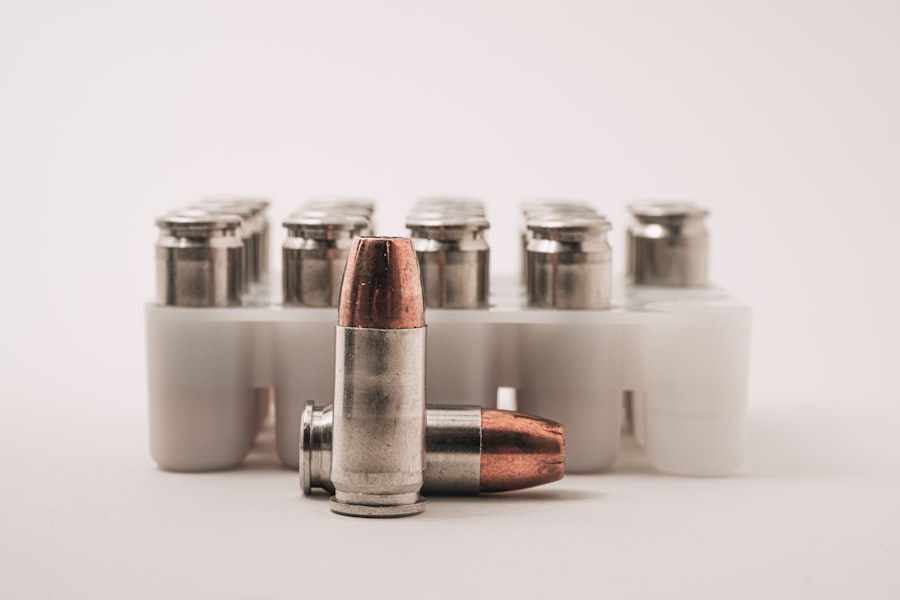
In ordinary range use, many shooters practice inside 25 yards and may extend training to 50 yards when the range, target system, and their skill allow it. These numbers describe common practice settings, not a fixed limit built into the cartridge.
At longer distances, small differences in sight alignment, trigger control, ammunition, and firearm setup become much more noticeable. The bullet also spends more time in flight, allowing gravity and wind to have a larger effect. A hit may still be possible under controlled conditions, but consistency becomes more difficult.
What Changes How Far the Bullet Travels?
- Muzzle velocity: Faster loads begin with more speed, but published velocity depends on the manufacturer’s test barrel.
- Barrel length: A different barrel may change velocity and point of impact. A longer barrel does not automatically make every load more accurate.
- Bullet weight and shape: Mass and aerodynamic shape affect starting velocity, drag, and retained speed.
- Launch angle: A level shot, a downward shot, and a high-arcing shot produce very different travel distances.
- Air density: Altitude, pressure, temperature, and humidity influence aerodynamic drag.
- Wind: Crosswinds move a relatively slow handgun projectile farther sideways as flight time increases.
Why There Is No Universal 100-Yard Drop Number
A trajectory figure is meaningful only when the load, muzzle velocity, sight height, sight-in distance, barrel, and environmental conditions are known. Two pistols firing ammunition with the same bullet weight may not produce the same velocity or point of impact.
Note: Generic online drop charts can be misleading. Use the ammunition manufacturer’s data and confirm point of impact only at an approved range with a proper backstop.
Comparison With Other Calibers
The table below uses representative manufacturer figures to show the general difference between common handgun and rifle cartridges. It does not define every load within each caliber.
| Cartridge | Bullet Weight | Muzzle Velocity | Muzzle Energy | Typical Platform |
|---|---|---|---|---|
| .22 LR | 40 grains | About 1,200 fps | About 128 ft-lb | Rimfire pistol or rifle |
| 9mm Luger | 124 grains | About 1,150 fps | About 364 ft-lb | Centerfire handgun |
| .45 Auto | 230 grains | About 890 fps | About 405 ft-lb | Centerfire handgun |
| .223 Remington | 55 grains | About 3,240 fps | About 1,282 ft-lb | Centerfire rifle |
| .308 Winchester | 150 grains | About 2,820 fps | About 2,649 ft-lb | Centerfire rifle |
Representative data are drawn from Federal product information and the Federal 2026 catalog. Energy alone does not measure accuracy, recoil, suitability, or terminal performance.
Legal and Safety Considerations
Legal Considerations
Federal law does not prohibit ordinary .45 Auto ammunition as a single class. It does, however, define armor-piercing ammunition by projectile construction and regulates its manufacture, importation, sale, and delivery by licensed entities. The current federal restrictions and exceptions appear in 27 CFR § 478.37.
State and local rules may separately regulate magazine capacity, firearm possession, carry, transportation, storage, and certain ammunition. These laws change, and a static national list can become inaccurate. New Jersey, for example, has special restrictions involving hollow-nose ammunition and fact-specific statutory exceptions. Review the current official New Jersey law text and obtain qualified legal advice when necessary.
Note: Do not rely on a retailer, forum post, old article, or another state’s rules when deciding whether ammunition, a magazine, or a transport method is legal in your location.
Core Firearm-Safety Rules
The National Shooting Sports Foundation emphasizes four primary rules:
- Treat every firearm as though it is loaded.
- Keep the muzzle pointed in a safe direction.
- Keep your finger away from the trigger until you are ready to fire.
- Know your target and what lies beyond it.
Wear appropriate eye and hearing protection. Use only an established shooting area with a backstop designed for the cartridge being fired. Do not shoot at water, rocks, flat steel not designed as a target, or other hard surfaces that can cause dangerous ricochets.
Responsible Shooting Practices
Match the ammunition designation on the box to the markings and owner’s manual for the firearm. Do not identify a cartridge only by its appearance. Keep firearms unloaded and secured when they are not in use, with access prevented for children and unauthorized people.
Stop shooting if the firearm produces an unusual sound, excessive recoil, smoke, a failure to cycle, or another sign of malfunction. Keep the muzzle in a safe direction and follow the manufacturer’s procedure or seek help from qualified range personnel.
Tips for Safe, Accurate .45 ACP Practice
- Use the correct factory ammunition: Confirm the exact cartridge marking and follow the firearm manufacturer’s instructions, including any warning about +P ammunition.
- Start at a suitable distance: Build consistent accuracy at the range distance recommended by the instructor or range before moving the target farther away.
- Confirm point of impact safely: A different load may strike the target in a different place even when the bullet weight appears similar.
- Focus on fundamentals: A stable stance, secure grip, clear sight picture, smooth trigger press, and follow-through matter more than small differences between ordinary factory loads.
- Use qualified instruction: A certified instructor or experienced range officer can identify technique and safety problems that are difficult to diagnose alone.
- Follow the range’s limits: Do not shoot beyond the target distance, ammunition rating, or firearm type permitted by the facility.
Pro Tip: Before relying on a new factory load, confirm reliable operation and point of impact at a lawful range. The appropriate test quantity depends on the firearm, ammunition, intended use, and manufacturer guidance.
Frequently Asked Questions
What is the maximum range of a .45 ACP bullet?
A historical U.S. War Department manual lists an approximate maximum range of 1,600 yards, or about 0.9 mile. A 1946 edition associates the figure with an elevation angle of approximately 30 degrees. Actual distance varies by load, firearm, and conditions.
Is 50 yards the effective range of .45 ACP?
Not as a universal rule. Fifty yards is a common longer-distance setting for pistol practice, but effective range depends on the firearm, ammunition, target requirement, shooter, and conditions. Maximum range is much farther and should not be confused with reliable accuracy.
What factors affect how far a .45 ACP bullet travels?
The main factors are muzzle velocity, barrel length, projectile weight and shape, launch angle, wind, and air density. The firearm’s sights and the shooter’s technique affect where the bullet lands relative to the intended target.
Does barrel length change .45 ACP range?
It can change muzzle velocity and point of impact, but the effect depends on the load and firearm. Barrel length alone does not provide a universal maximum-range or accuracy figure.
Are .45 ACP and 45 Auto the same cartridge?
Yes. “.45 ACP” is the widely used informal name. SAAMI recognizes the standardized names “45 Automatic” and “45 Auto.” Always match the ammunition label to the markings and manual for the firearm.
Is it safe to shoot a .45 ACP into the air?
No. A bullet fired upward can travel far beyond the shooter’s view and cause fatal injury or property damage when it descends. Fire only at an approved target with a suitable backstop.
What are the main safety rules for a .45 ACP firearm?
Treat every firearm as loaded, keep the muzzle in a safe direction, keep your finger off the trigger until ready to fire, and know the target and what lies beyond it. Use correct ammunition, wear eye and hearing protection, and follow all range and legal requirements.
Safety and Legal Disclaimer: This article provides general information, not firearm training or legal advice. Laws and range requirements vary by jurisdiction and can change. Consult the firearm manufacturer, qualified range personnel, current official statutes, and a licensed attorney when appropriate.
Conclusion
A .45 ACP bullet can travel approximately 1,600 yards under the high-arcing conditions described in historical U.S. military manuals. That figure is useful as a safety warning, not as a recommended shooting distance. Practical pistol use takes place much closer, where the shooter can maintain control and the range can provide a properly rated backstop.
The safest way to use .45 Auto ammunition is to match it precisely to the firearm, follow the owner’s manual, practice at an approved facility, and treat every shot as capable of traveling beyond the visible target. Reliable equipment and sound safety habits matter more than theoretical distance.
Sources
- U.S. War Department FM 23-35, 1940 edition — lists 800 fps at 25 feet and an approximate maximum range of 1,600 yards.
- U.S. War Department FM 23-35, June 1946 edition — gives approximately 1,600 yards at about 30 degrees elevation.
- ANSI/SAAMI Z299.3-2022 and the SAAMI FAQ — cartridge naming, dimensions, standard velocity information, and load-specific ballistics guidance.
- Federal American Eagle 45 Auto, 230-grain FMJ and the Federal 2026 catalog — representative manufacturer ballistics.
- National Shooting Sports Foundation: Firearm Safety Rules — safe handling, correct ammunition, backstops, and protective equipment.
- ATF ammunition definitions, 27 CFR § 478.37, and official New Jersey law text — federal armor-piercing rules and an example of jurisdiction-specific ammunition restrictions.

