
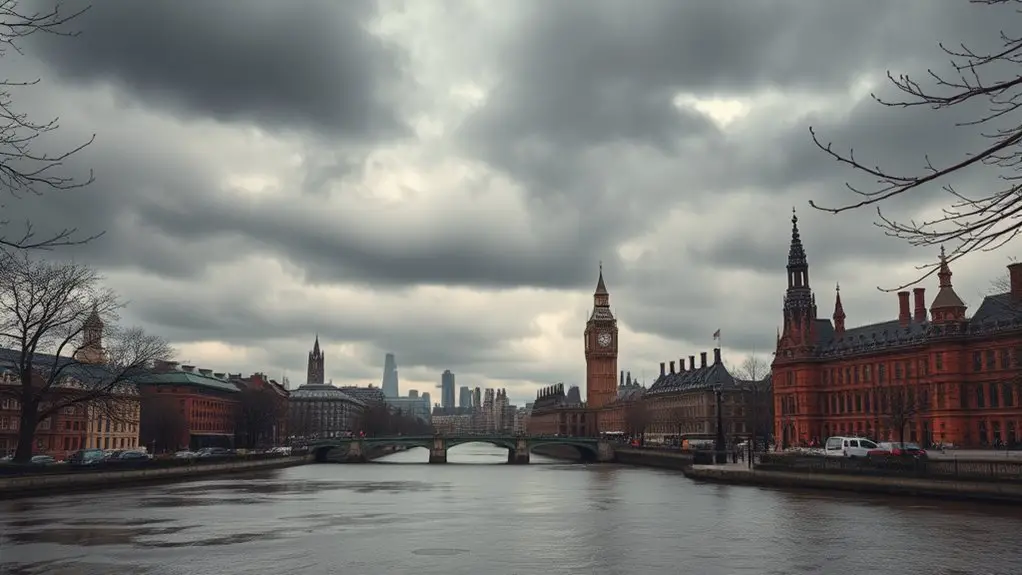
Last Updated on July 27, 2026 by Daniel Globe
London weather in March sits between winter and spring, so a visit can bring chilly mornings, mild afternoons, sunshine, cloud, and rain within the same trip. Long-term averages give you a useful packing guide, but the actual weather can vary widely from year to year. Layers and a water-resistant outer layer are the safest approach.
Quick Answer
London in March is cool, changeable, and noticeably brighter than winter. At Greenwich, 1991–2020 averages are about 12.1°C (53.7°F) for daytime highs and 4.7°C (40.4°F) for lows, with roughly 36.5 mm (1.4 in) of rain. Pack layers, a water-resistant outer layer, and comfortable shoes.
Key Takeaways
- Long-term March averages at Greenwich are about 12.1°C (53.7°F) by day and 4.7°C (40.4°F) at night.
- March averages about 36.5 mm (1.4 in) of rain and roughly eight days with at least 1 mm of rainfall.
- Daylight grows rapidly, from just under 11 hours at the start of March to nearly 13 hours by the end.
- The UK switches to British Summer Time on the last Sunday in March, moving clocks forward one hour.
- Bring layers, comfortable walking shoes, and a waterproof or water-resistant outer layer rather than packing only heavy winter clothing.
Disclosure: As an Amazon Associate I earn from qualifying purchases. Some links on this page are affiliate links, at no extra cost to you.
London March Weather at a Glance
The table below uses the Met Office 1991–2020 Greenwich climate averages, which provide a useful central-London reference point.
At a Glance
| Average Maximum | 12.1°C (53.7°F) |
| Average Minimum | 4.7°C (40.4°F) |
| Monthly Rainfall | 36.5 mm (1.44 in) |
| Days With ≥1 mm Rain | About 7.9 days |
| Monthly Sunshine | About 109.7 hours |
| Average Air-Frost Days | About 2.1 days |
| Daylight | Roughly 10 hours 55 minutes to 12 hours 54 minutes across March |
These figures describe long-term climate, not a promise of what you will experience on a particular trip. Check the short-range forecast shortly before you travel.
Typical Temperature Ranges in March

In March, London begins to warm as winter gives way to spring, but chilly spells are still possible. The Met Office’s 1991–2020 Greenwich averages put the typical daily maximum at about 12.1°C (53.7°F) and the minimum at about 4.7°C (40.4°F).
Actual temperatures can fall outside those averages. Some afternoons may feel pleasantly mild in sunshine, while an early morning or windy evening can still feel distinctly cold. Frost remains possible, with Greenwich averaging just over two days of air frost during March.
You should therefore think in terms of layers rather than one heavy outfit. A shirt or long-sleeve base layer, sweater, and medium-weight jacket lets you adjust as conditions change.
The month does not warm in a perfectly straight line. Late March generally has more solar warmth and longer days than early March, but individual weather systems can still produce a chilly late-month spell or an unusually mild period earlier in the month.
Note: Climate averages are best for deciding what to pack. For your actual sightseeing schedule, the forecast during the final week before your trip is far more useful.
Precipitation and Rainfall Patterns

Rain remains part of London weather in March, but the month is not normally wetter than midwinter. At Greenwich, long-term March rainfall averages 36.5 mm, compared with 43.9 mm in January and 39.9 mm in February.
Rain can arrive as drizzle, showers, or a longer spell associated with a passing weather front. There is no dependable rule that it will rain during a particular part of each week, so carrying a light waterproof layer is more useful than planning around an assumed pattern.
Some Marches are much drier than the long-term average, while others are wetter. That year-to-year variation is one reason London’s reputation for constant rain can be misleading.
Rainfall Frequency
The definition of a “rainy day” matters. The Met Office’s Greenwich climate normal records about 7.9 March days with at least 1 mm of rainfall. Other weather websites may report a higher number because they count days with much smaller traces of rain.
| Rainfall Pattern | What to Expect |
|---|---|
| Average monthly rainfall | About 36.5 mm (1.44 in) at Greenwich |
| Days with ≥1 mm rain | About 7.9 days |
| Typical forms | Drizzle, showers, or periods of steadier rain |
| Distribution | Variable; there is no fixed wet part of the month |
| Heavy rain | Possible during unsettled systems but not a defining feature of every March |
Note: Two sources can give different numbers of “rainy days” without either being wrong if one counts any measurable precipitation while another uses the Met Office threshold of at least 1 mm.
Seasonal Variations
March marks the start of meteorological spring, and London’s long-term averages show a modest move away from winter conditions. Rainfall is slightly lower than in January and February, average temperatures rise, and sunshine increases.
That does not mean each week becomes steadily warmer and drier. Atlantic weather systems can still bring cloud, rain, and wind, while high pressure may produce several dry and sunny days in a row.
For travelers, the practical lesson is simple: plan for both indoor and outdoor activities instead of assuming that March will be either consistently wet or consistently spring-like.
Daylight Hours and Sunshine Levels
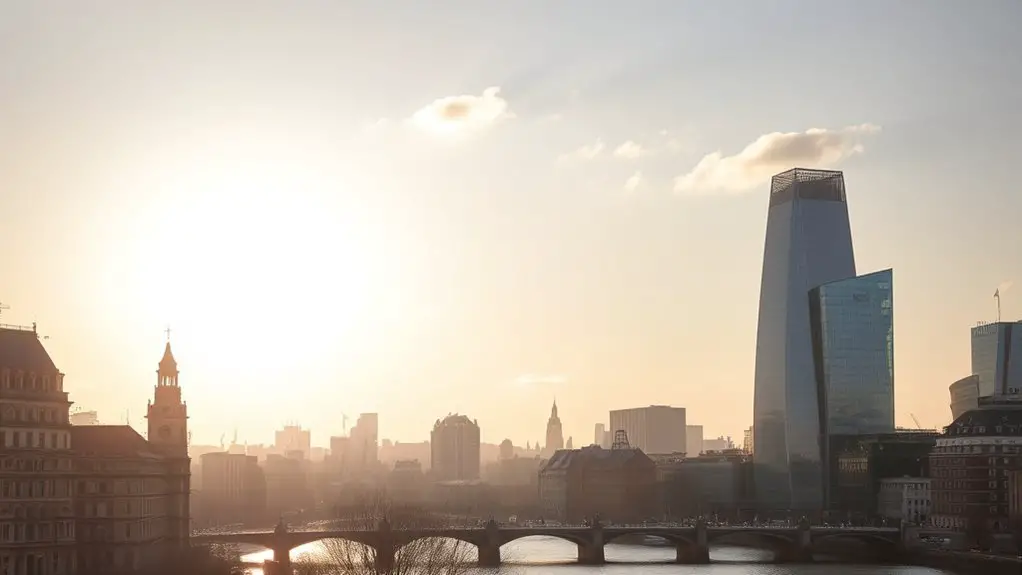
One of the biggest advantages of visiting London in March is the rapid increase in daylight. Based on London sunrise and sunset calculations for March 2026, day length increases from about 10 hours 55 minutes on March 1 to almost 12 hours 54 minutes on March 31.
Long-term Greenwich records also show about 109.7 hours of March sunshine in total. Sunshine hours are a climate average, not a guaranteed number of clear or sunny days.
| 2026 Date | Day Length | Approx. Sunrise / Sunset |
|---|---|---|
| March 1 | 10 hr 55 min | 6:45 AM / 5:40 PM |
| March 8 | 11 hr 22 min | 6:30 AM / 5:52 PM |
| March 15 | 11 hr 50 min | 6:14 AM / 6:04 PM |
| March 22 | 12 hr 18 min | 5:58 AM / 6:16 PM |
| March 31 | 12 hr 54 min | 6:38 AM / 7:32 PM |
The apparent jump in clock times near the end of the month happens because the UK switches to British Summer Time. According to GOV.UK, clocks move forward one hour at 1 AM on the last Sunday in March. In 2026, that date is March 29.
Pro Tip: Late-March visitors gain much more usable evening light than early-March visitors. That extra daylight is especially useful for parks, neighborhood walks, riverfront sightseeing, and outdoor photography after indoor attractions close.
Wind Conditions and Their Impact
Wind conditions can change from day to day in March. A breeze combined with cool temperatures can make exposed places such as bridges, riverside paths, and large parks feel colder than the thermometer suggests.
Stronger gusts can accompany passing low-pressure systems, but severe winds should not be treated as a normal feature of every March day. Most visitors simply need a jacket that blocks some wind and an umbrella sturdy enough for ordinary showers.
If stronger winds are forecast, a hooded waterproof jacket is often more practical than relying only on an umbrella. On calmer, sunnier days, you may find yourself removing a layer during a long walk.
What to Pack for London in March
Pack for a range of cool conditions rather than for deep winter. Layers let you adjust between chilly mornings, heated museums and restaurants, mild afternoons, and cooler evenings.
Rain protection is useful, but heavy rain boots are not essential for most city trips. Comfortable water-resistant walking shoes usually offer a better balance for long sightseeing days.
A practical March packing list includes a medium-weight jacket, one or two sweaters, long-sleeve and short-sleeve tops, comfortable trousers, walking shoes, a compact umbrella, and a light waterproof layer.
Layered Clothing Essentials
Start with a comfortable base layer such as a T-shirt or long-sleeve top. Add a sweater, cardigan, or fleece for colder periods and a medium-weight jacket for wind and early-spring chill.
A scarf can be useful because it adds warmth without taking much luggage space. A light hat and gloves may also be worthwhile if you are visiting early in March, spending long periods outside, or are accustomed to a warmer climate.
Thermal leggings are usually unnecessary for ordinary city sightseeing, but they can be helpful for travelers who feel the cold easily or expect to spend long evenings outdoors.
Choose clothing that can be mixed and matched. London’s indoor spaces can be much warmer than the street, so removable layers are more comfortable than one very heavy coat.
This approach also keeps your luggage manageable while leaving you prepared for a colder-than-average day.
Rain Gear Must-Haves
A compact umbrella is useful for light showers, provided winds are not too strong. A lightweight waterproof or water-resistant jacket gives you more reliable protection during longer walks.
Comfortable water-resistant shoes are usually more useful than bulky rain boots for a sightseeing trip. London’s pavements can stay wet after a shower, so good grip is also helpful.
Quick-drying trousers or tops are useful if your itinerary includes long periods outdoors. A small packable poncho can work as a backup, although most visitors will be comfortable with a jacket and umbrella.
The goal is not to dress for constant rain. It is to carry enough protection that an ordinary shower does not force you to abandon your plans.
Early March vs. Late March: What Changes?
Early March usually feels closer to winter. Mornings can be cold, frost remains possible, daylight is still under 11 hours near the beginning of the month, and you may rely on your warmer layers more often.
By late March, daylight is close to 13 hours and stronger spring sunshine can make mild afternoons feel noticeably warmer. British Summer Time also creates lighter evenings after the final Sunday of the month.
However, late March is not guaranteed to be warm. Cold northerly or northwesterly air can still produce chilly conditions, and rain or even wintry showers remain possible during an unsettled spell.
| Period | Practical Expectation |
|---|---|
| Early March | Cooler-feeling mornings, shorter days, greater value from gloves or a scarf |
| Mid-March | Noticeably increasing daylight with a mix of chilly and mild periods |
| Late March | Longer evenings and better chance of mild spring conditions, but cold snaps remain possible |
Notable Weather Events and Variability
March is a transition month, which means London can experience both lingering winter conditions and spring-like warmth. Sleet or snow can occur during a cold spell, although rain is a more typical form of precipitation in the city.
Periods of stronger wind and heavier rain are also possible when Atlantic weather systems cross southern England. At other times, high pressure can bring several dry, calm, and sunny days.
The latest completed March illustrates that variability. According to the Met Office’s March 2026 statistics, southeast and central southern England—the wider region containing London—had an average maximum of 12.6°C (54.7°F), an average minimum of 4.3°C (39.7°F), 30.4 mm of rain, and 154.4 sunshine hours.
March 2026 brought only 59% of normal rainfall but 125% of normal sunshine to southeast and central southern England, showing how different one March can be from the long-term average.
That is why climate statistics should guide your packing rather than dictate your daily itinerary. Check the forecast close to departure and adjust outdoor plans once you know the actual weather pattern.
Tips for Enjoying London Despite the Weather
Check the forecast each morning and keep your schedule flexible. A compact umbrella and removable layers make it easier to continue sightseeing through an ordinary shower or a cooler-than-expected afternoon.
Save museums, galleries, covered markets, historic interiors, and theatre visits as flexible options for wetter periods. When skies clear, switch to parks, neighborhood walks, outdoor viewpoints, or walks along the Thames.
You do not need to cancel outdoor plans simply because rain appears in a daily forecast. Look at the timing and intensity, because a day marked with rain may still contain long dry periods.
For the most useful short-range information, check the Met Office forecast rather than relying only on a monthly climate average.
Warning: If unusually strong wind, flooding, snow, or ice is forecast, check the Met Office London weather warnings and Transport for London status updates before setting out.
Frequently Asked Questions
How does March weather vary across different London neighborhoods?
Differences across London are usually modest, but local surroundings matter. Dense built-up areas can retain more heat, particularly overnight, while large parks, open spaces, low-lying areas, and exposed riverside locations can feel cooler or windier. Showers can also affect one part of the city more than another, but there is no reliable rule that central London is wetter while outer London is drier.
Are there any annual weather phenomena specific to London in March?
There is no special London-only weather event that occurs every March. The month is known mainly for its transition from winter to spring. Frost, rain, mild sunshine, and occasional wintry weather are all possible. The March equinox occurs during the month, and UK clocks move forward on the final Sunday of March, but those are astronomical and timekeeping events rather than weather phenomena.
How do London’s March temperatures compare to other UK cities?
London is generally milder in March than many northern and inland parts of the UK. Its southern location helps, and the urban heat-island effect can keep built-up areas warmer at night than nearby rural locations. However, London is not warmer than every UK location on every day, so nationwide comparisons depend on the specific weather pattern.
What are the best indoor activities during London’s March weather?
Museums, art galleries, historic interiors, covered markets, afternoon tea, theatre performances, and indoor observation attractions are easy options during wetter periods. Keeping one or two indoor activities flexible lets you move them to the rainiest part of your trip and use brighter weather for parks and walking.
How does March weather influence London’s public transport operations?
Normal March rain usually does not prevent you from using London’s transport network. More severe conditions such as flooding, strong winds, snow, or ice can sometimes disrupt individual rail, Underground, bus, or other services. Check Transport for London’s live status information when severe weather is forecast and allow extra travel time when necessary.
Does it snow in London in March?
Snow or sleet is possible during a cold March spell, but you should not plan your trip expecting regular snow. London more often receives rain, and long-term Greenwich data average only about two March days with air frost. Check the forecast immediately before your visit if wintry weather would affect your plans.
Conclusion
London in March is cool and changeable, but it is also noticeably brighter than winter. Long-term Greenwich averages suggest daytime highs around 12°C (54°F), nighttime lows around 5°C (40°F), moderate rainfall, and rapidly increasing daylight. Pack flexible layers, comfortable water-resistant shoes, and a light waterproof outer layer. Most importantly, treat the averages as a packing guide and check the real forecast before deciding how to organize each sightseeing day.
Sources
- Met Office — Greenwich Observatory long-term climate averages — 1991–2020 temperature, rainfall, sunshine, and frost averages.
- Met Office — March 2026 weather statistics — recent regional temperature, rainfall, and sunshine data for southeast and central southern England.
- GOV.UK — When do the clocks change? — official British Summer Time dates and rules.
- Timeanddate.com — London sunrise and sunset times — March daylight, sunrise, and sunset calculations.
- Met Office — Urban climate impacts — background on urban heat-island effects and city microclimates.
- Transport for London — Travel tools and status updates — live service information and disruption checks.
