
Last Updated on July 29, 2026 by Daniel Globe
London uses the same electrical system as the rest of the United Kingdom: Type G plugs, 230-volt power, and a 50-hertz frequency. A US plug will not fit a normal London wall socket, so you need an adapter. Before packing one, check the voltage and frequency printed on every charger or appliance you plan to use during your trip to London.
Quick Answer
London uses the Type G plug with three rectangular pins. UK mains power is 230V at 50Hz. Most genuine phone, tablet, camera, and laptop chargers marked “100–240V, 50/60Hz” need only a US-to-UK Type G adapter. Single-voltage 120V appliances require a suitable converter or should be left at home.
Key Takeaways
- London uses Type G sockets and a nominal supply of 230V at 50Hz.
- A plug adapter changes the shape of the connection; it does not change voltage or frequency.
- Check each device for an input such as “100–240V, 50/60Hz” before connecting it.
- Be especially careful with hair dryers, curling irons, heating tools, and other high-wattage appliances.
- Choose a fused adapter marked for BS 1363 and buy it from a reputable retailer.
At a Glance
| London Plug Type | Type G, with three rectangular pins |
| Power Supply | 230V at 50Hz |
| Most Travelers Need | A fused Type G adapter for dual-voltage chargers |
| Converter Needed? | Only for compatible single-voltage appliances; check voltage, frequency, and wattage first |
What’s in This Article
- Understanding UK Power and Voltage
- Plug Types Used in London
- How the BS 1363 System Works
- Choosing an Adapter or Converter
- Checking Device Compatibility
- Voltage and Frequency Differences
- Using Universal Travel Adapters
- Safe Charging Steps
- Extension Cords and Power Strips
- Where to Buy an Adapter in London
- Troubleshooting Common Problems
- Frequently Asked Questions
Disclosure: As an Amazon Associate I earn from qualifying purchases. Some links on this page are affiliate links, at no extra cost to you.
Understanding the UK Power System and Voltage Standards
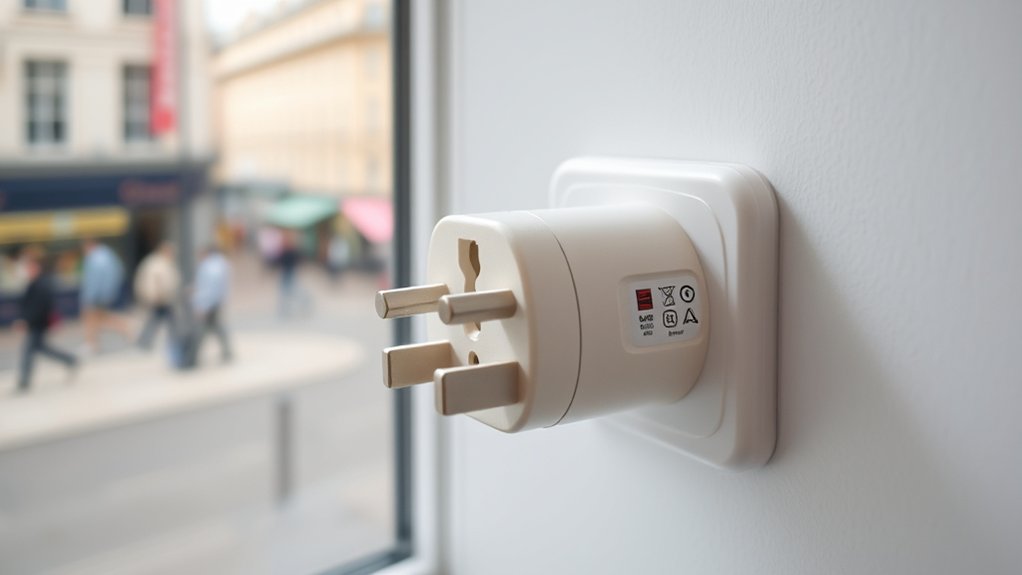
The United Kingdom operates on a nominal 230V supply at 50Hz. By comparison, the United States and Canada generally use 120V at 60Hz. The higher UK voltage matters because a travel adapter changes only the plug shape.
Look at the input line on the device, charger brick, or power supply. A label that reads “Input: 100–240V, 50/60Hz” means the power supply is designed for both systems. You still need a Type G adapter so the plug fits the socket.
Warning: Never connect a 120V-only appliance directly to 230V power through a simple plug adapter. The appliance can overheat, fail, or create a fire or electric-shock hazard.
The label on the charger matters more than the country where you bought the device: “100–240V, 50/60Hz” is the key compatibility range for most travel electronics.
Types of Plugs Used in London
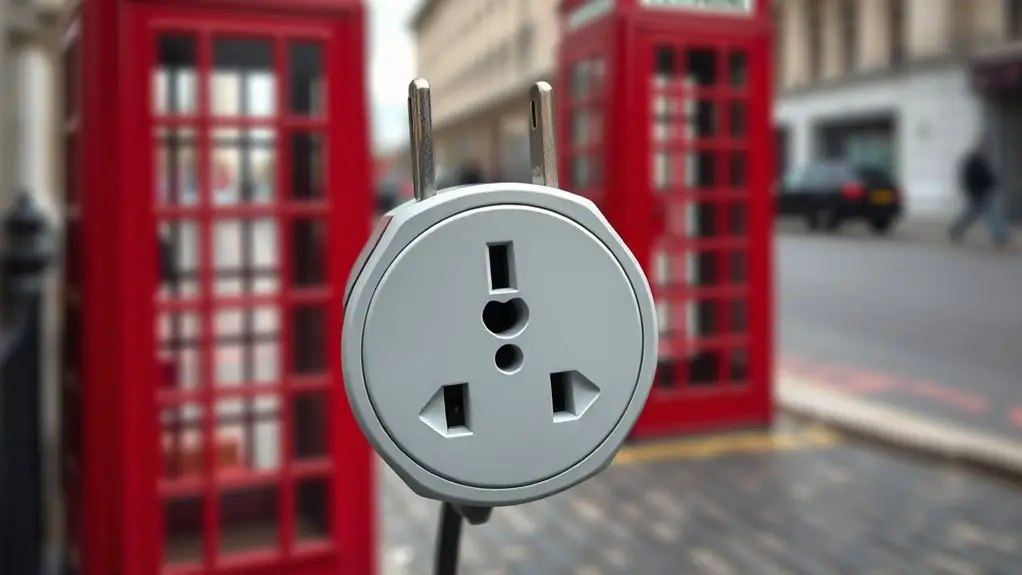
Standard wall outlets in London use Type G plugs. Specialty shaver sockets may appear in hotel bathrooms, but they are not substitutes for a normal wall outlet.
Type G Plugs and Sockets
A Type G plug has three rectangular pins in a triangular pattern. The UK system covered by BS 1363 uses fused plugs or adapters and shuttered socket outlets. The upper earth pin, or an approved insulated shutter-opening device on some double-insulated products, operates the socket’s shutter mechanism before the live and neutral pins make contact.
A US Type A or Type B plug does not fit a Type G socket. A continental European Type C plug also does not fit safely without the correct adapter. Never force a plug into a socket or use an object to open the shutters.
Bathroom Shaver Sockets
Some London hotel bathrooms have isolated two-pin shaver outlets, often marked 115V and 230V. They are intended for low-power shavers and similar bathroom appliances. Do not use them for laptops, high-power hair tools, or multi-device chargers, and follow the socket label and hotel instructions.
Note: A shaver socket’s shape does not make it a general-purpose European outlet. Use the room’s standard Type G socket for phones, tablets, cameras, and computers.
Adapter Compatibility
Choose the adapter based on your plug, device class, grounding needs, and power requirements.
| Option | Best For | Important Limit |
|---|---|---|
| US-to-UK Type G adapter | One or two dual-voltage US devices | Does not convert voltage or frequency |
| Universal travel adapter | Trips covering several plug systems | Must still be safely rated and compatible with Type G sockets |
| UK USB or USB-C charger | Phones, tablets, cameras, and compatible laptops | Match the required USB standard and wattage |
| Step-down converter or transformer | Some 120V-only appliances approved for converter use | Must handle the appliance’s wattage and does not normally change frequency |
| UK extension lead | Several compatible low-power chargers | Do not overload or daisy-chain it |
The British Standard BS 1363 Plug Explained
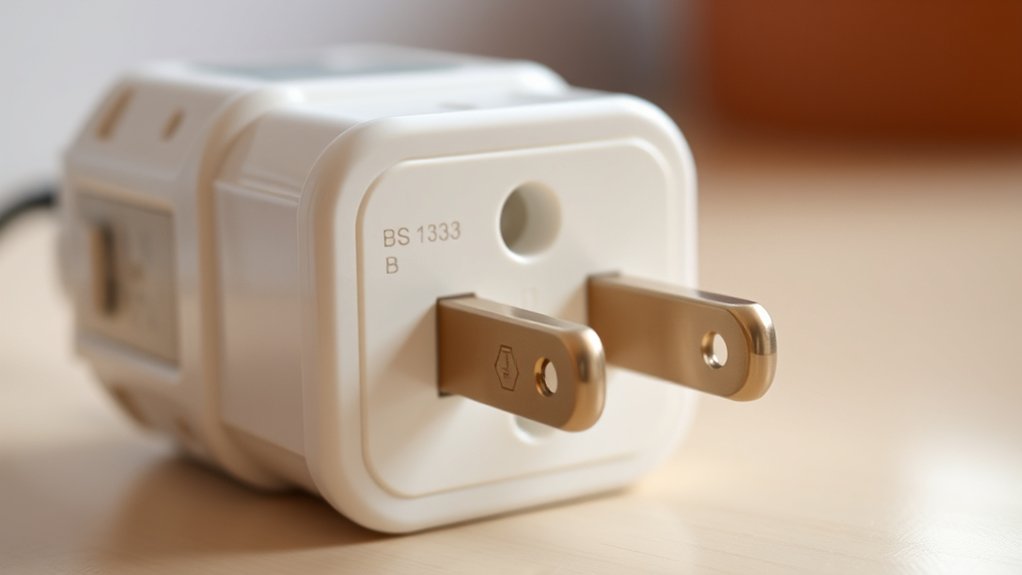
The BS 1363 series covers the safety, construction, dimensions, testing, and marking of UK 13-amp plugs, socket outlets, adapters, and related connection units.
Plug Design and Features
A standard Type G plug uses live, neutral, and earth pins. The live and neutral pins have insulated sleeves, and a BS 1363 plug or compliant adapter includes a fuse. The socket outlet contains shutters that reduce access to live contacts when no suitable plug is inserted.
- Fuse: Limits fault current through the plug or adapter when correctly selected.
- Insulated pin sleeves: Reduce contact with live metal during insertion or removal.
- Shuttered socket: Helps prevent access to the live and neutral contacts.
- Defined pin dimensions: Support a secure connection and reduce overheating or exposed-live-part risks.
Safety and Certification Standards
Do not rely on marketing phrases such as “UK compatible” alone. Check the product and packaging for clear manufacturer or importer details, electrical ratings, instructions, and the relevant standard. Electrical Safety First advises checking for “BS 1363” and an approval mark such as the BSI Kitemark, ASTA Diamond, or Nemko N on applicable plugs.
| Mark or Information | What It Tells You | What It Does Not Prove Alone |
|---|---|---|
| BS 1363 marking | The claimed UK plug, socket, or adapter standard | That an anonymous or counterfeit product has actually passed testing |
| Kitemark, ASTA Diamond, or Nemko N | Independent approval associated with the marked plug | Compatibility with every device or every charging protocol |
| UKCA or CE marking | A manufacturer conformity claim under applicable product rules | Specific compliance with BS 1363 or the quality of an online seller |
| Voltage, current, and wattage ratings | The product’s stated electrical limits | That the adapter converts voltage |
Compatible Adapter Options
A compact Type G adapter is usually the simplest choice for a traveler carrying one dual-voltage charger. A multi-port UK USB charger can be more convenient when every device charges by USB. A universal adapter can work well for a multi-country trip, but only when it has a compliant UK plug section, proper shutters, a fuse where required, and ratings that cover the connected equipment.
Choosing the Right Travel Adapter for London
Start with the labels on your devices rather than the number of plugs in the adapter. The right choice depends on voltage, frequency, wattage, grounding, and charging protocol.
Adapter or Converter? Use This Decision Guide
- Check the input voltage. If it says 100–240V, use a plug adapter. If it says only 110V or 120V, continue to the next step.
- Check the frequency. If the appliance requires only 60Hz, a basic voltage converter will not make it compatible with 50Hz.
- Check the wattage. A converter must be rated above the appliance’s running power, with extra capacity for startup surges when relevant.
- Check the appliance type. Heating devices and motor-driven appliances are often poor candidates for small travel converters.
- Check the manufacturer’s instructions. If converter use is not approved, use a UK version of the appliance instead.
Pro Tip: For phones, tablets, and USB-C laptops, a reputable UK USB-C Power Delivery charger can be simpler than stacking a US charger onto a travel adapter. Match the charger’s wattage and charging protocol to the device.
What to Look For When Buying
- A Type G plug section designed for UK BS 1363 sockets
- A fuse and electrical ratings that are clearly marked
- A secure, shuttered input socket with no exposed live parts
- Manufacturer or importer contact details and clear instructions
- Enough USB-C Power Delivery wattage for laptops or fast charging
- Grounding support when the connected device requires an earth connection
- A reputable retailer and a traceable brand rather than an anonymous marketplace listing
Compatibility of Your Devices With UK Power Outlets
Many modern chargers accept worldwide voltage, but compatibility must be checked device by device. The label may be tiny, so photograph it with your phone and zoom in before you travel.
How to Read the Label
Find the word “Input.” A compatible charger commonly shows a range such as “100–240V~ 50/60Hz.” The tilde means alternating current. Also check the current or wattage limit on the adapter and the output requirements of the device.
| Device | Typical Travel Setup | Check Before Use |
|---|---|---|
| Phone, tablet, camera charger | Type G adapter or UK USB charger | 100–240V input and required USB charging standard |
| Laptop charger | Type G adapter or suitable USB-C PD charger | Input range, grounding, connector, and wattage |
| CPAP or medical device | Manufacturer-approved power supply and Type G adapter | Exact model instructions, voltage, frequency, backup needs, and humidifier wattage |
| Dual-voltage hair tool | Type G adapter after selecting the 220–240V setting | Manual voltage switch, frequency, wattage, and adapter rating |
| 120V-only hair dryer or heating appliance | Usually leave it home and use a UK appliance | Converters may be bulky, limited, or unsuitable for the load |
Warning: High-wattage hair dryers, steamers, kettles, irons, and heating tools can exceed a travel adapter or converter’s rating. Use a compatible UK appliance when the label or manual does not clearly approve 230V/50Hz operation.
Voltage and Frequency: What Tourists Need to Know
Voltage and frequency are separate specifications. A device must be compatible with both, and a simple plug adapter changes neither.
Voltage Standards in the UK
London’s nominal supply is 230V. A dual-voltage charger handles this automatically within its stated range. A single-voltage 120V device may need a step-down converter or transformer, but only if the device manufacturer allows it and the converter can supply enough power.
- Check the input range before connecting the device.
- Confirm the adapter or converter’s maximum current and wattage.
- Allow for startup demand on appliances with motors or compressors.
- Do not assume “travel” in a product name means it converts voltage.
Frequency Compatibility Tips
The UK uses 50Hz, while North America generally uses 60Hz. Most switching power supplies for phones and laptops are marked 50/60Hz and work on either. Clocks, turntables, older motor-driven appliances, and some heating devices may run incorrectly or overheat when used on the wrong frequency.
A normal step-down transformer changes voltage, not frequency. If the label lists only 60Hz, do not assume a converter makes the appliance safe. Follow the manufacturer’s instructions or use a UK-compatible replacement.
Using Universal Travel Adapters in London
A universal adapter combines several destination plug types in one unit. It can save space on a multi-country trip, but it is not automatically safer or more capable than a dedicated Type G adapter.
Inspect the UK pins and the input socket before use. The unit should sit firmly in the wall without sagging, expose no live metal, and support the plug type you are inserting. Confirm whether the adapter carries earth through to the connected device; many compact models do not.
Note: The UK’s Office for Product Safety and Standards recalled a universal travel adapter in June 2026 because its shutters allowed access to live parts and its plug face did not meet BS 1363 dimensions. Check current safety notices and stop using any recalled model.
Surge protection can be useful, but it does not correct a voltage or frequency mismatch. Treat it as an extra feature, not a substitute for compatibility checks.
Tips for Safe and Effective Charging Abroad
- Inspect the equipment. Do not use cracked, loose, scorched, bent, or rattling adapters and chargers.
- Read every rating. Confirm voltage, frequency, current, wattage, and USB charging support.
- Connect in a dry, ventilated place. Keep chargers away from sinks, bedding, curtains, and direct heat.
- Insert the adapter fully. A loose or sagging connection can arc or overheat.
- Charge where you can notice a problem. Unplug equipment that becomes unusually hot, smells burnt, crackles, or repeatedly trips the socket or circuit.
- Use the hotel’s normal wall socket. Do not improvise with bathroom shaver outlets or force incompatible plugs.
Modern devices normally manage their own battery charging, but unnecessary unattended charging still increases the time that a faulty charger remains energized. Use intact, reputable equipment and disconnect it when convenient after charging is complete.
Additional Accessories: Extension Cords and Power Strips
When outlets are scarce, use a UK extension lead or travel power product that is explicitly rated for 230V and the total connected load. Do not assume a US power strip is safe merely because its plug fits an adapter. Some strips contain surge components, switches, or USB electronics designed only for 120V.
Electrical Safety First advises using only one extension device per wall socket, staying within its marked current rating, and never plugging one extension lead into another.
- Add the wattage of every connected device and stay below the strip’s limit.
- Use a grounded strip when any connected device requires grounding.
- Fully unwind a cable reel before use so heat can escape.
- Never place an operating strip under bedding, rugs, or luggage.
- Stop using equipment that feels hot, buzzes, crackles, or shows burn marks.
Where to Purchase Power Adapters and Chargers in London
You can usually find Type G adapters and UK USB chargers at established electronics chains, department stores, travel-goods shops, pharmacies, and airport retailers. Airport and tourist-area prices may be higher, so buying before departure can be more convenient.
Choose a traceable product from a retailer with a clear returns process. Inspect the packaging for the brand, model, manufacturer or importer, electrical ratings, instructions, and safety markings. Online marketplaces can be convenient, but the seller and product should still be identifiable; a marketplace name alone is not a safety certification.
Troubleshooting Common Adapter and Charging Problems
The Plug Will Not Fit
Stop and check that the destination side is Type G and fully deployed. Do not force the pins or use an object to open the socket shutters. Some universal adapters require a lock or release slider before the UK pins extend correctly.
The Device Does Not Charge
Confirm the wall switch is on, then test another outlet if the hotel permits. Check the cable, charger output, USB port, and device charging standard. A low-wattage USB port may charge a phone slowly but fail to power a laptop.
The Adapter Is Loose, Hot, Buzzing, or Sparking
Switch off the socket if it has a switch, unplug the adapter by its body, and stop using it. Do not continue testing a product that smells burnt, has discolored plastic, or fails to sit securely. Replace it with a reputable, compliant adapter and report a suspected unsafe product to the retailer.
The Fuse or Breaker Keeps Tripping
Disconnect all devices. The load may be too high, a connected product may be faulty, or the adapter may be damaged. Do not fit a higher-rated fuse as a workaround. Ask the hotel to check the outlet or consult a qualified electrician.
Frequently Asked Questions
Can I use my US plug directly in UK outlets?
No. A US Type A or Type B plug does not fit a normal UK Type G socket. Use a compliant US-to-UK Type G adapter, then confirm that the charger or appliance accepts 230V at 50Hz.
What is the difference between an adapter and a converter?
An adapter changes the plug shape so it fits the socket. A converter or transformer changes voltage. Most basic converters do not change frequency, so a 60Hz-only appliance may still be incompatible with London’s 50Hz supply.
Which safety markings should I look for on a UK adapter?
Look for clear electrical ratings, manufacturer or importer details, instructions, a BS 1363 marking, and an appropriate approval mark such as the BSI Kitemark, ASTA Diamond, or Nemko N. UKCA or CE markings may also apply, but neither one alone proves that the plug section meets BS 1363.
Do Apple or Samsung chargers work with UK voltage?
Many genuine modern Apple and Samsung power adapters are rated for 100–240V and work with UK voltage. Check the exact charger’s input label rather than relying on the brand name, especially with older or third-party products. A US version still needs a Type G plug adapter.
Can I use a US hair dryer or straightener in London?
Only when the appliance is explicitly rated for 220–240V and 50Hz, or its manufacturer approves use with a correctly sized converter. High-wattage 120V-only hair tools can overload small travel converters, so using a UK appliance is often safer and simpler.
Can I connect a US power strip through a Type G adapter?
Only if the entire strip, including any surge protection and USB circuitry, is marked for 230V/50Hz and the total load stays within every component’s rating. A UK-rated extension lead or multi-port charger is usually the safer choice.
How do I prevent damage when connecting my devices?
Check voltage, frequency, wattage, grounding, and USB charging requirements before use. Use an intact, compliant adapter, insert it fully, keep it dry and ventilated, and stop immediately if it becomes loose, unusually hot, noisy, discolored, or burnt-smelling.
Are adapters more expensive in London?
Prices vary by retailer and location. Airport and tourist-area shops may charge more than established high-street or online retailers. Compare the full price, but do not choose an anonymous or poorly marked adapter simply because it is cheaper.
Safety Disclaimer: This article provides general travel information, not device-specific electrical advice. Follow the manufacturer’s instructions for each appliance, adapter, charger, converter, or medical device. Ask the manufacturer or a qualified electrician when compatibility is unclear.
Wrapping Up
London uses Type G plugs and 230V/50Hz power. For most genuine dual-voltage phone, camera, tablet, and laptop chargers, a reputable fused Type G adapter is enough. The label must confirm the voltage and frequency range; the adapter’s shape alone does not make a device compatible.
Take extra care with high-wattage appliances, motor-driven equipment, medical devices, universal adapters, and power strips. Buy traceable equipment, stay within every rating, and stop using anything that becomes loose, hot, noisy, scorched, or damaged.
Sources
- Electrical Safety First: United Kingdom travel adapters — Type G plug, 230V supply, 50Hz frequency, and converter guidance
- BSI: BS 1363 plugs, sockets, adapters, and connection units — UK plug-system construction, testing, dimensions, fuses, and marking
- UK Legislation: Plugs and Sockets etc. (Safety) Regulations 1994 — legal framework for UK domestic plugs, sockets, and adapters
- UK Government: UKCA and CE product marking guidance — current Great Britain conformity-marking context
- Office for Product Safety and Standards: Universal Travel Adaptor 931E recall — June 2026 shutter and BS 1363 dimensional hazards
- Apple power-adapter specifications and Samsung charger guidance — examples of genuine modern adapters rated for 100–240V input
