
Last Updated on July 25, 2026 by Daniel Globe
London’s museums cover everything from ancient civilizations and dinosaurs to fashion, science and modern art. Many of the city’s biggest collections are free to enter, including the British Museum, Natural History Museum, V&A South Kensington, Science Museum, Tate Modern and National Gallery. The key is choosing the museums that match your interests, checking current opening and booking information, and leaving enough time for the collections you most want to see.
Quick Answer
The best museums in London include the British Museum for world history, Natural History Museum for dinosaurs and nature, V&A for art and design, Science Museum for technology, Tate Modern for modern art, and the National Gallery for European painting. General admission to these major collections is free, although some exhibitions and experiences cost extra.
Key Takeaways
- The British Museum, Natural History Museum, V&A South Kensington, Science Museum, Tate Modern and National Gallery all offer free general admission to their permanent collections, although some exhibitions are ticketed.
- At the Natural History Museum, Dippy is no longer the main Hintze Hall display; Hope the blue whale now hangs there, while the Dinosaurs Gallery features fossils and an animatronic T. rex.
- Families should consider the Natural History Museum, Science Museum and Young V&A. Wonderlab at the Science Museum is interactive but requires a separate paid ticket.
- The Tower of London, Hampton Court Palace and Kensington Palace are paid historic attractions rather than free national museums.
- Opening hours, gallery closures, timed-entry arrangements and temporary exhibitions change, so check each venue’s official website before travelling.
Disclosure: As an Amazon Associate I earn from qualifying purchases. Some links on this page are affiliate links, at no extra cost to you.
Best London Museums at a Glance
| Museum | Best For | General Entry | Suggested Time | Area |
|---|---|---|---|---|
| British Museum | Ancient history and world cultures | Free permanent collection | 2–4 hours | Bloomsbury |
| Natural History Museum | Dinosaurs, animals and Earth science | Free permanent galleries | 2–4 hours | South Kensington |
| V&A South Kensington | Art, design, fashion and decorative arts | Free permanent galleries | 2–3 hours | South Kensington |
| Science Museum | Technology, engineering, medicine and families | Free general admission; some experiences paid | 2–3 hours | South Kensington |
| Tate Modern | Modern and contemporary art | Free collection; some exhibitions paid | 2–3 hours | Bankside |
| National Gallery | European painting | Free permanent collection | 2–3 hours | Trafalgar Square |
You do not need to pay admission to build a world-class museum day in London. Many of the city’s flagship national collections are free; ticket costs usually come from temporary exhibitions, special experiences and historic-palace attractions.
British Museum Highlights
The British Museum is one of London’s strongest choices for ancient history and world cultures. General admission to the permanent collection is free, although the museum recommends advance booking and some exhibitions require separate tickets. Check the official British Museum visitor information before travelling.
Start in Room 4 with the Rosetta Stone, the granodiorite stela whose inscriptions helped scholars decipher ancient Egyptian hieroglyphs. The museum’s Rosetta Stone guide explains its history and significance.
Another major stop is Room 18, where the Parthenon Sculptures are displayed. The sculptures once decorated the Parthenon on the Acropolis in Athens and include sections of its frieze, metopes and pedimental sculpture.
The Assyrian lion hunt reliefs in Room 10a are also worth seeking out. Created for the palace of King Ashurbanipal at Nineveh, they depict royal lion hunts with extraordinary detail and movement.
Pro Tip: The British Museum is too large to cover properly in one short visit. Pick three or four galleries before you arrive rather than trying to walk every room.
Exploring the Natural History Museum
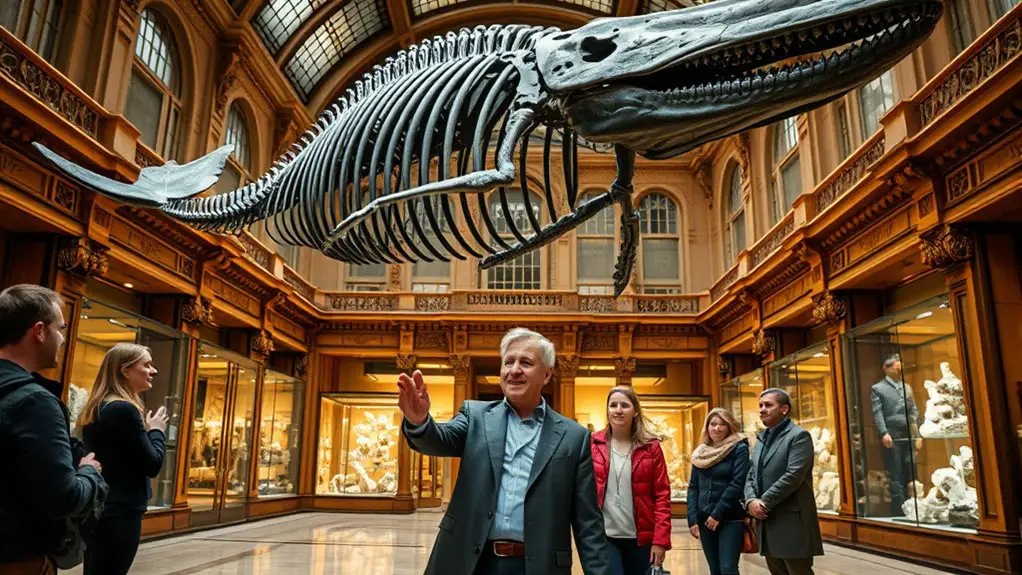
The Natural History Museum combines dinosaurs, animals, minerals, meteorites and Earth science in one of London’s most recognizable museum buildings. Its permanent galleries are free, although free advance tickets can help guarantee entry at busy times. The museum is currently open daily except December 24–26; confirm current details on its official visit page.
Your first major sight is likely to be Hope, the approximately 25-metre blue whale skeleton suspended in Hintze Hall. The famous Diplodocus cast known as Dippy greeted visitors in the hall from 1979 until 2017, when the blue whale became its replacement.
Dinosaur Exhibit Highlights
The current Dinosaurs Gallery is a better place to focus your dinosaur visit than looking for Dippy in Hintze Hall.
Highlights include part of the first Tyrannosaurus rex skeleton ever discovered, the first Iguanodon skeleton known to science, a Triceratops skull and the armoured dinosaur Scolosaurus. The gallery also features the museum’s famous animatronic T. rex.
The displays explain when different dinosaurs lived, what fossils reveal about their anatomy and behavior, and how palaeontologists investigate extinction and evolution.
Interactive Science Displays
The Natural History Museum combines physical specimens with digital interpretation, family trails, events and changing activities. Interactive features are not identical in every gallery, and temporary experiences can open, move or close, so avoid planning a visit around an unofficial promise of a specific virtual-reality station or hands-on exhibit.
Instead, check the museum’s current gallery map and family listings before you go. That gives you the most reliable picture of which trails, talks, tours and special activities are operating on your visit date.
Note: The Natural History Museum can become very busy during weekends and school holidays. Booking a free entry ticket in advance is recommended if you want more certainty about entry time.
Art and Design at the Victoria and Albert Museum

V&A South Kensington is the best fit for visitors interested in art, fashion, furniture, sculpture, ceramics, jewellery, architecture and decorative design. Its collections span thousands of years and connect historical craftsmanship with modern creative practice.
The permanent galleries are free. Current opening information is available through the V&A South Kensington visitor page. Fridays include extended opening hours, although some galleries may close earlier than the building.
Instead of trying to cover the entire museum, choose themes that interest you. Fashion lovers can focus on dress and textiles, while visitors interested in sculpture and architecture can prioritize the Cast Courts and related galleries. Furniture, ceramics, jewellery and performance collections can easily fill the rest of a visit.
V&A East Museum: A New 2026 Option
London’s V&A family has expanded beyond South Kensington. V&A East Museum opened at Queen Elizabeth Olympic Park on April 18, 2026. General admission is free, with some exhibitions and events carrying a separate charge.
The museum focuses on contemporary global culture through art, architecture, design, fashion and performance. Its opening makes Stratford another useful museum destination, especially for visitors who have already explored the V&A’s historic South Kensington galleries. Check V&A East visitor information for current exhibitions and hours.
Science and Innovation at the Science Museum
The Science Museum is one of London’s strongest family museums and covers engineering, space, medicine, energy, transport and changing technology. General museum admission is free, although booking is recommended during busy periods. Some experiences inside the building require separate paid tickets.
Interactive Exhibits Overview
The museum includes free interactive galleries as well as paid experiences. Its hands-on approach makes complicated ideas easier to explore through experiments, models, games and demonstrations.
Wonderlab is one of the best-known family experiences. It contains more than 50 interactive exhibits covering subjects including forces, electricity, maths, light, sound, matter and space. It also includes live demonstrations led by the museum’s Explainers.
However, Wonderlab is not included with free general admission. It requires a separate paid ticket, and the museum recommends advance booking. See the official Wonderlab information for current prices and availability.
Historic Scientific Innovations
The Science Museum’s historic collections show how engineering and medicine have changed everyday life.
In the Energy Hall, one important object is the Boulton and Watt rotative beam engine of 1788. The museum describes it as the world’s oldest essentially unaltered rotative engine. It is a much more accurate example to cite than calling any display “the first steam engine.”
Other major areas include Medicine: The Wellcome Galleries, which presents more than 500 years of medical history, and galleries devoted to space, engineering and modern technology.
- Explore historic engines and the development of industrial power.
- See objects connected with space exploration and changing technologies.
- Visit the medicine galleries for medical instruments, imaging technology and stories about healthcare.
Before visiting, confirm current hours, gallery closures and booking information on the Science Museum visit page.
Discovering Tate Modern
Tate Modern opened in 2000 inside the former Bankside Power Station and has become one of London’s major destinations for modern and contemporary art.
The permanent collection is free to enter, while major temporary exhibitions may require paid tickets. Because displays change, it is better to check what is currently on view than to plan solely around a particular artist.
The building itself is part of the experience. The vast Turbine Hall has hosted large-scale installations, while collection galleries explore different movements, artists and ideas across modern and contemporary art.
| Feature | What to Expect |
|---|---|
| Turbine Hall | A monumental former industrial space used for large-scale art and installations |
| Permanent Collection | Free displays of modern and contemporary art |
| Temporary Exhibitions | Changing major exhibitions that may require a separate ticket |
Check the official Tate Modern visitor page for current displays, admission arrangements and opening hours.
The National Gallery
For European painting, add the National Gallery in Trafalgar Square to your London museum plan. General admission to the permanent collection is free.
The collection spans Western European painting from the 13th to the early 20th centuries and includes works associated with artists such as Leonardo da Vinci, Rembrandt, Turner, Monet and Van Gogh. More than 1,000 paintings may be on display across the galleries, although individual works can travel or temporarily leave display.
Check the National Gallery visitor page before travelling, especially if you hope to see one particular painting.
The Historic Royal Palaces and Museums
London’s royal palaces add another layer of history, but they should be planned differently from the free national museums. The Tower of London, Hampton Court Palace and Kensington Palace are ticketed historic attractions managed by Historic Royal Palaces.
- Tower of London: Explore the medieval fortress, Crown Jewels, towers, battlements and stories connected with monarchy, imprisonment and defence.
- Hampton Court Palace: Discover Tudor and Baroque royal history, state rooms, courtyards and extensive gardens.
- Kensington Palace: Explore royal state apartments, exhibitions and stories linked with generations of the royal family.
Allow substantially more budget for these sites than for the major free museums. At the Tower of London, for example, Historic Royal Palaces recommends allowing several hours for a full visit. Check Historic Royal Palaces for current admission prices, closures and available attractions.
Warning: Do not assume a royal palace ticket works like free museum admission. These attractions use dated tickets, have their own amendment or refund policies, and can have route or room closures.
Family-Friendly Museums in London
London has several museums where children can explore through objects, games, creative activities and interactive exhibits rather than simply walking through display cases.
At the Science Museum, families can combine free galleries with separately ticketed experiences such as Wonderlab. Wonderlab is designed especially around hands-on science and is recommended primarily for children aged 7–14, although visitors of different ages can enjoy it.
The Natural History Museum remains a strong choice for dinosaur fans. The Dinosaurs Gallery, Hope the blue whale in Hintze Hall, fossils and animal collections give families several different themes to explore in one building.
The former V&A Museum of Childhood is now Young V&A. The Bethnal Green museum reopened under its new identity in 2023 after a major transformation and is designed around creativity for children and young people, with spaces focused on Imagine, Play and Design. General admission is free.
The National Gallery also runs family activities, while many of London’s museums schedule workshops and school-holiday programs throughout the year.
Pro Tip: For a family museum day in South Kensington, choose one main museum and treat a second as optional. Trying to cover the Natural History Museum, Science Museum and V&A fully in one day can leave children and adults exhausted.
Planning a London Museum Day
Three of London’s biggest museums sit close together in South Kensington: the Natural History Museum, Science Museum and V&A. That makes the area convenient for families and first-time visitors, but each institution is large enough to fill several hours.
A better plan is to pick one as your main destination, book any timed or paid experience you care about, and use a nearby museum as a flexible second stop.
The British Museum is in Bloomsbury, the National Gallery is at Trafalgar Square, and Tate Modern is on Bankside. Because these venues are spread across central London, grouping visits by neighborhood reduces unnecessary travel.
Tips for Visiting Museums in London
A little planning makes London’s busiest museums much easier to enjoy.
- Check the official website before you travel: Opening hours, entrances, gallery closures, special events and ticket requirements can change.
- Book free timed entry when recommended: Free admission does not always mean you can walk straight in during peak periods.
- Prioritize a few galleries: Large institutions such as the British Museum, V&A and Natural History Museum are difficult to cover meaningfully in one visit.
- Allow time for security: Major museums may inspect bags or operate security screening at entrances.
- Travel light: Large bags can slow entry and may be restricted in particular exhibitions.
- Use official maps and guides: Digital maps, audio guides, tours and family trails can help you find priority objects without unnecessary walking.
- Check accessibility in advance: Historic buildings may use specific step-free routes or entrances, while wheelchairs and mobility aids may need advance reservation at some venues.
- Respect gallery rules: Do not touch objects unless a display specifically invites interaction, keep noise reasonable and follow signs covering photography, food and restricted areas.
Note: “Free museum” normally refers to general admission to the permanent collection. Special exhibitions, IMAX screenings, interactive experiences, tours or events may still require payment.
Frequently Asked Questions
Are museum tickets refundable or exchangeable?
It depends on the museum and ticket type. Paid tickets at the British Museum, Tate and V&A are generally non-refundable and non-exchangeable except in limited circumstances. Historic Royal Palaces has a strict no-refund policy but may allow changes to some unused admission tickets bought directly from its website for an amendment fee. Always read the terms for the specific ticket before paying.
Can I bring food and drinks inside London museums?
Policies vary. Many museums have cafés or designated picnic spaces and do not allow eating inside collection galleries. V&A South Kensington and Young V&A, for example, allow visitors to bring cold food and drink but require it to be consumed in designated areas. Check the venue’s current visitor rules before arriving.
Are there guided tours available at these museums?
Yes. Many London museums offer guided tours, gallery talks, audio guides, digital visitor guides or self-guided trails. Availability and prices vary, so check the museum’s official events or visitor page before your trip. Some tours are free, while specialist or private tours may be ticketed.
What are the museum opening and closing times?
Hours vary by museum. As checked in July 2026, the British Museum normally opens 10:00–17:00 with later Friday opening, the Natural History Museum 10:00–17:50, V&A South Kensington 10:00–17:45 with later Friday opening, and the Science Museum 10:00–18:00. Tate Modern also has extended Friday and Saturday hours. Seasonal and event-related changes occur, so verify the live schedule before travelling.
Are photography and videography allowed inside the museums?
Personal handheld photography is allowed in many galleries, but restrictions can apply to particular objects, temporary exhibitions and copyrighted works. Flash, tripods, lighting and commercial filming are more restricted and may require permission. Follow signs and staff instructions in each gallery.
Are the main museums in London free?
Many are. The permanent collections at the British Museum, Natural History Museum, V&A South Kensington, Science Museum, Tate Modern and National Gallery can be visited without a general admission charge. Some temporary exhibitions and experiences cost extra. Historic Royal Palaces such as the Tower of London and Hampton Court Palace charge admission.
Which London museums are best for children?
The Natural History Museum is a strong choice for dinosaur and animal fans, while the Science Museum combines free galleries with hands-on paid experiences such as Wonderlab. Young V&A in Bethnal Green is designed specifically around creativity, play and design for children and young people.
Conclusion
London’s museum scene is large enough that you do not need to see everything in one trip. Start with the British Museum for ancient cultures, the Natural History Museum for dinosaurs and nature, the V&A for art and design, the Science Museum for technology, Tate Modern for modern art or the National Gallery for European painting.
Families can add Young V&A and carefully chosen interactive experiences, while visitors interested in royal history can budget separately for the Tower of London, Hampton Court Palace or Kensington Palace. Check current opening times and exhibitions, choose a few priority galleries, and leave enough time to enjoy them rather than rushing from one building to another.
Sources
- British Museum — Visit — general admission, opening hours and booking guidance.
- Natural History Museum — Visit — current entry, opening times, facilities and gallery planning.
- Victoria and Albert Museum — Visit — V&A South Kensington, Young V&A and V&A East visitor information.
- Science Museum — Visit — opening hours, free admission and visitor planning.
- Tate Modern — Visit — collection admission, exhibitions and current visitor information.
- Historic Royal Palaces — tickets, opening information and visitor guidance for the Tower of London, Hampton Court Palace and Kensington Palace.
