
Last Updated on July 25, 2026 by Daniel Globe
American Airlines traces its roots to a scheduled mail flight in 1926. American Airways was formed in 1930, and the company adopted the American Airlines name in 1934. Today, the Fort Worth-based airline and its regional and alliance partners connect travelers with more than 350 destinations in more than 60 countries and territories. Its mainline fleet includes aircraft such as the Airbus A321 and Boeing 737, 777, and 787.
Quick Answer
Yes. American Airlines is generally a reasonable choice for air travel because its operations are subject to FAA rules, safety management, pilot training, maintenance, and continuing oversight. However, no airline is risk-free, and a current assessment must include the fatal 2025 American Eagle collision near Washington, D.C.
Key Takeaways
- American Airlines mainline and American Eagle regional flights are not always operated by the same legal air carrier.
- American Airlines Flight 587 in 2001 remains the most recent fatal crash involving an American mainline passenger flight.
- In January 2025, a PSA Airlines regional jet operating for American Eagle collided with a U.S. Army helicopter near Reagan National Airport, killing 67 people.
- American describes an organization-wide Safety Management System supported by voluntary reporting, flight-data analysis, audits, training, and maintenance programs.
- Raw accident totals and consumer rankings should not be used without considering flight volume, operator identity, time period, and accident definitions.
- Passengers can reduce their risk of turbulence injuries by keeping their seat belts fastened whenever they are seated.
No airline can guarantee absolute safety. A useful assessment looks at regulatory oversight, recent accidents, the operating carrier, pilot and maintenance standards, risk-management programs, and the way an airline responds when problems are found.
Disclosure: As an Amazon Associate I earn from qualifying purchases. Some links on this page are affiliate links, at no extra cost to you.
American Airlines Safety Record at a Glance
| Safety question | Current evidence |
|---|---|
| Is American regulated as a major U.S. airline? | Yes. American’s mainline passenger operations are conducted under the FAA regulatory framework for Part 121 air carriers. |
| Most recent fatal American mainline passenger crash | American Airlines Flight 587 on November 12, 2001. |
| Most important recent American-branded regional accident | PSA Airlines Flight 5342, operating for American Eagle, was involved in the January 29, 2025 collision near Reagan National Airport. |
| Published safety programs | Safety Management System, Aviation Safety Action Programs, Flight Operations Quality Assurance, internal oversight, and IOSA participation. |
| Overall assessment | American operates within the extensive safety framework applied to major U.S. airlines, but its record must be discussed honestly and without ignoring recent regional events. |
Commercial aviation as a whole remains a low-risk form of long-distance transportation. The International Air Transport Association reported 51 accidents among approximately 38.7 million commercial flights in 2025, an all-accident rate of 1.32 per million flights. That industry-wide figure provides context, but it should not be treated as an individual score for American Airlines.
IATA recorded approximately one accident for every 759,646 commercial flights worldwide in 2025. Individual airline records still require operator-specific analysis.
Why a Lifetime Hull-Loss Count Can Be Misleading
A “hull loss” generally means an aircraft was destroyed or damaged beyond economical repair. It does not necessarily mean that passengers died or that the airline caused the event. Different databases may include or exclude regional partners, merged airlines, intentional acts, ground damage, older predecessor companies, and aircraft written off for economic reasons.
A raw lifetime total is also affected by the airline’s age and size. An airline that has operated millions of flights over many decades will have more exposure than a small or recently founded carrier. For those reasons, this article does not repeat the unsupported claim that American has experienced exactly 11 hull losses.
Note: Accident counts are meaningful only when the operator, period, event definition, number of flights, and source methodology are clear.
American Airlines Mainline vs. American Eagle
“American Airlines” can refer to the mainline airline or to the wider network sold under the American brand. American Eagle is the regional brand used for flights operated by several separately certificated carriers. These have included American-owned carriers such as PSA Airlines, Piedmont Airlines, and Envoy Air, along with contracted regional airlines.
This distinction matters when evaluating safety history. A ticket can carry an American Airlines flight number even though another carrier operates the aircraft and employs the pilots and cabin crew. The booking confirmation normally identifies this with wording such as “Operated by PSA Airlines as American Eagle.”
Regional carriers must still comply with the regulations that apply to their operations, but accident records and enforcement actions should be assigned to the actual operator rather than automatically combined with American mainline.
Pro Tip: Before booking, open the flight details and look for the “operated by” line. This tells you which airline will actually operate the aircraft.
Major Accidents in American’s Safety History
American Airlines Flight 587 in 2001
On November 12, 2001, American Airlines Flight 587, an Airbus A300, crashed in Belle Harbor, New York, shortly after departing John F. Kennedy International Airport. All 260 people aboard and five people on the ground died.
The National Transportation Safety Board determined that the vertical stabilizer separated after unnecessary and excessive rudder-pedal inputs created loads beyond the structure’s ultimate design. The NTSB also identified characteristics of the Airbus A300-600 rudder-control system and elements of American’s aircraft-maneuvering training program as contributing factors.
Flight 587 remains the most recent fatal accident involving an American Airlines mainline passenger flight. It should not, however, be described as the last major accident connected with the wider American-branded network.
The 2025 DCA Collision Involving American Eagle Flight 5342
On January 29, 2025, a CRJ700 operated by PSA Airlines as Flight 5342 collided with a U.S. Army UH-60L helicopter near Ronald Reagan Washington National Airport. The regional flight was operating for American Eagle and was approaching the airport from Wichita. The collision killed the 60 passengers and four crew members aboard the regional jet and all three crew members aboard the helicopter.
At its January 2026 board meeting, the NTSB identified systemic causes and contributing factors. These included the FAA’s placement and oversight of a helicopter route close to an airport approach path, overreliance on visual separation, ineffective visual separation by the helicopter crew, air traffic control workload and situational-awareness problems, Army altitude-management failures, limitations in collision-alerting systems, and weaknesses in safety-data sharing and risk management.
The NTSB did not identify American Airlines mainline aircraft maintenance as the primary cause. Even so, the event is relevant to passengers because the flight was sold under the American brand and operated by an American-owned regional subsidiary.
The January 2025 collision killed 67 people and was the deadliest U.S. aviation accident since 2001.
Safety Measures and Protocols at American Airlines

American states that its organization-wide Safety Management System is used to identify hazards, assess risk, verify whether safety controls are working, and promote safety awareness. Part 121 air carriers are required by the FAA to maintain an SMS under the federal framework in 14 CFR Part 5.
A Safety Management System is not a promise that accidents will never happen. It is a structured method for finding hazards, reporting errors, analyzing data, correcting weaknesses, and checking whether those corrections remain effective.
Aviation Safety Action Programs
American says it uses Aviation Safety Action Programs, commonly called ASAPs, in several workgroups. These voluntary reporting systems allow employees to report hazards, mistakes, and close calls so that the airline, employee representatives, and regulators can identify patterns and reduce repeat events.
Flight Operations Quality Assurance
Flight Operations Quality Assurance, or FOQA, uses recorded flight data to identify operational trends. For example, analysts can look for patterns involving unstable approaches, excessive speeds, hard landings, or other events that may require changes to procedures, training, airport guidance, or risk controls.
Operational Audits
American also states that it participates in the International Air Transport Association Operational Safety Audit program. IOSA reviews an airline’s operational management and control systems using standardized audit criteria. Participation is a useful signal of structured oversight, although it does not guarantee that an airline will never experience an accident.
Warning: A safety certification, audit, or long accident-free period cannot guarantee the outcome of a future flight. These measures show that systems and controls exist, not that risk has been eliminated.
Pilot Training and Experience at American Airlines
American Airlines pilots must hold the certificates, medical qualifications, ratings, and experience required for their assigned positions. The airline’s training program must be accepted or approved through the FAA framework that applies to Part 121 air carriers.
The original article included fixed numbers for pilots and training hours, but those figures were not supported by a reliable source. Training duration varies by aircraft, prior experience, qualification path, simulator availability, curriculum, and the type of check being completed.
| Training area | What it covers | Why it matters |
|---|---|---|
| Initial and qualification training | Aircraft systems, normal procedures, limitations, performance, emergency procedures, and crew duties. | Pilots must demonstrate competence before operating a specific aircraft in passenger service. |
| Simulator training | Engine failures, rejected takeoffs, system malfunctions, low-visibility operations, windshear, and other abnormal situations. | Crews can practice high-risk situations without exposing passengers or aircraft to danger. |
| Upset-prevention and recovery training | Recognition, prevention, and recovery from stalls and unusual aircraft attitudes. | Addresses situations that can lead to loss of control if they are not recognized and managed correctly. |
| Crew resource management | Communication, workload management, decision-making, leadership, monitoring, and challenge-and-response practices. | Helps crew members recognize errors and speak up before a developing problem becomes more serious. |
| Recurrent training and checking | Regular refresher training, proficiency checks, line checks, and requalification when required. | Confirms that skills remain current throughout a pilot’s career. |
The FAA’s enhanced air-carrier training framework includes stall and upset-prevention and recovery training. Flight-simulator standards are also designed to support realistic training for adverse weather and unusual aircraft conditions.
Maintenance and Inspection Procedures
American’s aircraft are maintained through an FAA-regulated continuous airworthiness program. This includes routine checks, scheduled inspections, component servicing, defect reporting, repairs, engineering support, and deeper maintenance visits based on approved programs.
It is not accurate to say that every aircraft receives a complete inspection and full service before every flight. Before departure, flight and ground personnel perform the checks required for that operation. More detailed work takes place at scheduled intervals or when a defect, warning, inspection result, or crew report requires it.
| Maintenance activity | Typical purpose |
|---|---|
| Preflight and transit checks | Look for visible damage, leaks, tire or brake concerns, open panels, fluid issues, warning messages, and discrepancies reported by the previous crew. |
| Routine scheduled maintenance | Inspect and service systems and components at approved intervals based on time, cycles, usage, and maintenance requirements. |
| Heavy maintenance | Complete detailed inspections, structural work, major component replacement, modifications, and extensive testing. |
| Unscheduled maintenance | Investigate and correct problems reported by crews, monitoring systems, technicians, or inspections. |
American’s Maintenance Operations Control team coordinates maintenance activity across its mainline fleet, while engineering and parts teams support repairs and aircraft returning to service. An aircraft with an unresolved airworthiness problem must not be released simply to maintain the schedule.
The FAA’s Continuous Airworthiness Maintenance Program guidance describes the maintenance-training framework expected for affected commercial operators.
Weather, Turbulence, and In-Flight Safety
Airline weather decisions involve more than a single tracking system. Dispatchers, pilots, meteorologists, air traffic control, airport observations, forecasts, radar information, pilot reports, and operational teams may all contribute to route and timing decisions.
American’s FAA-certificated dispatchers share operational-control responsibilities with the captain. They plan flights, monitor changing conditions, review fuel requirements, and provide updated information about weather and airspace hazards.
Turbulence can still occur without warning, including in clear air. It does not automatically mean that the aircraft is in danger, but unrestrained passengers and crew members can be injured when the aircraft moves suddenly.
Pro Tip: Keep your seat belt low and snug whenever you are seated, even when the seat-belt sign is off. The FAA identifies continuous seat-belt use as the most effective step passengers can take to reduce unexpected turbulence injuries.
Emergency Response and Preparedness
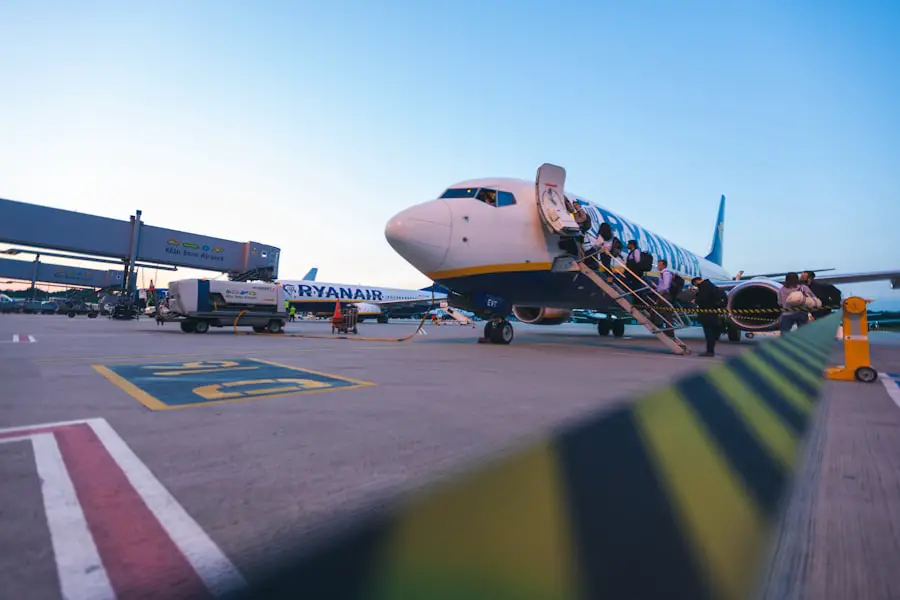
Image note: This photograph shows general airline ground operations involving a Ryanair aircraft. It is not an American Airlines aircraft.
Emergency preparation covers events such as medical emergencies, smoke or fire indications, severe weather, security concerns, mechanical warnings, airport closures, and evacuation requirements. Flight crews, dispatchers, maintenance teams, airport personnel, security teams, and emergency-response staff may all be involved.
American’s Integrated Operations Center supports flight monitoring, dispatch, crew coordination, maintenance control, security operations, and emergency planning. The airline says the center operates around the clock and helps coordinate decisions affecting both mainline and regional flights.
Flight and cabin crews receive recurrent emergency training. Ground stations may also conduct drills or tabletop exercises with airport authorities, medical responders, security agencies, and law enforcement.
A diversion or precautionary landing does not automatically mean an aircraft was close to crashing. In many cases, it shows that the crew detected a problem and used established procedures to place the aircraft on the ground where it could be inspected safely.
Customer Feedback and Perceptions of Safety
Passenger feedback can reveal how clearly a crew communicated, whether the cabin appeared orderly, whether the safety briefing was professional, and how the airline handled a delay or disruption. Those observations matter to customer confidence.
However, online reviews are not a reliable measure of technical safety. Passengers generally cannot evaluate maintenance records, flight-data trends, regulatory findings, training performance, or internal hazard reports. A calm flight is not proof of a perfect safety system, and a turbulent or delayed flight is not proof that an airline is unsafe.
For evidence-based research, travelers should prioritize:
- FAA regulations, enforcement notices, and safety guidance;
- NTSB accident reports and probable-cause findings;
- The identity of the operating carrier;
- Standardized audit information such as IOSA participation;
- Official descriptions of an airline’s risk-reporting and data-analysis programs; and
- Long-term records interpreted in relation to flight volume and operation size.
How American’s Safety Standards Compare With Other Major Airlines
American, Delta, United, Southwest, and other large U.S. passenger airlines operate within the FAA’s Part 121 regulatory system. They must meet federal requirements covering aircraft airworthiness, pilot qualifications, training, operational control, maintenance, duty limits, safety management, and reporting.
That does not mean every airline uses identical procedures. Airlines may differ in fleet age, route structure, internal reporting culture, training design, maintenance organization, technology, regional partnerships, and the way they analyze safety data.
There is no simple official FAA ranking that declares one major U.S. carrier the safest. Commercial “safest airline” lists often use proprietary scoring systems, and different lists can reach different results.
| Comparison signal | How useful is it? | Main limitation |
|---|---|---|
| Total historical accidents | Provides historical context. | Can mislead without airline age, flight volume, definitions, and operator scope. |
| Recent accident rate | More comparable when calculated consistently. | Individual-airline exposure data and definitions may not be publicly standardized. |
| FAA enforcement | Shows specific alleged or confirmed regulatory problems. | A proposal is not a final finding, and actions vary greatly in seriousness. |
| IOSA registration | Shows participation in a standardized operational audit program. | It does not guarantee accident-free operation. |
| Customer reviews | Useful for communication and service impressions. | Passengers cannot normally observe technical safety systems. |
Recent Incidents and Regulatory Developments
Major airlines regularly experience precautionary returns, medical diversions, bird strikes, turbulence encounters, warning indications, and mechanical issues. These events may receive significant media attention because commercial aviation is highly visible.
Each event should be evaluated by its outcome and official findings rather than by a dramatic headline. A crew returning to the departure airport after a warning can demonstrate conservative decision-making and functioning safety procedures.
2025 DCA Accident
The fatal Flight 5342 collision is the most important recent accident associated with the American brand. The NTSB’s findings focused heavily on airspace design, FAA oversight, Army helicopter operations, visual-separation practices, air traffic control workload, and safety-data failures. Its significance should neither be minimized nor inaccurately assigned to American mainline maintenance.
2026 Proposed FAA Civil Penalty
In April 2026, the FAA proposed a $255,000 civil penalty against American Airlines. The agency alleged that 12 flight attendants who had tested positive in drug or alcohol testing returned to safety-sensitive duties without completing every required follow-up test between 2019 and 2023.
This was a proposed enforcement action, not a final legal determination when announced. It does not establish that the employees were impaired while working, but it raises a legitimate compliance issue involving safety-sensitive personnel and should be reported accurately in a current review.
Note: FAA enforcement announcements may describe alleged violations before the airline has responded or a final resolution has been reached.
Steps American Uses to Manage and Improve Safety
American’s published safety framework emphasizes finding risks before they contribute to accidents. Important elements include:
- Safety reporting: Voluntary programs encourage employees to report hazards, mistakes, and close calls.
- Flight-data monitoring: Recorded operational data can reveal trends that may not be visible from a single event.
- Internal oversight: Safety-assurance processes evaluate whether procedures and risk controls are working.
- Recurrent training: Pilots, flight attendants, dispatchers, technicians, and other employees receive continuing role-specific training.
- Maintenance control: Technical teams monitor aircraft condition, coordinate repairs, and respond to crew reports.
- Operational control: Dispatchers and pilots jointly evaluate weather, fuel, routing, aircraft status, and other operating conditions.
- Emergency exercises: Drills and coordination help teams prepare for medical, security, weather, airport, and aircraft emergencies.
- External audits and oversight: FAA surveillance and standardized operational audits provide additional review.
The value of these programs depends on how consistently they are used, whether employees feel safe reporting concerns, how quickly hazards are corrected, and whether regulators and management act on warning signs.
What Passengers Can Do to Improve Their Own Safety
Passengers cannot control aircraft maintenance or air traffic systems, but they can reduce common cabin risks and prepare for emergencies.
- Keep your seat belt fastened while seated. Unexpected turbulence is a leading source of in-flight injury.
- Listen to the safety briefing. Exit locations and procedures can differ by aircraft.
- Read the safety card. Review the brace position, oxygen-mask instructions, flotation equipment, and nearest exits.
- Follow carry-on limits. Secure bags and heavy objects so they do not become hazards during turbulence or an evacuation.
- Use an approved child-restraint system. The FAA recommends an approved restraint rather than holding a small child on an adult’s lap.
- Follow crew instructions immediately. Cabin crews are trained primarily for safety, not only customer service.
- Report damaged equipment. Tell a crew member about a broken seat belt, blocked aisle, unusual smell, smoke, heat, or visible damage.
- Check the operating carrier. Look for the “operated by” statement when comparing flights and safety histories.
The FAA’s passenger safety guidance recommends paying attention to crew instructions, keeping seat belts secured, using an approved child-restraint device, and following carry-on rules.
Is American Airlines Safe for Travel?
American Airlines is generally a reasonable choice for domestic and international air travel. It operates under the same broad FAA regulatory structure that applies to other major U.S. carriers and describes established programs for safety management, voluntary reporting, flight-data monitoring, pilot training, maintenance control, and operational oversight.
Its mainline passenger operation has not experienced a fatal crash since Flight 587 in 2001. A complete and current answer must also acknowledge the January 2025 collision involving a PSA Airlines regional jet operating for American Eagle. That tragedy killed 67 people and exposed serious weaknesses involving airspace design, government oversight, helicopter operations, air traffic control, and safety-data management.
The accident does not support the claim that every American Airlines flight is unsafe. It does show why airline safety should never be reduced to marketing language, customer reviews, or a simple “zero accidents” claim.
Travelers should consider American within the broader context of U.S. commercial aviation, which remains highly regulated and statistically low risk. They should also check the operating carrier, follow crew instructions, keep their seat belts fastened, and use official FAA and NTSB information when researching specific concerns.
Helpful Travel Planning Resources
For another version of this topic, see the site’s American Airlines safety article. Travelers preparing for a flight may also find these existing guides useful: packing cubes for organized luggage, travel pillows for long flights, and lightweight laptops for travel.
Sources
- American Airlines: Operating Safely — American’s descriptions of its Safety Management System, ASAP, FOQA, and IOSA participation.
- NTSB: American Airlines Flight 587 — accident details, probable cause, contributing factors, and recommendations.
- NTSB: DCA Midair Collision Investigation — facts and probable-cause findings for the 2025 PSA Airlines and U.S. Army helicopter collision.
- FAA: Air Carrier Training — Part 121 enhanced pilot-training and simulator requirements.
- FAA: Continuous Airworthiness Maintenance Program Training — maintenance and preventive-maintenance training guidance.
- IATA 2025 Safety Report — worldwide commercial-aviation accident rates and safety context.
Frequently Asked Questions
Is American Airlines safe to fly with?
American Airlines is generally a reasonable choice for air travel. Its mainline operation is regulated by the FAA and uses safety-management, training, maintenance, reporting, and operational-control programs. No airline is completely risk-free, and a current assessment should include the 2025 American Eagle collision operated by PSA Airlines.
What is the difference between American Airlines and American Eagle?
American Airlines mainline operates its own aircraft with its own operating certificate. American Eagle is a regional brand used by several separately certificated airlines, including American-owned and contracted carriers. Check the “operated by” line on the booking to identify the actual airline.
What was American Airlines’ most recent fatal accident?
American Airlines Flight 587 in 2001 remains the most recent fatal crash involving an American mainline passenger flight. In 2025, PSA Airlines Flight 5342, operating for American Eagle, collided with a U.S. Army helicopter near Reagan National Airport and killed 67 people.
What safety measures does American Airlines use?
American describes a Safety Management System supported by hazard reporting, Aviation Safety Action Programs, Flight Operations Quality Assurance, internal oversight, maintenance control, emergency planning, recurrent training, and IOSA participation.
How are American Airlines pilots trained?
Pilots complete aircraft-specific qualification training, simulator sessions, emergency-procedure training, crew resource management, recurrent training, proficiency checks, and other FAA-required evaluations. Training length varies, so fixed universal hour totals should not be assumed.
Does American Airlines fully inspect every aircraft before every flight?
Aircraft receive required preflight or transit checks before operation, but they do not undergo a complete heavy inspection before every flight. Detailed inspections and component work occur through an approved maintenance program at scheduled intervals or when a defect requires attention.
Does a diversion or emergency landing mean the airline is unsafe?
Not necessarily. Crews may divert or return as a precaution after a warning, medical emergency, weather change, unusual smell, mechanical indication, or airport problem. The decision can demonstrate that safety procedures are working as intended.
What can passengers do to stay safer during an American Airlines flight?
Keep your seat belt fastened while seated, listen to the safety briefing, review the safety card, secure your luggage, use an approved child-restraint device when appropriate, and follow crew instructions immediately during turbulence or an emergency.

