

Last Updated on July 30, 2026 by Caleb Warren
Washing a backpack safely starts with one rule: follow the care label for that exact bag. Most structured hiking packs, coated bags, leather packs, and backpacks with fixed foam or frames should be cleaned by hand. Machine washing is only appropriate when the manufacturer specifically allows it. Use mild soap, gentle agitation, thorough rinsing, and complete air drying.
Quick Answer
Empty the backpack, read its care label, remove detachable parts, and spot-test your cleaner. Hand wash with lukewarm water and mild, additive-free soap unless the label clearly permits machine washing. Rinse until the water runs clear, reshape the bag, open every pocket, and air dry it fully away from direct sun and heat.
Key Takeaways
- The backpack’s care label and manufacturer instructions take priority over general cleaning advice.
- Hand washing is the safer default for structured, padded, coated, framed, leather-trimmed, and technical backpacks.
- Never use bleach, harsh solvents, fabric softener, a clothes dryer, or direct high heat unless the manufacturer expressly approves it.
- Test any cleaner on a hidden area before treating a visible stain.
- Dry every compartment, seam, strap, and foam panel completely before storing or using the backpack.
At a Glance
| Time Required | About 20–40 minutes of cleaning, plus 12–24 hours or more for air drying |
| Difficulty | Easy, with extra care needed for coated, framed, leather, suede, or vintage packs |
| Tools Needed | Care label, vacuum, soft cloth or sponge, soft toothbrush, mild soap, sink or tub, clean towels |
| Cost | Usually $0–$10 when using supplies already at home |
Warning: Do not machine wash a backpack simply because it is made of nylon or polyester. Agitation can damage foam, coatings, frames, seams, buckles, and water-resistant zipper treatments. Machine wash only when the bag’s own care label or manufacturer instructions clearly allow it.
Disclosure: As an Amazon Associate I earn from qualifying purchases. Some links on this page are affiliate links, at no extra cost to you.
Preparing Your Backpack for Cleaning

Good preparation prevents lost items, trapped dirt, and accidental damage. Before adding water or cleaner, complete these steps:
- Read the care label. Look for limits on soaking, water temperature, detergent, machine washing, and drying. Check the manufacturer’s support page when the label is missing or unclear.
- Empty every compartment. Check small organizer pockets, hydration sleeves, key clips, hidden security pockets, and laptop compartments.
- Shake and vacuum the bag. Turn it upside down, shake out loose debris, and use a low-suction vacuum attachment along seams and corners.
- Remove only detachable parts. Take out removable frames, stays, hipbelts, foam inserts, rain covers, and straps only when the owner’s instructions show they are designed to come out.
- Secure hardware. Close hook-and-loop tabs, loosen compression straps, and place loose strap ends where they will not snag. Open pockets and main zippers for hand washing and drying.
- Inspect for damage. Repair open seams, torn mesh, loose trim, or damaged zipper stitching before a deep wash so agitation does not make the problem worse.
Manufacturers do not all give the same directions. For example, JanSport recommends hand cleaning to protect shape and finish, while Osprey advises against machine washing its packs. Treat the instructions for your exact model as the final authority.
Pro Tip: Take a photo of removable frames, straps, and buckles before disassembly. The photo makes correct reassembly much easier after every part is fully dry.
Spot Treatment for Stains
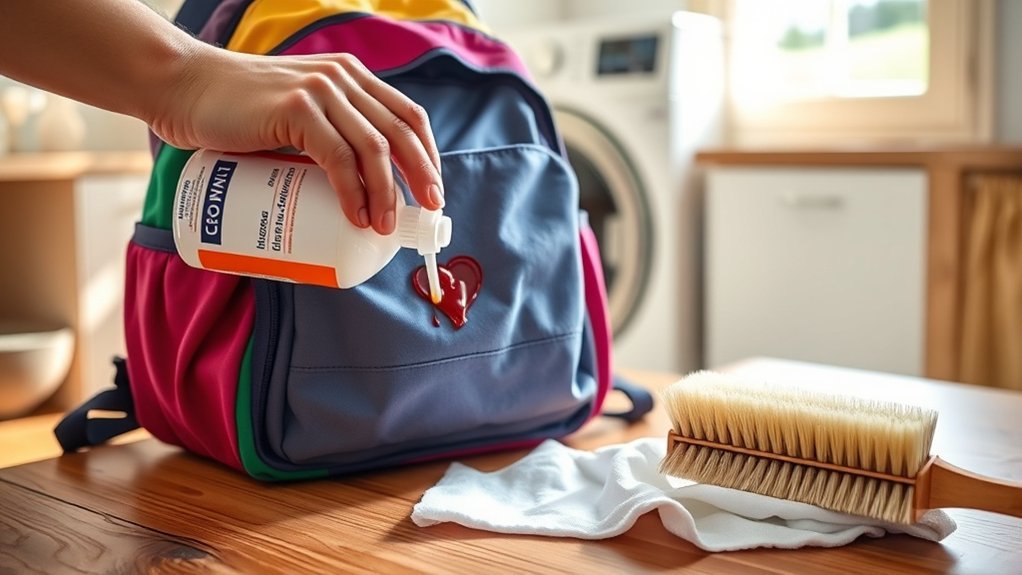
Spot cleaning is often enough for a small spill and is safer than soaking the whole backpack. Work from the outside edge of a stain toward the center, use as little moisture as practical, and avoid aggressive scrubbing that can roughen fabric or strip a coating.
Identify Stain Types
Choose the gentlest treatment that matches the stain and the backpack material:
| Stain | Safer First Step | Avoid |
|---|---|---|
| Dry dirt or mud | Let it dry, brush off loose soil, then dab with mild soapy water | Grinding wet mud deeper into the weave |
| Food or drink | Blot promptly, then dab with diluted mild soap | Rubbing hard or using hot water before checking the label |
| Oil or grease | Blot without spreading and consult the care instructions for an approved cleaner | Strong degreasers on coated or dyed fabric |
| Ink or permanent marker | Blot, stop the spread, and ask the manufacturer or a professional cleaner | Applying alcohol or solvent without approval and a hidden-area test |
Choose Effective Cleaners
Use a small amount of mild, fragrance-free soap or a cleaner made for the backpack’s fabric and coating. REI recommends mild soap without fragrances or additives for general backpack cleaning. Avoid assuming that a household stain spray, concentrated dish spray, rubbing alcohol, essential oil, or solvent is compatible with the bag.
Always test the diluted cleaner on a hidden area. Let the test spot dry completely, then check for color transfer, fading, stiffness, tackiness, whitening, or coating changes before treating a visible area.
Apply Pre-Treatment Techniques
- Blot fresh liquid with a clean, absorbent cloth. Do not rub.
- Apply a small amount of diluted cleaner to a cloth or soft brush rather than pouring it directly onto the backpack.
- Dab or brush gently for one to two minutes, paying attention to seams without saturating foam or leather trim.
- Allow only the contact time stated on the cleaner’s label.
- Rinse the treated area with a clean damp cloth until no soap remains, then inspect it after drying.
Note: Water-resistant zippers may have delicate coatings. Remove grit with a soft brush and light wiping; do not scrub them aggressively.
Washing Machine Method Explained

Machine washing is not a universal backpack-cleaning method. Many outdoor and school-bag manufacturers advise against it because tumbling and spinning can harm the pack’s structure, finish, coatings, foam, and hardware. Use this section only when the care label for your exact backpack clearly says machine washing is permitted.
Pre-Treatment Steps
Empty and vacuum the pack, remove any label-approved detachable frame or insert, treat stains gently, and close snag-prone hook-and-loop fasteners. Place the backpack in a large mesh laundry bag or pillowcase. Do not machine wash bags with fixed frames, wheeled chassis, rigid shells, leather or suede trim, glued decorations, electrical components, or nonremovable structured foam unless the manufacturer expressly approves it.
Proper Washing Technique
- Select the water temperature and cycle stated on the care label. When the label allows flexibility, a cold, gentle cycle is the lower-risk option.
- Use a small amount of mild detergent. Skip bleach, fabric softener, scent boosters, and harsh stain products.
- Wash the backpack without heavy garments, shoes, or objects that can strike its buckles and padding.
- Stop the cycle if the bag becomes trapped around an agitator or the machine becomes unbalanced.
- Remove the backpack promptly, reshape it by hand, and air dry it. Never put it in a clothes dryer unless its own care label specifically permits that step.
Hand Washing Your Backpack
Hand washing is the safer default for most fabric and technical backpacks. Some manufacturers permit full submersion, while others recommend wiping only, so confirm the care instructions first.
- Prepare the wash. Fill a clean tub or large sink with lukewarm water and a small amount of mild soap.
- Clean gently. If submersion is allowed, place the backpack in the water and move it by hand. Use a soft sponge or brush on dirty areas. If submersion is not allowed, clean section by section with a damp cloth.
- Focus on high-contact areas. Clean shoulder straps, the back panel, hipbelt, grab handle, and pocket interiors where sweat, skin oils, crumbs, and grime collect.
- Protect delicate parts. Use minimal pressure on mesh, printed graphics, seam tape, coated fabric, and water-resistant zippers.
- Rinse completely. Drain the dirty water and rinse with clean cool water or a clean damp cloth until no suds or slippery residue remain.
- Remove excess water. Press the backpack gently between clean towels. Do not wring, twist, or sharply fold padded panels.
Osprey’s care guidance recommends a tub or large sink, mild soapy water, a sponge or soft brush, thorough rinsing, and air drying out of direct sunlight. REI gives similar guidance but stresses that the manufacturer’s directions come first.
Drying Techniques for Optimal Care
Incomplete drying can trap odor and moisture deep in foam, seams, and pocket corners. Drying may take a full day or longer in cool or humid conditions.
| Technique | How to Do It | Why It Helps |
|---|---|---|
| Open the bag fully | Unzip compartments and turn pockets outward where practical | Improves airflow into seams and corners |
| Support the shape | Lay the bag on a clean mesh rack or hang it from its carry loop when the manufacturer allows | Prevents sharp folds and avoids unnecessary strain on shoulder straps |
| Use moving air | Choose a shaded, well-ventilated area; a room fan can improve circulation | Speeds evaporation without high heat |
| Rotate and check | Turn the pack several times and feel inside foam, pockets, and the bottom panel | Finds hidden damp areas before storage |
| Avoid heat and sun | Do not use a dryer, radiator, hair dryer, or prolonged direct sunlight | Protects foam, adhesives, coatings, and color |
JanSport, Osprey, and REI all recommend complete air drying. Osprey and REI specifically direct users to dry packs out of direct sunlight.
Tips for Maintaining Backpack Cleanliness
- Remove food, damp clothing, and trash as soon as you get home.
- Shake out crumbs and dirt after hikes, school trips, gym use, or travel.
- Wipe fresh spills before they dry.
- Let sweat-damp straps and back panels air out before storage.
- Store the bag clean, dry, uncompressed, and away from prolonged sun or high heat.
- Clean zipper teeth gently when sand or grit makes them difficult to operate.
- Reapply a water-repellent treatment only when the backpack manufacturer recommends a compatible product and method.
There is no single cleaning schedule for every backpack. A lightly used office bag may need only occasional wiping, while a school, gym, hiking, or travel pack may need cleaning whenever it is visibly dirty, smells, or has been exposed to food, sweat, mud, or spills.
Avoiding Common Mistakes
Warning: Never mix bleach with vinegar, ammonia, or other cleaners. Dangerous gases can form. Bleach can also discolor fabric and damage fibers, coatings, leather, and hardware, so do not use it on a backpack unless the manufacturer gives explicit instructions for that exact item.
- Skipping the label: Material names alone do not reveal how foam, coatings, adhesives, dyes, and trim will react.
- Using too much detergent: Residue can attract dirt, leave stiffness, and irritate skin.
- Scrubbing aggressively: Hard brushing can abrade fabric, mesh, prints, and water-resistant zipper coatings.
- Using unapproved solvents: Alcohol, acetone, concentrated degreasers, and stain sprays may alter color or protective finishes.
- Wringing padded panels: Twisting can crease foam and distort structure.
- Applying high heat: Dryers, radiators, and hair dryers can deform synthetic parts and weaken adhesives.
- Storing while damp: Moisture hidden in padding and seams can create persistent odor and encourage mildew.
When to Seek Professional Cleaning
Contact the backpack manufacturer or a cleaner experienced with bags when the pack has leather, suede, waxed canvas, specialty coatings, hand-painted details, vintage materials, a wheeled chassis, a rigid frame, glued ornamentation, or a care label that requires professional service. Professional help is also sensible for valuable or collectible bags, widespread ink or oil stains, severe odor, unknown chemical exposure, or damage that must be repaired before washing.
Do not try to hide mold with fragrance. If mold has penetrated thick foam, the bag still smells after correct cleaning and complete drying, or a household member is sensitive to mold, ask the manufacturer or a qualified remediation or cleaning professional whether the backpack can be safely restored. Replacement may be the safer choice when contamination cannot be removed.
Eco-Friendly Cleaning Solutions
The lowest-impact approach is usually to clean only when needed, spot clean before doing a full wash, use a small measured amount of mild detergent, avoid unnecessary hot water, and air dry. For a product screened for safer ingredients, use the EPA Safer Choice directory, then confirm that the product is compatible with the backpack’s care instructions.
Vinegar and baking soda are often promoted as universal natural cleaners, but they are not automatically safe for backpack coatings, dyes, leather, or metal parts. Vinegar should not be described as a reliable disinfectant: the CDC notes that vinegar does not kill all germs and recommends soap or detergent for cleaning. Essential oils may leave stains, odors, or residue and should not be added for an “antibacterial” effect unless the backpack maker and product label approve the use.
For ordinary backpack care, cleaning with compatible soap and water is usually enough. The CDC distinguishes cleaning from disinfecting and says routine cleaning removes most harmful viruses and bacteria from surfaces. When true disinfection is necessary because of a specific contamination risk, use only a product labeled for the backpack’s surface and follow its directions, or ask the manufacturer for guidance.
Cleaning Leather, Suede, Coated, and Structured Backpacks
| Backpack Type | General Care Direction |
|---|---|
| Leather | Do not soak or machine wash. Use the maker-approved leather cleaner and conditioner after a hidden-area test. Coach’s material-specific care guidance shows why the exact leather type matters. |
| Suede or nubuck | Keep away from water unless the manufacturer says otherwise. Use a suede brush or eraser approved for the material, or seek professional cleaning. |
| Waxed canvas | Avoid detergents and soaking unless the maker permits them; cleaning can remove wax and change the finish. |
| Waterproof or coated fabric | Use an approved technical wash or mild soap, low abrasion, thorough rinsing, and manufacturer-approved reproofing only when needed. |
| Framed or heavily padded pack | Remove only detachable structure, avoid machine washing unless expressly allowed, and allow extra drying time around foam and seams. |
| Wheeled backpack | Do not immerse the chassis unless the manufacturer permits it. Wipe the frame and wheels separately and spot clean the fabric. |
Troubleshooting Problems After Washing
Soap Residue or Stiff Fabric
Rinse again with clean cool water or repeatedly wipe with a clean damp cloth. Do not add fabric softener to hide stiffness. Let the bag dry fully before judging the final texture.
Color Bleeding or Fading
Stop cleaning, rinse away the product, blot with a white towel, and keep the backpack separate from other fabrics. Contact the manufacturer before trying another cleaner.
Misshapen Foam or Padding
Gently reshape the area while damp and let it dry in its normal position. Do not iron, steam, or apply a hair dryer. If the foam remains folded or lumpy, ask the manufacturer about repair or replacement.
Persistent Odor
Check for trapped food, damp foam, dirty removable inserts, and soap residue. Repeat a label-approved rinse or targeted hand clean, then dry with strong airflow. Avoid masking the smell with essential oils or perfume.
Sticky or Flaking Coating
Stop washing and do not apply solvents. Tackiness or flaking may indicate coating breakdown rather than surface dirt. Ask the manufacturer whether the pack can be repaired or reproofed.
Final Thoughts on Backpack Care
A backpack lasts longer when you use the least aggressive method that gets it clean. Start with emptying, vacuuming, and spot cleaning. Move to hand washing only when needed, and reserve machine washing for bags whose labels clearly allow it. Careful rinsing and complete air drying matter as much as the wash itself.
Regular Maintenance Tips
| Action | When to Do It | Benefit |
|---|---|---|
| Empty and shake out | After messy trips or whenever crumbs and debris collect | Prevents buildup and odors |
| Blot spills | As soon as practical | Reduces staining and spread |
| Inspect zippers, seams, and straps | Monthly for frequent-use packs | Finds small problems before they grow |
| Air out damp areas | After sweat, rain, gym use, or wet gear | Helps prevent persistent odor and mildew |
| Deep clean | When visibly dirty, stained, or smelly—not on an arbitrary calendar | Avoids unnecessary wear from overwashing |
Stain Treatment Techniques
Prompt blotting, a hidden-area test, mild cleaner, light brushing, and complete rinsing are the safest general stain-treatment sequence. Permanent marker, oil, dye transfer, and unknown chemical stains may not come out fully without harming the finish. Stop when the treatment begins changing the color or texture, and seek model-specific guidance rather than escalating to a stronger solvent.
Frequently Asked Questions
Can I use bleach to wash my backpack?
Usually no. Bleach can weaken or discolor fabric and damage coatings, leather, and hardware. Use it only when the backpack manufacturer explicitly allows it and provides directions for that exact model. Never mix bleach with vinegar, ammonia, or another cleaner.
How often should I clean my backpack?
Clean it when it is visibly dirty, stained, smelly, or exposed to food, sweat, mud, or spills. Frequent-use school, gym, hiking, and travel bags may need more attention than an occasional-use bag. Routine emptying and spot cleaning reduce the need for deep washing.
Is it safe to wash a leather backpack?
Do not soak or machine wash a leather backpack. Follow the maker’s instructions for that leather type, test a leather-specific cleaner on a hidden area, and condition only when the manufacturer recommends it. Suede, nubuck, haircalf, and specialty leathers often require different care.
Can I remove the straps before washing?
Remove straps, hipbelts, frames, or foam only when they are designed to detach and the owner’s instructions explain how. Do not cut stitching, force buckles, or pull fixed suspension parts apart. Photograph the setup before removing anything.
What should I do if my backpack has a bad odor?
Empty and vacuum it, inspect for food or damp inserts, clean the affected area with a label-approved mild soap, rinse away all residue, and air dry with every pocket open. Do not rely on perfume or essential oils, which can mask rather than remove the cause.
Can every nylon or polyester backpack go in the washing machine?
No. The outer fabric may tolerate water while the foam, coating, adhesive, frame, printed design, leather trim, or hardware does not. Machine wash only when the care label or manufacturer instructions explicitly permit it.
How do I know when the backpack is fully dry?
Feel the bottom corners, seams, shoulder straps, back padding, hipbelt, and deepest pockets. They should feel dry and room-temperature, not cool or clammy. Give thick foam extra time and rotate the bag during drying.
Conclusion
You can wash a backpack without ruining it by matching the cleaning method to the bag—not by following a one-size-fits-all shortcut. Read the label, remove loose debris, test your cleaner, hand wash gently when in doubt, rinse thoroughly, and air dry away from heat and direct sun. Those steps protect the fabric, coatings, padding, zippers, hardware, shape, and useful life of the pack.
Sources
- JanSport: How to Clean a Backpack — hand cleaning, avoiding bleach and harsh detergent, and complete air drying.
- Osprey: How to Clean Your Osprey Backpack — preparation, hand washing, rinsing, shade drying, wheeled-pack care, and the warning against machine washing.
- REI Expert Advice: How to Clean a Backpack — mild soap, manufacturer-first guidance, hand cleaning, zipper care, and air drying.
- CDC: When and How to Clean and Disinfect Your Home — the difference between cleaning and disinfecting and the role of soap or detergent.
- CDC: About Cleaning and Disinfecting Pet Supplies — limitations of vinegar as a disinfectant and safe cleaner use.
- EPA Safer Choice — finding cleaning products with ingredients screened for safer human-health and environmental profiles.

