

Last Updated on September 10, 2026 by Daniel Globe
Refilling a microbead travel pillow can restore its shape and support, but only if the inner pillow was designed to open. Before handling any loose beads, check the care label or manufacturer instructions, prepare a contained indoor workspace, and confirm that your replacement beads match the original filling.
Quick Answer
First confirm the inner pillow is designed to open. Work indoors in a draft-free, contained area, keep children and pets away, and use compatible beads with a wide funnel. Add small amounts, test the support, close the liner securely, and inspect every seam for leaks before using the pillow.
Key Takeaways
- Do not assume the outer-cover zipper gives access to the microbeads.
- Use only beads that match the pillow’s original material and size.
- Work indoors with fans, open windows, children, and pets kept away.
- Add a little filling at a time instead of aiming for a fixed percentage.
- Use the original secure closure or a strong sewn repair, then check for leaks.
At a Glance
| Time Required | About 20 to 30 minutes |
| Difficulty | Easy to moderate, depending on the liner closure |
| Tools Needed | Wide funnel, tape, scoop, storage tote or box, damp cloth, and sewing supplies if required |
| Cost | Varies by the approved refill material and amount needed |
Disclosure: As an Amazon Associate I earn from qualifying purchases. Some links on this page are affiliate links, at no extra cost to you.
Essential Steps to Refill Your Microbead Travel Pillow
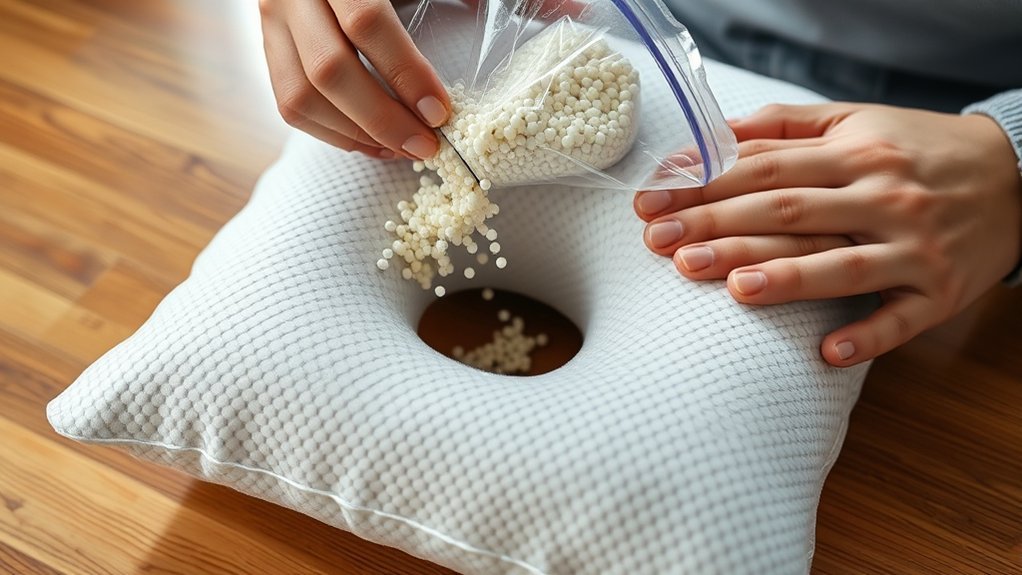
The safest method is to confirm compatibility first and then transfer the beads through a controlled opening. Many microbead pillows contain expanded-polystyrene, or EPS, beads, but other bead materials and sizes also exist. Check the product label, original packaging, or manufacturer information instead of choosing a refill by appearance alone.
- Confirm that the inner liner is refillable. A zipper on the removable cover may not open the bead chamber.
- Find a compatible refill. Match the original material and, when possible, the bead size and brand.
- Prepare a contained workspace. Close windows, turn off fans, and work inside a large tote, box, or empty dry bathtub.
- Inspect the pillow. Repair weak seams or damaged fabric before adding beads.
- Connect the funnel. Place a wide funnel in the refill opening and tape the connection lightly so it cannot slip.
- Add small amounts. Pour slowly, pause often, and test the pillow’s flexibility.
- Secure the liner. Close its locking zipper or sew the opening with strong thread.
- Perform a leak test. Gently squeeze and turn the pillow over a contained surface while checking every seam.
Warning: Loose foam beads can be inhaled or swallowed. Keep children and pets away from the work area, store unused beads in a sealed container, and never use a loose-filled microbead pillow for infant sleep. The U.S. Consumer Product Safety Commission identifies loosely filled granular infant pillows, including those containing polystyrene beads, as prohibited products.
Preparing Your Workspace for a Mess-Free Refill
Microbeads are light and can move with a small draft. Choose an indoor room where you can close the door and windows. Turn off ceiling fans, portable fans, air purifiers, heating vents, and air-conditioning airflow near the workspace.
Place the pillow and refill bag inside a large clean storage tote, deep cardboard box, or dry bathtub. This creates a second barrier if the funnel slips. A smooth, hard floor is easier to clean than carpet.
Gather Necessary Supplies
Collect everything before opening the refill package. You should not need to walk around while the inner liner is open.
- Manufacturer-approved or otherwise compatible refill beads
- A wide plastic or paper funnel
- Low-tack tape to hold the funnel in place
- A small scoop or cup for controlled filling
- A large storage tote, box, or other solid containment area
- A slightly damp microfiber cloth for collecting stray beads
- A lint roller for beads that cling to fabric
- Strong thread and a needle if the approved refill opening must be sewn
- A sealable bag or lidded container for leftover beads
Pro Tip: Make a temporary transfer sleeve by taping one end of a paper tube or wide funnel to the refill bag and placing the other end inside the liner opening. This reduces the gap through which beads can escape.
Select a Suitable Location
A draft-free indoor location is safer than an outdoor area. Wind can carry escaped beads beyond your reach, and plastic debris can break into smaller pieces that remain in the environment. NOAA explains that plastic can fragment into persistent microplastics that wildlife may mistake for food.
Keep food, drinks, drains, floor vents, and electronics away from the filling area. Do not work over a sink or near an open toilet because loose beads should not be washed down a drain.
What You’ll Need for the Refilling Process
The most important supply is a refill that matches the pillow. Many products use EPS microbeads, but you should not treat all foam beads, craft beads, beanbag filler, and pillow refills as interchangeable.
| Item | Why You Need It |
|---|---|
| Compatible refill beads | They preserve the intended weight, movement, and feel of the pillow. |
| Wide funnel | It creates a controlled path between the refill package and liner. |
| Tape | It keeps the funnel from slipping out during transfer. |
| Solid containment bin | It catches beads if the bag, funnel, or liner moves unexpectedly. |
| Sewing supplies | They provide a secure repair when the manufacturer-approved opening is sewn rather than zippered. |
Note: Some manufacturers sell refills intended for their own bead-filled products. For example, Yogibo sells EPS refill beads for compatible Yogibo products. This does not mean the same refill is suitable for every travel pillow.
Unzipping Your Pillow Cover
Examine the pillow before pulling any zipper. A travel pillow may have two separate layers: a washable outer cover and an inner liner that holds the beads. Opening the outer cover alone does not mean the inner liner is designed for refilling.
Confirm the Inner Pillow Is Refillable
Look for a manufacturer-approved refill zipper, a secured inner zipper, or written refill instructions. Do not cut a sealed inner liner merely because the pillow feels flat. Cutting it may void a warranty, weaken the fabric, and make a reliable closure difficult.
If the inner liner has no approved opening, contact the manufacturer or replace the pillow. A professional sewing repair may be possible, but the final seam must be strong enough to prevent any beads from escaping during travel.
Locating the Zipper Pull
Place the pillow inside your containment bin and feel along the seams. First identify the outer-cover zipper. Remove the cover only if the care label and construction allow it.
Next, inspect the inner pillow. A refillable liner may have a small zipper with the pull tucked beneath a fabric flap. Some safety-oriented zippers intentionally have no easy pull tab. Do not force a concealed or disabled zipper unless the manufacturer states that it is the refill opening.
Carefully Unzipping the Cover
Open only the part required for the refill. Keep the opening facing upward and hold the fabric around it so the existing beads do not press against the zipper.
| Step | Safe Method |
|---|---|
| Position the pillow | Keep the opening upright inside the containment bin. |
| Move beads away | Gently press the existing filling away from the zipper or seam. |
| Open slowly | Use short movements and stop if fabric becomes trapped. |
| Insert the funnel | Place it inside the opening before widening the gap further. |
If the zipper sticks, move it back slightly, remove trapped fabric, and try again. Do not yank the pull because a damaged zipper may no longer contain the beads securely.
Inspecting for Damage
Inspect the outer cover and inner liner before adding new material. More filling creates additional pressure against the seams, so a weak area may open after the refill.
- Check every seam for loose or missing stitches.
- Look for pinholes, stretched fabric, or thin worn areas.
- Inspect the zipper teeth, slider, and end stops.
- Check for beads already trapped in the zipper.
- Confirm that the inner liner is dry and free from odors or visible contamination.
Small seam openings may be repaired with strong thread and close stitches. Do not depend on ordinary craft glue as the only repair for a flexible liner. Replace the pillow if the fabric is brittle, widely stretched, torn in several places, or unable to hold a secure seam.
Best Techniques for Pouring Microbeads Into Your Pillow
Place the refill package and pillow inside the same containment area. Cut only the small opening needed to fit your funnel or transfer tube. A large opening makes the flow difficult to stop.
- Insert the wide end of the funnel into the refill bag or scoop beads into it gradually.
- Place the narrow end well inside the liner opening.
- Use a small amount of tape to hold the liner around the funnel.
- Pour slowly while keeping both the pillow and refill package supported.
- Pause if the funnel blocks. Tap its side gently instead of pushing beads with a sharp object.
- Close the refill package before removing the funnel from the pillow.
Pro Tip: Ask another adult to hold the pillow opening while you control the refill bag. Two-person handling reduces the chance that the funnel or liner will shift.
If beads cling to the outside of the funnel or bag, wipe the exterior with a slightly damp cloth. Do not pour water into the refill or wet the beads.
Achieving the Perfect Filling Level
There is no universal percentage that suits every microbead travel pillow. The correct amount depends on the pillow’s shape, liner stretch, bead size, and your preferred support.
Add a small amount, close the opening temporarily with your fingers or the zipper, and gently distribute the beads. Test the pillow in the position in which you normally use it. Your head and neck should feel supported, but the pillow should still bend and allow the beads to shift.
Stop adding beads if:
- The pillow feels hard or rigid.
- The seams appear stretched.
- The zipper becomes difficult to close.
- The pillow pushes your head forward.
- The beads cannot move when you squeeze the pillow.
If you add too much, remove a small amount with a scoop and store it in a sealed container. Do not mix in flaxseed, dried lavender, buckwheat hulls, or another filling unless the manufacturer confirms that the liner was designed for it.
A well-filled travel pillow should support your neck without becoming so tight that the beads cannot move.
Securing Your Pillow Cover After Refilling
Close the inner liner before replacing or closing the outer cover. Brush all beads away from the zipper teeth or seam so they cannot prevent a complete closure.
If the liner has a refill zipper:
- Move the slider fully to its closed position.
- Return any concealed pull or locking feature to its original position.
- Check both zipper ends for gaps.
- Confirm that no fabric is trapped in the teeth.
If the approved refill opening must be sewn, use strong thread and small, close stitches. Sew a second line across the opening for extra security. Knot the thread securely and inspect the fabric around the repair.
Warning: Do not use safety pins, office clips, or removable fabric clips as the final closure. They can open, create sharp points, or allow beads to leak. CPSC recalls have documented serious choking and suffocation hazards from accessible foam beads in zippered products.
Once the liner is closed, place it inside the outer cover and close the outer zipper or fastener completely.
Fluffing Your Pillow for Even Distribution
Hold the closed pillow over your containment area for the first fluffing. Gently shake it from side to side, rotate it, and knead thicker areas with your hands. This spreads the new beads through the existing filling.
- Press from the fullest area toward any flat section.
- Rotate the pillow several times.
- Check that both sides feel balanced.
- Test the pillow around your neck before adding more filling.
Do not pull hard on the fabric or force beads through a narrow section. Allow the filling to move gradually.
How to Clean Up Spilled Microbeads
Close the liner and refill package before starting cleanup. Prevent people and pets from walking through the area because the beads can spread to other rooms.
- Pick up larger groups with a scoop, stiff paper, or dustpan.
- Use a slightly damp microfiber cloth for beads clinging to hard surfaces.
- Use a lint roller for beads attached to clothing or upholstery.
- Inspect corners, baseboards, floor vents, and the underside of the work container.
- Place recovered beads in a sealed bag or lidded container.
A vacuum may be used only when its manufacturer permits collecting light foam particles and you can empty it without releasing the beads again. Avoid blowing, sweeping rapidly, or using compressed air.
Do not wash loose beads down a sink, toilet, or outdoor drain. The EPA notes that very few localities accept polystyrene foam through curbside recycling. Check your local waste or recycling program before deciding whether to recycle or dispose of old filling. See the EPA’s guidance on recycling common materials.
Top 5 Mistakes to Avoid When Refilling Your Microbead Pillow
- Opening the wrong zipper: The outer cover may be removable even when the inner pillow is permanently sealed.
- Working outdoors or near moving air: A small draft can scatter lightweight beads beyond the work area.
- Using an unverified refill: Bead material, size, and density can change the pillow’s weight and feel.
- Overfilling the liner: Excess filling can strain the zipper and seams while making the pillow too rigid.
- Using a temporary closure permanently: Pins, clips, weak glue, and partially closed zippers can allow beads to escape.
Another common error is emptying the entire pillow without a clear reason. If the existing beads are clean and the pillow only lacks loft, a small top-up may be enough. Removing all the filling creates more opportunities for spills.
How Often Should You Refill Your Microbead Pillow?
There is no standard three-month, six-month, or yearly refill schedule. Check the pillow’s condition instead of following a calendar.
A refill may be useful when:
- The pillow has lost noticeable loft.
- The beads move away from your neck and no longer return easily.
- You need to fold or bunch the pillow to receive support.
- The liner and closure remain strong and undamaged.
- The manufacturer allows additional filling.
Normal flattening may take months or years, depending on the material, use, storage, and construction. Do not add beads simply because a certain amount of time has passed.
When to Replace the Pillow Instead of Refilling
Refilling cannot correct every problem. Replace the pillow when the liner is badly weakened, the closure cannot be secured, or the product is not designed to open.
Replacement is usually the safer choice if:
- The fabric has several holes or worn patches.
- The zipper teeth are missing or the slider separates after closing.
- Beads continue to appear outside the pillow after repair.
- The filling is wet, contaminated, or has a persistent odor.
- The care label warns against opening the inner pillow.
- The pillow’s shape no longer supports your neck even after adjustment.
Frequently Asked Questions
Can I use any type of microbeads for refilling?
No. Match the original material, bead size, and manufacturer recommendation whenever possible. Craft beads, beanbag filler, and pillow-grade microbeads may differ in size, density, odor, and durability. An incompatible refill can change the pillow’s weight or escape through the fabric.
How do I clean my pillow cover before refilling?
Follow the sewn-in care label. If the outer cover is removable and machine-washable, wash it separately using the stated temperature and drying method. Do not machine-wash or soak the filled inner pillow unless the manufacturer expressly permits it. Care varies by model, and Samsonite, for example, advises against machine washing its current microbead travel pillow.
Is it safe to use my pillow immediately after refilling?
You can use it after the liner is fully closed, the outer surface is clean, and a careful squeeze test shows no leaks. There is no universal waiting period. Do not use the pillow if beads continue to escape or the closure appears weak.
Where can I buy replacement microbeads?
Start with the pillow manufacturer or an authorized seller because a product-specific refill is more likely to match the original filling. Specialty cushion and beanbag suppliers also sell EPS refill beads, but verify the material, bead size, intended use, and package handling instructions before ordering.
Are there alternatives to microbeads for pillow filling?
Other pillows use polyester fiber, buckwheat hulls, foam pieces, cotton, or similar materials, but they are not direct substitutes for microbeads. They have different weights, particle sizes, moisture behavior, and liner needs. Use an alternative only when the pillow shell is specifically designed for that material.
Are loose microbeads safe around children and pets?
No loose bead should be left where a child or pet can reach it. Foam beads can be inhaled or swallowed, and accessible beads have been linked to serious choking and suffocation incidents. Keep the room closed during refilling and store leftovers in a sealed container.
Can I refill a pillow that has no inner zipper?
Only if the manufacturer provides an approved method or a qualified repair professional can create and securely resew an opening. Do not cut a sealed inner liner without a reliable closure plan. Replacing a non-refillable pillow is often safer than creating a permanent leak risk.
Conclusion
To refill a microbead travel pillow safely, first confirm that the inner liner is meant to open and that your replacement beads match the original filling. Work slowly in a draft-free containment area, add only enough material to restore flexible support, and secure the liner with its original closure or a strong sewn seam. Finish by checking every seam for leaks and storing or disposing of leftover beads responsibly.
Sources
- U.S. Consumer Product Safety Commission: Pillows — requirements and infant-suffocation concerns involving loosely filled granular pillows.
- U.S. Consumer Product Safety Commission: Foam-bead product recall — choking and suffocation hazards involving accessible polystyrene beads.
- U.S. Environmental Protection Agency: Recycling Common Materials — limited curbside acceptance of polystyrene foam.
- NOAA Marine Debris Program: Microplastics — how plastic breaks into smaller persistent pieces and affects wildlife.
- Samsonite Microbead 3-in-1 Neck Pillow — an example of product-specific construction and care guidance.
- Yogibo Refill Beads — an example of manufacturer-supplied EPS refill material for compatible products.
