

Last Updated on September 10, 2026 by Daniel Globe
Packing batteries in a carry-on backpack is simple once you separate spare batteries from batteries installed in devices. The most important rules are to keep spare lithium batteries and power banks in the cabin, protect every exposed terminal, check each battery’s watt-hour rating, and confirm the operating airline’s limits before leaving for the airport.
Quick Answer
Pack spare lithium batteries and power banks in your carry-on only. Keep each one in its original packaging, an individual pouch, or a fitted case, and cover exposed terminals with nonmetallic tape. Batteries up to 100 Wh are normally allowed; 101–160 Wh batteries require airline approval, while larger batteries are generally prohibited.
Key Takeaways
- Spare lithium batteries, power banks, and portable chargers belong in carry-on baggage, not checked baggage.
- Protect every spare battery from damage and short circuits by covering its terminals and packing it separately.
- Lithium-ion batteries of 100 Wh or less are normally allowed. Batteries from 101–160 Wh need airline approval and are limited in quantity.
- Remove spare batteries and power banks before a carry-on backpack is checked at the gate or planeside.
- Do not travel with a battery that is swollen, leaking, unusually hot, smoking, damaged, defective, or subject to a safety recall.
At a Glance
| Time Required | About 10 minutes, plus time to verify airline rules |
| Difficulty | Easy |
| Tools Needed | Nonmetallic tape, individual battery bags or sleeves, and an optional protective case |
| Cost | $0–$10, depending on whether you already have tape or a battery case |
Disclosure: As an Amazon Associate I earn from qualifying purchases. Some links on this page are affiliate links, at no extra cost to you.
Assessing the Necessity of Your Batteries
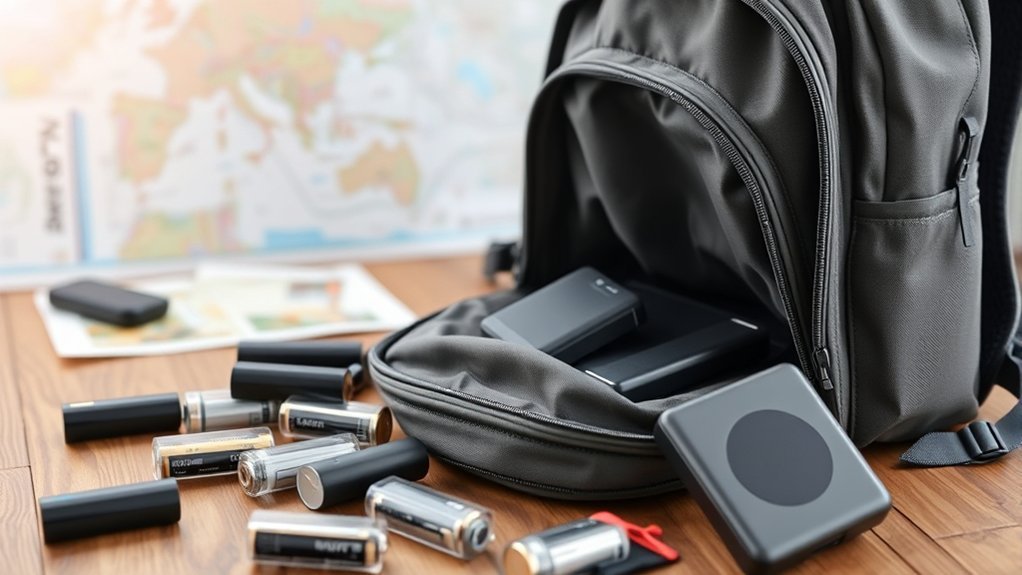
Before packing, decide which devices and spare batteries you will actually use. A short weekend trip may require only a phone, earbuds, and one small power bank. A photography trip may require several camera or drone batteries.
Check whether you will have access to wall outlets, USB ports, or a safe charging location at your destination. Reducing the number of batteries in your backpack makes the bag lighter and lowers the chance of a terminal being damaged or short-circuited.
Keep all batteries for personal use. Under FAA passenger guidance, ordinary personal-use lithium-ion batteries of 100 Wh or less do not have a fixed numerical limit, but batteries carried for resale or distribution are not covered by that allowance. Airlines and international rules may set stricter limits.
Pro Tip: Put all battery information in one note on your phone before traveling. Record each battery’s brand, watt-hour rating, quantity, and device. This makes airline approval easier if you carry camera, drone, medical, or professional equipment.
Preparing Batteries for Safe Transport

Prepare every battery before placing it in your backpack. The correct method depends on whether the battery is installed in a device, removed from a device, or designed as a power bank.
Identify the Battery Type and Rating
Read the label on the battery or device. Look for the battery chemistry and its watt-hour rating:
- Lithium-ion or Li-ion: Rechargeable batteries used in phones, laptops, tablets, cameras, drones, tools, and power banks.
- Lithium-metal: Usually non-rechargeable batteries used in cameras, watches, flashlights, and small electronics.
- Dry-cell batteries: Common alkaline, nickel-metal hydride, or nickel-cadmium AA, AAA, C, D, 9-volt, and button-cell batteries.
- Nonspillable batteries: Gel-cell or absorbed-electrolyte batteries that have separate packaging and marking rules.
A battery with a missing, damaged, or unreadable rating may be refused because airline staff cannot verify whether it meets the size limit. Bring the manufacturer’s specification sheet when the rating is not easy to see.
Calculate Battery Watt-Hours
Use the battery’s printed watt-hour value whenever one is provided. When only voltage and capacity are shown, use one of these formulas:
- Wh = volts × amp-hours
- Wh = volts × milliamp-hours ÷ 1,000
For example, a battery marked 3.7 V and 20,000 mAh is approximately 74 Wh: 3.7 × 20,000 ÷ 1,000 = 74. The manufacturer’s official rating still controls because power-bank marketing capacity and internal-cell voltage can differ from the output rating.
Battery Packaging Techniques
- Inspect each battery. Do not pack one that is swollen, crushed, punctured, leaking, unusually hot, corroded, smoking, or recalled.
- Protect exposed terminals. Leave the battery in its retail packaging, cover the terminals with nonmetallic tape, or place it in a fitted battery sleeve.
- Separate each spare. Use individual plastic bags, protective pouches, or case compartments so terminals cannot touch coins, keys, cables, tools, or another battery.
- Prevent physical damage. Place batteries where they will not be bent, crushed, or pierced by other items.
- Keep lithium spares in the cabin. Power banks, portable chargers, charging cases, and removed lithium batteries must not go in checked baggage.
- Keep them accessible. Do not bury a power bank beneath the entire contents of your backpack.
- Check the airline. Ask for approval before travel when a lithium-ion battery is over 100 Wh.
Warning: Do not board with a lithium battery or battery-powered device that is damaged, recalled, expanding, smoking, or likely to create sparks or dangerous heat. A protective case does not make a defective battery safe for air travel.
Airline Regulations Overview
| Battery or Device | Carry-On | Checked Bag | Main Rule |
|---|---|---|---|
| Lithium-ion battery installed in a device, 100 Wh or less | Yes; preferred | Generally yes under U.S. rules | A checked device must be completely off and protected from damage and accidental activation. |
| Spare lithium-ion battery, 100 Wh or less | Yes | No | Protect each battery from short circuits and damage. Airline quantity limits may apply. |
| Lithium-ion battery, 101–160 Wh | Possible with airline approval | Spare batteries: No | No more than two spare batteries per person under FAA rules. |
| Ordinary lithium-ion battery over 160 Wh | Generally no | Generally no | Usually must be transported as regulated cargo. Mobility-aid exceptions are separate. |
| Power bank or portable charger | Yes | No | Treated as a spare battery. Verify current airline quantity, use, and storage restrictions. |
| Lithium-metal battery, up to 2 g lithium | Yes | Installed batteries may be allowed; spares are not | Protect spare terminals and carry them in the cabin. |
| Alkaline, NiMH, or NiCad dry cells | Yes | Yes | Protect the batteries from damage and prevent the terminals from touching metal. |
This table summarizes common U.S. passenger rules. International regulations and airline policies may be stricter, so always verify the operating carrier’s current instructions for every leg of the trip.
Packing Guidelines for Electronic Devices

Phones, laptops, tablets, cameras, gaming systems, watches, and similar devices should be carried in your backpack when possible. Keeping them in the cabin makes it easier to spot and report overheating, expansion, smoke, or fire.
Under FAA guidance for portable electronic devices, a device with an installed lithium battery may generally be placed in checked baggage when all applicable limits are met. The device must be completely switched off—not in sleep or hibernation mode—and protected from accidental activation and physical damage.
Do not place a loose battery, power bank, portable charger, or charging case in checked baggage. These items are treated as spare batteries even when they are intended to recharge another device.
What to Do if Your Carry-On Is Gate-Checked
Airline staff may ask you to check a backpack at the gate because cabin space is limited. Before handing over the bag:
- Remove all power banks, portable chargers, and spare lithium batteries.
- Remove electronic cigarettes or vaping devices if they are legal and permitted on the route.
- Keep the removed items with you in the aircraft cabin.
- Ask whether laptops, cameras, and other lithium-powered devices must also be removed under the airline’s policy.
A carry-on bag does not remain a carry-on once airline staff send it to the cargo hold. Remove every spare lithium battery and power bank before surrendering the bag.
Understanding Airline Regulations
The FAA sets U.S. hazardous-material limits, TSA controls security screening, and airlines may apply stricter operating rules. International flights may also be subject to rules from the departure country, arrival country, and connecting country.
Lithium-Ion Size Limits
- 100 Wh or less: Normally allowed for personal use without airline approval. Spare batteries must stay in carry-on baggage.
- 101–160 Wh: Airline approval is required. FAA rules allow no more than two spare batteries in this range per passenger.
- Over 160 Wh: Generally prohibited in ordinary passenger baggage and handled as regulated cargo.
Do not apply the 300 Wh mobility-aid limit to an ordinary power bank, drone battery, camera battery, laptop battery, or portable power station. Wheelchairs and mobility aids have separate provisions and normally require advance arrangements with the airline.
Current Power-Bank Guidance
Power banks must be carried in hand baggage. The IATA 2026 passenger guidance recommends a maximum of two lithium-ion power banks, each no more than 100 Wh. It also recommends that passengers:
- Do not recharge a power bank from an aircraft power supply.
- Do not store a power bank in an overhead locker.
- Do not use it to power another device during taxi, takeoff, or landing.
- Follow any stricter airline restriction on onboard use or storage.
Note: FAA rules and IATA guidance do not always use identical quantity limits. The airline operating your flight can impose the stricter rule, so its published baggage policy is the final check before travel.
Special Battery-Powered Items
- Cameras and drones: Installed batteries may travel in the device, but all spare lithium batteries must be protected and kept in carry-on baggage. Batteries over 100 Wh require approval.
- Smart luggage: A checked smart bag generally needs a removable battery. The removed battery must remain in the cabin. Very small tracking batteries may qualify for a separate exception.
- Electronic cigarettes and vapes: When legal and accepted by the airline, these are carry-on only, must be protected from accidental activation, and must not be recharged aboard the aircraft.
- Portable power stations and battery generators: Many exceed 160 Wh and are prohibited in passenger baggage.
- Medical devices and mobility aids: Exceptions may apply, but the passenger should contact the airline well before departure and provide the battery type, rating, and installation details.
Organizing Your Carry-On for Security Checks
Place electronics and protected batteries in an easy-to-reach section of your backpack. At many standard U.S. checkpoints, TSA asks passengers to remove personal electronics larger than a cell phone and place them in a bin. Procedures can differ at checkpoints with newer scanners and for eligible expedited-screening passengers.
Follow the officer’s instructions rather than assuming every battery must go in a separate bin. Spare batteries normally can stay inside their protective case unless an officer requests additional screening.
- Keep large electronics near the top of the backpack.
- Use one battery pouch instead of scattering batteries through several pockets.
- Keep cables separate so metal connectors cannot touch battery terminals.
- Do not place keys, loose coins, tools, or metal jewelry in the battery pouch.
- Keep airline approval documentation with any 101–160 Wh battery.
Pro Tip: Photograph the battery label before packing. A clear photo of the Wh rating, model number, and certification markings can help when the label is difficult to read without removing the battery from its case.
Monitoring Device Condition During Travel
Check your devices when you reach the airport and again before boarding. Warning signs include swelling, unusual heat, hissing, popping, smoke, a sharp chemical odor, leakage, a cracked case, or unexpected shutdowns while charging.
Do not pack a battery immediately after heavy use or fast charging while it is still warm. Allow it to cool in an open, supervised location. Never cover a charging device with clothing, bedding, or other insulating material.
Keep power banks and frequently used devices accessible rather than buried in the overhead locker. Follow the airline’s instructions on charging and onboard use. Some carriers prohibit power-bank use or require passengers to keep power banks where they can be seen and reached.
If a device becomes hot, expands, smokes, or burns during a flight, notify the cabin crew immediately. Do not attempt to hide the device, place it in a closed bag, carry it to another part of the cabin, or handle leaking material unless a crew member directs you to do so.
Emergency Protocols for Device Issues
Before Boarding
Do not take a questionable battery through security or onto the aircraft. If you notice heat, swelling, damage, smoke, leakage, or a recall notice while at the airport, move away from fumes and alert airline or airport staff. Do not place the battery in ordinary airport trash.
During the Flight
- Tell a flight attendant immediately.
- Disconnect external power only if it is safe and the crew instructs you to do so.
- Do not touch leaking material with bare skin.
- Do not cover, crush, puncture, or place a smoking device inside baggage.
- Follow the crew’s directions and keep the surrounding area clear.
Cabin crews are trained to respond to lithium-battery events. A quick report gives them the best chance to cool the device, prevent spread, and monitor it for renewed heating.
After Landing
Do not reuse or recharge a battery involved in an overheating, impact, swelling, or leakage event. Follow the manufacturer’s instructions and local household-hazardous-waste or battery-recycling rules. Damaged lithium batteries often require special handling and should not be mailed or placed in curbside recycling.
Staying Informed About Safety Standards
Battery policies can change after safety incidents, regulatory updates, or airline risk reviews. Complete this final check before every flight:
| Check | What to Confirm |
|---|---|
| Battery label | Chemistry, Wh rating, voltage, capacity, and model number are visible. |
| Battery condition | No swelling, leakage, cracks, corrosion, unusual heat, smoke, or recall notice. |
| Terminal protection | Each spare is in original packaging, an individual bag, a sleeve, or a fitted case. |
| Bag location | Spare lithium batteries and power banks are in carry-on baggage and remain accessible. |
| Airline approval | Written approval is secured for any applicable 101–160 Wh battery. |
| Power-bank policy | Quantity, onboard-use, charging, and storage restrictions are confirmed. |
| Gate-check plan | The battery pouch can be removed quickly if the backpack is sent to the cargo hold. |
Check the operating airline rather than relying only on the company that sold the ticket. A codeshare itinerary may be operated by a different carrier with different battery rules.
Sources
- Federal Aviation Administration — Airline Passengers and Batteries — U.S. battery size limits, quantity rules, watt-hour calculations, and baggage placement.
- Federal Aviation Administration — Portable Electronic Devices Containing Batteries — Carry-on preference, checked-device precautions, gate-check rules, and damaged-battery restrictions.
- Federal Aviation Administration — Batteries — Dry-cell and nonspillable battery packaging requirements.
- Transportation Security Administration — Security Screening — U.S. checkpoint screening guidance for larger electronic devices.
- International Air Transport Association — Safe Travel With Lithium Batteries — International passenger guidance and airline-specific policy reminders.
- Pipeline and Hazardous Materials Safety Administration — Damaged, Defective, or Recalled Lithium Batteries — Risks associated with compromised lithium batteries.
Frequently Asked Questions
Can I bring lithium batteries in my checked luggage?
Spare or removed lithium batteries, power banks, and portable chargers cannot go in checked baggage. A lithium battery installed in a device may be accepted in checked baggage under U.S. rules when the device is completely switched off, protected from accidental activation, protected from damage, and within the applicable size limit. Carry-on storage is still preferred, and an airline may impose stricter rules.
What types of batteries are prohibited on flights?
Ordinary lithium-ion batteries over 160 Wh are generally prohibited in passenger baggage. Batteries that are swollen, leaking, smoking, badly damaged, defective, or recalled and likely to produce sparks or dangerous heat also must not be carried. Spare lithium batteries are prohibited in checked baggage but may be allowed in carry-on baggage when they meet the size limits and are individually protected.
How many spare batteries can I pack?
FAA guidance does not set a fixed limit for personal-use lithium-ion batteries of 100 Wh or less, although an airline may impose its own quantity limit. For spare lithium-ion batteries from 101–160 Wh, airline approval is required and no more than two are allowed per passenger. IATA’s revised 2026 guidance recommends a maximum of two power banks of 100 Wh or less, so check the operating airline before travel.
Are battery-powered devices allowed in checked baggage?
Many devices with batteries installed may be checked under U.S. rules, but they must be completely switched off and protected against accidental activation and physical damage. Spare lithium batteries, power banks, portable chargers, and electronic cigarettes must remain in carry-on baggage. International carriers may require all lithium-powered devices to stay in the cabin.
What should I do if a battery leaks?
Do not touch the leaked material with bare skin or attempt a generic cleanup during a flight. Move away from fumes and tell airport staff or the cabin crew immediately. Do not board with the battery or place it in ordinary trash. On the ground, follow the battery manufacturer’s instructions and local hazardous-waste or battery-recycling requirements.
How do I calculate a battery’s watt-hour rating?
Multiply volts by amp-hours: Wh = V × Ah. When capacity is shown in milliamp-hours, use Wh = V × mAh ÷ 1,000. For example, a 3.7 V, 20,000 mAh battery is about 74 Wh. Use the manufacturer’s printed Wh rating when available because it is the value airline staff are most likely to verify.
Can I use or charge a power bank during the flight?
The answer depends on the airline. IATA’s 2026 guidance recommends that power banks not be recharged from aircraft power and not be used to power another device during taxi, takeoff, or landing. Some airlines prohibit power-bank use for the entire flight or require the unit to remain visible and accessible.
Do I need to tape every battery terminal?
Not when the battery is already protected by unopened retail packaging or a fitted case that prevents the terminals from touching metal. Taping exposed terminals with nonmetallic tape is one accepted option. Each spare should still be separated from coins, keys, tools, cables, jewelry, and other batteries.
Conclusion
To pack batteries in a carry-on backpack safely, identify each battery, check its watt-hour rating, inspect it for damage, and protect every exposed terminal. Keep spare lithium batteries and power banks in the cabin, remove them before a gate check, and secure airline approval for batteries from 101–160 Wh. A final carrier-policy check prevents most airport surprises.
