

Last Updated on July 26, 2026 by Daniel Globe
Hotels and motels both provide short-term lodging, but they were traditionally designed for different kinds of trips. Hotels usually place guest rooms along interior hallways and may offer more shared facilities and services. Motels developed around automobile travel and commonly provide simple rooms with easy access from an outdoor parking area. Today, however, the line between the two can be surprisingly blurry.
Quick Answer
The main difference between a hotel and a motel is usually the layout and level of service. Hotels commonly have interior hallways, lobbies, and a wider range of amenities. Motels were designed for motorists, so rooms often open directly to an outdoor walkway or parking area and services tend to be simpler.
Key Takeaways
- Hotels usually have rooms reached through interior corridors, while traditional motels often have exterior room entrances close to parking.
- Hotels may offer restaurants, gyms, meeting rooms, concierge service, and other facilities, but many limited-service hotels are quite simple.
- Motels are commonly found near highways and major roads because they developed around automobile travel.
- Motels often cost less because they may have fewer shared facilities and services, but a motel is not automatically cheaper than every hotel.
- The names are not perfect quality ratings. Location, cleanliness, reviews, accessibility, parking, total price, and amenities matter more than the word on the sign.
Hotel vs. Motel: Main Differences at a Glance
| Feature | Hotel | Motel |
| Room access | Usually through a lobby and interior hallway | Traditionally from an outdoor walkway or parking area |
| Typical location | Cities, airports, resorts, business districts, tourist areas, and suburbs | Highways, major roads, small towns, suburbs, and road-trip routes |
| Amenities | Ranges from basic to extensive | Usually focused on essential lodging needs |
| Parking | May be in a surface lot, garage, or valet area and may cost extra | Often close to guest rooms and commonly included |
| Typical trip | Business trips, vacations, events, resorts, and longer stays | Road trips, overnight stops, and simple short stays |
| Price | Ranges from economy to luxury | Often budget-oriented, but rates vary by property and demand |
Note: Hotel and motel are useful descriptive terms, not universal quality grades. In U.S. industry data, the Census Bureau and Bureau of Labor Statistics classify non-casino hotels and motels together within the same traveler-accommodation industry. Individual properties can therefore blur the traditional distinctions.
Definition and Characteristics of a Hotel
A hotel is a lodging establishment that rents guest rooms for short stays. Hotels vary enormously. An economy hotel may provide little more than a room, front desk, Wi-Fi, and breakfast, while a full-service or luxury hotel can operate restaurants, bars, spas, pools, conference facilities, and extensive guest services.
The U.S. Bureau of Labor Statistics describes the accommodation sector as including properties that provide lodging alone as well as properties that also offer meals, laundry, recreational facilities, and other services. This is important because no single amenity list defines every hotel.
Comprehensive Amenities
Full-service hotels may offer room service, restaurants, fitness centers, swimming pools, business facilities, meeting rooms, laundry service, and concierge assistance. Limited-service hotels may offer only a few of these features.
For travelers, the important question is not simply whether a property calls itself a hotel, but which amenities are included in the rate. Parking, breakfast, Wi-Fi, late checkout, pools, airport shuttles, and resort facilities can vary widely.
Comfort Levels Range From Basic to Luxury
Some hotels are designed around luxury, with premium bedding, upscale furnishings, spas, fine dining, and large suites. Others compete mainly on price and convenience. A property being called a hotel does not automatically mean it is luxurious.
Full-Service and Limited-Service Hotels
Many full-service hotels employ specialized staff for areas such as food service, events, housekeeping, bell service, and guest assistance. Smaller and limited-service hotels may operate with far fewer services. Travelers who value on-site help should check the specific property’s facilities and front-desk hours before booking.
Definition and Characteristics of a Motel

A motel is a lodging property traditionally designed around automobile travel. The word combines “motor” and “hotel.” Merriam-Webster defines a motel as lodging with parking where rooms are usually accessible from an outdoor parking area.
That direct access is one of the most recognizable differences between a traditional motel and a traditional hotel. Instead of entering a large lobby and walking through interior corridors, motel guests may be able to park near their room and enter from an exterior walkway.
Motels generally emphasize practical lodging rather than extensive shared facilities. Common features can include a bed, private bathroom, television, Wi-Fi, parking, basic toiletries, vending machines, and sometimes breakfast or a swimming pool.
However, exterior room entrances are not an absolute rule. Some properties with “motel” in their name have interior corridors, while some resorts and older hotels use exterior walkways.
The easiest traditional distinction is the path from your car to your room: hotels commonly use interior corridors, while motels were built to make room access convenient for motorists.
Differences in Size and Amenities
Hotels can range from small boutique properties to large resorts with hundreds or even thousands of rooms. Motels are often lower-rise and more compact, but there is no universal room-count cutoff that turns a property into a hotel or motel.
The more useful distinction is the service model. A large full-service hotel may have multiple restaurants, meeting facilities, room service, a gym, a pool, and concierge service. A motel may focus on the essentials needed for a comfortable overnight stop.
There are plenty of exceptions. Some small hotels offer almost no shared facilities, while renovated or boutique motels may have pools, stylish restaurants, bars, landscaped courtyards, and upgraded rooms.
Pro Tip: Compare the actual amenity list instead of assuming a “hotel” includes more. A lower-priced hotel without free parking or breakfast can cost more overall than a motel that includes both.
Location and Accessibility
Location has traditionally been another major difference. Hotels are common in city centers, resort areas, business districts, near airports, and around tourist attractions. These locations can make it easier to walk to restaurants, reach public transportation, or attend meetings and events.
Motels became closely associated with highways and automobile routes. Roadside sites made it easy for drivers to pull in, park, sleep, and continue their journey the next morning.
That pattern still exists, but it is not a rule. Motels can be found inside cities, and hotels are common at highway exits and in suburban commercial areas.
Accessibility for Travelers With Disabilities
Travelers who need an accessible room should compare specific features rather than choosing by property type. In the United States, hotels, motels, inns, and similar lodging businesses can fall under the Americans with Disabilities Act’s rules for places of lodging. The U.S. Department of Justice ADA guidance also addresses how accessible guest-room features are described during reservations.
Useful details to confirm include accessible parking, step-free routes, elevators, roll-in showers or accessible tubs, bed configuration, door clearance, and whether the room’s specific accessibility features meet your needs.
Target Audience and Pricing

Products Worth Considering

Parking pass tags set includes five eye-catching colors: orange, red, blue, green, and yellow. Each tag is 7.75 x 4.25 Inch, with 100 tags of each color, totaling 500 tags. Each color tag is equipped with a unique numerical code from 001 to 100. It can be distinguished by vehicle type, parking area, visitor identity, etc., using both color and code, making registration and traceability clear at a glance, completely eliminating the management chaos of traditional single tags.

Premium Aluminum Quality – Crafted from high-grade, rust-free aluminum to deliver a strong, professional-looking sign that resists wear, maintains its shape, and provides long-lasting performance you can rely on.
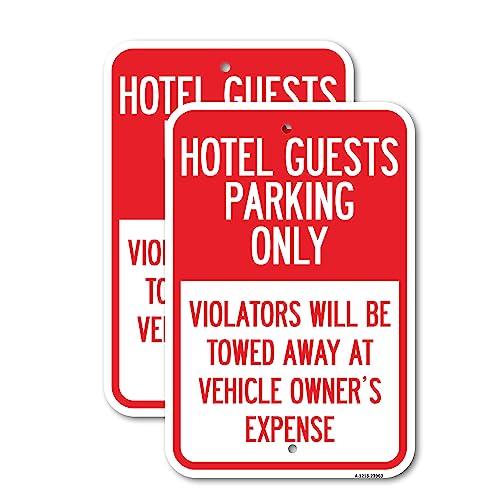
SIZE & SPECS: (2 Pack) 12" X 18" .063 Heavy-Gauge Aluminum
Hotels Serve Many Types of Travelers
Hotels serve business travelers, vacationers, families, couples, groups, conference attendees, airline passengers, and long-stay guests. Prices range from economy rooms to high-end suites, so the word “hotel” says very little about the nightly rate by itself.
Motels Often Focus on Convenience and Value
Motels have traditionally appealed to motorists, road-trippers, workers traveling by vehicle, and people who simply need a convenient place to sleep for a night or two. Their simpler facilities can help keep operating costs and room rates lower.
Are Motels Always Cheaper Than Hotels?
No. Motels are often positioned as budget lodging, but actual rates depend on location, season, local events, demand, property quality, and the room type. A popular motel in a vacation destination can cost more than an economy hotel nearby.
Compare the total price, not just the advertised room rate. Parking charges, resort fees, breakfast, pet fees, and other extras can change which property is the better value.
Services and Facilities Offered
Full-service hotels may provide a 24-hour front desk, restaurants, bars, room service, housekeeping, concierge assistance, meeting spaces, laundry service, fitness facilities, and recreational areas. Large properties may also run loyalty programs and business centers.
Motels generally focus on essential lodging services such as parking, housekeeping, Wi-Fi, and a front desk. Some also include breakfast, pools, guest laundry, vending machines, or small common areas.
The difference has narrowed as hotel brands have introduced limited-service properties and older motels have been renovated into more upscale accommodations. For that reason, booking decisions should be based on the individual property’s services rather than its label alone.
Products Worth Considering

EASY INSTALLATION-This reception desk has a simple structure and can be easily installed by following the instructions and completing a few simple steps. Even one person can easily handle it.

【MODERN RECEPTION DESK】Welcome your visitors with this stunning reception table! A class black-looking accent with a unique circular texture gives this receptionist desk a modern and chic look that is sure to make an impression. Start your workday stylish and professionally at our counter desk.

Privacy & Cable Management:43.3" high wrap-around side panels shield your monitors from view, with a desktop cable grommet to keep cords organized
Parking and Room Access
Parking is especially important for road travelers. At a traditional motel, parking is often arranged directly outside or close to guest rooms. That can make unloading luggage, children’s gear, or other items faster.
Hotels may use a surface lot, parking garage, off-site facility, or valet service. Downtown hotels sometimes charge separately for parking, while suburban properties may include it.
Note: Direct exterior access can be convenient, but travelers should still evaluate lighting, door and window locks, recent guest reviews, front-desk coverage, and the general condition of the property. Neither the word “hotel” nor “motel” guarantees a particular level of safety.
Typical Length and Purpose of a Stay
Motels were designed largely around short automobile stops, so one-night stays remain a natural fit. A traveler driving across several states may prefer being able to park near the room, sleep, and get back on the road quickly.
Hotels are often better equipped for stays where guests expect to spend more time on the property or need services such as restaurants, meeting rooms, gyms, business facilities, or housekeeping over several nights.
These are tendencies rather than restrictions. You can stay in a motel for several nights or use a hotel for a quick overnight stop.
Historical Evolution of Hotels and Motels
Travel lodging existed long before modern hotels. Inns, taverns, guest houses, and other forms of paid accommodation served travelers for centuries. As transportation and cities developed, hotels grew into increasingly specialized businesses offering lodging and additional services.
Motels belong more specifically to the age of the automobile. The word “motel” is recorded from 1925 as a blend of “motor” and “hotel.” Early motor courts and roadside cabins offered motorists places to stop without navigating crowded city centers.
The motel concept expanded strongly as automobile travel grew. The Smithsonian National Museum of American History documents how tourist cabins and roadside accommodations developed before World War II and how motel chains later brought greater consistency to long-distance automobile travel.
The classic parking-oriented design can still be seen in historic motor courts. The National Park Service’s history of the West Winds Motel, for example, describes architectural features closely tied to the period when private automobiles became a common form of transportation.
After World War II, expanding automobile ownership and long-distance highway travel helped roadside motels and chains become a familiar part of American travel. Modern lodging has since evolved again, with economy hotels, limited-service chains, resorts, boutique motels, extended-stay properties, vacation rentals, hostels, and other options competing for travelers.
Hotel vs. Motel vs. Inn
An inn is another type of traveler accommodation, but the name is even less standardized. Inns are often smaller properties that emphasize a cozy or locally distinctive atmosphere. Some are independently operated, located in historic buildings, or include a restaurant.
- Hotel: Usually associated with interior room access and a potentially wider range of services.
- Motel: Traditionally designed around motorists, parking, and convenient exterior room access.
- Inn: Often smaller and more intimate, although facilities and layouts vary widely.
Because these labels overlap, photographs, recent reviews, amenity lists, and booking details often tell you more than the property name.
Cultural and Societal Perceptions
Hotels are often marketed around comfort, service, business convenience, resorts, or luxury. Motels have traditionally been marketed around affordability, roadside convenience, and easy parking.
Those images can create stereotypes that are not always fair. A hotel can be basic and poorly maintained, while a renovated motel can be clean, stylish, and expensive. Historic roadside motels have also become attractions in their own right, especially along classic driving routes.
Instead of assuming one category is automatically better, judge each property on recent guest feedback, cleanliness, location, maintenance, security features, amenities, and total price.
Environmental Impact and Sustainability
Hotels and motels both use energy and water for guest rooms, laundry, heating and cooling, lighting, and property operations. Sustainability therefore depends more on the practices of the individual property than on whether it calls itself a hotel or motel.
Measures can include efficient lighting and HVAC systems, reduced laundry loads, recycling programs, water-efficient bathroom fixtures, leak detection, and better landscaping practices. The U.S. Environmental Protection Agency’s WaterSense H2Otel Challenge provides water-efficiency guidance specifically for the lodging industry.
Travelers interested in sustainability can look for clearly documented environmental programs rather than relying only on vague claims such as “green” or “eco-friendly.”
How to Choose Between a Hotel and a Motel
The better option depends on the trip rather than the label.
Products Worth Considering

Rich in Quantity: this package comes with 1000 pieces key envelopes; The quantity is ample that can meet your daily usage needs; These key card envelopes can avoid the magnetic stripes of the cards from wearing

Size: Tag Length: 9cm / 3.54inch; Width: 4.5cm / 1.77inch; Thickness: 0.4cm / 0.16inch; key ring diameter: 2.6cm / 1.02inch; Total length: 11.8cm / 4.65inch.
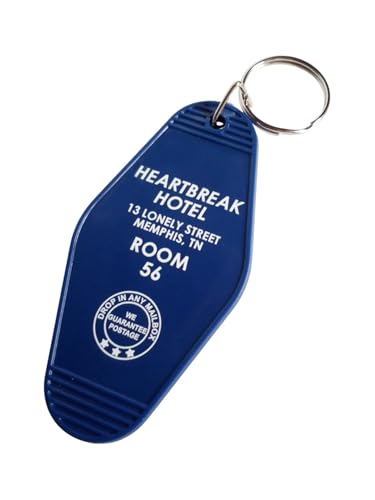
Authentic Vintage Design: Retro motel key tag style measuring 3.5" x 1.5", featuring a 1" metal key ring; perfect for adding nostalgic charm to keys, bags, or displays.
Choose a Hotel When:
- You want restaurants, a gym, a pool, a lounge, or other on-site facilities.
- You prefer rooms reached through interior hallways.
- You are staying in a downtown area or near a business district, airport, convention center, or resort.
- You need meeting facilities or more extensive guest services.
- You expect to spend several days at the property.
Choose a Motel When:
- You are on a road trip and want quick access from your vehicle to your room.
- You mainly need a clean place to sleep rather than extensive facilities.
- Free or convenient parking is a high priority.
- A particular motel offers a lower total price for the location you need.
- You prefer a smaller, simpler property.
Check These Details Before Booking Either One
- Total price after taxes and mandatory fees.
- Parking availability and cost.
- Recent cleanliness and maintenance reviews.
- Front-desk hours and check-in rules.
- Breakfast and Wi-Fi inclusions.
- Cancellation policy.
- Pet rules, if applicable.
- Accessible features you need.
- Distance from the places you plan to visit.
- Photos showing the actual building layout and room entrances.
Conclusion and Considerations for Choosing Between a Hotel and Motel
The traditional hotel-vs.-motel difference comes down mainly to design, services, and the kind of travel each property was built to support. Hotels commonly use interior corridors and may provide more shared amenities, while motels developed for motorists and often make parking and direct room access a priority.
Neither option is automatically better. A hotel may make sense for a city vacation, business trip, or amenity-rich stay, while a motel may be ideal for an affordable overnight road-trip stop. Compare the individual property’s location, total cost, cleanliness, amenities, parking, accessibility, and recent reviews before deciding.
If you’re planning a trip and also need easier transportation once you arrive, you can review this guide to the best travel scooter as part of your broader trip planning.
Frequently Asked Questions
What is the difference between a hotel and a motel?
Traditionally, hotels have rooms reached through interior corridors and may offer more shared facilities, while motels were designed for motorists and often have rooms reached directly from an outdoor parking area. Modern properties can blur this distinction.
What amenities can be found in a hotel?
Depending on the property, a hotel may offer restaurants, bars, pools, fitness centers, meeting rooms, room service, concierge assistance, laundry service, breakfast, parking, and business facilities. Limited-service hotels may offer far fewer amenities.
What amenities can be found in a motel?
Motels commonly provide essential lodging amenities such as a private room, bathroom, parking, television, Wi-Fi, and basic toiletries. Some also have breakfast, swimming pools, guest laundry, vending machines, or other facilities.
What is the typical size of a hotel?
There is no standard hotel size. Hotels range from small boutique properties with relatively few rooms to large convention hotels and resorts with hundreds or more. Size alone does not determine whether a lodging property is a hotel.
What is the typical size of a motel?
Motels are often smaller and lower-rise than large hotels, but there is no universal room-count limit. The classic motel design emphasizes automobile access and parking more than a specific number of rooms.
Can hotels and motels be found in the same location?
Yes. Hotels and motels commonly operate in the same tourist districts, suburban commercial areas, highway exits, and other destinations. Their locations increasingly overlap, particularly where travelers have a wide range of budgets and needs.
Are motels always cheaper than hotels?
No. Motels are often budget-oriented because they may provide fewer shared services, but prices depend on demand, location, season, property quality, and local events. Compare the total cost of specific properties rather than assuming a motel will always be cheaper.
Are hotels safer than motels?
Not automatically. Interior access, exterior access, staffing, locks, lighting, cameras, maintenance, and the surrounding area all vary by property. Check recent reviews and the property’s actual security features instead of treating “hotel” or “motel” as a safety rating.
Sources
- U.S. Bureau of Labor Statistics — Accommodation: NAICS 721 — lodging-industry scope and variation in services.
- Merriam-Webster — Motel Definition & Meaning — motel definition, outdoor parking access, and the motor + hotel word origin.
- Smithsonian National Museum of American History — Roadside Communities — development of roadside lodging and postwar motel chains.
- National Park Service — West Winds Motel — historic motor-court architecture and automobile-oriented motel development.
- U.S. Department of Justice — ADA Title III Regulations — accessibility rules affecting hotels, motels, inns, and other places of lodging.
- U.S. Environmental Protection Agency — WaterSense H2Otel Challenge — water-efficiency practices for lodging properties.
