
Last Updated on September 11, 2026 by Daniel Globe
Airplane seat pitch is a useful starting point when you want more room, but it does not tell the whole comfort story. The number measures spacing between rows—not the exact space available for your knees. Before booking, compare the operating airline, aircraft configuration, seat width, recline, and row-specific restrictions as well as pitch.
Quick Answer
Seat pitch is the distance from one point on an airplane seat to the same point on the seat in the next row. More pitch usually means more room, but seat shape, width, recline, bulkheads, and under-seat equipment can change how spacious a seat actually feels.
Key Takeaways
- Seat pitch measures row spacing; it is not a direct measurement of knee clearance or total personal space.
- A difference of two or three inches can be noticeable, especially for taller travelers and on longer flights.
- Check the operating carrier and exact aircraft configuration instead of relying on an airline-wide average.
- Exit-row and bulkhead seats can provide more room, but they also come with safety rules and practical tradeoffs.
- Airline layouts change, so verify the seat map again before check-in.
What Seat Pitch Means
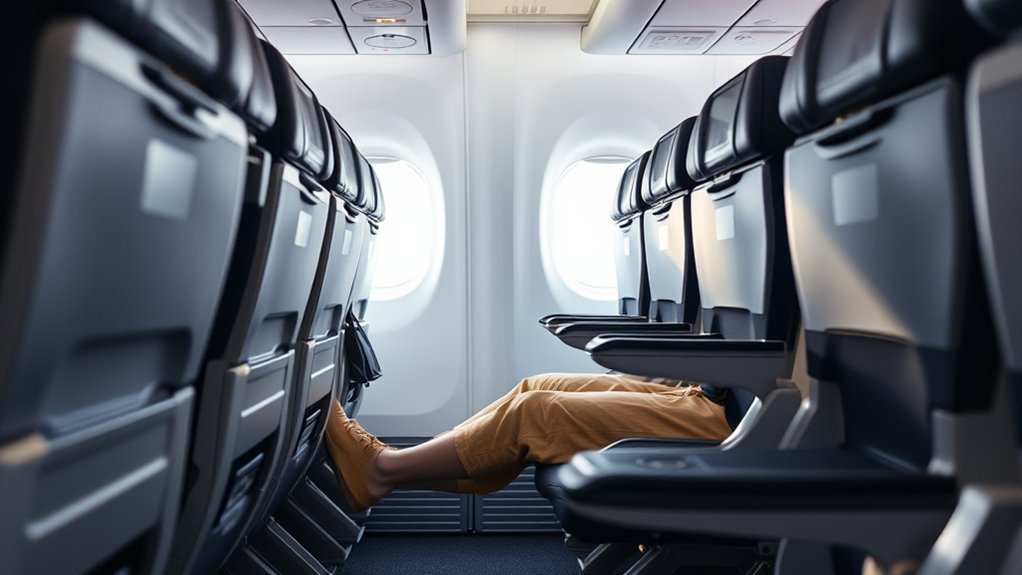
The Federal Aviation Administration defines seat pitch as the distance from a point on one seat to the same point on the seat directly in front of or behind it. The airline industry commonly measures it from one seatback to the next.
Seat pitch is therefore a measure of row spacing. It does not directly measure the open space between your knees and the seat in front. A slim seatback can leave more usable knee room than a thick seatback at the same pitch.
Seat Pitch vs. Legroom and Seat Width
Several measurements and design choices work together to determine comfort:
- Seat pitch: The repeated distance between rows.
- Usable legroom: The space available for your knees, shins, and feet after the seat structure is installed.
- Seat width: The side-to-side space between or inside the armrests.
- Seat cushion depth: The amount of support underneath your thighs.
- Recline: How far the seatback can move—or whether it is fixed or pre-reclined.
- Under-seat space: Foot room that may be reduced by entertainment boxes, support bars, or stored equipment.
A larger pitch can help, but the roomiest-looking number does not always produce the most comfortable seat.
How Seat Pitch Affects Comfort
More pitch generally gives your knees more clearance and makes it easier to change position. It may also make it less disruptive when the passenger in front reclines. The benefit becomes more noticeable for tall travelers and during flights where you remain seated for several hours.
A tighter layout can limit knee movement and make it harder to reach a bag under the seat. However, two seats with the same published pitch may still feel different because of the seatback shape, cushion angle, tray-table design, and location of support bars.
Note: There is no universal comfort grade that makes one pitch “good” for every traveler. Your height, leg length, mobility, seat design, and flight duration all matter.
What Is a Good Airplane Seat Pitch?
The following ranges can help you compare economy seats, but they are practical shopping guidelines rather than legal or industry-wide comfort standards:
- Below 30 inches: Often feels compact, especially for taller passengers.
- 30 to 32 inches: A common economy range that may be adequate for many travelers.
- 33 to 34 inches: Generally roomier than a typical tightly configured economy row.
- 35 inches or more: Often associated with an extra-legroom product, premium economy cabin, or special row.
Do not compare the number alone. A 31-inch seat with a slim back and open footwell may feel better than a nominally larger seat with a thick shell, fixed armrests, or an equipment box beneath it.
Current Airline Seat-Pitch Examples
Airline layouts change too often for a permanent “best seat pitch” ranking. The most reliable approach is to use current airline pages as examples and then verify the exact flight you plan to book.
- JetBlue: The airline currently advertises up to 38 inches of legroom in its paid EvenMore product. Its official seating page separates Core, preferred, extra-legroom, EvenMore, and Mint seats, so the selected product matters.
- Finnair: Finnair’s official fleet specifications list a minimum pitch of 29 inches for economy and 31 inches for business on the Airbus A319. Its long-haul Premium Economy seats are listed separately at 38 inches on applicable aircraft.
- WestJet: WestJet’s Boeing 737-800 aircraft page currently lists 30 inches for standard economy. Other rows and aircraft configurations may differ.
Older online comparison lists may still include airlines that have closed or cabin layouts that were replaced years ago. Treat an undated airline ranking as a starting point, not as proof of what will be installed on your flight.
How to Compare Seat Pitch Before Booking
- Identify the operating carrier. A flight may be sold under one airline’s code but operated by another airline. Google explains the distinction between the marketing and operating carrier in its flight-booking guidance.
- Note the aircraft model. Look for details such as Airbus A320, Airbus A321neo, Boeing 737-800, or Boeing 787-9.
- Check the exact configuration. One airline may operate several layouts of the same aircraft. JetBlue, for example, distinguishes between Classic and Restyled A320 configurations.
- Open the operating airline’s seat map. Check row labels, seat products, exit locations, limited-recline rows, and bulkheads.
- Compare more than pitch. Review seat width, recline, fixed armrests, under-seat space, proximity to lavatories, and passenger comments about the specific row.
- Check again before departure. Airlines may substitute another aircraft or cabin configuration for operational reasons.
Pro Tip: Save a screenshot of the aircraft type and seat map when you select your seat. Check the reservation again when online check-in opens so you can spot an aircraft swap or changed seat assignment.
SeatGuru was once widely used for this task, but it is no longer a dependable source for current layouts. Start with the airline’s own aircraft and seat-selection pages, then use a recently updated third-party diagram only as a secondary reference.
How to Find More Legroom Without Upgrading
You may be able to improve your space without buying a higher cabin, but free extra-legroom seats are not guaranteed. Compare standard economy layouts first, then examine row-specific benefits and restrictions.
| Option | What to Verify |
| JetBlue | EvenMore advertises up to 38 inches of legroom, but it is generally a paid seat product. Check whether a standard Core seat meets your needs before paying. |
| Finnair | Pitch varies by aircraft and cabin. The A319 currently lists 29 inches in economy, while extra-legroom exit-row seats are sold separately. |
| Exit row | Often provides extra space, but eligibility rules apply. Check recline, fixed armrests, window alignment, and whether a seat-selection fee is charged. |
| Bulkhead | There is no reclining seat directly ahead, but a wall or bassinet position may limit how far you can stretch your feet. Floor storage may be unavailable during takeoff and landing. |
| Off-peak flight | A lighter load may leave an adjacent seat empty, but it does not guarantee a free exit row, bulkhead, or premium seat. |
An aisle seat can make it easier to stand and stretch, but it normally has the same pitch as other seats in its row. Selecting a seat near the front may speed up deplaning, but it does not automatically provide more legroom.
Frequent-flyer benefits can help when you have qualifying elite status or a fare that includes preferred seating. Simply joining a loyalty program does not usually guarantee a complimentary extra-legroom seat or upgrade.
Warning: Do not choose an exit-row seat only for the added space unless you are willing and physically able to assist in an emergency. The FAA advises passengers who cannot perform the required actions to request another seat.
When Seat Pitch Is Not Enough
Travelers with long legs, broad shoulders, limited mobility, or a need for a movable aisle armrest should look beyond the headline pitch number.
- Tall travelers: Check seatback shape, foot space, tray-table position, and whether the row ahead reclines.
- Travelers needing easier aisle access: Confirm whether the aisle armrest lifts and whether the seat is close to a suitable lavatory.
- Travelers using a seat-belt extender: Check airline rules before selecting an exit row; some airlines prohibit extenders in those rows.
- Travelers with medical or mobility needs: Contact the operating airline before travel rather than relying on a generic seat-map label.
Frequently Asked Questions
What does airplane seat pitch measure?
Seat pitch measures the distance from a point on one seat to the same point on the seat in the next row. It describes row spacing, not the exact open space between your knees and the seatback.
Is seat pitch the same as legroom?
No. Pitch is a seat-to-seat measurement. Usable legroom is affected by seatback thickness, cushion shape, support bars, entertainment equipment, recline, and the space available for your feet.
What is a good seat pitch on an airplane?
There is no universal cutoff. As a practical economy comparison, 30 to 32 inches is common, 33 to 34 inches is generally roomier, and 35 inches or more is often associated with an extra-legroom or premium product. Seat design and your body size still matter.
Do exit-row seats always have more legroom?
Many exit rows provide extra space, but not every exit-row seat is equally comfortable. Some have fixed armrests, limited recline, a missing window, or a seat-selection fee. Passengers must also meet the airline’s emergency-assistance requirements.
Does a bulkhead seat have more legroom?
Sometimes. A bulkhead seat has no passenger seat directly ahead, but a solid wall may stop you from extending your feet. Tray tables may be stored in fixed armrests, and carry-on bags usually must go overhead during takeoff and landing.
Why can my aircraft or seat change after booking?
Airlines may substitute aircraft because of maintenance, scheduling, weather, or operational needs. The replacement aircraft may have a different seat map, so review your reservation again when check-in opens.
What is the 3-to-1 rule for pilots?
The 3-to-1 rule is an initial descent-planning guideline: allow about 3 nautical miles for every 1,000 feet of altitude to lose. Pilots must still follow air-traffic-control clearances, published restrictions, aircraft procedures, and stabilized-approach requirements.
Why do some flight attendants appear to sit on their hands?
Flight attendants use a protective brace position during takeoff and landing. The exact hand and body position depends on the jump seat’s direction and restraint system. FAA guidance may place the hands in the lap or against the sides of the seat rather than requiring every flight attendant to sit on them.
Why do some pilots leave airline jobs?
Reasons vary by person and career stage. They may include irregular schedules, commuting, training costs, seniority progression, family needs, health, retirement, or a move to another aviation role. It is inaccurate to attribute every departure to one industry-wide cause.
Conclusion
Seat pitch is one of the first numbers to check when comparing airplane seats, but it should not be the last. Confirm the operating carrier, exact aircraft configuration, seat width, recline, and row-specific tradeoffs before paying for a seat. A few minutes of verification can prevent a cramped surprise and help you choose the space that best fits your body and trip.
Sources
- Federal Aviation Administration — General Statements — Defines airplane seat pitch and explains the FAA’s seat-spacing safety review.
- Federal Aviation Administration — Flying Safe — Explains passenger responsibilities in emergency-exit rows.
- JetBlue — Seats — Lists current JetBlue seat products, aircraft widths, recline limitations, and EvenMore legroom.
- Finnair — Fleet and Seat Dimensions — Provides current seat-pitch figures by aircraft and travel class.
- WestJet — Boeing 737-800 Next Generation — Provides current seating information for WestJet’s 737-800 configuration.
- Google Travel Help — Flight and Booking Options — Explains marketing carriers, operating carriers, and codeshare flight details.
