
Last Updated on July 29, 2026 by Daniel Globe
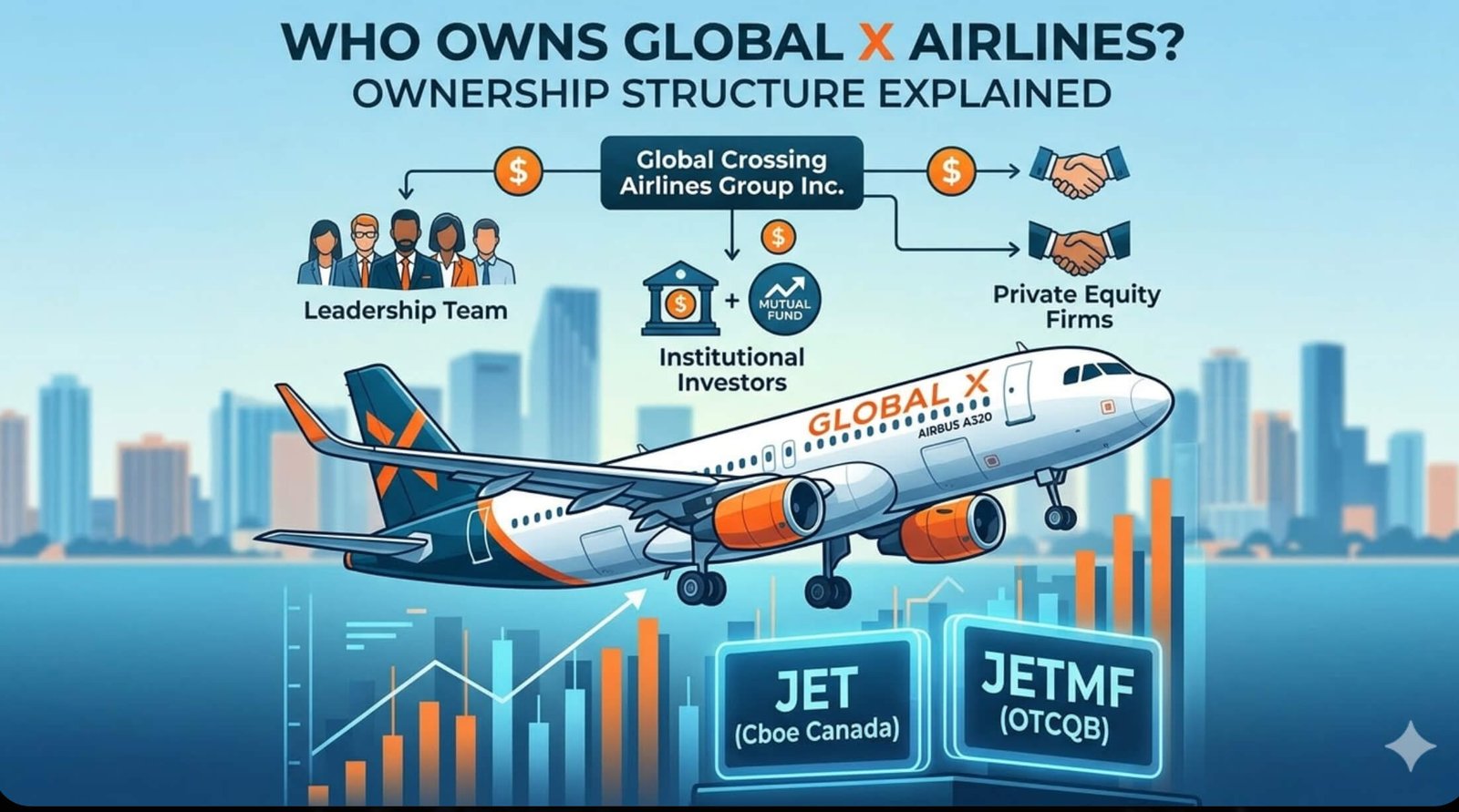
Global X Airlines is a Miami-based charter carrier that flies under the GlobalX brand. Unlike a scheduled carrier built around a traditional airline hub, it mainly provides ACMI, wet-lease, and ad-hoc charter operations. Its ownership is publicly traceable, but the legal chain between its shareholders, parent company, and operating airline is easy to misunderstand.
Quick Answer
Global X Airlines, commonly branded GlobalX, is not owned by one person or by the U.S. government. The operating airline, Global Crossing Airlines, Inc., is wholly owned through a holding-company chain by publicly traded Global Crossing Airlines Group Inc. Public investors, insiders, and several disclosed beneficial owners hold the parent company’s shares.
Key Takeaways
- Global Crossing Airlines Group Inc. is the publicly traded parent at the top of the GlobalX ownership chain.
- The parent owns 100% of Global Crossing Airlines Holdings, Inc., which owns 100% of the operating airline, Global Crossing Airlines, Inc.
- No disclosed shareholder owns more than 50% of the voting common stock, so GlobalX is not owned outright by one individual or investment firm.
- The parent has voting common stock as well as Class A and Class B non-voting shares, so not every shareholder has the same voting rights.
- GlobalX has performed ICE-related flights as a subcontractor under contracts awarded to CSI Aviation; this work does not amount to government ownership.
- Ownership percentages can change through trading, warrants, conversions, employee awards, and new share issues, so each figure must be read with its filing date.
What’s in This Article
- Ownership Structure of Global X Airlines
- Major Shareholders
- Share Classes and Minority Shareholders
- Government Ownership and Influence
- GlobalX’s Government Charter Work
- How Ownership Shapes GlobalX’s Operations
- What Future Ownership Changes Could Mean
- Why Ownership Structure Matters
- How to Verify Current Ownership
- Frequently Asked Questions
Disclosure: As an Amazon Associate I earn from qualifying purchases. Some links on this page are affiliate links, at no extra cost to you.
Ownership Structure of Global X Airlines
The simplest answer is that Global Crossing Airlines Group Inc. is the public company at the top of the ownership structure. However, the operating airline sits two levels below that parent.
| Entity | Ownership | Role |
| Global Crossing Airlines Group Inc. | Owned by public shareholders | Public parent and reporting company |
| Global Crossing Airlines Holdings, Inc. | 100% owned by Global Crossing Airlines Group Inc. | Intermediate holding company |
| Global Crossing Airlines, Inc. | 100% owned by Global Crossing Airlines Holdings, Inc. | U.S. Part 121 charter airline operating under the GlobalX brand |
The parent company’s securities are quoted on Cboe Canada under JET and JET.B. Its voting common shares are also quoted in the United States on the OTCQB market under JETMF. The company identifies all three symbols in its May 2026 financial-results release.
Note: OTCQB is an over-the-counter market rather than a national securities exchange such as Nasdaq or the New York Stock Exchange. Buying JETMF gives an investor an interest in the public parent, not direct title to a particular aircraft or flight operation.
The parent completed its acquisition of all outstanding shares of Global Crossing Airlines, Inc. during 2020. The company’s annual report says flight operations began in August 2021. This documented timeline is more precise than describing the current airline simply as a company founded by one person in a particular year.
Major Shareholders of Global X Airlines
No shareholder listed in the latest annual beneficial-ownership table held more than 50% of the voting common stock. GlobalX therefore does not have one disclosed majority owner. Instead, ownership is divided among investment firms, current or former company leaders, other individual holders, and public-market investors.
The table below combines the parent company’s amended 2025 annual report with a newer April 10, 2026 Schedule 13D/A. Percentages use the denominator and SEC beneficial-ownership method stated in each filing, so they should not be added together as though every row came from the same day.
| Disclosed beneficial owner | Reported interest | Reported percentage | Source date |
| Red Oak Partners, LLC | 9,244,147 voting common shares, plus 4,435,333 Class A non-voting shares and warrants subject to ownership limits | 17.97% of voting common in the annual table | Ownership table based on February 16, 2026 |
| Andrew Axelrod / Axar Capital | Warrants to purchase 5,195,451 voting common shares, counted as beneficial ownership under the filing’s SEC methodology | 10.10% | Ownership table based on February 16, 2026 |
| Edward J. Wegel | 4,432,276 voting common shares, including shares held by his spouse, plus 11,900 Class B non-voting shares | 8.62% of voting common | Ownership table based on February 16, 2026 |
| Galloway Capital Partners, LLC and affiliates | 5,372,000 voting common shares | 8.10% | Schedule 13D/A dated April 10, 2026 |
| Ronald T. Bevans, Jr. | 2,960,715 voting common shares | 5.76% | Ownership table based on February 16, 2026 |
The annual table also listed LyonIX Aviation, LLC, associated with Executive Chairman Chris Jamroz, with 2,060,520 voting shares and 1,101,980 Class A non-voting shares. President and Chief Financial Officer Ryan Goepel was listed with beneficial ownership of 1,969,724 voting common shares, including restricted stock units eligible to settle within the filing’s 60-day window.
Note: “Beneficial ownership” is an SEC reporting concept. It can include shares a person controls as well as options or warrants exercisable within 60 days. It does not always mean that every listed share has already been issued and held as ordinary voting stock.
Share Classes and Minority Shareholders
“Minority shareholder” is a general description for someone who owns less than a controlling interest. It is not a separate GlobalX security class, and the company’s filings do not support an estimate that minority holders collectively own exactly 25%.
As of May 1, 2026, the parent reported 66,820,278 shares outstanding across three classes:
| Share class | Shares outstanding | Voting status |
| Common Stock | 52,193,858 | Voting common stock |
| Class A Non-Voting Common Stock | 5,537,313 | Non-voting; conversion is subject to ownership limits |
| Class B Non-Voting Common Stock | 9,089,107 | Non-voting; may convert subject to the company’s terms and U.S. airline-ownership limits |
As of May 1, 2026, about 52.2 million of the parent’s 66.8 million outstanding shares were voting common stock; approximately 14.6 million were Class A or Class B non-voting shares.
The three classes share equally in dividend rights and liquidation preferences according to the Q1 2026 filing. Their main differences concern voting and conversion rights. This means a smaller voting shareholder may participate in elections and other shareholder votes, while a holder of non-voting shares normally cannot vote those shares unless they are properly converted.
Minority investors can still influence the company collectively by voting, filing shareholder proposals when eligible, communicating with management, or buying and selling shares. However, it is inaccurate to say that every minority holder has voting rights equal to every major beneficial owner.
Government Ownership and Influence
Global X Airlines has no disclosed federal, state, or foreign-government owner. Its parent is publicly owned, and its latest beneficial-ownership disclosures list private investment entities, individuals, executives, directors, and other shareholders—not a government agency.
Government oversight is different from ownership. As a U.S. Part 121 carrier, GlobalX operates within federal aviation rules and certificate requirements. Regulation affects safety procedures, maintenance, crew qualifications, international authority, and other parts of air travel, but it does not give the regulator an equity stake in the airline.
Government contracts are also different from government ownership. A private airline can receive public money for specific transportation services without becoming a government-owned company. This distinction is important when comparing GlobalX with questions about whether U.S. airlines are government funded.
GlobalX’s Government Charter Work
A high-profile part of GlobalX’s charter activity has involved flights connected to U.S. Immigration and Customs Enforcement. ICE says its Air Operations division uses charter aircraft, commercial airlines, and ground transportation for domestic transfers and international removals.
The contract chain needs careful wording. Federal award data identifies CSI Aviation as the prime contractor for an ICE task order covering scheduled large-aircraft and high-risk charter services. GlobalX has operated flights as a subcontractor under CSI Aviation’s contracts rather than appearing as the prime recipient on that award. Readers can review the official USAspending award record.
A May 28, 2025 House Committee on Homeland Security letter described GlobalX as a CSI Aviation subcontractor and said it had operated 74% of ICE removal flights during the preceding year. That is a dated oversight-letter figure, not proof that GlobalX operates the same percentage today.
The same letter cited reported flight-attendant safety concerns and requested records from CSI Aviation. Because it was an oversight request rather than a final court or agency finding, its allegations should be identified as reported concerns rather than established conclusions.
The parent company’s annual report disclosed that one unnamed customer generated about 50% of consolidated revenue in 2025. The filing labels that account only as “Customer A.” It does not identify the customer, so the 50% figure should not automatically be assigned to ICE, CSI Aviation, or any other organization.
Warning: GlobalX disclosed that it discovered unauthorized activity in its computer networks on May 5, 2025. Its SEC filing says the incident did not disrupt operations or have a material effect on the company. That filing does not state that ICE passenger manifests were exposed, so it should not be cited as proof of that broader claim.
How Ownership Shapes GlobalX’s Day-to-Day Operations
Public ownership affects GlobalX mainly through access to capital, board oversight, shareholder voting, disclosure duties, and pressure to produce sustainable financial results. It does not mean shareholders personally select each flight, route, or customer.
Management decides how to deploy aircraft within customer contracts, regulatory authority, crew availability, maintenance needs, and expected returns. Larger voting shareholders can have more influence in director elections and other corporate votes, while the board supervises management and major strategic decisions.
Latest Financial and Fleet Snapshot
GlobalX ended 2025 with 16 passenger aircraft and four cargo aircraft. Its annual report said management expected to reach 21 passenger aircraft while retaining four cargo aircraft by the end of 2026. That figure is a company plan, not a guaranteed final fleet count.
For fiscal 2025, the company reported approximately $8 million in operating income—its first positive annual operating result—but still recorded a net loss of about $2.6 million. It also disclosed a $60.5 million working-capital deficit and substantial doubt about its ability to continue as a going concern without enough income or additional financing.
The newer quarter ended March 31, 2026 showed improvement:
- Revenue: $76.6 million, up from $66.6 million a year earlier.
- Operating income: $6.1 million, compared with $3.1 million.
- Net income attributable to the company: $2.7 million, compared with approximately $154,000.
- Operating cash flow: Approximately $9 million, compared with about $100,000 in the prior-year quarter.
These results show why a balanced ownership analysis should consider both growth and financing risk. Fleet expansion requires deposits, leases, maintenance spending, working capital, and sometimes new debt or equity.
What Future Ownership Changes Could Mean for GlobalX
GlobalX’s ownership can change without the airline being sold. Ordinary trading, employee share awards, warrant exercises, conversions of non-voting shares, private placements, and public offerings can all change the number of shares and each holder’s percentage.
New equity can provide money for aircraft, maintenance, hiring, and working capital. It can also dilute existing shareholders by reducing the percentage represented by each previously outstanding share. The annual report specifically warns that warrant exercises and conversion of Class A non-voting shares may dilute current owners.
Large shareholders may also seek changes in governance, capital allocation, management, or strategy. For example, Galloway Capital’s April 2026 Schedule 13D/A said it intended to engage the board and management on performance, governance, capital allocation, and strategy. That filing documents active shareholder engagement, but it does not transfer control of the airline to Galloway.
A merger, strategic partnership, or sale could alter ownership more dramatically. However, such transactions should be treated as possibilities unless the company announces a signed agreement. General speculation about airline consolidation is not evidence that GlobalX currently plans to merge or sell itself.
Note: Share counts and ownership percentages in this article are dated snapshots, not investment recommendations. They may change after new SEC filings, conversions, warrant exercises, or stock transactions.
Why Ownership Structure Matters in Aviation
Ownership helps explain who elects directors, who can influence major corporate decisions, and where an airline may obtain expansion capital. It also reveals whether control is concentrated in one owner or divided among several investors.
For GlobalX, the most important points are that the operating airline is wholly owned within a public-company structure, no disclosed holder owns a voting majority, and some outstanding shares are non-voting. That combination gives the parent access to public capital while spreading economic interests and voting power across different holders.
Ownership should not be confused with three separate issues:
- Regulation: Federal agencies oversee airline safety and operating authority but do not thereby own the airline.
- Contracting: Government-funded charter work produces revenue but does not create a government equity stake.
- Aircraft title: An airline may lease, finance, or own individual aircraft regardless of who owns the airline company.
How to Verify Current GlobalX Ownership
Ownership can change quickly, especially for a smaller public company. Use this process to check the newest information:
- Start with the latest Form 10-K or 10-K/A. Item 12 normally contains the annual beneficial-ownership table and footnotes explaining warrants, restricted units, and non-voting shares.
- Check the latest Form 10-Q. The cover page and share-capital note provide newer outstanding-share counts.
- Search for Schedules 13D, 13D/A, 13G, and 13G/A. These filings can reveal changes by holders that cross applicable reporting thresholds.
- Compare the reporting dates. A newer filing may supersede one holder’s row without updating every other shareholder’s position.
- Read the footnotes. A beneficial-ownership total may include warrants, options, restricted units, shares held by related entities, or securities that cannot yet be converted because of ownership caps.
Pro Tip: Use the company’s official investor-relations page to locate recent reports, then confirm ownership figures in the underlying SEC document rather than relying only on a finance-site summary.
Frequently Asked Questions
Who owns Global X Airlines?
Global Crossing Airlines, Inc., the operating airline behind GlobalX, is 100% owned by Global Crossing Airlines Holdings, Inc. That holding company is 100% owned by publicly traded Global Crossing Airlines Group Inc., whose shares are divided among public investors and disclosed beneficial owners.
Is Global X Airlines privately owned or publicly traded?
The operating airline is a privately held subsidiary, but its ultimate parent, Global Crossing Airlines Group Inc., is publicly traded. Investors obtain an interest in the parent rather than buying shares issued directly by the airline subsidiary.
Who is the largest disclosed GlobalX shareholder?
In the annual beneficial-ownership table based on February 16, 2026, Red Oak Partners held 9,244,147 voting common shares, or 17.97%, plus Class A non-voting shares and warrants subject to ownership limits. No holder in that table owned a voting majority.
Does Ed Wegel own Global X Airlines?
Edward J. Wegel was listed as a significant shareholder, not the sole owner. The annual table attributed 4,432,276 voting common shares to him, including shares held by his spouse, equal to 8.62% under that filing’s methodology, plus 11,900 Class B non-voting shares.
Does Chris Jamroz own GlobalX?
Chris Jamroz is GlobalX’s Executive Chairman and has a disclosed interest through LyonIX Aviation, LLC. The annual table listed LyonIX with 2,060,520 voting shares and 1,101,980 Class A non-voting shares. That is a meaningful interest but not outright ownership of the airline.
Does the U.S. government own Global X Airlines?
No government owner appears in the company’s corporate chain or current beneficial-ownership disclosures. Federal regulation and government-paid charter work do not give the government an equity stake.
Does GlobalX’s ICE work make it a government airline?
No. GlobalX has operated ICE-related flights as a subcontractor under contracts awarded to CSI Aviation. Providing a paid service to a federal agency does not make the airline government owned.
Do all GlobalX shareholders have the same voting rights?
No. The parent has voting common stock and two non-voting classes. Class A and Class B non-voting shares share certain economic rights with common stock but differ in voting and conversion rights.
What are the JET, JET.B, and JETMF ticker symbols?
JET and JET.B are Cboe Canada symbols used for securities of Global Crossing Airlines Group Inc. JETMF is the U.S. OTCQB symbol for the parent company’s voting common stock. They refer to interests in the public parent, not separate airlines.
Sources
- Global Crossing Airlines Group Inc. amended 2025 Form 10-K — corporate structure, beneficial owners, fleet, customer concentration, liquidity, cybersecurity, and share terms
- Global Crossing Airlines Group Inc. Q1 2026 Form 10-Q — latest quarterly results and May 2026 outstanding-share count
- Galloway Capital Partners Schedule 13D/A — 5,372,000-share position reported April 10, 2026
- GlobalX Investor Relations — official company overview, reports, filings, and investor presentation
- ICE Air Operations Factsheet — official description of ICE charter, commercial-flight, and ground-transport operations
- House Committee on Homeland Security letter to CSI Aviation — subcontracting description, dated 74% flight figure, and oversight questions
