
Last Updated on September 10, 2026 by Daniel Globe
Knowing how to talk about hiking in Spanish can make a trail day much easier, whether you are asking for directions in Spain, looking for a refuge in Patagonia, or arranging a hike in the Andes. The most useful general term is senderismo, but everyday wording changes from one Spanish-speaking region to another. Learning a few trail, safety, and emergency phrases can help you communicate much more confidently.
Quick Answer
The standard Spanish word for hiking is senderismo. To say “to go hiking,” use hacer senderismo. You may also hear ir de caminata, ir de excursión, or trekking, depending on the country and the type of trip. “Senderismo” is pronounced roughly sehn-deh-REES-moh.
Key Takeaways
- Senderismo is the most useful general Spanish translation of “hiking,” while hacer senderismo means “to go hiking.”
- Regional alternatives include ir de caminata, ir de excursión, and, in some countries, the borrowed word trekking.
- Useful trail words include sendero (trail), inicio del sendero (trailhead), cima (summit), refugio (shelter/refuge), and agua potable (drinking water).
- Learn emergency phrases such as Necesito ayuda (I need help) and Estoy perdido/perdida (I am lost).
- Check official trail conditions, weather, local emergency numbers, altitude risks, and park rules before starting a hike.
Disclosure: As an Amazon Associate I earn from qualifying purchases. Some links on this page are affiliate links, at no extra cost to you.
How to Say “Hiking” in Spanish
The most widely useful word for hiking is senderismo. FundéuRAE recommends senderismo as the Spanish alternative to the English word hiking. A natural way to say “I like hiking” is Me gusta el senderismo, while “We are going hiking” can be Vamos a hacer senderismo. You can read the language guidance from FundéuRAE.
| English | Spanish |
| Hiking | El senderismo |
| To go hiking | Hacer senderismo / ir de caminata |
| Hiker | Senderista / excursionista |
| Hiking trail | Sendero / ruta de senderismo |
| Hiking boots | Botas de senderismo / botas de montaña |
Note: Spanish varies by region. Senderismo is widely understood, but it is not always the word locals use most often. FundéuRAE specifically notes that the term can carry a different association in Peru, where expressions such as ir de caminata or the locally common trekking may sound more natural.
Basic Spanish Vocabulary for Hiking
A small vocabulary list can cover most conversations at a trailhead, visitor center, campsite, or mountain refuge. Start with words for terrain, directions, equipment, water, and weather.
| English | Spanish | Useful Example |
| Trail | Sendero / camino | ¿Dónde está el sendero? |
| Trailhead | Inicio del sendero / punto de partida | ¿Dónde está el inicio del sendero? |
| Mountain | Montaña | La ruta sube la montaña. |
| Summit | Cima | ¿Cuánto falta para la cima? |
| Viewpoint | Mirador | ¿Está lejos el mirador? |
| Shelter / mountain refuge | Refugio | ¿Hay un refugio cerca? |
| Junction | Cruce | Gire a la izquierda en el cruce. |
| Detour | Desvío | Hay un desvío más adelante. |
| Backpack | Mochila | Llevo agua en la mochila. |
| Hiking boots | Botas de senderismo / botas de montaña | Necesito botas de montaña. |
| Map | Mapa | ¿Tiene un mapa del sendero? |
| Compass | Brújula | Tengo una brújula. |
| Flashlight | Linterna | Necesito una linterna. |
| Headlamp | Linterna frontal | Traigo una linterna frontal. |
| Drinking water | Agua potable | ¿Hay agua potable? |
| Rain | Lluvia | Se espera lluvia esta tarde. |
| Sun | Sol | Hay mucho sol hoy. |
Essential Phrases for Hiking in Spanish
You do not need fluent Spanish to ask the questions that matter most on a hike. Short, clear sentences are often enough.
Asking About the Trail
- ¿Dónde está el sendero? — Where is the trail?
- ¿Dónde está el inicio del sendero? — Where is the trailhead?
- ¿Este es el sendero a la cima? — Is this the trail to the summit?
- ¿Está abierto el sendero? — Is the trail open?
- ¿Cuánto falta para la cima? — How much farther is it to the summit?
- ¿Cuánto tiempo se tarda en llegar? — How long does it take to get there?
- ¿Hay algún tramo peligroso? — Are there any dangerous sections?
- ¿Hay un refugio cerca? — Is there a shelter/refuge nearby?
- ¿Hay agua potable cerca? — Is there drinking water nearby?
Emergency and Injury Phrases
- Necesito ayuda. — I need help.
- Estoy perdido. / Estoy perdida. — I am lost.
- No puedo caminar. — I cannot walk.
- Me he torcido el tobillo. — I have twisted my ankle.
- Estoy herido. / Estoy herida. — I am injured.
- Mi amigo está herido. / Mi amiga está herida. — My friend is injured.
- Llame a emergencias, por favor. — Call emergency services, please.
- ¿Hay cobertura de móvil aquí? — Is there mobile phone coverage here?
- ¿Dónde está el centro médico más cercano? — Where is the nearest medical center?
Pro Tip: Save a few emergency phrases and the local emergency number as a screenshot before leaving. That way, you can still read them when mobile data or trail coverage is unavailable.
Senderismo, Caminata, Excursionismo, or Trekking?
There is no single expression that sounds equally natural in every Spanish-speaking country. These four terms overlap, but they are not always used in exactly the same way.
Senderismo
Senderismo is the safest general translation for recreational hiking on trails. Hacer senderismo means “to hike” or “to go hiking.” FundéuRAE describes it as the preferred Spanish term for recreational walks along countryside trails.
Caminata
Caminata means a walk or hike and is common in everyday speech in many parts of Latin America. Ir de caminata may sound more conversational than hacer senderismo in some regions.
Excursión and Excursionismo
Excursión refers broadly to an outing or excursion. Excursionismo, which the Real Academia Española defines as the activity of taking excursions, can include hiking but is somewhat broader and more formal than senderismo.
Trekking
The English loanword trekking is widely understood in outdoor tourism and is especially common in some Latin American destinations. Usage varies: one person may use it for any mountain hike, while another may reserve it for longer or more demanding routes. When speaking with local guides, use the word they use for the activity.
Note: Do not worry about finding one “perfect” regional expression. Phrases such as ¿Dónde está el sendero?, Quiero hacer esta ruta, or Vamos de caminata make your meaning clear even where local vocabulary differs.
Reading Trail Signs in Spanish
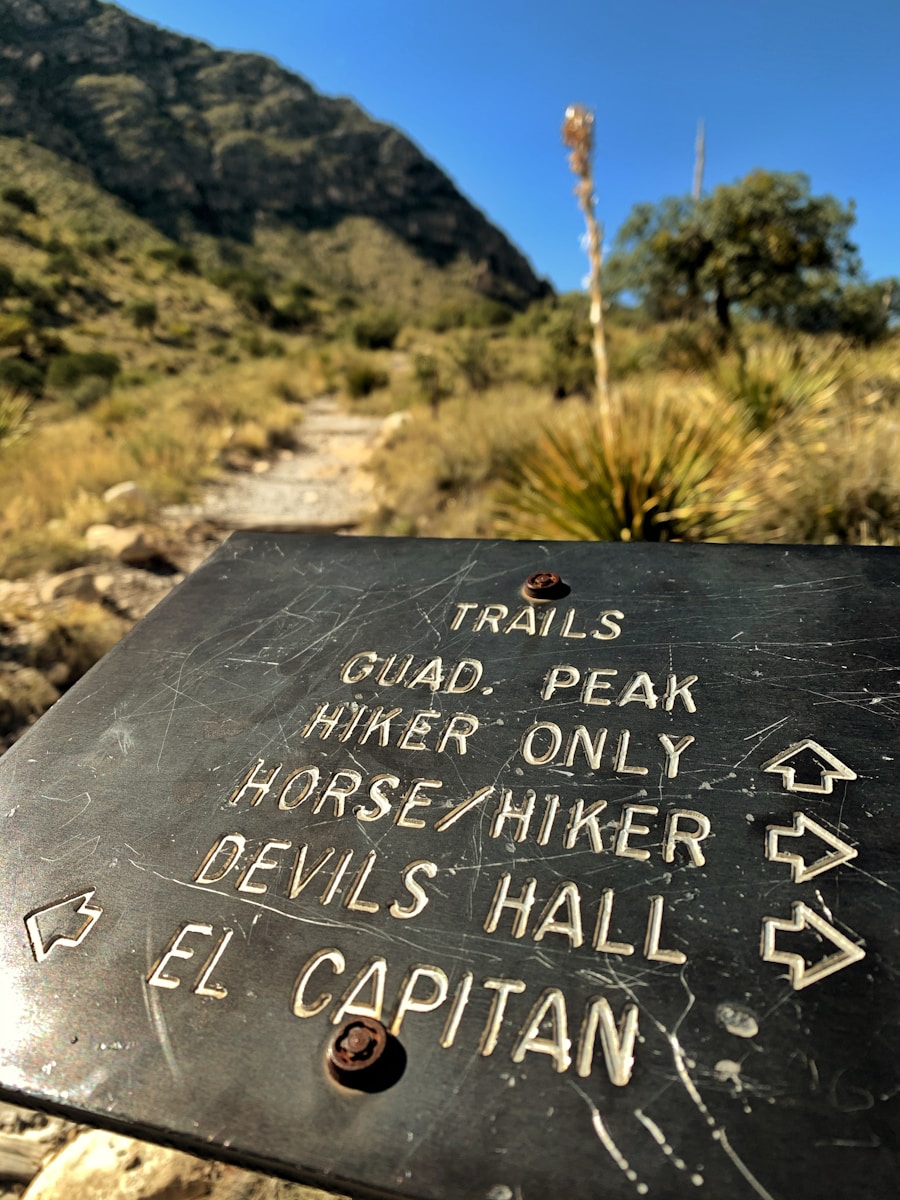
Trail signs often use short words rather than complete sentences. Recognizing the following terms can help you understand closures and directions quickly.
| Spanish Sign | Meaning |
| Sendero cerrado | Trail closed |
| Prohibido el paso | No entry / passage prohibited |
| Desvío | Detour |
| Precaución | Caution |
| Peligro | Danger |
| Agua potable | Drinking water |
| Agua no potable | Water not safe for drinking |
| Refugio | Shelter / mountain refuge |
| Mirador | Viewpoint |
| Salida | Exit |
Safety Tips for Hiking in Spanish-Speaking Countries
Safety starts with local information. Check the official park or protected-area website, current weather, trail closures, transportation rules, elevation, and expected daylight before leaving. The U.S. National Park Service’s Ten Essentials provides a useful general framework: navigation, sun protection, insulation, illumination, first aid, fire where permitted, repair tools, food, hydration, and emergency shelter.
Tell someone where you are going, the route you expect to follow, and when you plan to return. A useful sentence is Voy a hacer senderismo por esta ruta y espero volver a las seis — “I am hiking this route and expect to return at six.”
| Country | Common Planning Concerns | Practical Safety Approach |
| Spain | Summer heat, strong sun, dehydration, steep or rocky terrain, and sudden mountain weather | Carry adequate water and sun protection, check official forecasts and closures, and know that Spain’s general emergency number is 112. |
| Chile | Fast-changing mountain weather, remoteness, wind, snow or ice on some routes, and difficult terrain | Check the specific park or reserve’s rules, carry navigation and weather protection, and follow local wildlife guidance rather than relying on generic advice. |
| Argentina | Remote trails, rapidly changing Patagonian weather, river crossings, wind, navigation, and seasonal snow | Stay on the approved route, check current trail conditions, carry offline navigation, and turn around when weather or water conditions exceed your experience. |
Warning: Conditions can differ dramatically between parks in the same country. Official park closures, ranger instructions, fire restrictions, weather alerts, and local emergency guidance always take priority over general hiking advice.
High-Altitude Hiking
Some popular Spanish-speaking destinations are at elevations high enough for altitude illness to matter. The CDC Yellow Book lists places such as Cusco, Peru, at roughly 3,350 meters (11,000 feet) and recommends gradual acclimatization for travelers going to high altitude.
Headache, unusual fatigue, dizziness, nausea, or worsening shortness of breath after a rapid ascent should not simply be dismissed as being “out of shape.” Do not keep climbing when symptoms are becoming worse. Travelers with medical concerns or plans for very high elevations should seek individualized medical advice before the trip.
Water Safety on the Trail
Do not assume a clear-looking mountain stream is safe to drink. The CDC advises treating water when you are unsure whether it is safe; boiling is the most reliable way to kill germs, with appropriate filtration and disinfection as alternatives depending on the situation.
Useful questions include ¿Se puede beber esta agua? (“Can this water be drunk?”) and ¿Dónde puedo llenar mi botella con agua potable? (“Where can I fill my bottle with drinking water?”).
Emergency Numbers
Emergency numbers are not the same in every Spanish-speaking country. Save the official number for your destination before heading into the backcountry. In Spain, the general emergency number is 112 nationwide, according to the Government of Spain. Do not assume that the same number applies everywhere in Latin America.
Cultural Etiquette for Hiking in Spanish-Speaking Countries
Respect for local communities matters as much as knowing the right words. Some routes pass through indigenous territories, privately managed land, farming areas, sacred sites, or protected ecosystems. Do not assume that every visible track is public or that access is automatically permitted.
When in doubt, ask ¿Se puede pasar por aquí? (“Can I pass through here?”) or ¿Necesito permiso para entrar? (“Do I need permission to enter?”). Follow posted rules, gates, ranger instructions, and community guidance.
Environmental care also matters. A natural Spanish expression for “Leave No Trace” is no dejar rastro. Stay on established trails where required, carry out your rubbish, avoid disturbing animals, and leave plants, rocks, archaeological objects, and cultural items where you find them. Leave No Trace provides additional guidance through its Seven Principles.
Pro Tip: A local guide can provide much more than directions. Guides can explain community access rules, regional vocabulary, seasonal hazards, weather patterns, and the cultural meaning of the landscape.
Finding Hiking Trails in Spanish-Speaking Countries
Research and Online Resources
Start with the official website of the national park, reserve, municipality, or tourism authority that manages the area. Search using Spanish terms such as senderos, rutas de senderismo, parque nacional, estado del sendero (trail condition), cierres (closures), and acceso (access).
Hiking forums, mapping apps, social media groups, and user reviews can help you understand recent experiences, but they should not override current information from the land manager. A route description posted months earlier may no longer reflect closures, fires, washed-out bridges, permit requirements, or transportation restrictions.
Local Visitor Centers
Visitor centers are especially useful when conditions are changing. Staff can explain which trails are open, provide maps, clarify permit requirements, and tell you whether water sources, refuges, roads, or transportation services are operating.
Useful questions include ¿Qué senderos están abiertos hoy? (“Which trails are open today?”), ¿Necesito un permiso? (“Do I need a permit?”), and ¿A qué hora debo regresar? (“What time should I return?”).
Enhancing the Hiking Experience
Research can also help you choose a hike that suits your ability instead of simply selecting the most photographed route. Compare distance, elevation change, trail surface, exposure, river crossings, expected weather, daylight, and transportation before committing to a route.
Learning the Spanish names of major landmarks before leaving can make navigation easier because signs, maps, drivers, and local guides may use those names rather than English translations.
Gear and Equipment for Hiking in Spanish-Speaking Countries
The right equipment depends on the trail rather than the country. A short coastal walk may require little more than comfortable footwear, water, sun protection, and navigation, while a high Andean or Patagonian route may require insulation, rain protection, trekking poles, emergency equipment, and more food.
A well-equipped mochila (backpack) may include:
- Agua — water
- Comida or provisiones — food or provisions
- Mapa — map
- Brújula — compass
- Linterna frontal — headlamp
- Botiquín de primeros auxilios — first-aid kit
- Protector solar — sunscreen
- Repelente de insectos — insect repellent
- Chaqueta impermeable — waterproof jacket
- Ropa de abrigo — warm clothing
- Bastones de senderismo — trekking poles
- Cargador portátil or batería externa — portable power bank
A mobile phone is useful, but it should not be your only safety system in remote terrain. Download maps for offline use where possible, conserve battery, and carry the navigation and emergency equipment appropriate for the route.
Practice Conversation on the Trail
Putting several phrases together makes them easier to remember:
Hiker: Buenos días. ¿Dónde está el inicio del sendero a la cima?
Local: Siga este camino y gire a la izquierda en el cruce.
Hiker: Gracias. ¿Cuánto tiempo se tarda en llegar?
Local: Unas tres horas. Hay un tramo empinado después del refugio.
Hiker: ¿Hay agua potable en el camino?
Local: No. Lleve suficiente agua.
Hiker: Perfecto. Muchas gracias por su ayuda.
Translation:
Hiker: Good morning. Where is the trailhead for the summit?
Local: Follow this path and turn left at the junction.
Hiker: Thank you. How long does it take to get there?
Local: About three hours. There is a steep section after the refuge.
Hiker: Is there drinking water along the way?
Local: No. Carry enough water.
Hiker: Perfect. Thank you very much for your help.
Embracing the Outdoors in Spanish
Hiking in a Spanish-speaking country is easier when you know a few words that solve real problems. Senderismo, sendero, agua potable, refugio, and Necesito ayuda are far more useful on the trail than memorizing a long vocabulary list without context.
Language also helps you connect more respectfully with the place you are visiting. Asking before entering land, understanding warning signs, following local conservation rules, and speaking with guides or rangers can turn a simple hike into a safer and more meaningful experience.
You do not need perfect Spanish. Start with hacer senderismo, learn a few questions, and listen to the terms local hikers use. Regional expressions may change, but a clear question and a polite gracias will take you a long way.
If you are preparing for a longer outdoor trip, you can also read our guide to the best sleeping bag for backpacking travel. For additional travel-packing ideas, see our article on travel skirts for women.
Love travel? Join Our Facebook Community
Frequently Asked Questions
What is the translation of “hiking” in Spanish?
The most useful general translation is senderismo. “To go hiking” is commonly expressed as hacer senderismo. You may also hear ir de caminata, ir de excursión, or trekking, depending on the region.
How do you pronounce “senderismo” in Spanish?
It is pronounced approximately sehn-deh-REES-moh, with the stress on ris. The IPA pronunciation is /sendeˈɾismo/.
Are there other Spanish words for “hiking”?
Yes. Caminata, excursión, and excursionismo can overlap with hiking, while the borrowed term trekking is common in some outdoor-tourism contexts. The most natural word depends on the country and the type of route.
Can “hiking” be used as a verb in Spanish?
Spanish normally uses a phrase rather than a single verb. Hacer senderismo means “to hike” or “to go hiking.” You can also say ir de caminata or ir de excursión.
Is “senderismo” used in every Spanish-speaking country?
It is widely understood, but usage varies. FundéuRAE notes that it is not normally used with the same meaning in Peru because of its association with Sendero Luminoso. Local hikers may instead use expressions such as caminata or trekking.
How do I ask where the trailhead is in Spanish?
Say ¿Dónde está el inicio del sendero? You can also ask ¿Dónde empieza el sendero?, which means “Where does the trail start?”
What should I say if I need help while hiking?
The simplest phrase is Necesito ayuda (“I need help”). If you are lost, say Estoy perdido if you are male or Estoy perdida if you are female. For an injury, No puedo caminar means “I cannot walk.”
Sources
- FundéuRAE — “senderismo,” mejor que “hiking” — Spanish terminology and regional usage.
- Real Academia Española — excursionismo — definition and language usage.
- SpanishDictionary — senderismo pronunciation — pronunciation and IPA reference.
- U.S. National Park Service — Ten Essentials — general hiking preparedness and safety.
- CDC Yellow Book — High-Altitude Travel and Altitude Illness and CDC — Water Treatment When Hiking, Camping, or Traveling — altitude and backcountry water safety.
- Government of Spain — Emergency Number 112 — Spain’s nationwide general emergency number.

