

Last Updated on July 29, 2026 by Mason Reed
Yes, you can use polycro as a tent groundsheet, especially when low weight and a small packed size matter. This thin plastic film creates a waterproof barrier between the tent floor and damp or dirty ground. However, it is easier to puncture than Tyvek or a fitted manufacturer footprint, so terrain preparation and correct sizing are essential.
Quick Answer
Polycro works well as an ultralight tent groundsheet on grass, forest soil, sand, and other relatively smooth surfaces. Cut or fold it slightly smaller than the tent floor so rain cannot collect on exposed edges. Clear sharp debris before pitching, secure the sheet in wind, and rely on your sleeping pad—not the film—for insulation.
Key Takeaways
- Intact polycro is waterproof and helps protect a tent floor from moisture, dirt, and light abrasion.
- Many thin, pre-cut polycro sheets weigh about 1.5–1.8 ounces, but weight varies with dimensions and thickness.
- Every edge should remain beneath the tent floor; exposed material can catch runoff and channel water underneath.
- Polycro is best on smooth campsites. Tyvek or a fitted footprint is usually better for sharp gravel, rocky desert ground, pets, and frequent base-camp use.
- A groundsheet is not a substitute for an insulated sleeping pad with an appropriate R-value.
At a Glance
| Time Required | About 10–20 minutes to measure, cut, and test the fit |
| Difficulty | Easy |
| Tools Needed | Tape measure, washable marker, scissors, and optional repair tape |
| Cost | Commonly under $25, depending on size, thickness, brand, and quantity |
Disclosure: As an Amazon Associate I earn from qualifying purchases. Some links on this page are affiliate links, at no extra cost to you.
What Is Polycro?
Polycro, also called polycryo by some retailers and backpackers, is a very thin plastic film. Similar material is used in heat-shrink window-insulation kits. Outdoor brands sell pre-cut versions as ultralight tent footprints, while some campers make their own from suitable window-film sheets.
The material is popular because it is waterproof, inexpensive, easy to cut, and much lighter than most woven footprints. As one current product example, Six Moon Designs lists 0.75-mil polycro sheets weighing 1.5 ounces in its small size and 1.8 ounces in its large size. Those figures are not universal; a wider, longer, or thicker sheet will weigh more.
A footprint is optional rather than mandatory for every trip. Modern tent floors are designed for outdoor use, and careful campers may skip one on smooth grass or sand. A groundsheet becomes more useful when you want to keep the tent cleaner, protect a lightweight floor from abrasion, or place an inflatable sleeping pad inside a floorless shelter.
Benefits of Using Polycro as a Groundsheet
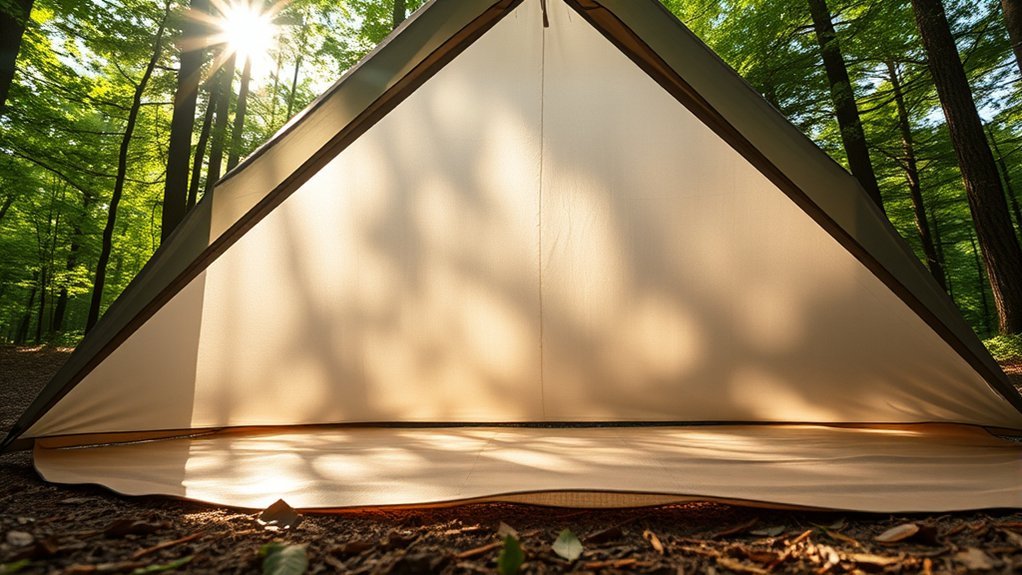
The main advantage of a polycro tent groundsheet is its low weight. Thin pre-cut sheets can weigh less than two ounces and fold into a package small enough to fit in a tent or stake bag. That makes polycro appealing to backpackers who want basic floor protection without carrying a heavier fitted footprint.
Polycro also creates a waterproof barrier between the tent and wet soil. It can keep mud, sap, sand, and damp debris off the tent floor, which makes packing and cleaning easier. A clean groundsheet is usually simpler to wipe down than the bottom of an assembled tent.
Other practical benefits include:
- Low packed bulk: Thin film takes up little room in a backpack.
- Easy customization: It can be cut for tapered, rectangular, or irregular tent floors.
- Fast drying: Water does not soak into the plastic film.
- Low replacement cost: Damaged sheets are generally less expensive to replace than fitted footprints.
- Sleeping-pad protection: In a floorless tarp or shelter, it provides a clean barrier beneath an inflatable pad.
A current 0.75-mil product example weighs 1.5–1.8 ounces, while comparable Tyvek sheets from the same manufacturer weigh 4.5–7 ounces.
Note: Polycro provides little meaningful insulation by itself. Use a sleeping pad with an appropriate tested R-value when protection from cold ground matters.
Limitations and When Polycro Is Not the Best Choice
Polycro is tougher than its thin appearance suggests, but it is not as abrasion-resistant as Tyvek or a fitted fabric footprint. Its performance depends heavily on the campsite surface and how carefully it is handled.
Consider a tougher option when camping on:
- Jagged gravel or crushed rock
- Desert sites with thorns, cactus spines, or sharp stone
- Rough wooden tent platforms with exposed splinters or fasteners
- Ground used repeatedly for a long base-camp stay
- Sites where dogs may scratch or walk across the sheet
- Areas where chairs, cots, or narrow furniture legs will create concentrated pressure
The material is also extremely light. Even a mild breeze can lift it before the tent is placed on top. It may cling to itself, become noisy while being unfolded, or slide on smooth surfaces until the shelter is fully pitched.
Warning: Do not place hot cookware, a stove, a lantern, a heater, or burning material on polycro. It is a thin heat-sensitive film and can shrink, melt, or develop holes near high heat.
Polycro vs. Tyvek and Fitted Tent Footprints
Polycro is not automatically better than Tyvek or a manufacturer-made footprint. The right choice depends on how much weight you are willing to carry, the ground conditions, and how often you camp.
| Feature | Polycro | Tyvek | Fitted Footprint |
| Weight | Usually the lightest | Heavier and bulkier | Varies by tent and fabric |
| Durability | Best on smooth ground; vulnerable to cuts and punctures | Better abrasion and puncture resistance | Usually durable and designed for the tent floor |
| Fit | Must be cut or folded | Must be cut, folded, or purchased pre-sized | Matches the shelter and may connect to its poles or buckles |
| Wind handling | Can blow away very easily | Easier to position | Often includes attachment points |
| Best for | Ultralight trips on prepared or smooth sites | Frequent use and rougher ground | Convenience, exact fit, and fast-fly compatibility |
DuPont describes Tyvek as a fused high-density polyethylene fiber sheet with water resistance, vapor permeability, and substantial tear strength. Those qualities make Tyvek more forgiving on rough ground, although it occupies more pack space than thin polycro.
A fitted footprint usually offers the simplest setup because it follows the tent’s exact shape. Some models also connect to tent poles and allow a fast-fly pitch without the tent body. The disadvantages are higher cost and, in many cases, more weight.
How to Measure and Cut a Polycro Groundsheet

The correct footprint is slightly smaller than the tent floor. No part of the sheet should remain visible after the tent is pitched. An exposed edge can catch rain or condensation and direct it between the footprint and the tent floor.
1. Measure the Actual Tent Floor
Check the manufacturer’s floor dimensions, but confirm them with the tent pitched whenever possible. Published measurements may describe the floor’s widest points and may not show tapered corners.
For a rectangular tent, record the length and width. For a tapered or irregular floor, pitch the tent over the uncut film and lightly trace the shape. Do not cut directly against the tent fabric.
2. Mark an Inset Cutting Line
Move the cutting line about 1–2 inches inward from every floor edge. This produces an overall sheet that is roughly 2–4 inches shorter in length and width than a rectangular floor. The exact reduction is less important than keeping the finished footprint completely underneath the tent.
For example, an 84-by-48-inch rectangular tent floor could use a finished sheet of about 80-by-44 inches. A more sharply tapered tent should be traced and cut to match its actual outline rather than treated as a rectangle.
3. Cut the Film on a Clean Surface
Spread the polycro flat indoors or on a swept surface. Use sharp scissors and make long, smooth cuts. Rounded corners are less likely to catch on vegetation than sharp projecting points.
You do not need to sew or hem the edges. If you want a removable attachment point, reinforce a small area on both sides with compatible repair tape before making a hole. Never drive a stake through unreinforced film.
4. Test the Fit Before the Trip
Pitch the tent over the finished sheet. Walk around the shelter and tuck in any visible material. Check vestibules and tapered corners because these are common places for an oversized sheet to remain exposed.
Warning: Never leave a groundsheet projecting beyond the tent floor. Rain can land on the exposed plastic and become trapped underneath the tent.
How to Use a Polycro Groundsheet at Camp
- Choose a suitable campsite. Use an established, durable surface when available. Avoid depressions, drainage channels, loose scree, thorny vegetation, and places beneath dead branches.
- Inspect the ground. Remove loose sticks, cones, sharp stones, glass, and other objects that could puncture the sheet or tent floor. Do not dig, trench, or strip living vegetation.
- Control the sheet in wind. Keep it folded until you are ready to pitch. Place smooth rocks, shoes, water bottles, or gear bags near the corners while unfolding it.
- Center the tent over the sheet. Confirm that every polycro edge is hidden beneath the tent floor.
- Pitch and tension the tent normally. Once the tent is weighted and staked, remove temporary objects from around the groundsheet.
- Check after heavy rain. If water has reached an exposed edge, tuck the material farther underneath without dragging it across sharp ground.
- Dry it before storage. Shake off debris, wipe away mud, and let both sides dry whenever conditions allow.
Pro Tip: In windy weather, place the rolled tent body on one end of the polycro before unfolding the rest. Move the tent across the sheet as you open it so the film is never completely unsecured.
How Polycro Performs in Wet Conditions
Undamaged polycro film is waterproof, so wet soil should not pass through it. However, the complete tent system can still become wet for several reasons:
- A puncture or tear allows water and mud through the damaged area.
- An exposed edge catches runoff and channels it beneath the tent.
- The tent is pitched in a depression where water pools.
- The tent floor or seams are damaged.
- Condensation forms because humid air contacts a cooler surface.
A groundsheet can separate the tent from wet soil, but it cannot correct poor campsite drainage. Choose a level site that is not the lowest point in the area and avoid reshaping the ground or digging drainage trenches.
Polycro may limit direct contact with damp soil, but it does not prevent airborne condensation. Ventilation, occupant moisture, outside humidity, temperature, and shelter design still affect how much condensation forms. REI’s tent-care guidance notes that moisture can accumulate beneath both floors and rainflies and recommends drying the shelter thoroughly.
Note: Water found between the tent and groundsheet does not necessarily mean the polycro leaked. It may have entered from an exposed edge or formed as condensation on a cool surface.
Maintenance and Care for Polycro
A polycro groundsheet can last from a few outings to many trips. There is no reliable universal number because service life depends on thickness, terrain, campsite preparation, folding, wind exposure, and how much the material slides beneath the tent.
Cleaning and Drying
Shake off loose dirt after each trip. For mud or sap, wipe the film gently with cool or lukewarm water and a soft cloth. A small amount of mild, unscented soap can be used when water alone is not enough.
Rinse away soap residue and dry both sides completely before long-term storage. The plastic itself does not absorb water, but dirt and organic residue left on a damp folded sheet can develop odors or support mildew.
Repairing Small Holes and Tears
Clean and dry the damaged area before applying tape. For a pinhole or short cut, place a smooth patch of compatible clear repair tape over the damage. Applying tape to both sides can reduce stress at the tear.
Trim loose flaps rather than leaving jagged material that can catch while unfolding. A repair is reasonable when the rest of the sheet remains sound, but replacement is usually better when:
- A tear continues to spread beyond the patch
- Several holes are clustered beneath the sleeping area
- The film has become brittle or badly distorted
- The sheet no longer lies flat enough to remain beneath the tent
- Repair tape covers a large portion of the footprint
Storage
Fold or roll the dry sheet without forcing extremely sharp creases. Store it in a cool, dry place away from direct sunlight, rodents, sharp tools, and high heat. Do not leave it near a campfire, in contact with hot equipment, or inside a very hot vehicle for an extended period.
The type of film used in window-insulation kits is designed to shrink when heated. 3M describes its window-insulator film as heat-shrink material, which is another reason to keep a polycro footprint away from heaters, dryers, flames, and hot cookware.
User Experiences and Practical Recommendations

Backpackers generally choose polycro for three reasons: low weight, low bulk, and easy customization. Those benefits are most noticeable on trips where campsites are smooth and the groundsheet is handled carefully.
The most useful field recommendations are:
- Prepare the surface every time. One sharp stone can matter more than the camper’s total body weight.
- Keep it under control in wind. Thin film can blow away before the tent is placed over it.
- Carry a small repair patch. A few inches of compatible tape can keep a minor cut from spreading during a trip.
- Do not count on it for warmth. Choose a sleeping pad based on expected temperatures and an appropriate R-value. Therm-a-Rest explains that sleeping-pad R-values are tested under ASTM F3340.
- Upgrade for rough terrain. The small weight penalty of Tyvek or a fitted footprint may be worthwhile when puncture risk is high.
- Reuse rather than guessing by trip count. Inspect the sheet before each outing and replace it based on condition, not an arbitrary number of uses.
Damaged polycro should be packed out rather than left at a campsite. Reuse sound sections for gear organization or small moisture barriers when practical, and follow local waste or film-recycling rules when disposing of the material.
Frequently Asked Questions
Is polycro waterproof for tent use?
Yes. Intact polycro film is waterproof and works as a barrier between a tent and wet soil. It can still fail as a system if it is punctured, extends outside the tent floor, or is placed where water pools. It also does not repair a worn or leaking tent floor.
Can polycro be reused multiple times?
Yes. A carefully handled sheet can be reused until holes, spreading tears, brittleness, or distortion make it unreliable. There is no standard number of trips because terrain, film thickness, movement, and campsite preparation vary widely.
How does polycro perform in heavy rain?
The film blocks water when it is intact, correctly sized, and placed on a draining campsite. Heavy rain becomes a problem when runoff reaches an exposed edge, water pools beneath the shelter, or the sheet has a hole. Keep every edge underneath the tent floor.
What weight can polycro support without tearing?
There is no useful universal person-weight rating. The ground supports the camper, not the film. Damage is more likely to result from concentrated pressure against a sharp object, sliding abrasion, chair legs, pet claws, or a cut that begins to spread.
Can polycro be cut for a tapered or custom tent floor?
Yes. Pitch the tent over the uncut film, trace its floor shape, and mark a second line about 1–2 inches inside the perimeter. Cut along the inner line and test the fit so no film remains visible outside the shelter.
Should polycro go inside or underneath the tent?
For normal tent use, place it underneath the tent floor. Inside placement can protect a damaged floor or keep gear away from moisture, but it does not protect the exterior floor from rocks and abrasion. In a floorless shelter, place it directly beneath the sleeping pad and sleeping area.
Which side of polycro faces up?
Most plain polycro film does not have a functional top or bottom side, so either side can face upward. If a specific branded product includes printed instructions or a treated surface, follow the manufacturer’s guidance.
Does a polycro groundsheet stop condensation?
No. It blocks direct moisture from the soil but does not stop condensation caused by humidity, breathing, temperature differences, and limited airflow. Use the tent’s vents and dry the shelter and groundsheet after wet nights.
Conclusion
Polycro is a practical ultralight tent groundsheet when you understand its limits. It is waterproof, compact, easy to customize, and effective at keeping a tent floor cleaner on smooth ground. Its main weaknesses are puncture resistance, wind handling, and heat sensitivity.
For the best results, cut the sheet slightly smaller than the actual tent floor, remove sharp debris before setup, keep every edge tucked underneath, and inspect it after each trip. Choose Tyvek or a fitted footprint when durability matters more than saving a few ounces, and use a properly rated sleeping pad whenever ground insulation is needed.
Sources
- Six Moon Designs — Ultralight Shelter Footprint — current polycro and Tyvek weights, dimensions, thickness, wind warning, and durability comparison
- REI Co-op — What Is a Tent Footprint? — footprint purpose, terrain considerations, materials, and correct sizing
- REI Co-op — Tent Care Basics — campsite preparation, footprint positioning, condensation, drying, and storage
- DuPont — Tyvek HomeWrap Product Information — Tyvek composition, water resistance, vapor permeability, and strength characteristics
- Therm-a-Rest — Z Lite Sleeping Pad and R-Value Information — ASTM sleeping-pad R-value testing and ground-insulation context
- 3M — Indoor Window Insulator Kit — heat-shrink window-film use and heat sensitivity context
