

Last Updated on September 11, 2026 by Daniel Globe
IHSS does not automatically stop the moment you leave the United States. California uses specific residency and absence rules. International IHSS eligibility must generally be discontinued if you remain outside the defined United States for every day of a calendar month or for 30 consecutive days. Shorter trips still require careful planning, because provider payment is limited to authorized services actually performed.
Quick Answer
You may be able to keep IHSS during a short trip, but international travel is not automatically approved. California discontinues IHSS when a recipient is outside the United States for every day of a calendar month or for 30 consecutive days. Notify your county before leaving and request written instructions about eligibility and provider timesheets.
Key Takeaways
- International travel does not necessarily close an IHSS case on the first day, but two absence thresholds can trigger discontinuance.
- Being outside the United States for an entire calendar month can trigger discontinuance even when the month has fewer than 30 days.
- Travel to another U.S. state follows different California residency rules, including a county inquiry after 30 continuous days.
- Providers should claim only authorized hours they actually worked. A short trip does not guarantee that services performed abroad are payable.
- If the county reduces or stops IHSS, request a written Notice of Action and review your state-hearing deadline immediately.
Note: This article provides general information about California IHSS rules. It is not legal advice. Your county decides case-specific facts, but it must follow applicable state and federal law. Ask for important instructions and eligibility decisions in writing.
Disclosure: As an Amazon Associate I earn from qualifying purchases. Some links on this page are affiliate links, at no extra cost to you.
Can You Get IHSS While Traveling Abroad?

You should not assume that IHSS will either continue or stop automatically on the day you travel abroad. The controlling California rule is more specific. Under California Manual of Policies and Procedures section 30-770.461, IHSS must be discontinued when a recipient is outside the United States:
- For 30 consecutive days; or
- For every day of a calendar month.
The full-calendar-month rule is important. For example, being abroad for every day of February may trigger discontinuance even when February has fewer than 30 days.
A trip shorter than both thresholds does not guarantee that a provider can submit paid IHSS hours for services performed outside the country. The provider may claim only authorized services that were actually provided, and the recipient must remain eligible. Contact the assigned county social worker before departure and ask for written instructions about the trip, the provider arrangement, Electronic Visit Verification, and timesheet reporting.
Warning: Do not submit hours for care that was not provided. Do not assume that a short international trip makes overseas services payable. Incorrect timesheets can lead to delayed payment, overpayment recovery, program violations, or a fraud investigation.
Why Can IHSS Stop Outside the U.S.?
The main legal issue is eligibility and residency, not simply whether a county can observe care abroad. IHSS recipients generally must be California residents who physically reside in the state, subject to the temporary-absence rules in section 30-770.
The separate international rule also connects the foreign absence to SSI/SSP-based eligibility. Once the recipient has been outside the United States for every day of a month or for 30 days in a row, the county must discontinue IHSS through the applicable Notice of Action process.
For this rule, California defines the “United States” as:
- The 50 states
- The District of Columbia
- The Northern Mariana Islands
The regulation does not include every U.S. territory in that definition. Ask the county to confirm how it will classify a trip to Puerto Rico, Guam, American Samoa, the U.S. Virgin Islands, or another territory before you leave.
The article’s earlier explanation that IHSS ends because all recipients need “continuously supervised care” was inaccurate. Protective supervision is only one possible IHSS service. The foreign-travel rule applies through residency and eligibility standards, not because every recipient receives constant supervision.
How Long Can IHSS Continue During Travel?
The answer depends on where you travel. A trip within California, a temporary stay in another state, and an international trip do not use the same rule.
| Travel situation | Main rule | What to do |
|---|---|---|
| Travel within California | There is no special statewide 30-day vacation cutoff in the cited residency rule. Eligibility, authorized tasks, actual care, and timesheet rules still apply. | Tell the county where services will occur and ask how the provider should complete EVV and timesheets. |
| Another U.S. state for fewer than 30 continuous days | The 30-day California residency inquiry has not yet been triggered, but continued payment is not automatic. | Get written county guidance before claiming services delivered outside California. |
| Another U.S. state for 30 continuous days or more | The county must inquire whether the recipient intends to remain a California resident. | Respond by the deadline with the expected return date, reason for the absence, location, and California housing information. |
| Another U.S. state for 60 days or more | The extended absence is evidence of changed residence unless continued California residence or qualifying good cause is established. | Provide proof of California residence and any illness or other qualifying good-cause facts. |
| Outside the United States for an entire calendar month or 30 consecutive days | IHSS must be discontinued under section 30-770.461. | Contact the county about the Notice of Action, return requirements, eligibility reestablishment, and reapplication. |
If a recipient remains outside California for 60 days or more but the county approves continued eligibility because illness or other qualifying good cause prevented a return, the regulation allows the existing authorized hours to continue until reassessment is required. It also states that an approved out-of-state individual provider is paid at the county’s lowest current individual-provider base rate.
An absence from California that exceeds six months can lead to suspension even when services continued beyond 60 days because of illness or good cause. After returning, the recipient must request a reassessment before IHSS resumes.
What Should You Tell Your IHSS Social Worker Before You Leave?
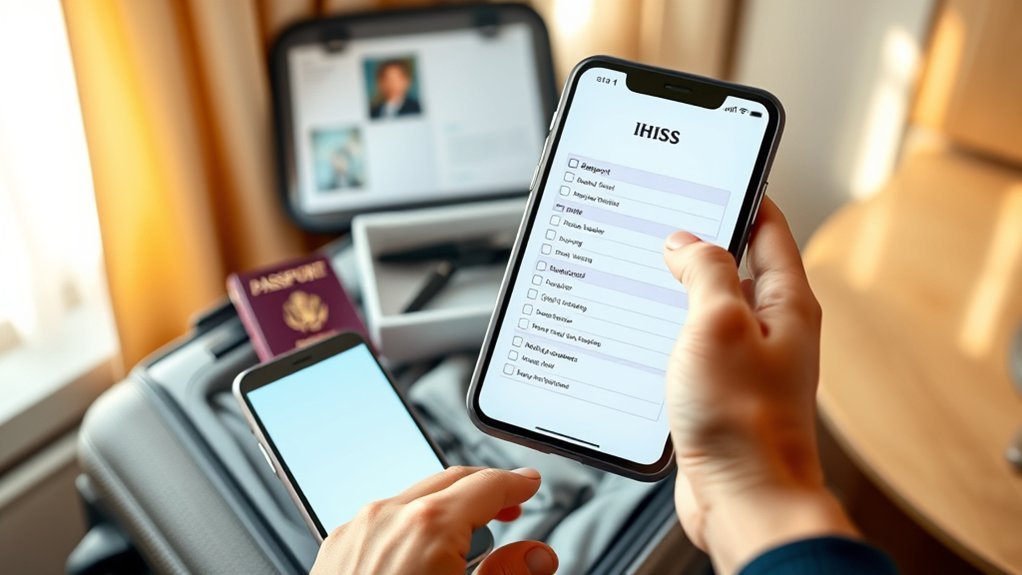
Give your IHSS social worker enough information to determine which absence rule applies and whether your current care plan can continue. Written notice is better than relying only on a phone call.
Notify Travel Plans
Report the trip before departure whenever possible. Include:
- Your destination, including the state, country, or territory
- Your departure and expected return dates
- Whether you will be outside the United States for every day of a calendar month
- The reason for the trip
- Your temporary address and contact information
- Whether you will maintain your California home
- Whether your regular provider will travel with you
- Which authorized services you expect the provider to perform
If the trip may keep you outside California for 30 continuous days or longer, be prepared to explain your intent to remain a California resident. The county may ask for a written statement describing your return date, reason for the continued absence, current location, and household arrangements.
Confirm Care Continuation
Ask the social worker to answer these questions in writing:
| Question | Why it matters |
|---|---|
| Will my IHSS eligibility remain active during these exact dates? | The answer depends on the destination, length of absence, residency facts, and applicable eligibility rule. |
| May my provider claim services performed at the destination? | A short absence does not automatically prove that overseas or out-of-state services are payable. |
| How should the provider use EVV or complete a timesheet? | The provider must report actual authorized hours correctly. |
| Do you need proof that I am maintaining my California residence? | This may become important during an extended absence from California. |
| Will the county issue a Notice of Action? | A written notice identifies the action, effective date, reason, and hearing rights. |
Pro Tip: Send the information by a method that creates a record, such as an online county portal, email accepted by the worker, fax with confirmation, certified mail, or hand delivery with a stamped copy. Keep the county’s reply with your travel records and timesheets.
What Happens If You’re Gone More Than 30 Days?

Passing day 30 does not have the same result for every destination.
More Than 30 Days Outside California but Within the U.S.
After 30 continuous days outside California, the county must investigate whether you still intend to remain a California resident. You may be asked to provide a written statement with:
- Your expected return date
- The reason for your continued absence
- Your current location
- Your California housing arrangements
- Other facts showing that California remains your residence
If you do not respond by the county’s deadline, the county may presume that you do not intend to maintain California residency and discontinue IHSS after the absence exceeds 60 days.
Thirty Consecutive Days Outside the United States
If you remain outside the defined United States for 30 days in a row, the separate international rule requires discontinuance. The same rule applies if you are abroad for every day of a calendar month, even when the total is fewer than 30 days.
After returning, the regulation states that you may apply for IHSS again after reestablishing the applicable SSI/SSP status or SSI/SSP-based eligibility. The county then redetermines eligibility and completes a current needs assessment.
A 30-day absence outside California starts a residency inquiry. A 30-day absence outside the United States can require IHSS discontinuance. These are different rules.
Can Family Caregivers Keep Getting Paid?
Being a spouse, parent, child, or other family member does not create a separate travel exception. A family provider can be paid only for authorized IHSS services actually performed while the recipient remains eligible and the work complies with applicable program and timesheet rules.
Do not assume that accompanying a recipient automatically makes every hour during the trip payable. Before departure, ask the county whether services at the destination remain authorized and how the provider should report them.
Family Caregiver Pay Limits
A family caregiver should follow the same basic safeguards as any other individual provider:
- Report the recipient’s travel dates and destination.
- Confirm whether IHSS remains active during the trip.
- Record only authorized tasks and hours actually worked.
- Follow workweek, overtime, EVV, and timesheet requirements.
- Keep the county’s written instructions.
If the county approves continued IHSS during an extended absence in another U.S. state because the recipient maintains California residency or qualifies under the applicable good-cause rules, section 30-770.471 states that an out-of-state individual provider is reimbursed at the county’s lowest current individual-provider base rate.
When Payment Can Continue
| Condition | Possible effect |
|---|---|
| Recipient remains eligible and the provider performs authorized services | Payment may continue when the county confirms that the arrangement complies with IHSS rules. |
| Provider accompanies the recipient but performs no authorized care | The provider should not claim regular IHSS hours merely for accompanying the recipient. |
| Recipient reaches an international discontinuance threshold | IHSS must be discontinued under the foreign-absence rule. |
| Provider goes on vacation without the recipient | The provider does not claim regular hours not worked. The recipient may arrange another enrolled provider. |
How Do U.S. Travel and International Trips Differ Under IHSS?
Domestic and international trips use different eligibility tests.
- Travel within California: The foreign-absence and out-of-state residency rules do not apply, but authorized-service, actual-work, EVV, and timesheet requirements still do.
- Travel to another state: At 30 continuous days outside California, the county must investigate whether you remain a California resident. At 60 days, additional residency and good-cause rules apply.
- Travel outside the United States: IHSS must be discontinued when you are abroad for every day of a calendar month or for 30 consecutive days.
Counties administer IHSS and decide case-specific facts, but they do not have unlimited discretion to replace statewide regulations. Ask the worker to identify the rule supporting any proposed reduction or discontinuance.
What Should You Do Before Leaving the Country?
Use this checklist before an international trip:
- Count the exact days. Check whether the trip covers every day of a calendar month or reaches 30 consecutive days.
- Notify the county. Give the assigned worker your destination, departure date, return date, temporary address, reason for travel, and provider plan.
- Request a written decision. Ask whether eligibility remains active and whether services performed during the trip can be claimed.
- Review SSI or related benefits. International absence may affect other benefits connected to IHSS eligibility.
- Plan authorized care. Identify which tasks the provider will actually perform and how the hours will be documented.
- Confirm EVV and timesheet steps. Do not guess how location, check-in, check-out, or time entry should be reported.
- Keep proof of your return. Save tickets, passport records, boarding passes, and other documents showing the actual dates.
- Arrange backup care. If your regular provider will not travel, contact the county or Public Authority for help locating another enrolled provider.
You can find local contact information through the CDSS County IHSS Offices directory.
When Do You Need to Reapply for IHSS?
You do not automatically need a new application merely because you travel for more than 30 days. Reapplication depends on whether the county actually discontinued your IHSS case.
After International Discontinuance
If IHSS was discontinued because you were outside the United States for an entire calendar month or for 30 consecutive days, you may apply again after returning and reestablishing the applicable SSI/SSP status or SSI/SSP-based eligibility. The county must redetermine eligibility and assess your current needs.
After Loss of California Residency
If the county determines that you are no longer a California resident, IHSS can be discontinued. If you later return and establish California residency again, contact the county to ask whether a new application is required.
After a Six-Month Out-of-State Absence
If an extended domestic absence exceeds six months, the regulation provides for suspension even when illness or good cause previously allowed services to continue. IHSS does not resume until you return, request a reassessment, and the reassessment is completed.
A change in health, functional ability, provider availability, or living arrangements may require a reassessment. It does not always require a completely new application.
What If the County Stops or Reduces Your IHSS?
Ask for a written Notice of Action if the county says your IHSS will be suspended, reduced, or discontinued. The notice should state the reason, legal basis, effective date, and hearing rights.
You generally have 90 days from the county action to request a state hearing. If you request the hearing before the effective date shown on the Notice of Action, you may be able to receive aid pending while the dispute is reviewed. If the final decision is not in your favor, the county may seek repayment of benefits paid during the pending period.
You can request a hearing through the California Department of Social Services State Hearing Requests page. Keep the Notice of Action, its envelope, your travel notice, the county’s reply, tickets, passport records, timesheets, and any proof that you maintained your California residence.
Frequently Asked Questions
Does IHSS know if you leave the country?
IHSS does not rely on one universal border-tracking system described in its public guidance. However, the county can learn about an absence through information you report, eligibility records, residency reviews, timesheets, EVV data, or other case information. You are responsible for reporting facts that may affect eligibility and should not conceal travel.
How long can an IHSS recipient travel out of the country?
There is no safe blanket answer that a recipient may travel abroad for “up to 30 days” and automatically keep payment. IHSS must be discontinued if the recipient is outside the United States for 30 consecutive days or for every day of a calendar month. A shorter trip still requires county guidance about eligibility and payable services.
Can IHSS track your location?
The IHSS EVV mobile app collects GPS latitude and longitude when a non-live-in provider checks in and checks out. According to the CDSS privacy policy, location is collected only at those two points, and the app does not continuously track the provider’s movement. Other EVV methods and live-in-provider rules differ.
What happens if an IHSS provider goes on vacation?
A provider’s vacation does not automatically end the recipient’s IHSS eligibility. The provider should not claim regular IHSS hours that were not worked. The recipient can hire another enrolled provider or ask the county or Public Authority for help finding backup care. The provider and recipient should also review workweek and timesheet rules before shifting hours.
Can IHSS continue while you visit another state?
It may continue during a temporary out-of-state absence, but the county must review residency after 30 continuous days outside California. At 60 days, the absence is evidence of changed residence unless you establish continued California residence or qualifying good cause. Obtain written approval for the care and provider arrangement.
Does medical travel create an exception to the international cutoff?
The published IHSS regulation lists medical treatment and other good-cause circumstances for certain extended absences from California. The separate rule for being outside the United States does not state the same good-cause exception to its full-month or 30-consecutive-day cutoff. Discuss the exact facts with the county before travel.
Sources
- California Department of Social Services, MPP Division 30 — California residency, out-of-state absence, international absence, discontinuance, and reassessment rules.
- IHSS EVV Mobile App Privacy Policy — GPS collection at check-in and check-out and the prohibition on continuous movement tracking.
- CDSS Electronic Visit Verification Help — current EVV requirements for live-in and non-live-in providers.
- CDSS County IHSS Offices — official county contact directory.
- CDSS State Hearing Requests — hearing deadline and request procedures.
Conclusion
IHSS does not necessarily stop on the first day of an international trip, but you should never assume that eligibility or provider payment will continue. The key international triggers are being outside the United States for every day of a calendar month or for 30 consecutive days. Travel to another state follows different 30-day and 60-day California residency rules.
Before leaving, report the exact destination and dates, explain the provider plan, and request written county instructions. Claim only authorized services actually performed. If the county changes your benefits, review the Notice of Action and hearing deadline immediately.
