
Last Updated on July 27, 2026 by Daniel Globe
Building endurance for hiking means training your heart, lungs, legs, core, balance, and ability to stay comfortable on your feet for hours at a time. A long hike can be much harder than an ordinary walk because elevation gain, steep descents, uneven ground, heat, altitude, and a loaded backpack all increase the work your body must do. The best preparation combines regular aerobic exercise, hiking-specific strength work, hills, longer practice hikes, good recovery, and gradual exposure to the conditions you expect on your goal trail.
Quick Answer
Build hiking endurance by combining regular moderate aerobic work with hill-specific walking, two weekly strength sessions, progressively longer hikes, and recovery. Train on terrain similar to your goal hike, practice with your pack gradually, and use the talk test to control effort. Increase only one major stressor at a time: duration, elevation, intensity, or pack weight.
Key Takeaways
- Build an aerobic base with brisk walking, hiking, cycling, swimming, or similar activities, then add hills and longer trail sessions.
- Strength-train at least twice a week, with extra attention to the legs, hips, calves, core, and movements used for climbing and descending.
- Train for the hike you actually plan to do by considering distance, elevation, terrain, altitude, weather, and backpack weight.
- Progress gradually. Avoid increasing distance, elevation, intensity, and pack weight all at once.
- Fuel, hydrate, sleep, and recover well enough that your body can adapt between hard sessions.
At a Glance
| Time Required | Plan at least 6 weeks when possible; larger jumps in distance, elevation, altitude, or pack weight may require substantially longer. |
| Difficulty | Beginner to intermediate; scale every session to your present fitness and hiking experience. |
| Tools Needed | Walking or hiking shoes, access to hills/stairs or an incline treadmill, a backpack, water, and optional resistance equipment or trekking poles. |
| Cost | Potentially $0 using outdoor walking, stairs, and bodyweight exercises; gym memberships and additional hiking gear are optional. |
Note: This guide provides general fitness information, not individualized medical advice. Moderate activity is safe for most people, but anyone with a chronic medical condition, significant mobility limitation, or uncertainty about vigorous exercise should discuss an appropriate training level with a qualified health professional. See the CDC guidance on adding physical activity.
Disclosure: As an Amazon Associate I earn from qualifying purchases. Some links on this page are affiliate links, at no extra cost to you.
Why Endurance Matters for Hiking
Hiking endurance is more than the ability to walk a long distance. Your body must repeatedly climb, descend, stabilize on uneven ground, and support your backpack while continuing to produce energy for several hours.
Aerobic fitness helps your heart and lungs deliver oxygen efficiently. Muscular endurance helps your legs keep producing force after hundreds or thousands of steps. Strength and balance help you stay controlled on hills and rough ground. Hiking-specific practice teaches you how to pace yourself, manage your gear, eat and drink on the move, and recognize fatigue before it becomes a problem.
Endurance also affects the mental side of hiking. When an effort is within your physical capacity, it is easier to make good decisions, maintain attention, and stay patient during long climbs or uncomfortable weather. Mental strategies cannot replace physical preparation, but they can help you manage a demanding day more calmly.
The goal is not to make every workout exhausting. The goal is to arrive at your hike with enough aerobic fitness, muscular endurance, trail-specific practice, and recovery to handle the planned distance and terrain.
Set Realistic Hiking Endurance Goals
Start by defining what you are training for. “I want better endurance” is difficult to measure. A useful target describes the hike itself.
- Distance: How many miles will you cover?
- Elevation: How much climbing and descending is involved?
- Terrain: Is the trail smooth, rocky, sandy, muddy, or highly technical?
- Expected duration: Will you be moving for two hours or eight?
- Pack weight: Are you carrying a light daypack or overnight gear?
- Altitude: Is the trail much higher than the elevation where you normally live and train?
- Weather: Are heat, cold, rain, snow, or strong sun likely?
The National Park Service Hike Smart guidance recommends choosing hikes that match your abilities and considering how much equipment, food, and water you can comfortably carry. It also recommends checking weather, trail conditions, park alerts, and altitude before leaving.
Establish a Baseline First
Before increasing training, complete a walk or easy hike that feels manageable and record a few details: time, distance, elevation gain, backpack weight, and how hard the effort felt. Also note how your legs feel later that day and the following morning.
You do not need to test yourself to exhaustion. The purpose is to establish a starting point. Repeat a similar route every few weeks under comparable conditions. If you can finish it faster at the same effort, carry the same pack with less fatigue, or complete more elevation at a similar effort, your hiking endurance is improving.
A Practical 6-Week Hiking Endurance Plan
This framework is designed as a flexible template rather than a rigid prescription. A new hiker may need to make the sessions shorter, while an experienced hiker preparing for a difficult trek may need a longer training cycle.
| Week | Main Focus | What to Do |
|---|---|---|
| 1 | Build consistency | Complete 2–3 comfortable aerobic sessions, 2 strength sessions, and one easy longer walk or hike that is well within your current ability. |
| 2 | Add a little time | Keep the same basic schedule and make one or two aerobic sessions slightly longer if you recovered well from week 1. |
| 3 | Introduce more hills | Use hills, stairs, or an incline treadmill for one session. Keep strength work and one longer easy outing. |
| 4 | Absorb the training | Make the longer outing easier or shorter than the previous week. Maintain light-to-moderate aerobic activity and strength without chasing new records. |
| 5 | Practice specificity | Complete your most hike-specific outing: similar terrain, meaningful elevation, hiking footwear, and a gradually loaded pack. |
| 6 | Consolidate and arrive fresh | Do your harder work early in the week, then reduce training stress before the goal hike rather than trying to gain fitness at the last minute. |
Pro Tip: Make your longest training hike resemble your goal hike rather than simply chasing mileage. A shorter route with sustained climbing, descending, uneven footing, and the pack you plan to use may prepare you better than a longer flat walk.
Build Cardiovascular Endurance for Hiking

Aerobic exercise improves your ability to keep moving without becoming breathless or exhausted too early. Walking and hiking are the most specific choices, but cycling, swimming, elliptical training, and other aerobic activities can help build fitness while reducing repetitive impact.
For general health, the CDC recommends that adults accumulate at least 150 minutes of moderate-intensity aerobic activity each week, or an equivalent amount of vigorous activity, plus muscle-strengthening work on at least two days. Those are public-health minimums rather than a complete hiking-training prescription, but they provide a useful aerobic foundation.
Use the Talk Test to Control Intensity
You do not need a heart-rate monitor to distinguish an easy-to-moderate session from a hard one. According to the CDC talk test:
- Moderate effort: You can talk, but singing would be difficult.
- Vigorous effort: You can say only a few words before pausing for breath.
Most endurance-building sessions do not need to be all-out efforts. Regular comfortable-to-moderate work allows you to accumulate useful training time without making every workout difficult to recover from.
Add Hills and Intervals Strategically
Once you have a basic aerobic routine, add one hill-oriented session. Walk uphill, use stairs, or increase a treadmill’s incline for repeated blocks of work separated by easier recovery periods.
Intervals can improve fitness, but they should complement rather than replace longer steady sessions. Beginners should first become comfortable with regular walking or hiking before adding very hard intervals.
Train for Elevation, Descents, and Backpack Weight
Flat-road fitness does not prepare you completely for a mountain trail. Climbing increases cardiovascular and muscular demands, while long descents require repeated controlled braking from the quadriceps and other lower-body muscles.
Include hills whenever practical. If you live in a flat area, stairs, stadium steps, a stair-climbing machine, or an incline treadmill can provide useful climbing practice.
Do Not Ignore Downhill Training
Going downhill may feel easier on your lungs, but it can be demanding on your legs because your muscles repeatedly lengthen under load as they control your descent. Step-downs, split squats, lunges, squats performed with a slow lowering phase, and real downhill walking can help develop that control.
Practice With Your Backpack Gradually
A loaded pack changes posture, balance, foot loading, and the amount of work required on climbs. Begin with a comfortable load and add weight only after you can handle the current setup without excessive soreness, altered walking mechanics, or pain.
Avoid simultaneously making your hike much longer, much steeper, much faster, and much heavier. Changing one important variable at a time makes it easier to understand how your body is responding.
Strength Training for Hiking Endurance
Cardiovascular fitness helps you keep moving, but muscular strength and endurance help you climb, descend, stabilize your body, and carry a pack efficiently. The 2026 American College of Sports Medicine position stand on resistance training found that progressive resistance training improves strength, muscular endurance, balance, gait speed, power, and other measures of physical function.
For hiking, focus on movement patterns that resemble trail demands: squatting, stepping, hinging at the hips, controlling one leg at a time, raising the heels, and stabilizing the trunk.
| Exercise | Repetitions | Sets | Rest Time |
|---|---|---|---|
| Squats | 12–15 | 3 | 60 seconds |
| Lunges | 10–12 each leg | 3 | 60 seconds |
| Deadlifts or Hip Hinges | 8–10 | 3 | 90 seconds |
| Calf Raises | 15–20 | 3 | 45 seconds |
| Step-Ups | 8–12 each leg | 2–3 | 60–90 seconds |
Treat this table as a starting template, not a mandatory prescription. Choose resistance that lets you perform each repetition with control. Beginners may need fewer sets or bodyweight-only versions. More experienced trainees can add resistance gradually.
Core exercises such as planks, side planks, carries, and controlled rotational movements can help you maintain trunk stability while wearing a backpack. Upper-body work can also make carrying gear and using trekking poles more comfortable, but hiking performance still depends heavily on the legs, hips, trunk, and aerobic system.
Nutrition and Hydration for Hiking Endurance
Training creates the demand for adaptation; food and fluids help support the work and recovery. A balanced diet that supplies enough total energy, carbohydrate, protein, fats, vitamins, and minerals is more useful than relying on a special supplement.
The joint sports-nutrition position statement from the Academy of Nutrition and Dietetics, Dietitians of Canada, and ACSM notes that appropriate food and fluid strategies support exercise performance and recovery. See the Nutrition and Athletic Performance position statement.
Fuel Longer Training Sessions
Carbohydrate is an important fuel for prolonged and higher-intensity exercise. Before a long hike, choose familiar foods that provide useful energy without upsetting your stomach. Examples include oatmeal, toast, rice, potatoes, fruit, yogurt, or other foods you already tolerate well.
For longer outings, carry easy-to-eat snacks so you do not have to wait until you feel depleted. Trail mix, fruit, sandwiches, bars, crackers, and similar portable foods can work. The best choices are foods you have already tested during training.
Hydrate According to Conditions and Your Needs
There is no single fluid amount that is correct for every hiker. Temperature, humidity, altitude, intensity, duration, body size, sweat rate, and access to water all matter.
Drink regularly enough to avoid substantial dehydration, but do not force excessive amounts of water simply to meet an arbitrary hourly target. The ACSM fluid-replacement position stand emphasizes that sweat losses vary widely and that hydration strategies should be individualized.
Electrolyte-containing drinks or salty foods can be useful during prolonged exercise, hot conditions, or heavy sweating. They are not automatically necessary for every short training session. ACSM’s 2025 hydration and electrolyte guidance notes that most people training for less than roughly 60–90 minutes in normal conditions are unlikely to become substantially depleted of electrolytes.
Warning: Heat illness can become an emergency. Stop activity if you become faint or severely weak. Confusion, altered mental status, seizures, loss of consciousness, or other signs of possible heat stroke require emergency medical care. The CDC advises calling 911 for suspected heat stroke and beginning rapid cooling while help is coming.
Mental Preparation for Long-Distance Hiking
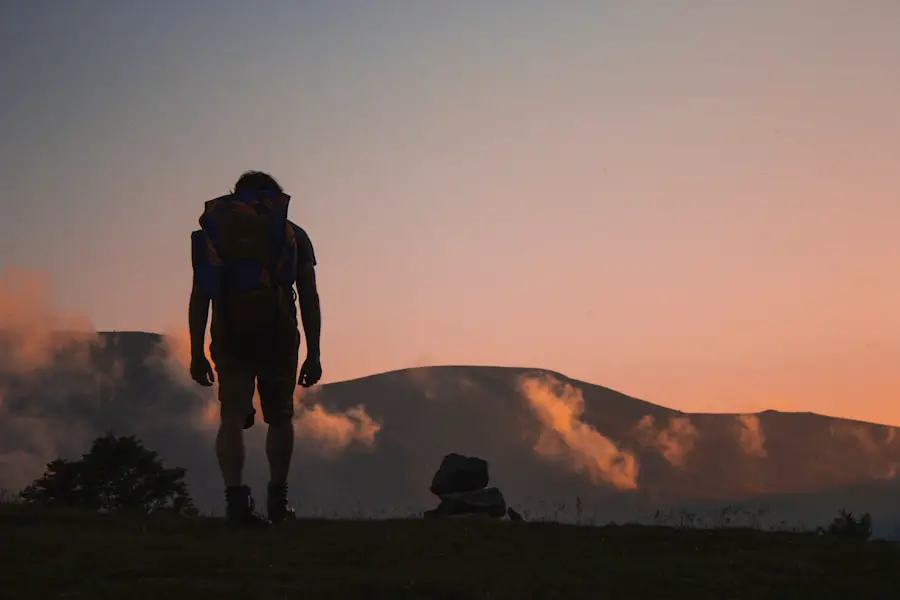
Long hikes are mentally demanding because discomfort, slow progress, changing weather, and fatigue can make the remaining distance feel harder than it is. Mental preparation works best when it supports—not replaces—physical training.
Practice pacing yourself on training hikes. Instead of starting fast because you feel fresh, settle into an effort you can maintain. Break long climbs into manageable landmarks, such as reaching the next switchback or hiking steadily for another 10 minutes.
Mindfulness can also help. Pay attention to your breathing, foot placement, surroundings, and body signals instead of repeatedly worrying about how many miles remain. Visualization can be useful before a goal hike: picture yourself climbing steadily, eating and drinking on schedule, responding calmly to a hard section, and turning around if conditions become unsafe.
After each significant training hike, ask three questions:
- What felt easier than last time?
- Where did fatigue begin to affect my pace or technique?
- What should I change before the next long outing?
This turns every training hike into useful information.
Gradually Increase Distance and Difficulty
Your body needs enough training stress to adapt, but simply adding more every week is not always better. Sudden changes in training load may contribute to injury risk, yet research does not support one universal percentage increase that works for everyone.
A systematic review of running-related injuries found limited evidence linking particular week-to-week increases with injury, while a later review found conflicting evidence for individual training parameters. For that reason, a rigid “10% rule” should not be treated as a guarantee. See the systematic review of training-load changes and injury.
Increase One Major Stressor at a Time
A safer practical approach is to adjust training according to your current ability and recovery. On a given week, you might make a session longer, add more elevation, increase pace, or add a little pack weight. Avoid making large increases in all four at once.
Back off when you notice signs that the previous workload was too much, such as worsening pain, unusually heavy fatigue that persists between sessions, deteriorating walking mechanics, or a clear drop in performance.
Pro Tip: Track elevation as well as mileage. Five steep miles can be more demanding than a much longer flat walk, so distance alone does not describe hiking workload.
Rest and Recovery for Building Endurance
Fitness improves between training sessions as your body recovers and adapts. More exercise is therefore useful only when you can recover well enough to benefit from it.
Include easier days and full rest days in your schedule. Light walking, gentle mobility work, or other easy movement can be useful when you want activity without another demanding training session.
Sleep matters as well. A hard training week followed by poor sleep may leave you less prepared for the next session, while adequate recovery makes it easier to maintain good movement quality and consistent training.
Before an important hike, resist the urge to cram extra fitness into the final few days. Your last major hike-specific workout should leave enough time for normal soreness and fatigue to settle. Arriving slightly undertrained but rested is generally more useful than arriving exhausted from a last-minute training surge.
How to Know Your Hiking Endurance Is Improving
Progress is not limited to walking more miles. Look for several signs:
- You complete the same climb with less breathlessness.
- Your usual route feels easier at the same pace.
- You can hike longer before your legs become heavy.
- You recover faster after a long outing.
- You handle descents with better control late in the hike.
- You can carry your planned pack without major posture changes or shoulder discomfort.
- You can eat and drink while moving without stomach problems.
- You finish with enough energy and attention to make safe decisions.
These measures often tell you more than speed alone.
Prepare for Heat, Altitude, and Trail Conditions
Fitness does not eliminate environmental risk. A distance that feels easy in cool weather near sea level may become much harder in high heat or at an unfamiliar altitude.
Before a goal hike, check the route, forecast, park alerts, water availability, and expected conditions. The National Park Service recommends knowing your limits, leaving a trip plan, preparing for emergencies, carrying appropriate food and water, and allowing extra time to acclimate when hiking at higher elevations than you are accustomed to.
Heat should also change your expectations. Slow the pace, seek cooler parts of the day where possible, take breaks, and carry enough fluid for the conditions. The CDC’s hot-weather exercise guidance advises starting slowly and stopping activity if you feel faint or weak.
Note: Pain that changes your walking pattern, keeps getting worse as you continue, or persists instead of improving with recovery is different from ordinary training fatigue. Do not try to “push through” a suspected injury simply to complete a scheduled workout.
If hiking is part of a larger international trip, physical preparation is only one part of planning. Travelers should also verify current entry requirements for their destination. For example, this guide to Canada entry requirements for Mexican citizens covers a separate travel-planning issue that may be relevant to some itineraries.
Frequently Asked Questions
What is endurance hiking?
Endurance hiking means sustaining hiking effort for a prolonged period while managing distance, elevation, uneven terrain, and sometimes a loaded backpack. It relies on aerobic fitness, muscular endurance, strength, balance, pacing, fueling, hydration, and the ability to continue making safe decisions as fatigue develops.
Why is endurance important for hiking?
Good endurance lets you sustain a manageable pace for longer and reduces the chance that ordinary fatigue will overwhelm you early in the hike. It is especially useful on long trails, repeated climbs, sustained descents, rough terrain, and hikes where you must carry food, water, or overnight equipment.
How can I build endurance for hiking?
Combine regular aerobic exercise with two weekly strength sessions, hills or stairs, and progressively longer hiking-specific outings. Practice on terrain similar to your goal hike when possible. Add backpack weight gradually, recover between demanding sessions, and avoid increasing distance, elevation, intensity, and load all at once.
What exercises are best for hiking endurance?
Useful aerobic exercises include hiking, brisk walking, incline treadmill walking, stair climbing, cycling, and swimming. For strength, squats, step-ups, lunges, hip hinges or deadlifts, calf raises, step-downs, loaded carries, and core-stability exercises transfer well to common hiking demands.
How should I prepare for a long-distance hike?
Work backward from the distance, elevation, terrain, altitude, and pack weight of the goal hike. Build regular aerobic activity first, then add hills, longer outings, strength work, downhill practice, and progressively more specific trail sessions. Test your footwear, pack, food, water strategy, and pacing before the actual trip.
Are there any tips for improving hiking endurance?
Train consistently instead of relying on occasional exhausting workouts. Keep most aerobic sessions manageable, practice hills regularly, strengthen the legs and core, track elevation as well as distance, use your hiking footwear during longer sessions, and arrive at major hikes rested rather than trying to cram training into the final days.
How long does it take to improve hiking endurance?
There is no single timeline because improvement depends on your starting fitness, training consistency, recovery, age, health, and the difficulty of your goal hike. Several weeks of consistent training can improve readiness, but a large jump from short flat walks to a strenuous mountain or backpacking trip may require months of gradual preparation.
Should I train with a backpack?
Yes, if your goal hike requires one. Begin with a comfortable load and practice the pack’s fit before adding significant weight. Increase load gradually and avoid combining a much heavier pack with a major increase in distance or elevation during the same training session.
Sources
- Centers for Disease Control and Prevention — Physical Activity for Adults — current aerobic and muscle-strengthening recommendations.
- Centers for Disease Control and Prevention — Measuring Physical Activity Intensity — moderate/vigorous intensity and the talk test.
- National Park Service — Hike Smart — hiking ability, planning, weather, altitude, food, water, equipment, and emergency preparation.
- American College of Sports Medicine Position Stand on Resistance Training, 2026 — current evidence on resistance training, muscular endurance, strength, balance, and physical function.
- Academy of Nutrition and Dietetics, Dietitians of Canada, and ACSM — Nutrition and Athletic Performance — food, fluid, training, and recovery guidance for exercise.
- Systematic Review of Training-Load Changes and Running-Related Injuries — evidence relevant to avoiding unsupported universal weekly mileage-increase rules.

