
Last Updated on July 25, 2026 by Daniel Globe
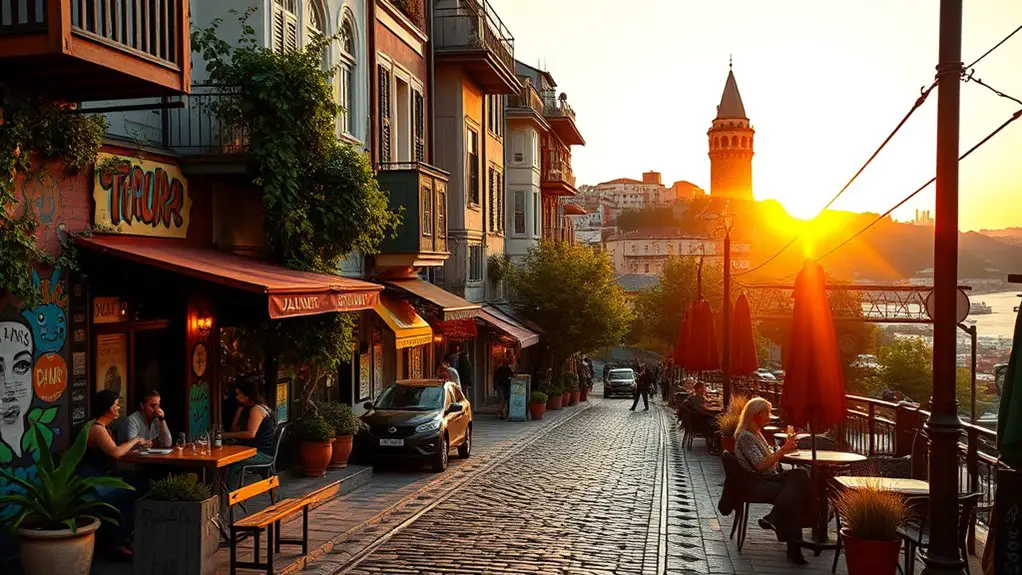
Karaköy packs waterfront views, historic architecture, street art, cafés, galleries, and the steep lanes leading toward Galata into a compact part of Istanbul. Some of the strongest photo stops are directly in Karaköy, while others—such as Galata Tower—sit just uphill. Salacak is much farther away on the Asian side, so it works best as an optional detour rather than part of the same walking route.
Quick Answer
The best Instagram spots in Karaköy include the Kamondo Stairs, Karaköy waterfront and ferry pier, Istanbul Modern, Galataport, Karaköy Güllüoğlu, local street art, and the uphill Galata Tower area. Visit early for quieter streets or around golden hour for warmer light, then stay through blue hour for ferries and city lights.
Key Takeaways
- Kamondo Stairs are one of the most distinctive architectural photo stops near Karaköy, with curved late-19th-century stonework that works well from both the top and bottom.
- Galata Tower gives you the classic elevated Istanbul panorama, but it is uphill in the Galata area rather than on the Karaköy waterfront.
- Istanbul Modern and Galataport add contemporary architecture, waterfront reflections, ferries, and broad views toward the Historical Peninsula.
- Karaköy street art changes over time, so treat Tersane Caddesi and nearby back streets as areas to explore rather than expecting one permanent mural wall.
- Salacak is not in Karaköy. It is across the Bosphorus in Üsküdar and is best treated as a separate trip for Maiden’s Tower and Historical Peninsula views.
Note: Karaköy, Galata, and Tophane blend into one another on many visitor itineraries, but they are not interchangeable place names. This guide includes a few nearby Galata stops because they are easy to combine on foot and are among the area’s strongest photo locations.
Disclosure: As an Amazon Associate I earn from qualifying purchases. Some links on this page are affiliate links, at no extra cost to you.
Best Karaköy Instagram Spots at a Glance
| Spot | Best For | Best Light | Location Note |
|---|---|---|---|
| Kamondo Stairs | Architecture and portraits | Morning or late afternoon | Between Karaköy and Galata |
| Galata Tower | Panoramic skyline | Late afternoon to sunset | Uphill in Galata |
| Istanbul Modern | Contemporary architecture and art | Daylight | Karaköy/Tophane waterfront |
| Galataport Waterfront | Waterfront, ferries and skyline | Golden hour and blue hour | Karaköy waterfront |
| Karaköy Back Streets | Street art and urban details | Morning or bright overcast light | Murals and decorations change |
| Karaköy Ferry Pier | Ferries and Historical Peninsula | Late afternoon and blue hour | Central Karaköy |
| Salacak Waterfront | Maiden’s Tower | Sunset | Üsküdar; separate Asian-side detour |
Galata Tower
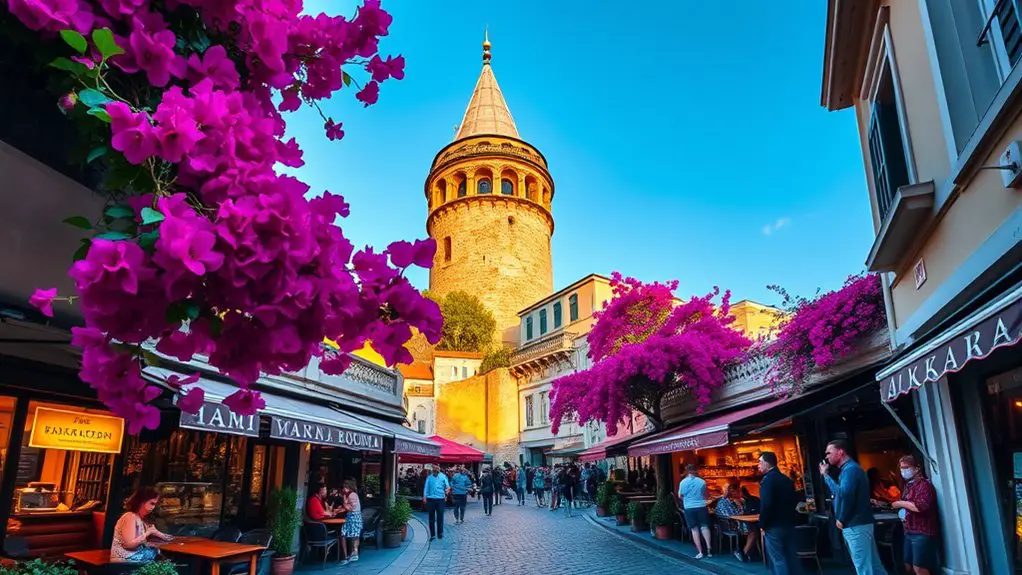
Galata Tower is one of the most recognizable landmarks to combine with a Karaköy photo walk. It stands uphill in Bereketzade, in the historic Galata area of Beyoğlu, so expect a noticeable climb from the waterfront.
According to the Turkish Ministry of Culture and Tourism’s Galata Tower Museum information, the present tower traces its origins to the Genoese period in the mid-14th century and has been repaired and restored repeatedly after fires, earthquakes, and later changes in use.
The upper levels open onto a broad Istanbul panorama. From here, the Golden Horn, Bosphorus, Historical Peninsula, bridges, ferries, domes, minarets, and tightly packed rooftops form a much stronger photograph than a generic skyline selfie.
Late afternoon gives buildings warmer light, while sunset can add color behind the skyline. It is also a popular time to visit, so check the official museum page for current admission hours and access conditions before making sunset the fixed point of your route.
The streets around the base deserve attention too. A low-angle tower shot from the surrounding lanes can be just as memorable as the view from the top, especially when café tables, old façades, or pedestrians provide foreground interest.
Pro Tip: Photograph the tower from street level before going inside. That gives you two very different images—one showing Galata Tower as part of the neighborhood and another showing Istanbul from above.
Karaköy Fish Market
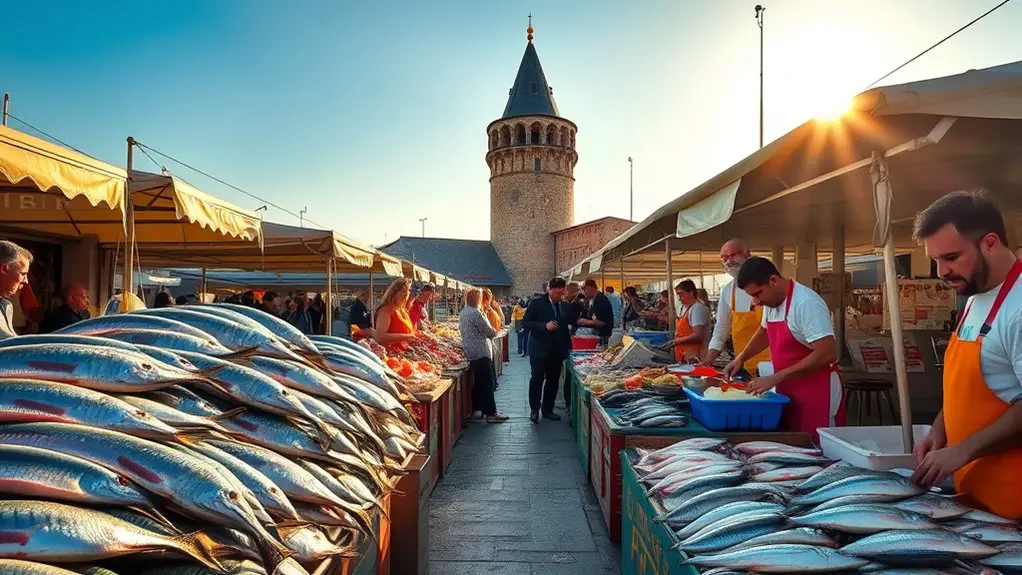
The Karaköy fish-market area near the Golden Horn offers a different kind of photo opportunity from the neighborhood’s polished cafés and museums. Depending on the hour and day, you may find seafood displays, fish sellers, small eateries, working waterfront details, and the constant movement of people between Karaköy and the Galata Bridge area.
Do not expect every visit to match a staged market photograph. Stock, vendors, crowds, and nearby waterfront activity vary, which is part of what makes documentary-style shots here more interesting.
Vibrant Market Atmosphere
The best photographs here usually come from observing what is actually happening rather than trying to manufacture a scene. Look for hands arranging fish, handwritten signs, trays of seafood, reflections on wet surfaces, customers choosing what to buy, and the contrast between the working market and the surrounding city.
Keep pathways clear and avoid holding a phone or camera directly in a seller’s face. A quick gesture or request before taking a close portrait is both more respectful and more likely to produce a natural image.
Fresh Seafood Variety
Seafood displays can add color, texture, and repetition to a photograph, but the exact selection is seasonal and changes from day to day. Rather than expecting specific prawns, sardines, or octopus, photograph the day’s actual display and use tighter framing to highlight patterns, ice, scales, labels, and trays.
This is also a useful place to capture part of Karaköy’s maritime identity without relying only on panoramic Bosphorus views.
Scenic Waterfront Views
Step back toward the waterfront and the composition changes again. Ferries, the Golden Horn, the Galata Bridge area, and the Historical Peninsula can give you layers of foreground and background activity.
Late-afternoon light can reflect off the water, while blue hour brings stronger contrast between boat lights, waterfront buildings, and the darkening sky. The scene changes quickly, so burst mode or several short attempts often work better than waiting for one perfectly empty frame.
Salacak Waterfront: An Üsküdar Detour, Not Karaköy
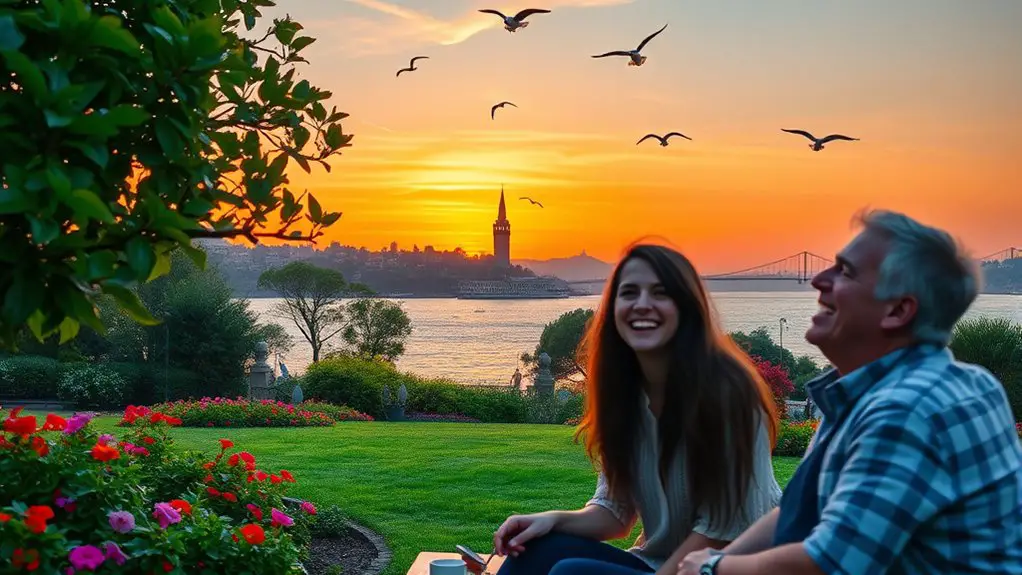
Salacak offers beautiful Bosphorus photographs, but it is important to place it correctly: Salacak is in Üsküdar on Istanbul’s Asian side, not in Karaköy. The official Maiden’s Tower visitor information lists the Salacak pier in Üsküdar and a separate boat point in Karaköy.
That makes Salacak an excellent extra photo trip if you have more time, rather than a stop to insert into a short Karaköy walking route.
Scenic Views of the Bosphorus
The Salacak waterfront faces Maiden’s Tower and looks back toward Istanbul’s European-side skyline. With a longer lens or careful framing, you can layer the tower, passing boats, the water, and silhouettes from the Historical Peninsula into one frame.
The shore also works well for simpler compositions: rippling water in the foreground, Maiden’s Tower as the main subject, and the city softened in the distance.
Ideal for Sunset Shots
Sunset is the main photographic draw. Warm light and changing sky colors can silhouette Maiden’s Tower while the European skyline settles into the background.
Arrive before the sun reaches the horizon so you have time to test vertical and horizontal compositions. After sunset, stay a little longer for blue hour, when the tower and city lights become more visible without the sky turning completely black.
Note: Official tourism information lists boat access to Maiden’s Tower from both the Üsküdar-Salacak side and a Karaköy pier. Boat operations can change with weather and operating schedules, so check current information before traveling specifically for a sunset visit.
Istanbul Modern
Istanbul Modern gives Karaköy a completely different visual language from the stone streets around Galata. The museum’s current waterfront building was designed by Renzo Piano Building Workshop and opened at the museum’s original Karaköy location on May 4, 2023.
The architecture uses broad glazing, clean lines, open interior spaces, water-facing terraces, and changing natural light. That makes the building itself as useful a photographic subject as the exhibitions.
Inside, focus on architectural lines, gallery transitions, reflections, and permitted views of the artworks rather than trying to photograph every piece. The waterfront side also opens views toward the Bosphorus and Historical Peninsula.
For current exhibitions, opening information, and tickets, use the official Istanbul Modern website.
Warning: Istanbul Modern states that personal, noncommercial photography is generally allowed unless otherwise indicated, but flash, tripods, camera supports, and selfie sticks are prohibited. Follow any additional restrictions posted beside individual works or exhibitions.
Kamondo Stairs
The Kamondo Stairs, also called the Camondo Staircase, are among the most recognizable architectural photo locations between Karaköy and Galata. GoTürkiye describes the staircase as a late-19th-century Art Nouveau landmark associated with the influential Sephardic Camondo banking family.
The curved stone design creates strong leading lines, symmetry, and layered shapes, which means you can get several different compositions without moving far.
Unique Architectural Design
From the bottom, the stairway pulls the eye upward through its curves. From higher up, you can use the rails and landings to frame people below. A centered composition emphasizes symmetry, while shooting from one side brings out the staircase’s bends and depth.
The surrounding façades add another layer of contrast between historic stonework and the dense urban fabric of Galata.
Perfect Lighting Conditions
Golden hour can work well, but it is not the only useful time. Morning often gives you fewer people and softer street conditions, while bright overcast weather can reveal stone detail without harsh shadows.
Late-afternoon light may create stronger shadow patterns across the steps. Move a few meters in either direction before deciding where to shoot—the difference between flat and dimensional light can be surprisingly small.
Instagrammable Angles Galore
Try one wide image that shows the full curve of the stairs, one tighter portrait using the stone rail as a leading line, and one top-down or elevated frame. That gives you variety without repeatedly photographing the same pose.
The staircase remains an active public passage, so avoid blocking the steps for long photo sessions. A quick setup is both more considerate and more likely to capture the street naturally.
Mural Art on Tersane Street and Nearby Lanes
Karaköy has a long-running street-art presence, but murals are temporary by nature. Walls get repainted, businesses change, and a piece seen in an older travel photo may no longer exist when you arrive.
Tersane Caddesi and nearby streets can still be worth exploring for graffiti, painted shutters, stickers, typography, weathered façades, and industrial textures. Treat the walk as a search for what is there now rather than expecting a fixed outdoor exhibition.
Use wider compositions when a mural interacts with a doorway or building, then move closer for details such as spray textures, lettering, peeling paint, or layered posters.
This approach produces photographs that feel more like present-day Karaköy and less like a recreation of someone else’s Instagram post.
Karaköy Güllüoğlu
Karaköy Güllüoğlu combines a food stop with one of the neighborhood’s most recognizable culinary names. According to the company’s official history, its first Istanbul shop opened in Karaköy in 1949.
For photographs, the strongest subject is usually the baklava itself: crisp layers of pastry, chopped pistachio, trays of different cuts, and the contrast between golden pastry and green nuts.
Instead of photographing only a plate from directly above, try a lower side angle that shows the layers. A glass of Turkish tea can add scale and context without making the frame too busy.
The company’s current official contact information lists its Karaköy store on Kemankeş Caddesi. Check opening information before making a special early-morning or late-night trip because business hours can change.
Rooftop Cafes With Bosphorus Views
Rooftop and upper-floor terraces around Karaköy and the uphill Galata area can give you a higher perspective without committing to the Galata Tower observation level.
The exact venues change more often than historic landmarks, so it is better to choose a currently operating café based on its verified terrace access and view rather than rely on an old list of names.
For a stronger rooftop photograph, use ferries, domes, minarets, or Galata’s rooftops as clear subjects instead of treating the entire skyline as one distant background.
Golden hour gives the city warmer tones. Blue hour can be even more useful because interior lights, ferry lights, and the remaining color in the sky create natural contrast.
When taking portraits, position the person slightly away from the brightest part of the sky. That gives your phone or camera a better chance of keeping detail in both the face and the background.
Remember that a café is a business rather than a public photo studio. Order normally, avoid blocking tables or walkways, and ask before bringing larger photography equipment.
The Historic Karaköy Pier and Waterfront
Karaköy’s ferry area is one of the easiest places to photograph Istanbul’s everyday movement. Ferries pull in and out, commuters cross the quay, gulls sweep across the water, and the Historical Peninsula provides a recognizable background.
The waterfront also connects naturally with nearby Galataport, where restored heritage structures sit beside contemporary public spaces. Galataport’s official information describes the project as reopening a substantial stretch of the Karaköy shoreline to public access.
Here’s what to look for:
| Activity | Photo Opportunity | Best For |
|---|---|---|
| Ferry Ride | Water-level skyline and passing boats | City panoramas |
| Café Stop | Food, coffee, windows and street scenes | Lifestyle photography |
| Waterfront Walk | Architecture, ferries and reflections | Wide and vertical shots |
| People Watching | Commuters and daily waterfront life | Street photography |
For current ferry routes and departure times, check the official Şehir Hatları timetables. Multiple inner-city services call at Karaköy, but routes and schedules can change.
Galataport Waterfront and Clock Tower Square
Galataport has changed the photographic character of the Karaköy waterfront. The area combines a broad promenade, restored heritage structures, the Tophane Clock Tower, Istanbul Modern, contemporary architecture, cafés, and open water.
It works particularly well for architectural photography because you can move between historic stone, glass façades, landscaped areas, reflections, and the skyline across the water within a short distance.
Late afternoon is useful for warmer façades, but staying into blue hour adds ferry lights and stronger reflections. Cruise operations can temporarily change access to parts of the immediate waterfront, so follow signs and staff instructions when ships are in port.
Street Art of Karaköy
Karaköy’s back streets remain rewarding for urban photography even when individual murals change. Painted walls, shutters, stickers, signs, utility boxes, old workshops, café façades, and layers of weathered texture turn an ordinary walk into a collection of smaller visual details.
Official Turkish tourism guidance also highlights street art hidden around Karaköy’s older lanes, reinforcing that the experience is less about one permanent wall and more about exploring the neighborhood.
The best street-art photograph is often the one that shows how the artwork fits into Karaköy—a doorway, passing pedestrian, old façade, or café can give the wall a sense of place.
Pay attention to side streets instead of walking only on the busiest route. Morning is useful if you want cleaner compositions, while later in the day gives you more people and street activity.
When photographing people at close range, ask first. Avoid blocking entrances, leaning on private property, or moving objects simply to improve a photograph.
Best Time to Photograph Karaköy
There is no single perfect hour for every Karaköy photo spot. The right time depends on whether you want quiet architecture, busy street life, warm waterfront light, or illuminated night scenes.
- Early morning: best for quieter streets, Kamondo Stairs, façades, café exteriors, and cleaner compositions.
- Late morning to afternoon: useful for Istanbul Modern, food photography, markets, and street details where even light matters more than an empty scene.
- Golden hour: strongest for Galata viewpoints, rooftop terraces, waterfront portraits, and warmer architectural tones.
- Blue hour: ideal for ferries, city lights, Galataport, the Karaköy waterfront, and skyline photographs with color still left in the sky.
Pro Tip: Do not spend all of golden hour waiting in one queue. If Galata Tower is crowded, photograph the streets and waterfront first, then use blue hour for ferry and city-light shots.
A Practical Karaköy Photo Route
For a compact route that avoids unnecessary backtracking, begin near the Karaköy ferry pier. Photograph ferries and the waterfront, stop at Karaköy Güllüoğlu, then explore the nearby back streets for street art and architectural details.
From there, head toward Bankalar Caddesi and the Kamondo Stairs. Continue uphill to Galata Tower if you want the panoramic viewpoint. The climb is short on a map but steep enough that comfortable shoes help.
After Galata, walk back downhill toward the waterfront and continue toward Istanbul Modern and Galataport. This puts you near open water toward the end of the day, which is convenient for golden-hour and blue-hour shots.
Allow roughly half a day if you want to stop for food and take photographs without rushing. Add more time if you plan to enter Galata Tower or spend meaningful time inside Istanbul Modern.
Save Salacak for a separate ferry trip or another evening. Crossing to Üsküdar simply for one photograph breaks the otherwise walkable Karaköy-Galata route.
Photography Rules and Etiquette
Karaköy’s public streets are easy to photograph casually, but museums, restaurants, businesses, and private properties can set their own rules. Look for posted restrictions and ask staff when you are unsure.
At Istanbul Modern, personal nonprofessional photography is generally permitted unless a work or exhibition says otherwise, but flash, selfie sticks, tripods, and camera supports are not allowed. Commercial or professional shooting requires separate permission.
For street portraits, asking before taking a close, identifiable photo is good practice. Keep equipment close to you in busy areas, avoid creating obstructions on the Kamondo Stairs or waterfront, and never step into vehicle or tram paths just to improve an angle.
Frequently Asked Questions
What is the best time to visit Karaköy for photos?
Early morning is best for quiet streets and architecture. Golden hour works well for Galata and waterfront portraits, while blue hour is excellent around Karaköy Pier and Galataport because ferries and city lights stand out against the remaining color in the sky.
Are there hidden Instagram spots in Karaköy?
Yes. The most interesting finds are often the small back streets around the waterfront, Bankalar Caddesi, old shopfronts, painted shutters, passages, and changing street art. Murals and decorative installations are temporary, so explore rather than relying on one exact wall from an older social-media post.
Is it safe to explore Karaköy at night?
Karaköy remains active into the evening, but no busy city neighborhood should be treated as risk-free. Stay aware in crowded tourist areas and transport hubs, keep phones and valuables secure, avoid demonstrations, and use well-traveled routes late at night. Check your government’s current Türkiye travel advice before your trip.
Can I find public restrooms in Karaköy?
Facilities are available at some museums, transport facilities, shopping areas, restaurants, and cafés, but access rules vary. Major visitor destinations such as Istanbul Modern and Galataport are more dependable places to plan a restroom stop than assuming every small café will offer public access.
What is the best way to get to Karaköy?
The T1 Kabataş-Bağcılar tram has a Karaköy stop, making it convenient from areas such as Sultanahmet, Sirkeci, Eminönü, Tophane, and Kabataş. Karaköy is also served by Şehir Hatları ferry routes from the Asian side and other waterfront districts. Check current timetables before travel.
Is Salacak Park in Karaköy?
No. Salacak is in Üsküdar on Istanbul’s Asian side. It is a good sunset viewpoint for Maiden’s Tower and the European-side skyline, but it should be planned as a separate ferry or cross-Bosphorus detour rather than part of a Karaköy walking route.
Can I use a tripod or selfie stick at Istanbul Modern?
No. Istanbul Modern’s visitor rules prohibit flash, tripods, camera supports, and selfie sticks. Personal nonprofessional photography is generally allowed unless otherwise indicated beside an artwork or exhibition.
How long should I allow for a Karaköy photo walk?
A relaxed half day works well for the waterfront, back streets, Kamondo Stairs, Galata Tower area, food stops, and Galataport. Allow longer if you plan to enter Galata Tower or spend significant time inside Istanbul Modern.
Conclusion
Karaköy’s appeal comes from variety rather than one famous Instagram wall. Within a relatively compact area, you can photograph ferries, historic commercial streets, modern museum architecture, baklava, changing street art, waterfront reflections, and the steep route toward Galata Tower.
Start early if you prefer quiet architecture, use late afternoon for warmer city light, and stay through blue hour if waterfront photography matters most. Most importantly, keep the geography realistic: combine Karaköy with nearby Galata on foot, while treating Salacak in Üsküdar as a separate Bosphorus detour.
Sources
- GoTürkiye — Karaköy — Karaköy, Kamondo Stairs, Galata-area route, and neighborhood context.
- Turkish Ministry of Culture and Tourism — Galata Tower Museum — official Galata Tower history, location, and visitor information.
- Istanbul Modern Visitor Guide — current museum photography and visitor rules.
- Metro Istanbul — T1 Kabataş-Bağcılar Tram Line — confirms Karaköy station and T1 stops.
- Şehir Hatları Timetables — current official ferry routes serving Karaköy.
- Karaköy Güllüoğlu — Official History — Karaköy origins and company history.
