
Last Updated on July 25, 2026 by Daniel Globe
A walking tour of Taksim is one of the easiest ways to experience central Beyoğlu on foot. Start at Taksim Square, see the Republic Monument and Atatürk Cultural Centre, then follow İstiklal Avenue past historic passages, churches, cultural venues, Galatasaray High School, cafés, and street-food stops before finishing near Tünel and the Galata Mevlevi Lodge.
Quick Answer
For a self-guided Taksim walking tour, begin at Taksim Square and walk down İstiklal Avenue toward Tünel. Allow about 2–4 hours for the main route, depending on café, museum, church, and shopping stops. Highlights include the Republic Monument, Atlas 1948, Galatasaray High School, Saint Anthony of Padua Church, Çiçek Pasajı, and Galata Mevlevi Lodge.
Key Takeaways
- Walk from Taksim Square toward Tünel for a simple one-way route along İstiklal Avenue.
- Allow at least 2–4 hours if you want time for passages, cultural venues, food, and short breaks.
- Use the M2 metro or F1 funicular to reach Taksim; check live transport notices before depending on the heritage T2 tram.
- Keep valuables secure in dense crowds and avoid demonstrations or areas where police have restricted access.
- The main avenue is easier than many surrounding side streets for visitors with reduced mobility, but cobbles, crowds, slopes, and the heritage tram can create barriers.
At a Glance
| Time Required | About 2–4 hours for the main route; longer with museum visits, meals, or a Galata extension |
| Difficulty | Easy to moderate; the main avenue is walkable, but crowds, paving, and optional steep side streets add difficulty |
| Tools Needed | Comfortable shoes, water, phone or offline map, and weather-appropriate clothing |
| Cost | Free to walk; budget separately for food, transport, museums, and other ticketed attractions |
Disclosure: As an Amazon Associate I earn from qualifying purchases. Some links on this page are affiliate links, at no extra cost to you.
Taksim Walking Tour Route: Stop by Stop
The simplest route follows İstiklal Avenue in one direction rather than repeatedly doubling back. Start at Taksim Square and finish around Tünel. From there, you can take the metro from Şişhane, explore the Galata area, or continue downhill toward Karaköy.
- Taksim Square and Republic Monument — orient yourself at the northern end of the route.
- Atatürk Cultural Centre — see one of modern Taksim’s major cultural landmarks.
- Upper İstiklal Avenue and Atlas 1948 — begin the pedestrian section and explore the historic cinema district.
- Galatasaray area — see Galatasaray High School, Çiçek Pasajı, and nearby side streets.
- Saint Anthony of Padua Church — step away from the busy avenue for a quieter historic interior when visitor access is available.
- Tünel and Galata Mevlevi Lodge — finish near the lower end of İstiklal before deciding whether to continue toward Galata.
Pro Tip: Start earlier in the day if your priority is architecture, photography, museums, and easier walking. Visit later if you care more about restaurants, crowds, street activity, and nightlife.
Taksim Square: The Heart of the District
Taksim Square is the natural starting point for this walking tour. It is a major gathering space and transport hub where the historic and contemporary sides of Beyoğlu meet.
The square is served by the M2 metro, while the F1 Taksim–Kabataş funicular connects the area with Kabataş and onward tram and ferry services.
Republic Monument Significance
At the center of the square stands the Republic Monument, or Cumhuriyet Anıtı. Italian sculptor Pietro Canonica created the monument, which was unveiled in 1928. It commemorates the establishment of the Turkish Republic and depicts Mustafa Kemal Atatürk and other figures associated with the country’s early republican period.
The Republic Monument was unveiled in 1928 and remains the defining historic landmark at the center of Taksim Square.
Take a few minutes to walk around the monument rather than viewing it from only one side. Its position also makes it a useful meeting point before entering İstiklal Avenue.
Atatürk Cultural Centre
On the edge of the square, the Atatürk Cultural Centre (AKM) provides a striking modern contrast to the monument. The renewed building opened in 2021 and includes an opera hall, theatre, gallery, library, and other cultural spaces.
Even when you do not have a performance ticket, it is worth checking the current AKM programme before your walk. Exhibitions and public cultural spaces can turn a quick exterior stop into a longer visit.
The Vibrant Istiklal Avenue
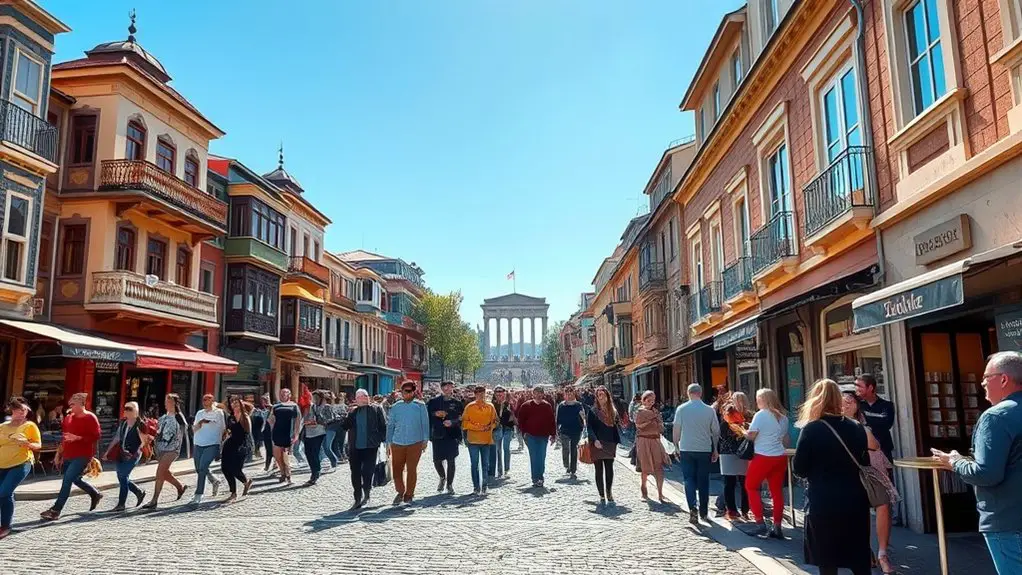
From Taksim Square, head onto İstiklal Avenue. The broad pedestrian street is one of Beyoğlu’s main shopping, entertainment, architecture, and cultural corridors. Historic buildings stand beside modern stores, restaurants, passages, consular buildings, cinemas, churches, galleries, and small side streets.
Street musicians and performers often add to the atmosphere, while cafés and food counters make it easy to pause. The character changes throughout the day: mornings tend to feel calmer, while evenings bring denser crowds and more nightlife.
The red T2 heritage tram is closely associated with İstiklal Avenue and normally links the Taksim and Tünel ends of the street. However, official transport authorities sometimes suspend service or restrict access in the area, so treat the tram as an attraction or optional ride rather than an essential part of your walking plan.
Note: Check current Metro İstanbul and IETT notices on the day of your visit. Temporary security measures or events can affect the T2 tram, buses, Taksim Square, and nearby roads.
Exploring Historical Landmarks
One advantage of this route is that many important landmarks sit directly on İstiklal Avenue or require only a short detour. Rather than rushing from one famous building to another, slow down around the passages and side streets; much of Beyoğlu’s character is in the details between the major stops.
Atlas 1948 and the İstanbul Cinema Museum
Atlas Cinema belongs on a cultural walking tour, but its history needs one important clarification: the cinema opened in 1948, not in the 1920s. The building itself is older, dating to the nineteenth century.
Following restoration, the complex reopened as Atlas 1948 and incorporates the İstanbul Cinema Museum. Check the official Atlas programme if you want to add a screening or museum visit.
Galatasaray High School
Continue toward Galatasaray High School, one of the avenue’s best-known institutional landmarks. The institution traces its roots to the Galata Palace school established in 1481, while Mekteb-i Sultani was established in 1868 as a major modern Ottoman educational institution. Its long history is documented by Galatasaray’s official history.
You do not need to enter the school to appreciate its role in the street. Its gate and location form one of İstiklal’s most recognizable gathering points.
Çiçek Pasajı and the Galatasaray Area
Near the school, step into Çiçek Pasajı, also known historically as Cité de Péra. This covered passage is lined with restaurants and preserves the feel of nineteenth-century Beyoğlu architecture.
The surrounding streets are also worth a short wander. Rather than treating every restaurant as a must-visit, use this area to compare menus, inspect historic façades, and decide whether you want a full meal or only a quick snack before continuing.
Saint Anthony of Padua Church
Saint Anthony of Padua Church is another important stop directly associated with İstiklal Avenue. Turkey’s Ministry of Culture and Tourism notes that the Franciscan church was rebuilt in 1913. The church provides a quiet contrast to the avenue when it is open to visitors.
Enter respectfully, keep voices low, and avoid interrupting worship or religious services. Visitor access may change for services, holidays, or special events.
Tünel and Galata Mevlevi Lodge
Continue toward the Tünel end of İstiklal Avenue. Near this end of the route stands the Galata Mevlevi Lodge Museum.
The lodge was established in 1491 and today interprets Mevlevi culture, music, calligraphy, and the history of the complex. The official museum page lists current visitor information and should be checked before planning an interior visit because opening hours and access conditions can change.
This is a logical place to end the main Taksim walking tour. From here, you can continue down Galip Dede Street toward Galata Tower or finish near Şişhane.
Hidden Gems: Cafes and Shops
The best smaller discoveries in Taksim are often not individual businesses that may close or move, but the passages and side streets branching from İstiklal Avenue.
Look for bookshops and sahaf stores, independent cafés, historic arcades, record shops, art spaces, and architectural details above street level. The İstanbul Provincial Directorate of Culture and Tourism specifically highlights second-hand booksellers around Beyoğlu and the music-instrument shops of Galip Dede Street.
Near Tünel, walking down Galip Dede Street gives you a different atmosphere from the commercial center of İstiklal. Instrument stores and smaller businesses line the descent toward the Galata area.
Karaköy Güllüoğlu, sometimes recommended in Taksim guides for baklava, is actually in Karaköy. It can still make sense as an optional food stop if you continue your walk downhill after Galata, but it should not be treated as an İstiklal Avenue café.
The Cultural Scene: Art and Music
Taksim and Beyoğlu remain major cultural areas, but you do not have to depend on chance street performances to experience them.
At the beginning of the walk, AKM hosts opera, theatre, concerts, exhibitions, and other events. Farther along the avenue, Atlas 1948 and the İstanbul Cinema Museum connect the neighborhood with Turkish film history. Smaller galleries, cultural institutions, and live venues fill the surrounding streets.
Programmes change constantly, so check official schedules shortly before your visit rather than relying on an old list of performances.
Large annual events also take place around İstanbul. For example, the İstanbul Music Festival is organized by İKSV, but its dates vary by year; in 2026 it ran from June 11 to 25. Check the İKSV calendar for current festival dates.
Local Cuisine: Must-Try Dishes
Walking İstiklal Avenue gives you plenty of opportunities to try Turkish food without committing to a long restaurant stop. A few easy options include:
- Simit — a sesame-coated bread ring that works well as a quick walking snack.
- Kebap — a broad family of grilled-meat dishes rather than one single recipe; styles and accompaniments vary by restaurant.
- Börek — layered or rolled pastry that may be filled with cheese, minced meat, potatoes, or greens.
- Baklava — layered pastry with nuts and syrup, best enjoyed when you have time to sit rather than carrying an overloaded plate through the crowds.
You will also see döner, köfte, Turkish coffee, tea, meze, desserts, and regional dishes throughout Beyoğlu. Prices can vary sharply between tourist-heavy frontage and smaller businesses on surrounding streets, so checking a menu before sitting down is worthwhile.
Optional Extension to Galata
If you still have energy at Tünel, continue down Galip Dede Street toward Galata. The street slopes more noticeably than the main İstiklal route, so this extension is less convenient for some visitors with mobility limitations.
Galata Tower is the obvious landmark ahead. The official museum describes it as a Genoese-era tower constructed in the mid-fourteenth century and now operated as a museum with panoramic views.
From Galata, you can continue down toward Karaköy for cafés, dessert, waterfront connections, and the T1 tram, or turn back toward Şişhane for easier rail access.
Tips for an Enjoyable Walking Tour
Choose the Right Time of Day and Year
Spring and autumn can be pleasant for walking, but saying temperatures simply “hover around 20°C” is too broad. According to Turkey’s official meteorological statistics, İstanbul’s long-term average temperature is about 17.6°C in May, 21.2°C in September, and 16.7°C in October.
Summer afternoons can feel hot during a long urban walk, while winter weather may be wet and chilly. Check the forecast on the morning of your tour.
Wear Comfortable Footwear
Comfortable shoes matter more than fashionable footwear here. Even though İstiklal itself is a straightforward pedestrian corridor, paving, long periods on your feet, crowded passages, and optional hilly side streets add up.
Carry water in warm weather and take breaks rather than trying to complete every attraction without stopping.
Plan Your Arrival and Exit
The M2 metro is one of the easiest ways to reach Taksim Square. The F1 funicular links Taksim with Kabataş, where connections are available to the T1 tram and waterfront transport.
If you finish near Tünel, Şişhane station provides M2 access. That makes the route convenient as a one-way walk without returning to your starting point.
Do not assume the heritage T2 tram or nearby surface transport will always operate normally. Events, demonstrations, security measures, or temporary operational changes can affect service.
Warning: Tourist areas of İstanbul can experience pickpocketing and other street theft. Keep phones, wallets, passports, and bags secure in dense crowds. Demonstrations can also develop or trigger transport restrictions around central İstanbul; avoid protests and follow instructions from local authorities.
Accessibility and Mobility
Taksim’s M2/F1 station complex has lifts, which can make the square a practical starting point for travelers with reduced mobility. However, do not assume the entire walking tour is step-free.
İstiklal Avenue is largely pedestrianized, but crowds, paving, thresholds at historic buildings, and steep surrounding streets can create barriers. Metro İstanbul’s published accessibility information has also excluded the historic T2 Taksim–Tünel tram from its general accessible-rail statement.
For an easier route, remain mainly on İstiklal Avenue, limit steep Galata side-street extensions, and confirm accessibility directly with any museum, church, restaurant, or cultural venue you intend to enter.
Plan Restroom Stops
Do not depend on finding a free public restroom exactly when you need one. Larger cultural venues, museums, shopping complexes, cafés, and restaurants may provide facilities, but access can depend on opening hours or customer policies.
Use a convenient restroom when one is available, especially before continuing into smaller side streets or a longer Galata extension.
Frequently Asked Questions
What Is the Best Time of Year to Visit Taksim?
May, September, and October are attractive months for many walkers because average conditions are milder than midsummer. Official İstanbul averages are about 17.6°C in May, 21.2°C in September, and 16.7°C in October. Weather varies, so check the forecast before setting out.
How Long Does a Taksim Walking Tour Take?
Allow about 2–4 hours for a relaxed walk from Taksim Square along İstiklal Avenue to Tünel. Museum visits, meals, shopping, photography, or a continuation to Galata can easily turn it into a half-day outing.
Are There Guided Walking Tours Available in Taksim?
Yes. Private and group walking tours operate around Taksim, Beyoğlu, Galata, and İstiklal Avenue. Compare the stated route, tour length, language, group size, and whether admission fees are included before booking.
Is Taksim Safe for Solo Travelers?
Many people explore central İstanbul independently, but no busy urban area is risk-free. Keep valuables secure because pickpocketing and street theft occur in major tourist areas. Avoid demonstrations, stay aware of changing local conditions, and follow current government and local-authority travel guidance.
How Accessible Is Taksim for Travelers With Mobility Issues?
The M2/F1 Taksim station complex has lifts, and much of the main İstiklal route is pedestrianized. However, crowds, uneven surfaces, building thresholds, and steep side streets can be challenging. The historic T2 tram should not be assumed to provide step-free transport, so confirm individual venue and transport accessibility before traveling.
Can I Find Public Restrooms During My Walking Tour?
Restroom options exist around central Beyoğlu, but availability and access vary. Museums, larger cultural venues, shopping complexes, cafés, and restaurants are usually better places to plan a stop than relying on an unrestricted public toilet appearing exactly when needed.
Where Should I Finish the Taksim Walking Tour?
Tünel is a convenient finish for the main route. From there, you can reach Şişhane metro station, visit Galata Mevlevi Lodge, continue downhill toward Galata Tower and Karaköy, or return toward Taksim if you still want more time on İstiklal Avenue.
Sources
- Republic of Türkiye Ministry of Culture and Tourism — İstanbul — İstiklal Avenue, Saint Anthony of Padua, Galatasaray High School, Çiçek Pasajı, Taksim, and Beyoğlu landmarks.
- Atatürk Cultural Centre — renewed AKM history, facilities, and cultural role.
- Galatasaray — History of Galatasaray High School — institutional history and the development of Mekteb-i Sultani.
- Türkiye Museums — Galata Mevlevi Lodge Museum — museum history, location, and current visitor information.
- Metro İstanbul — M2 Yenikapı–Hacıosman Metro Line — Taksim and Şişhane rail connections.
- Turkish State Meteorological Service — İstanbul Climate Statistics — long-term monthly temperature averages used for walking-season guidance.
